Within Somalia
When Spiritual Healing Delays Medical Care
Spiritual care may offer comfort, but treating every crisis as possession or a curse can delay essential medical and psychiatric help.
On this page
- Why curses, possession and divine will shape explanations
- The risks of missed neurological and psychiatric illness
- How healers and clinicians can work without ridicule or harm
Page outline Jump by section
Introduction
In Somalia, spiritual explanations for mental distress are not simply old traditions competing with modern medicine. They have become deeply embedded in everyday health decisions because decades of conflict, displacement, poverty and the collapse of public services have left many communities with little or no access to trained mental-health professionals. For many families, the first question is not whether an illness has a spiritual or medical cause, but where help can realistically be found.
Religious belief and spiritual healing can provide comfort, community support and meaning during periods of crisis. The difficulty arises when every episode of confusion, severe depression, psychosis, epilepsy or dementia is interpreted solely as spirit possession, curses or divine punishment. In those circumstances, neurological or psychiatric illnesses may go untreated for months or years, sometimes with serious consequences for patients and their families. Research increasingly argues that the most effective approach is not to dismiss religious belief but to build cooperation between trusted religious leaders, traditional healers and evidence-based mental-health services.[nih.gov]pmc.ncbi.nlm.nih.govPMCMental health crisis in Somalia: a review and a way forwardFebruary 9, 2022…
Why curses, possession and divine will shape explanations
Supernatural explanations remain influential in Somalia because they fit within widely understood religious and cultural frameworks while formal mental-health services remain scarce. Many Somalis interpret severe behavioural changes through concepts such as spirit possession, black magic, the evil eye or divine testing. Qur’anic recitation, prayer and religious counselling are therefore commonly sought before psychiatric assessment.[PMC]pmc.ncbi.nlm.nih.govPMCMental health crisis in Somalia: a review and a way forwardFebruary 9, 2022…
These beliefs are reinforced by practical realities.
- Specialist psychiatric services are extremely limited outside a handful of urban centres.
- Long civil conflict destroyed much of the country’s health infrastructure and interrupted professional training.
- Families often trust local religious leaders whom they know personally more than distant medical institutions.
- Mental illness carries significant social stigma, making spiritual explanations more socially acceptable than psychiatric diagnoses.[PMC]pmc.ncbi.nlm.nih.govPMCMental health in SomaliaNovember 1, 2011…
Many symptoms also blur the boundary between physical and psychological illness. Trauma-related anxiety, depression and post-traumatic stress frequently appear as headaches, chronic pain, exhaustion or sleep disturbance rather than complaints about emotions. When sufferers themselves experience distress through bodily symptoms, spiritual interpretations may seem entirely consistent with their experience.[PMC]pmc.ncbi.nlm.nih.govPMCMental health crisis in Somalia: a review and a way forwardFebruary 9, 2022…
Importantly, these beliefs should not automatically be dismissed as irrational. Religious practice often provides emotional support, hope and social solidarity. The problem is not belief itself but exclusive reliance on supernatural explanations when medical assessment is also needed.
The risks of missed neurological and psychiatric illness
The greatest danger appears when serious medical conditions are mistaken for purely spiritual problems.
Psychotic disorders, severe depression, bipolar disorder, epilepsy, dementia and some brain infections may all produce behaviour that communities interpret as possession or curses. Delayed diagnosis can allow symptoms to worsen while opportunities for effective treatment are lost.[PMC]pmc.ncbi.nlm.nih.govPMCMental health crisis in Somalia: a review and a way forwardFebruary 9, 2022…
Researchers have documented several common patterns:
- Families often seek multiple religious or traditional treatments before considering psychiatric care.
- Mild mental-health problems may be ignored until behaviour becomes disruptive or dangerous.
- Patients may arrive at medical services only after prolonged illness or repeated unsuccessful spiritual interventions.
- Some people receive treatment only when relatives can no longer manage their care at home.[PMC]pmc.ncbi.nlm.nih.govPMCMental health crisis in Somalia: a review and a way forwardFebruary 9, 2022…
The consequences extend beyond delayed diagnosis. Reviews of Somalia’s mental-health system have documented cases in which individuals in unregulated private institutions were physically restrained, chained or beaten, often because facilities lacked trained staff and appropriate treatment methods. Such practices represent failures of care rather than inevitable features of religious healing, but they illustrate how weak regulation can expose vulnerable people to abuse.[King's College London]kcl.ac.ukOpen source on kcl.ac.uk.
Families themselves may also suffer. Caring for someone experiencing untreated psychosis or severe behavioural disturbance places enormous emotional and financial strain on relatives who often have few alternative sources of support.
Why the care gap reinforces supernatural explanations
The relationship between supernatural beliefs and limited healthcare works in both directions.
When psychiatric services are unavailable, expensive or distant, families naturally rely on accessible alternatives. If the only nearby support comes from a mosque, religious teacher or traditional healer, those providers become the practical front line of mental-health care regardless of whether a condition has biological, psychological or spiritual dimensions.[PMC]pmc.ncbi.nlm.nih.govPMCMental health in SomaliaNovember 1, 2011…
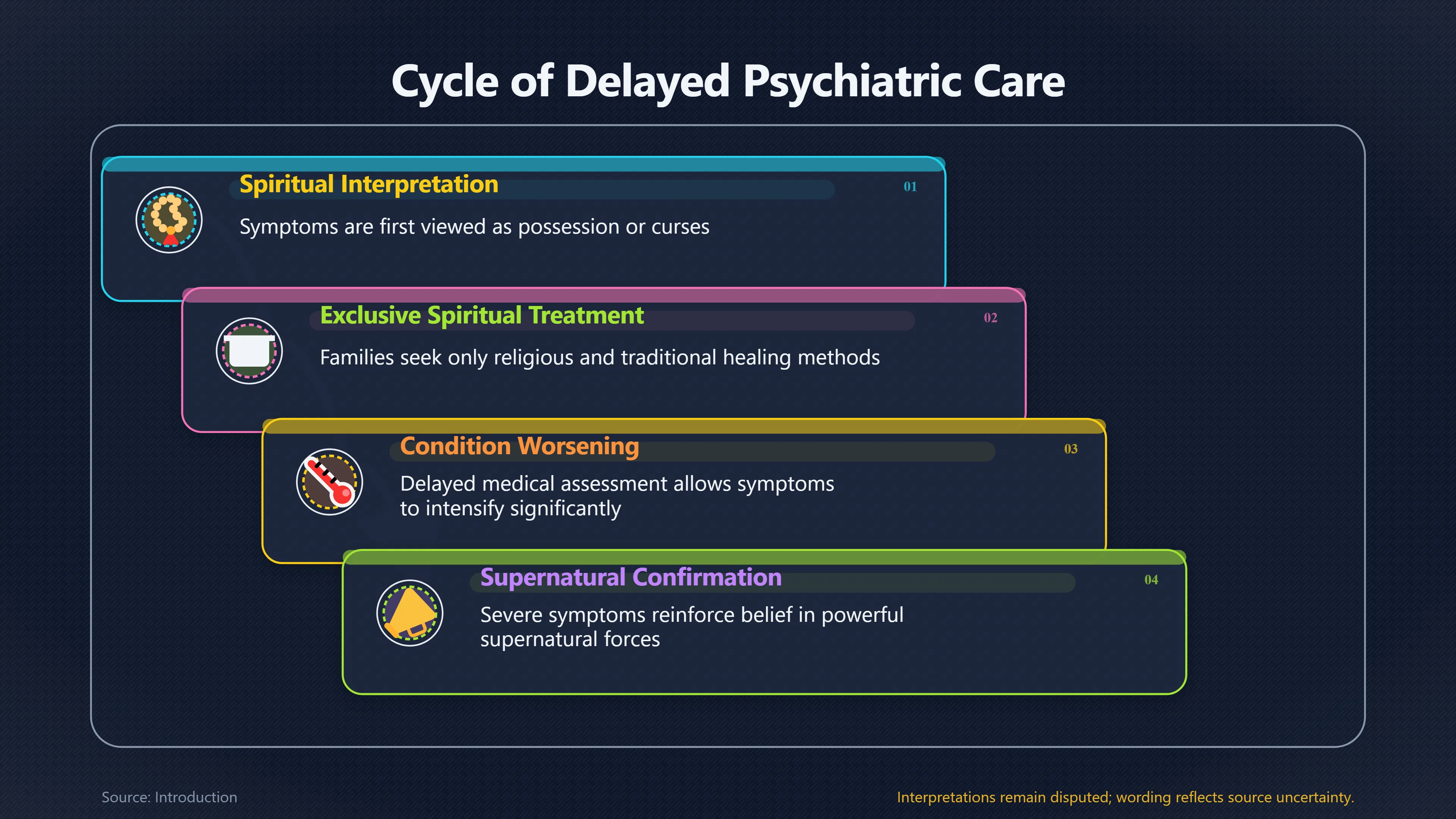
This can create a self-reinforcing cycle.
First, symptoms are interpreted spiritually. Next, families seek exclusively spiritual treatment. Because professional assessment is delayed, illnesses often become more severe. The worsening condition may then appear to confirm that powerful supernatural forces are involved, encouraging even more intensive spiritual intervention rather than medical referral.[PMC]pmc.ncbi.nlm.nih.govPMCMental health crisis in Somalia: a review and a way forwardFebruary 9, 2022…
Stigma strengthens this cycle. Several studies note that mental illness is frequently viewed in sharply binary terms: people are either considered “well” or “mad”, leaving little public understanding of anxiety, depression or trauma that might benefit from early intervention. This discourages people from seeking help before problems become severe.[PMC]pmc.ncbi.nlm.nih.govPMCMental health crisis in Somalia: a review and a way forwardFebruary 9, 2022…
How healers and clinicians can work without ridicule or harm
Increasingly, researchers argue that successful mental-health policy in Somalia should avoid framing religious belief and psychiatric care as mutually exclusive.
Religious leaders are often the first people approached by distressed families. Rather than attempting to replace them, several mental-health programmes encourage cooperation in which trusted community figures recognise warning signs and refer patients whose symptoms suggest neurological disease, psychosis, severe depression or suicide risk.[Umeå University Journals]journals.ub.umu.seUmeå University JournalsTraining of front-line health workers in Somalia on mental health: A mixed-methods effectiveness study on the imp…
Promising approaches include:
- Training primary healthcare workers. Somalia has begun implementing the World Health Organization’s Mental Health Gap Action Programme (mhGAP), which trains non-specialist health workers to recognise and manage common mental disorders where psychiatrists are unavailable.[Umeå University Journals]journals.ub.umu.seUmeå University JournalsTraining of front-line health workers in Somalia on mental health: A mixed-methods effectiveness study on the imp…
- Building respectful referral systems. Religious healers can continue offering spiritual support while encouraging medical assessment when symptoms persist or worsen.
- Improving public understanding. Community education that explains depression, trauma, epilepsy and psychosis in accessible language helps families recognise that religious faith and medical treatment need not conflict.
- Protecting patients’ rights. Better regulation of mental-health facilities reduces the risk of abusive practices such as prolonged chaining or physical punishment.[King's College London]kcl.ac.ukOpen source on kcl.ac.uk.
Experience from newer counselling centres also suggests that culturally adapted psychological therapies can gain acceptance when practitioners acknowledge religious values instead of treating them as obstacles. Somali clinicians have reported success by explaining mental illness in familiar terms while combining evidence-based therapy with respect for patients’ spiritual beliefs.[Vogue]vogue.comThe Somali-American Therapist Bringing Her Work HomeReturning from the US, she was struck by the lack of mental health services in Somalia, a country battered by war, political instability…

Why this matters for understanding Somalia
Somalia’s experience illustrates that supernatural explanations cannot be understood separately from the country’s health system. Belief in possession, curses or divine intervention did not arise because psychiatric medicine was absent, but prolonged conflict and the shortage of accessible services have made those explanations especially influential in decisions about care.
The central public-health challenge is therefore not to eliminate spiritual healing but to ensure that it does not become the only response to illnesses that also require medical assessment. Where religious leaders, traditional healers and clinicians cooperate rather than compete, patients are more likely to receive timely diagnosis while still retaining the spiritual support that many families consider essential.[umu.se]journals.ub.umu.seUmeå University JournalsTraining of front-line health workers in Somalia on mental health: A mixed-methods effectiveness study on the imp…
Amazon book picks
Further Reading
Books and field guides related to When Spiritual Healing Delays Medical Care. Use these as the next step if you want deeper reading beyond the article.

The Spirit Catches You and You Fall Down
Shows how cultural beliefs influence healthcare.


The anthropology of religion, magic, and witchcraft
Provides comparative framework for belief and illness.

Endnotes
1.
Source: pmc.ncbi.nlm.nih.gov
Title: PMCMental health crisis in Somalia: a review and a way forward
Link:https://pmc.ncbi.nlm.nih.gov/articles/PMC8827242/
Source snippet
February 9, 2022...
Published: February 9, 2022
2.
Source: iris.who.int
Title: Iris A SITUATION
Link:https://iris.who.int/bitstream/handle/10665/116674/EMROPUB_2010_EN_736.pdf?sequence=1
3.
Source: pmc.ncbi.nlm.nih.gov
Title: PMCMental health in Somalia
Link:https://pmc.ncbi.nlm.nih.gov/articles/PMC6735037/
Source snippet
November 1, 2011...
Published: November 1, 2011
4.
Source: pmc.ncbi.nlm.nih.gov
Link:https://pmc.ncbi.nlm.nih.gov/articles/PMC11382377/
5.
Source: vogue.com
Title: The Somali-American Therapist Bringing Her Work Home
Link:https://www.vogue.com/article/the-somali-american-therapist-bringing-her-work-home
Source snippet
Returning from the US, she was struck by the lack of mental health services in Somalia, a country battered by war, political instability...
6.
Source: journals.ub.umu.se
Link:https://journals.ub.umu.se/index.php/shaj/article/view/1079
Source snippet
Umeå University JournalsTraining of front-line health workers in Somalia on mental health: A mixed-methods effectiveness study on the imp...
7.
Source: kcl.ac.uk
Link:https://www.kcl.ac.uk/reducing-the-gap-in-mental-health-services-in-somaliland
8.
Source: pmc.ncbi.nlm.nih.gov
Link:https://pmc.ncbi.nlm.nih.gov/articles/PMC13107296/
9.
Source: journals.ub.umu.se
Link:https://journals.ub.umu.se/index.php/shaj/article/view/342
10.
Source: pmc.ncbi.nlm.nih.gov
Link:https://pmc.ncbi.nlm.nih.gov/articles/PMC10289922/
11.
Source: pmc.ncbi.nlm.nih.gov
Link:https://pmc.ncbi.nlm.nih.gov/articles/PMC7592587/
12.
Source: pubmed.ncbi.nlm.nih.gov
Link:https://pubmed.ncbi.nlm.nih.gov/31921334/
13.
Source: pmc.ncbi.nlm.nih.gov
Link:https://pmc.ncbi.nlm.nih.gov/articles/PMC8277527/
14.
Source: pubmed.ncbi.nlm.nih.gov
Link:https://pubmed.ncbi.nlm.nih.gov/20957328/
Additional References
15.
Source: cambridge.org
Link:https://www.cambridge.org/core/journals/bjpsych-open/article/since-people-who-have-mental-illness-are-stigmatised-their-service-is-also-stigmatised-you-get-a-massive-hospital-building-and-there-is-no-mental-health-facility-exploring-perceptions-of-mental-health-stigma-of-mental-illness-careseeking-and-service-use-in-the-somali-regional-state-of-ethiopia/63AF9C242F6ADDFF8BDCF1BFD0D8E809
Source snippet
You get a massive hospital building and there is no mental health facility’: exploring perceptions of mental health, stigma of mental ill...
16.
Source: youtube.com
Title: The War Inside: Treating Somalia’s Mentally Ill
Link:https://www.youtube.com/watch?v=2JmzOSuu12w
Source snippet
Jinn Possession or Mental Health? Prof Rasjid Skinner Explains...
17.
Source: researchgate.net
Link:https://www.researchgate.net/publication/381969099_Balancing_Belief_and_Burden_A_Comparative_Analysis_of_Spiritual_and_Exploitative_Practices_in_Somali_Traditional_Healing_for_Mental_Health_Case_Study_Mogadishu_Areas
18.
Source: researchgate.net
Link:https://www.researchgate.net/publication/353801188_Mental_Health_Crisis_in_Somalia_a_Review_and_a_Way_Forward
19.
Source: cambridge.org
Link:https://www.cambridge.org/core/journals/bjpsych-open/article/exploring-the-distinction-between-jinn-possession-and-serious-mental-disorders-through-the-lens-of-the-traditional-and-faithbased-healers-in-korail-slum/94614819B5F279FDD2439D100B239AD2
20.
Source: doi.org
Link:https://doi.org/10.1186%2Fs13033-022-00525-y
21.
Source: sciencedirect.com
Link:https://www.sciencedirect.com/org/science/article/abs/pii/S1747989419000036
22.
Source: research.ed.ac.uk
Link:https://www.research.ed.ac.uk/en/publications/since-people-who-have-mental-illness-are-stigmatised-their-servic/
23.
Source: kclpure.kcl.ac.uk
Link:https://kclpure.kcl.ac.uk/portal/en/publications/since-people-who-have-mental-illness-are-stigmatised-their-servic/
24.
Source: doi.org
Link:https://doi.org/10.1192/bjo.2026.11016
Topic Tree