Within Nepal Belief Panics
How Witchcraft Accusations Become Collective Violence
Witchcraft accusations in Nepal are forms of social violence shaped by gender, caste, poverty and unequal local power.
On this page
- Who is accused and what harms follow
- Why communities reinforce the allegations
- How law and protection measures respond
Page outline Jump by section
Introduction
Witchcraft accusations in Nepal are not simply expressions of traditional belief. They are a form of organised social violence that disproportionately targets women, especially widows, older women, Dalits, people living in poverty and those with little social protection. Accusations often emerge after illness, unexplained deaths, crop failures or family disputes, but they are sustained by unequal power rather than by evidence. Victims may be beaten, publicly humiliated, forced to confess, driven from their homes or deprived of property. Although Nepal has introduced laws criminalising witchcraft accusations and related abuse, enforcement remains uneven, and many cases are believed to go unreported because victims fear retaliation or have little confidence in the justice system.[ecoi.net]ecoi.netUSDOS – US Department of State (Author): “2021 Country Report on Human Rights Practices: Nepal”, Document #2071211 - ecoi.netApril 12, 2022…
Unlike episodes of mass psychogenic illness, witchcraft accusations are not contagious medical events. They are collective acts of persecution in which communities, relatives, local leaders or self-proclaimed spiritual healers reinforce suspicion until violence becomes socially accepted. Understanding these accusations therefore requires examining local power structures as much as supernatural belief.
Who is accused and what harms follow?
The people most frequently accused of witchcraft occupy vulnerable positions within Nepali society. Reports by human rights organisations, government agencies and journalists consistently show that victims are overwhelmingly women, particularly:
- Widows with limited family protection.
- Elderly women living alone.[ecoi.net]ecoi.netSource details in endnotes.
- Women from Dalit communities or other marginalised groups.
- Women with mental illness or disabilities.
- Poor households involved in land, inheritance or neighbourhood disputes.[ecoi.net]ecoi.netUSDOS – US Department of State (Author): “2021 Country Report on Human Rights Practices: Nepal”, Document #2071211 - ecoi.netApril 12, 2022…
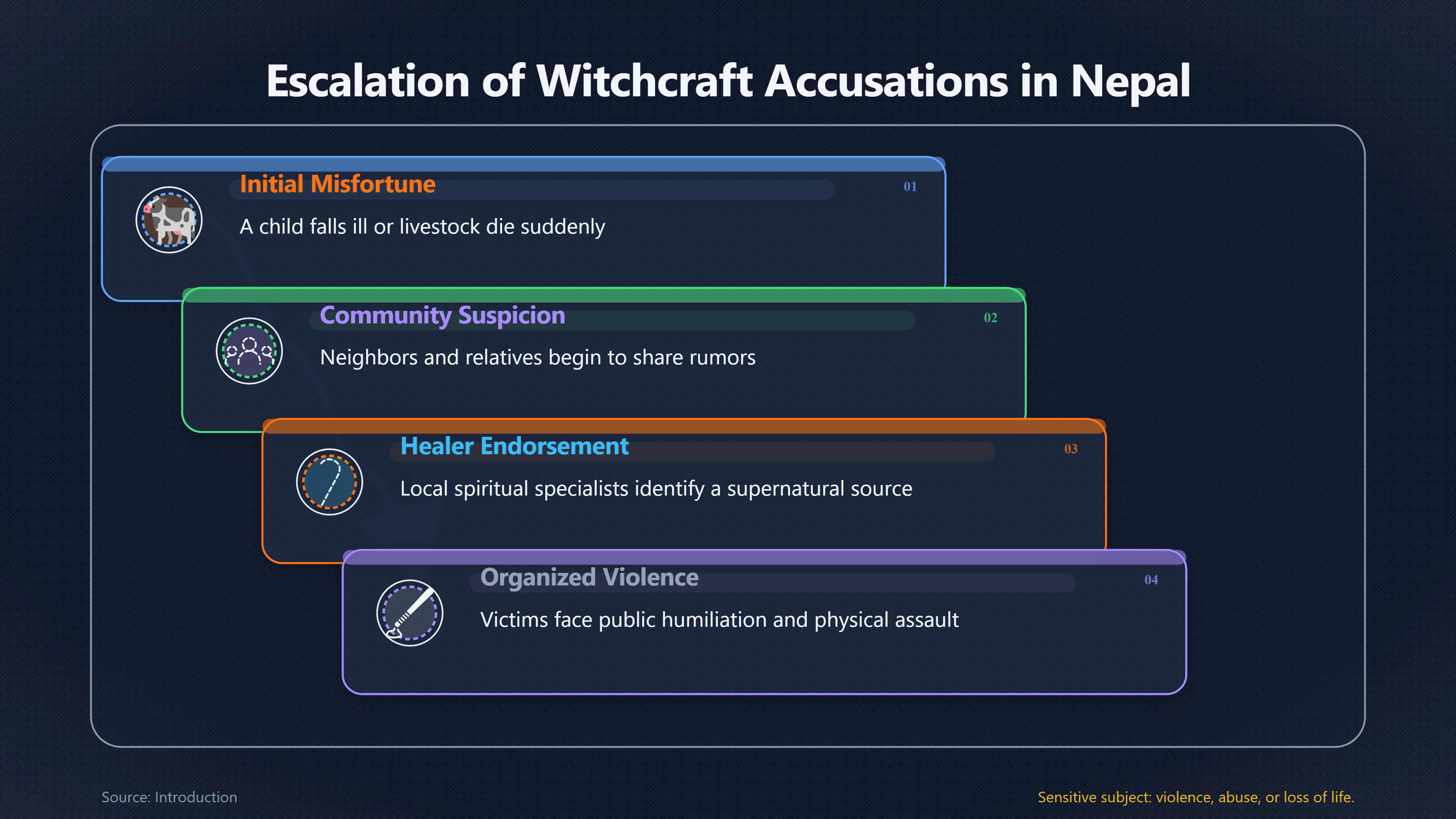
The accusation itself often begins after an ordinary misfortune. A child falls ill, livestock die, a harvest fails or someone experiences prolonged illness. Rather than remaining a private suspicion, the allegation may be endorsed by neighbours or reinforced by a local healer claiming supernatural knowledge. Once a supposed explanation has been identified, pressure on the accused can escalate rapidly.
The violence is frequently organised rather than spontaneous. Victims have reported being dragged from their homes, beaten with sticks, branded with hot objects, forced to consume human waste, paraded through villages, shaved, ostracised or compelled to “confess” publicly. Others lose access to their land or are permanently expelled from their communities. In some cases the abuse results in death or long-term physical and psychological injury.[ecoi.net]ecoi.netUSDOS – US Department of State (Author): “Country Report on Human Rights Practices 2018 - Nepal”, Document #2004213 - ecoi.net…
The consequences extend beyond the immediate victim. Children may be excluded from school, families may lose livelihoods, and entire households can become socially isolated long after the accusation itself has faded.
Why communities reinforce the allegations
Although belief in harmful supernatural powers exists in many societies, belief alone does not explain why accusations become collective persecution. Research and human rights reporting point instead to several interacting social pressures.
First, accusations provide a simple explanation for events that otherwise appear random or difficult to understand. Serious illness, unexpected deaths or repeated economic hardship create uncertainty, and blaming a neighbour can appear emotionally satisfying when medical or scientific explanations seem unavailable or inaccessible.
Second, accusations often reflect existing inequalities. Gender, caste and economic status strongly influence who becomes a credible target. Women with little family protection or low social standing have fewer opportunities to challenge rumours or seek influential allies. Amnesty International’s research on caste discrimination notes that Dalit women frequently experience overlapping forms of discrimination that make access to justice particularly difficult.[Amnesty International]amnesty.orgAmnesty InternationalNepal: “No-one cares”: Descent-based discrimination against Dalits in Nepal - Amnesty International…
Third, local authority figures can strengthen accusations rather than defuse them. Some traditional healers or self-proclaimed spiritual specialists claim to identify the supposed source of supernatural harm. Their statements may be treated as authoritative by frightened communities, encouraging collective punishment even when no objective evidence exists. Conversely, many religious and community leaders actively oppose such practices, illustrating that these accusations are social choices rather than inevitable products of local culture.
Property disputes, family conflicts and personal revenge also appear repeatedly in documented cases. An accusation of witchcraft may provide a socially acceptable justification for removing an unpopular neighbour, intimidating a widow over inheritance or settling longstanding disagreements.

How Nepal’s legal response has changed
Nepal’s legal approach has shifted markedly over the past two decades. Rather than treating witchcraft accusations as legitimate expressions of belief, lawmakers increasingly recognise them as forms of violence and discrimination.
Important reforms include:
- Criminalisation of violence and abuse committed through witchcraft accusations.
- Legal penalties for publicly accusing someone of witchcraft.
- Inclusion of witchcraft-related abuse within broader protections against violence against women.
- Later incorporation of offences into the National Penal Code as part of wider criminal law reforms.[Human Rights Watch]hrw.orgHuman Rights WatchWorld Report 2020: Nepal | Human Rights Watch…
These reforms reflected sustained campaigning by women’s organisations, human rights advocates and survivors, who argued that accusations should be treated as criminal assaults rather than cultural traditions.
The legal framework now allows police to investigate physical assault, intimidation, humiliation and other abuses linked to witchcraft allegations. In principle, the law recognises that the accusation itself can constitute a form of violence.
Why protection remains difficult
Despite stronger legislation, enforcement remains inconsistent.
Victims frequently hesitate to report attacks because the perpetrators are neighbours or relatives who continue to hold influence within the community. Fear of retaliation, economic dependence and social isolation discourage formal complaints. Some incidents are instead resolved through informal community mediation, leaving perpetrators unpunished and victims without meaningful protection.[Amnesty International]amnesty.orgAmnesty InternationalNepal: “No-one cares”: Descent-based discrimination against Dalits in Nepal - Amnesty International…
Police have recorded cases under the witchcraft provisions, showing that the legislation is being used. For example, official reporting cited in the US State Department’s human rights review noted 61 registered cases involving witchcraft accusations and torture during the 2020–21 fiscal year, a substantial increase from the previous year. However, these figures almost certainly underestimate the true scale because many incidents never reach the criminal justice system.[ecoi.net]ecoi.netUSDOS – US Department of State (Author): “2021 Country Report on Human Rights Practices: Nepal”, Document #2071211 - ecoi.netApril 12, 2022…
Human Rights Watch has similarly observed that Nepal has outlawed harmful practices including witchcraft allegations, yet implementation remains weak because deeply rooted social attitudes continue to sustain abuse.[Human Rights Watch]hrw.orgHuman Rights WatchWorld Report 2020: Nepal | Human Rights Watch…
Access to justice is especially difficult for Dalit women and people living in remote rural areas, where legal assistance, shelters and victim support services may be limited. Amnesty International argues that broader patterns of caste discrimination contribute to a culture of impunity, reducing confidence that authorities will respond effectively.[Amnesty International]amnesty.orgAmnesty InternationalNepal: “No-one cares”: Descent-based discrimination against Dalits in Nepal - Amnesty International…
What these cases reveal about collective violence
Witchcraft persecution in Nepal illustrates how collective belief can become organised violence without requiring an entire community to share identical convictions. Often only a few influential individuals initiate the accusation, but neighbours, relatives and local authorities may reinforce it through silence, participation or failure to intervene.
The episode therefore becomes self-reinforcing. Public humiliation appears to validate the accusation, while fear discourages witnesses from defending the victim. As more people participate, responsibility becomes dispersed across the group, making accountability harder to establish.
This distinguishes witchcraft persecution from isolated interpersonal assault. The violence gains legitimacy because it is presented as protecting the community from an invisible threat, even though there is no objective evidence for the accusation.
Why the issue remains important
Nepal’s experience demonstrates that legal reform alone cannot eliminate deeply embedded forms of collective persecution. Criminalisation has established an important public principle: accusing someone of witchcraft is not a cultural defence for violence but a punishable offence. Yet effective protection also depends on policing, victim support, public education and broader efforts to reduce gender inequality, caste discrimination and rural poverty.
For historians and social scientists, these cases provide an important example of how fear, local authority and social inequality interact. The accusations are less about supernatural powers than about who lacks the power to resist becoming the community’s chosen scapegoat.
Amazon book picks
Further Reading
Books and field guides related to How Witchcraft Accusations Become Collective Violence. Use these as the next step if you want deeper reading beyond the article.
The Better Angels of Our Nature
Provides broader context for declines in persecution and collective violence.


The Penguin book of witches
Illustrates historical patterns of accusation and persecution.
Endnotes
1.
Source: ecoi.net
Link:https://www.ecoi.net/en/document/2071211.html
Source snippet
USDOS – US Department of State (Author): “2021 Country Report on Human Rights Practices: Nepal”, Document #2071211 - ecoi.netApril 12, 2022...
Published: April 12, 2022
2.
Source: amnesty.org
Link:https://www.amnesty.org/en/documents/asa31/7980/2024/en/
Source snippet
Amnesty InternationalNepal: “No-one cares”: Descent-based discrimination against Dalits in Nepal - Amnesty International...
3.
Source: ecoi.net
Link:https://www.ecoi.net/en/document/2004213.html
Source snippet
USDOS – US Department of State (Author): “Country Report on Human Rights Practices 2018 - Nepal”, Document #2004213 - ecoi.net...
4.
Source: amnesty.org
Title: International Systemic descent-based discrimination against Dalits in Nepal
Link:https://www.amnesty.org/en/latest/news/2024/05/descent-based-discrimination-against-dalits-in-nepal/
Source snippet
Systemic descent-based discrimination against Dalits in NepalMay 10, 2024 — 10 May 2024 Also available in Français NEPAL: SYSTEMIC DESCEN...
Published: May 10, 2024
5.
Source: amnesty.org
Title: Victims of witchcraft accusations need protection and reparation
Link:https://www.amnesty.org/en/latest/news/2025/04/ghana-witchcraft-accusations/
Source snippet
April 14, 2025 — 14 April 2025 Also available in Español,Français GHANA: HUNDREDS ACCUSED OF WITCHCRAFT URGENTLY NEED PROTECTION AND REPA...
Published: April 14, 2025
6.
Source: amnesty.org
Title: Nepal: “No-one cares”: Descent-based discrimination against Dalits in Nepal
Link:https://www.amnesty.org/fr/documents/asa31/7980/2024/en/
Source snippet
May 10, 2024 — 10 May 2024 Also available in English NEPAL: “NO-ONE CARES”: DESCENT-BASED DISCRIMINATION AGAINST DALITS IN NEPAL Authorit...
Published: May 10, 2024
7.
Source: amnesty.org
Title: Nepal: “No-one cares”: Descent-based discrimination against Dalits in Nepal
Link:https://www.amnesty.org/zh-hans/documents/asa31/7980/2024/en/
8.
Source: amnesty.org
Title: Nepal: “No-one cares”: Descent-based discrimination against Dalits in Nepal
Link:https://www.amnesty.org/zh-hant/documents/asa31/7980/2024/en/
9.
Source: ecoi.net
Link:https://www.ecoi.net/en/document/2107776.html
10.
Source: ecoi.net
Link:https://www.ecoi.net/en/document/2089245.html
11.
Source: ecoi.net
Link:https://www.ecoi.net/en/document/2048148.html
12.
Source: ecoi.net
Link:https://www.ecoi.net/en/document/1430386.html
13.
Source: ecoi.net
Link:https://www.ecoi.net/en/document/1394438.html
14.
Source: amnesty.org
Link:https://www.amnesty.org/en/location/asia-and-the-pacific/south-asia/nepal/report-nepal/
15.
Source: hrw.org
Link:https://www.hrw.org/world-report/2020/country-chapters/nepal
Source snippet
Human Rights WatchWorld Report 2020: Nepal | Human Rights Watch...
16.
Source: hrw.org
Link:https://www.hrw.org/world-report/2025/country-chapters/nepal
17.
Source: hrw.org
Link:https://www.hrw.org/world-report/2022/country-chapters/nepal
18.
Source: hrw.org
Link:https://www.hrw.org/world-report/2021/country-chapters/nepal
Additional References
19.
Source: medhacorplaw.com
Title: an overview of national criminal code 2074 2017
Link:https://medhacorplaw.com/an-overview-of-national-criminal-code
Source snippet
An Overview of National Criminal Code, 2074 (2017) | Medha Law & Partners | Medha Law and PartnersAugust 6, 2025 — AN OVERVIEW OF NATIONA...
Published: August 6, 2025
20.
Source: youtube.com
Title: The Morning Show | Gender Violence & Causes
Link:https://www.youtube.com/watch?v=Bcy1YFDSgfE
Source snippet
What It's Like Being Declared a Witch in Modern India...
Published: March 2018
21.
Source: youtube.com
Title: Witch Accusation and Persecution
Link:https://www.youtube.com/watch?v=4SrY2jXkal0
Source snippet
The Morning Show | Gender Violence & Causes - 14 March 2018...
Published: March 2018
22.
Source: right-docs.org
Link:https://www.right-docs.org/doc/a-hrc-16-23/
23.
Source: un.org.np
Link:https://un.org.np/resource/literature-review-harmful-practices-nepal
24.
Source: researchgate.net
Title: (PDF) Accusations of witchcraft: A form of violence against women in Nepal
Link:https://www.researchgate.net/publication/349632929_Accusations_of_witchcraft_A_form_of_violence_against_women_in_Nepal
25.
Source: youtube.com
Title: Laws Against Witchcraft in Nepal
Link:https://www.youtube.com/watch?v=OdEBlmljQss
Source snippet
Witch Accusation and Persecution - Nepali Version...
26.
Source: researchgate.net
Title: Accusations of witchcraft in Nepal: Problems and impact on women
Link:https://www.researchgate.net/publication/297593635_Accusations_of_witchcraft_in_Nepal_Problems_and_impact_on_women
27.
Source: researchgate.net
Title: (PDF) Witchcraft Accusation and Persecution of Women in Nepal
Link:https://www.researchgate.net/publication/337705425_Witchcraft_Accusation_and_Persecution_of_Women_in_Nepal
28.
Source: youtube.com
Title: Women accused of witchcraft in Nepal tortured
Link:https://www.youtube.com/watch?v=9KYBpJbxSu8
Source snippet
Laws Against Witchcraft in Nepal...
Topic Tree