Within Cameroon Panics
Can a Court Prove an Invisible Crime?
Cameroonian courts tried to contain witchcraft accusations, but criminal trials often gave supernatural claims official authority.
On this page
- How witchcraft entered the Penal Code
- Diviners, confessions and courtroom evidence
- Protection from mobs or legalised accusation
Page outline Jump by section
Introduction
Cameroon is unusual in modern criminal law because it retains a specific offence covering harmful witchcraft, magic and divination. The intention was not simply to endorse supernatural beliefs but to give the state a legal means of responding when accusations of occult harm threatened public order or when people believed they had been injured through witchcraft. Yet this created an immediate legal dilemma: how can a court prove an offence that, by definition, is said to operate through invisible or supernatural means?
For decades, Cameroonian judges, lawyers and scholars have debated this question. Courts have tried to balance popular belief, criminal procedure and public safety, but the search for proof has often drawn judges into relying on confessions, diviners, circumstantial evidence or subjective judicial conviction. Critics argue that this risks giving official authority to accusations that cannot be tested by ordinary forensic methods, while supporters contend that ignoring such cases would leave communities vulnerable to violence and vigilante justice. The controversy has become one of the defining features of Cameroon’s approach to witchcraft law.[Cambridge University Press & Assessment]cambridge.orgCambridge University Press & AssessmentContaining Occult Practices: Witchcraft Trials In Cameroon | African Studies Review | Cambridge Co…
Can a Court Prove an Invisible Crime?
The central problem is not whether many Cameroonians believe harmful witchcraft exists. Surveys and ethnographic research show that such beliefs remain widespread across different regions and social groups. The legal challenge is whether a criminal court can establish guilt using standards that are meant to protect defendants from wrongful conviction.
Unlike offences such as assault or theft, alleged witchcraft rarely leaves physical evidence that directly demonstrates a supernatural act. Illness, death, crop failure or financial ruin may all be sincerely interpreted by complainants as the result of occult attack, but those events can also have many ordinary explanations. Criminal law therefore faces a gap between lived belief and evidential proof.
This tension has existed since the colonial period. Colonial administrators generally regarded witchcraft accusations as impossible to verify in legal terms, yet many local communities viewed that reluctance as protecting dangerous witches. After independence, Cameroon chose a different route by criminalising certain forms of witchcraft rather than excluding them entirely from the courts.[Cambridge University Press & Assessment]cambridge.orgCambridge University Press & AssessmentContaining Occult Practices: Witchcraft Trials In Cameroon | African Studies Review | Cambridge Co…
How Witchcraft Entered the Penal Code
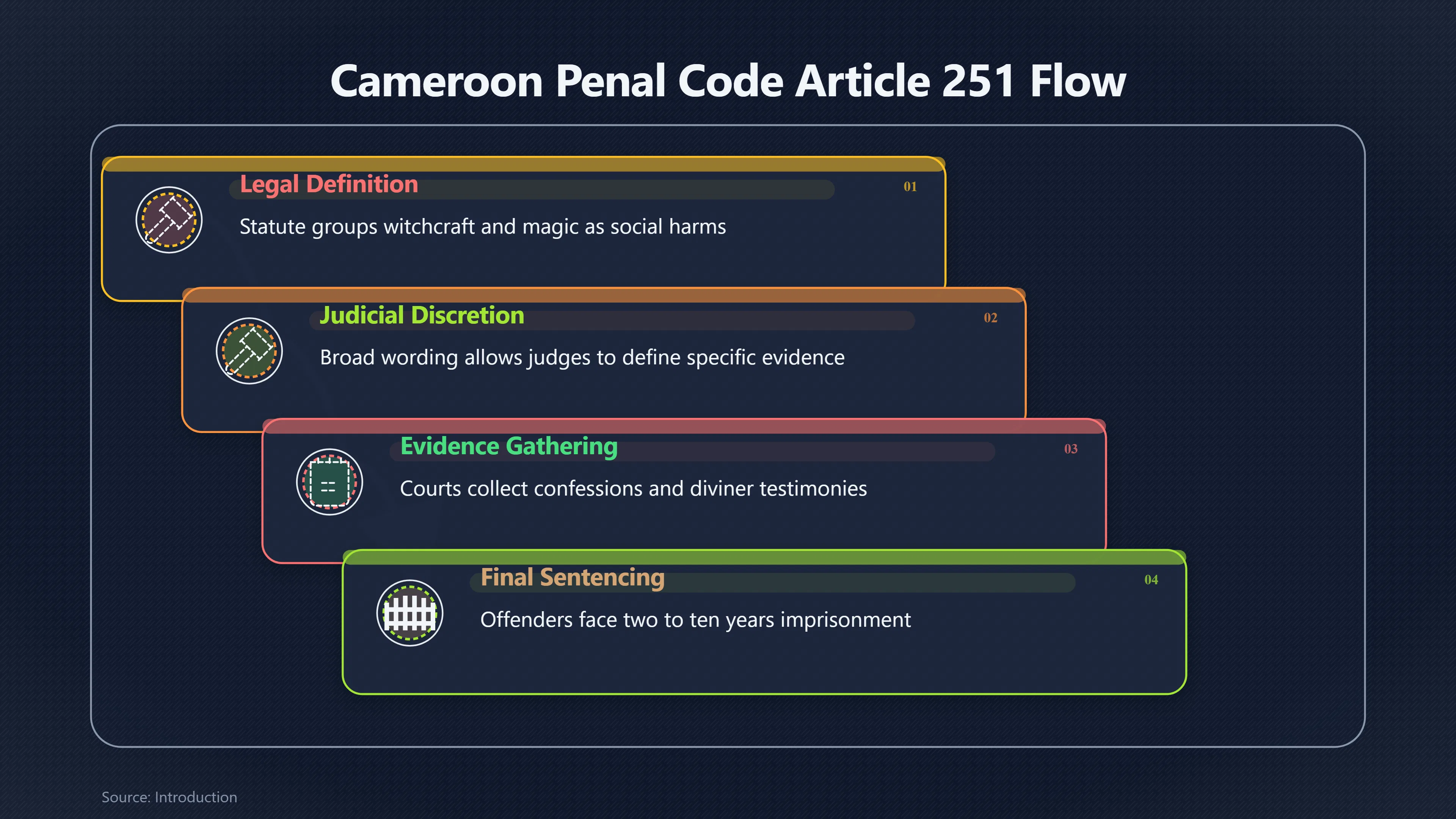
Article 251 of Cameroon’s Penal Code makes it an offence to practise witchcraft, magic or divination where those acts are liable to disturb public order or tranquillity, or to harm another person, their property or their wealth. The offence carries penalties of two to ten years’ imprisonment together with a fine.[WIPO]wipo.intLey N° 2016/007 de 12 de julio de 2016, relativa al Código Penal, Camerún, WIPO LexJuly 12, 2016…
The wording is significant in two respects.
First, the law does not attempt to define witchcraft scientifically. Instead, it groups together “witchcraft, magic or divination” as conduct capable of producing social harm.
Secondly, the offence links supernatural practices to concrete legal interests such as public order and harm to individuals. Legislators appear to have hoped that criminal law would both discourage occult practices and reduce the violence that often followed accusations.
In practice, however, this broad wording left judges considerable discretion. Because the statute provides no objective test for proving supernatural causation, courts have had to decide what kinds of evidence can satisfy the offence.
Diviners, Confessions and Courtroom Evidence
The greatest controversy has concerned evidence rather than the wording of the law itself.
Researchers have documented several recurring forms of proof presented in witchcraft prosecutions:
- voluntary or disputed confessions by the accused;
- testimony from alleged victims or relatives;
- statements by traditional healers or diviners claiming specialist knowledge;
- behaviour interpreted as suspicious after a death or illness;
- physical injuries or objects presented as supporting evidence but interpreted through beliefs about witchcraft rather than demonstrating supernatural causation directly.
Cyprian Fisiy’s influential study argued that post-independence courts increasingly relied on traditional specialists as expert witnesses. This produced an unusual situation in which people recognised locally for dealing with occult forces were effectively asked to advise state courts on whether witchcraft had occurred. Rather than separating legal procedure from supernatural belief, the courtroom risked incorporating the logic of witchcraft into judicial decision-making itself.[Cambridge University Press & Assessment]cambridge.orgCambridge University Press & AssessmentContaining Occult Practices: Witchcraft Trials In Cameroon | African Studies Review | Cambridge Co…
Fisiy further argued that judges often relied on the French-derived idea of l’intime conviction—the judge’s personal conviction after considering the evidence. Although this principle exists in many civil-law systems, critics contend that in witchcraft cases it can become especially subjective because there is rarely empirical evidence capable of independently confirming or disproving supernatural claims.[Cambridge University Press & Assessment]cambridge.orgCambridge University Press & AssessmentContaining Occult Practices: Witchcraft Trials In Cameroon | African Studies Review | Cambridge Co…
Why Ordinary Rules of Proof Become Difficult
Cameroon’s legal system combines civil-law and common-law traditions. In criminal proceedings, prosecutors are generally expected to establish guilt using recognised rules of evidence and to respect the presumption of innocence.
Witchcraft cases make those standards unusually difficult to apply.
A prosecutor may be able to prove that:
- a complainant became ill;
- an accused person consulted a traditional healer;
- neighbours believed someone possessed occult powers;
- an accused person admitted involvement.
What remains much harder to prove is the essential causal claim—that a supernatural act actually caused the alleged harm.
Legal commentators therefore distinguish between evidence that people believed witchcraft occurred and evidence that a criminal offence, as defined by law, has been established. This distinction explains why confessions have often assumed exceptional importance. Without a confession, prosecutors frequently struggle to connect alleged supernatural practices to legally demonstrable harm.[Human Rights and Legal Research Centre]hrlrc.orgHuman Rights and Legal Research CentreWitchcraft as an Offence in the Cameroon Penal Code - Human Rights and Legal Research Centre…
Protection from Mobs or Legalised Accusation?
Supporters and critics of Article 251 often begin from the same concern but reach opposite conclusions.
Those defending the law argue that ignoring witchcraft accusations entirely can encourage vigilantism. If communities believe the state refuses to act, suspected witches may instead face assaults, banishment or killings outside the legal system. Bringing allegations before a court, even imperfectly, may therefore reduce mob violence by replacing private revenge with legal procedure.[Cambridge University Press & Assessment]cambridge.orgCambridge University Press & AssessmentContaining Occult Practices: Witchcraft Trials In Cameroon | African Studies Review | Cambridge Co…
Critics respond that criminal trials can unintentionally legitimise accusations that cannot be objectively tested. Once a court accepts diviners, supernatural interpretations or unverified confessions as evidence, the authority of the legal system may strengthen belief that the accusations themselves have been officially proven. Human rights lawyers have argued that this creates risks of wrongful conviction, social stigma and discrimination against vulnerable people, particularly elderly women and socially marginal individuals who are disproportionately accused in many African contexts.[Cambridge University Press & Assessment]cambridge.orgCambridge University Press & AssessmentMalleus Maleficarum: Scrutinizing Sorcery in Cameroon | Journal of African Law | Cambridge Core…
The law therefore sits uneasily between two competing goals:
- protecting suspected victims of alleged occult harm; and
- protecting accused individuals from convictions based on evidence that would be inadequate for most other criminal offences.

What Court Cases Reveal
Published legal analyses show that appellate courts have sometimes overturned convictions where evidence proved insufficient, while other cases have upheld convictions where confessions or additional corroborating circumstances persuaded judges that the statutory requirements had been met.
Some decisions have also involved the related offence of falsely accusing another person of witchcraft. This reflects another feature of Cameroonian law: it attempts not only to punish harmful witchcraft but also to discourage defamatory or malicious allegations. In principle, both alleged witches and false accusers can face criminal liability, although the practical balance between those objectives has remained controversial.[Human Rights and Legal Research Centre]hrlrc.orgHuman Rights and Legal Research CentreWitchcraft as an Offence in the Cameroon Penal Code - Human Rights and Legal Research Centre…
These cases illustrate that the legal system has never found a consistently accepted method of resolving the underlying evidential problem. Instead, judges have continued to navigate between community expectations, statutory language and ordinary criminal procedure.
Why the Debate Still Matters
Cameroon’s experience has become an important case study for legal scholars because it highlights a broader question faced by plural legal systems: how should the state respond when widely held cultural beliefs concern harms that cannot easily be demonstrated through conventional evidence?
The debate is not simply about belief in witchcraft. It concerns the role of criminal courts, the limits of expert testimony, the meaning of proof and the protection of both complainants and defendants. Researchers continue to argue that the law’s greatest difficulty is not deciding whether occult beliefs exist within society, but determining how a modern court can fairly judge allegations whose essential claims remain beyond empirical verification.
For that reason, witchcraft prosecutions occupy a distinctive place in Cameroon’s history of collective fear. They show how attempts to control dangerous accusations through formal law can also grant those accusations new official authority, leaving courts caught between maintaining public order and preserving the principles of criminal justice.[Cambridge University Press & Assessment]cambridge.orgCambridge University Press & AssessmentContaining Occult Practices: Witchcraft Trials In Cameroon | African Studies Review | Cambridge Co…
Amazon book picks
Further Reading
Books and field guides related to Can a Court Prove an Invisible Crime?. Use these as the next step if you want deeper reading beyond the article.
The witch-hunt in early modern Europe
Explains evidence, law and prosecution in witchcraft cases.
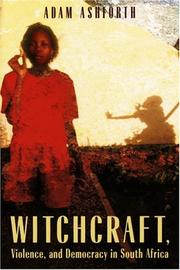
Witchcraft, Violence, and Democracy in South Africa
Explores legal and social responses to witchcraft accusations.
Endnotes
1.
Source: cambridge.org
Link:https://www.cambridge.org/core/journals/african-studies-review/article/abs/containing-occult-practices-witchcraft-trials-in-cameroon/BEAEAB2D75CCE76261CF3E6B96515FF9
Source snippet
Cambridge University Press & AssessmentContaining Occult Practices: Witchcraft Trials In Cameroon | African Studies Review | Cambridge Co...
2.
Source: cambridge.org
Link:https://www.cambridge.org/core/journals/journal-of-african-law/article/abs/malleus-maleficarum-scrutinizing-sorcery-in-cameroon/087C71286E4C82F8D1495D459C51D9D0
Source snippet
Cambridge University Press & AssessmentMalleus Maleficarum: Scrutinizing Sorcery in Cameroon | Journal of African Law | Cambridge Core...
3.
Source: cambridge.org
Link:https://www.cambridge.org/core/journals/africa/article/abs/domesticating-personal-violence-witchcraft-courts-and-confessions-in-cameroon/4721FE16F77AAD3DB3E721F314576362
Source snippet
Cambridge University Press & AssessmentDomesticating personal violence: witchcraft, courts and confessions in Cameroon | Africa | Cambrid...
4.
Source: wipo.int
Link:https://www.wipo.int/wipolex/es/legislation/details/16366
Source snippet
Ley N° 2016/007 de 12 de julio de 2016, relativa al Código Penal, Camerún, WIPO LexJuly 12, 2016...
Published: July 12, 2016
5.
Source: cambridge.org
Title: Sorcellerie et Modernité
Link:https://www.cambridge.org/core/journals/annales-histoire-sciences-sociales/article/abs/sorcellerie-et-modernite-les-enjeux-des-nouveaux-proces-de-sorcellerie-au-cameroun-approches-anthropologiques-et-historiques/0DD31158BB3FDEBB5B793C8DBF560F0A
Source snippet
Les enjeux des nouveaux procès de sorcellerie au cameroun approches anthropologiques et historiques | Annales. Histoire, Sciences Sociale...
6.
Source: hrlrc.org
Link:https://hrlrc.org/2023/09/15/witchcraft-as-an-offence-in-the-cameroon-penal-code/
Source snippet
Human Rights and Legal Research CentreWitchcraft as an Offence in the Cameroon Penal Code - Human Rights and Legal Research Centre...
Additional References
7.
Source: ecoi.net
Title: Criminal cases generally were tried in statutory courts. Customary courts serve
Link:https://www.ecoi.net/en/document/1149785.html
Source snippet
USDOS – US Department of State (Author): “Country Report on Human Rights Practices 2012 - Cameroon”, Document #1149785 - ecoi.netApril 19...
8.
Source: youtube.com
Link:https://www.youtube.com/watch?v=DEgf8xgkUNc
Source snippet
Portfolio Committee on Social Development hold public hearings on the Older Persons Amendment Bil…...
9.
Source: juriafrica.com
Title: art 251 code penal cameroun 21120
Link:https://www.juriafrica.com/lex/art-251-code-penal-cameroun-21120.htm
Source snippet
251, Code Pénal au CamerounJuly 12, 2016 — Code Pénal au Cameroun LOI N° 2016/007 DU 12 Juillet 2016 PORTANT CODE PENAL LIVRE II — DES CR...
Published: July 12, 2016
10.
Source: youtube.com
Title: POLICE WARN AGAINST WITCHCRAFT ACCUSATIONS
Link:https://www.youtube.com/watch?v=aXnAcrK5MfU
Source snippet
In Uganda: Swarm of bees disrupted Court Session of a Man charged for practicing witchcraft...
11.
Source: ecoi.net
Link:https://www.ecoi.net/en/document/1135185.html
Source snippet
Customary courts served as a primary means for settling domestic cases, such as succession, inheritance, and child custody. Customary cou...
12.
Source: africabib.org
Link:https://www.africabib.org/rec.php?RID=089525000
13.
Source: africabib.org
Link:https://www.africabib.org/rec.php?RID=079973604
14.
Source: persee.fr
Link:https://www.persee.fr/doc/cea_0008-0055_1990_num
15.
Source: ascleiden.nl
Link:https://www.ascleiden.nl/publications/palm-tree-justice-bertoua-court-appeal-witchcraft-cases
16.
Source: youtube.com
Title: Witchcraft in Bamenda (Cameroon) | Documentary
Link:https://www.youtube.com/watch?v=80YVsORQH2E
Source snippet
POLICE WARN AGAINST WITCHCRAFT ACCUSATIONS - nbc...
Topic Tree