When Belief Became a National Threat
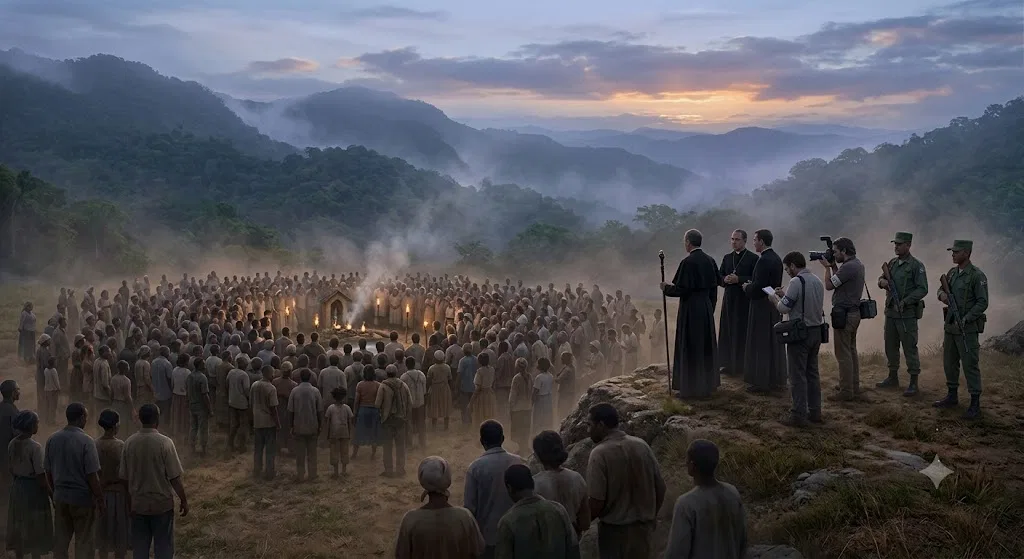
The Dominican Republic’s clearest history of contagious belief and moral panic does not resemble the classic European witch trial. Its central episode is the rise, persecution and violent suppression of the religious movement associated with the healer Olivorio Mateo and, later, the community at Palma Sola.
Page outline Jump by section
Introduction
A second pattern is the demonisation of Haitian and Afro-Dominican religious practices, especially under Rafael Trujillo. A much smaller but revealing modern example came in 2015, when Dominican television coverage portraying the schoolyard game “Charlie Charlie” as Satanic helped propel the scare around the world. Together, these cases show that collective fear in the Dominican Republic has usually emerged where religious difference, racial hierarchy, political insecurity and sensational media meet.
Papá Liborio: healer, prophet and political threat
Olivorio Mateo, widely remembered as Papá Liborio, emerged as a religious leader in the San Juan Valley in the early twentieth century. Accounts describe him as a healer and prophet whose followers combined Christian imagery with Afro-Dominican spiritual traditions. Stories surrounding his emergence included disappearance, divine instruction and miraculous healing. Although outsiders sometimes reduced the movement to superstition, historian Richard Adams interprets it as an alternative vision of modern life created by rural people whose land, trade and autonomy were being disrupted.[Wikipedia]WikipediaOlivorio MateoOlivorio Mateo
The setting matters. The San Juan Valley was a borderland connected economically and culturally with Haiti. From the late nineteenth century, Dominican elites sought firmer borders, private property, centralised government and a national identity sharply separated from Haiti. Communal land was enclosed, cross-border trade was restricted and American financial and military influence increased. Adams argues that local religious practice provided a language through which peasants could respond to these changes rather than simply endure them.[ETH Zurich Files]files.ethz.chOpen source on ethz.ch.
Liborio’s authority was therefore never purely religious. Healing the sick, gathering followers and moving through the mountains created networks beyond easy state control. During the United States occupation of the Dominican Republic from 1916 to 1924, the authorities treated him as a security threat. His followers also resisted restrictions on movement and trade across the Haitian border. Liborio was pursued for years and killed in 1922, but his death strengthened rather than erased his sacred reputation among many followers.[ethz.ch]files.ethz.chOpen source on ethz.ch.
It is tempting to call this a “cult story”, but that wording conceals the central dispute. Government officials saw an armed, mobile and autonomous following. Devotees saw a healer, religious teacher and protector of the poor. Later scholars have treated the movement as a mixture of popular religion, peasant resistance, messianic hope and local responses to state-building. The conflict was real, but the image of an irrational sect threatening civilisation was also politically useful.
Palma Sola: how a religious community became an enemy
Liborio’s religious legacy survived his death. Around 1960, León and Plinio Ventura Rodríguez became leading figures in a renewed movement centred on Palma Sola in the San Juan region. Their family had longstanding links with Liborio’s followers and had experienced persecution under both the American occupation and Trujillo’s dictatorship.[ETH Zurich Files]files.ethz.chOpen source on ethz.ch.
The movement grew during the collapse of the Trujillo regime. According to Adams’s account, the brothers taught that the Holy Spirit had instructed them to establish a sacred place and that the old world associated with Trujillo would end. Peasants travelled to Palma Sola for worship and healing. The community drew upon Christian prayer, the Holy Trinity, sacred springs, herbs, dreams, spirit possession and the continuing memory of Liborio. Its message also promised dignity, equality and unity for rural followers.[ETH Zurich Files]files.ethz.chOpen source on ethz.ch.
This was millenarian belief: an expectation that the existing order was nearing a decisive transformation and that a renewed world would follow. Such beliefs are not automatically violent or irrational. They often flourish during abrupt political change because they translate uncertainty into a meaningful story. In Palma Sola, the end of Trujillo’s dictatorship created both hope and fear. Rural people could imagine a more equal future, while elites worried that a large, organised peasant movement might escape their authority.
Local professionals, businesses and churches raised alarms. The national press joined in, presenting the movement as an embarrassing survival from an uncivilised past. One contemporary newspaper editorial characterised the community as an anachronism in the twentieth century. This language did more than criticise theology: it framed the followers as people standing outside legitimate modern society.[ETH Zurich Files]files.ethz.chOpen source on ethz.ch.
On 28 December 1962, Dominican forces moved against Palma Sola. People were killed, wounded and arrested, including women and children. The exact death toll remains disputed. Contemporary and later estimates range from several dozen to roughly 150 or more; claims of 600 or 800 deaths, sometimes linked to an alleged napalm attack, circulate widely but are not securely established by the strongest available scholarship. One detailed historical study notes that official accounts reported no more than forty deaths, while a movement leader suggested 150 to 200. A modern Dominican history syllabus describes more than one hundred killed and an unknown number wounded.[UBC Open Library]open.library.ubc.caLeón Rodríguez, who was already in police custody at the time of the massacre, suggested perhaps 150 to 200. Most scholars…Read more…
That uncertainty is important. Palma Sola has accumulated legend in much the same way that Liborio did. Later retellings sometimes enlarge casualty figures or add dramatic details without clear documentation. Yet correcting doubtful numbers should not minimise what happened. The established core is grave enough: the state treated a popular religious community as a political and social danger and answered it with lethal force.
Was Palma Sola a cult, a panic or an uprising?
No single label captures Palma Sola. It was a religious movement with charismatic leaders and prophetic expectations. It was also a gathering place for poor rural people seeking healing, community and social change. Some followers may have accepted extraordinary claims about divine power, but that alone does not explain the massacre.
Calling it a “cult” reproduces the language of officials and hostile commentators unless the term is carefully qualified. In everyday use, “cult” often implies manipulation, criminality or extreme isolation. The evidence instead points to a movement embedded in regional family networks, popular religion and memories of political persecution. Scholars more commonly discuss it as a messianic, millenarian, peasant or Afro-Dominican religious movement.[jstor.org]jstor.orgRoberto Cassá, Con la palabra de Dios. Santo DomingoCon la palabra de Dios deals with a religious movement created some time around…
Nor was the episode simply “mass hysteria”. There is no strong evidence that followers experienced a medically defined outbreak of mass psychogenic illness. The collective element lay in shared prophecy, pilgrimage and elite fear. The panic was primarily outside the movement: newspapers, churches, officials and security forces increasingly imagined Palma Sola as a threat to national order.
The most convincing interpretation combines religion with politics. The followers’ beliefs helped them make sense of poverty, dictatorship, land loss and uncertain transition. At the same time, the state interpreted independent rural organisation through a security lens. The resulting confrontation was not caused by belief alone; it grew from an unequal struggle over who could define legitimate religion, modernity and political authority.

The demonisation of Haitian and Afro-Dominican religion
The treatment of Liborio’s followers formed part of a broader struggle over race and religion. Dominican popular religion developed through Catholic, African and Haitian influences, especially in border regions. Yet elite nationalism often portrayed Haitian identity and African-derived spirituality as foreign, primitive or dangerous.
Under Trujillo, this hostility became state policy. Adams records that the regime outlawed Afro-Dominican religious practice and threatened practitioners with imprisonment. Suppressing popular religion accompanied the killing of regional leaders, land seizures and the centralisation of political control.[ETH Zurich Files]files.ethz.chOpen source on ethz.ch.
Religious fear also overlapped with anti-Haitianism. Trujillo’s government worked to weaken Haitian-Dominican communities and impose firmer racial and national divisions on a border where families, trade and culture had long crossed the official line. Archival research by Amelia Hintzen shows that the regime first attempted deportation and coercive population control; when local authorities resisted, Trujillo used mass violence to destroy cross-border networks and enforce obedience.[ScienceDirect]sciencedirect.comScienceDirect“A Veil of Legality”ScienceDirect“A Veil of Legality”
The 1937 massacre of Haitians and Dominicans of Haitian descent was not a spontaneous outbreak of supernatural fear. It was organised state violence driven by dictatorship, racism, territorial control and economic policy. UNESCO describes it as a genocide ordered by Trujillo in which more than ten thousand people were killed. Recent scholarship likewise stresses that anti-Haitianism was historically constructed and politically intensified, rather than an eternal or universal Dominican attitude.[UNESCO]unesco.orgOpen source on unesco.org.
Nevertheless, the language of dangerous Haitian religion helped make persecution appear culturally defensible. Associating people with sorcery or sinister ritual could transform neighbours into imagined internal enemies. This is one reason historians distinguish belief from panic: a religious practice may be real, while the claim that its practitioners constitute a hidden national menace may be propaganda.
The distinction also protects Dominican religious minorities from two opposite distortions. One is demonisation, in which their practices are represented as evil or criminal. The other is romanticisation, in which every conflict is turned into a simple story of heroic spirituality. Popular religion can contain authority disputes, healing claims and internal tensions like any other institution. What demands scrutiny is the disproportionate power of governments and media to define minority belief as a public danger.
“Charlie Charlie”: a local television scare goes global
In April 2015, a Dominican television report warned that a pencil-and-paper game known as “Charlie Charlie” was spreading through schools and exposing pupils to Satanic influence. The footage, filmed in Hato Mayor, circulated online and helped turn a regional schoolyard game into an international internet craze. Religious-studies scholar Joseph Laycock notes the paradox: coverage intended to warn children about the game made it more visible and attractive.[Religion Dispatches]religiondispatches.orgOpen source on religiondispatches.org.
The game used two balanced pencils over a paper divided into “yes” and “no” sections. Players asked an invisible being called Charlie to answer questions. Small movements could be produced by gravity, an unstable pivot, air movement or breathing. Yet the ritual framing—calling a named entity, waiting for an answer and formally ending the session—made ordinary movement feel uncanny.[Wikipedia]WikipediaOpen source on wikipedia.org.
Reports from the Dominican school included parental claims that children had become possessed. The available evidence does not establish a widespread medical outbreak, demonic event or organised occult movement. What is documented is a rapid cycle of rumour, adult alarm, news coverage, adolescent curiosity and online imitation.[Alasdair Baverstock]alasdairbaverstock.comOpen source on alasdairbaverstock.com.
This episode belongs more clearly to moral-panic history than to the history of cults. There was no stable religious organisation, doctrine or leadership. The central fear was that an apparently harmless youth game opened a door to Satanic power. Once that interpretation appeared on television, it supplied both a warning to adults and a ready-made supernatural adventure for young people.
The Dominican Republic’s role in the phenomenon is culturally significant because the viral chain crossed languages and borders. A report about a supposed threat in one provincial school became part of a worldwide story about a “Mexican demon”, even though the game’s origins were uncertain and the Mexican identity attached to Charlie was largely invented. The case shows how global folklore can now be assembled from local television, mistranslation, religious commentary and social-media repetition.[Wikipedia]WikipediaOpen source on wikipedia.org.

What these cases reveal
The Dominican evidence is strongest when treated as a history of contested belief rather than a catalogue of bizarre incidents. Three recurring mechanisms stand out.
Political anxiety turns religious independence into danger. Liborio and Palma Sola attracted suspicion because they gathered rural followers outside established political and church structures. Prophecy mattered, but autonomy mattered just as much.
Racial and class hierarchies shape whose religion is called superstition. Elite Catholic or official nationalism was rarely described as irrational collective belief. Afro-Dominican, Haitian-influenced and peasant practices were much more likely to be labelled witchcraft, primitivism or fanaticism.
Warnings can spread the behaviour they condemn. The Charlie Charlie report illustrates a modern feedback loop: media exposure increased curiosity, religious condemnation increased the game’s supernatural appeal, and repetition transformed uncertain claims into apparent fact.
These mechanisms also explain why “mass hysteria” should be used sparingly. The term can obscure the difference between people sharing bodily symptoms, people participating in a religious movement, authorities exaggerating a social threat and governments deliberately manufacturing an enemy. In Dominican history, those are distinct processes with very different victims and consequences.
Why the history still matters
Papá Liborio remains present in Dominican cultural memory, religious practice, scholarship and film. His survival as a sacred and political figure demonstrates that state persecution did not settle the meaning of his movement. For some, he remains a healer and popular saint; for others, a rebel, mystic or symbol of the rural poor. The continued importance of Palma Sola likewise reflects unresolved questions about dictatorship, land, race and the treatment of popular religion.[wikipedia.org]WikipediaOlivorio MateoOlivorio Mateo
The history also offers a warning about archives and legends. Governments often minimise violence, while later activists or popular retellings may repeat dramatic figures that cannot be verified. Responsible interpretation must hold both problems in view: scepticism about inflated claims should not become denial, and condemnation of repression should not require accepting every later story as fact.
Above all, the Dominican Republic’s cult-and-panic history is not chiefly a tale of credulous crowds losing their reason. It is a history of struggles over who is allowed to define reality. Healers, peasants, journalists, churches, soldiers and political rulers all competed to decide whether a gathering was a pilgrimage or conspiracy, whether a spirit was sacred or demonic, and whether an unfamiliar community deserved dialogue or force. The greatest harm came not from strange belief by itself, but from fear joined to unequal power.
Amazon book picks
Further Reading
Books and field guides related to When Belief Became a National Threat. Use these as the next step if you want deeper reading beyond the article.
The Serpent and the Rainbow
First published 1985. Subjects: Social life and customs, Description and travel, Zombiism, Bizango (Cult), Religious life and customs.
Silencing the past
First published 1995. Subjects: Historiography, Historicism, Power (Social sciences), Historiographie, Historicisme.
Why the cocks fight
First published 1999. Subjects: Haiti, Haitians, Relations, International relations, Außenpolitik.
Endnotes
1.
Source: Wikipedia
Title: Olivorio Mateo
Link:https://en.wikipedia.org/wiki/Olivorio_Mateo
2.
Source: tiboko.com
Link:https://tiboko.com/wp-content/uploads/2023/07/Revolutionary-Kiskeya-from-Caonabo-to-Liborio.pdf
Source snippet
occupation of the Dominican custom houses and closing off of the Haitian border. This was distasteful to the peasantry of the central sou...
3.
Source: open.library.ubc.ca
Link:https://open.library.ubc.ca/media/stream/pdf/24/1.0069836/1
Source snippet
León Rodríguez, who was already in police custody at the time of the massacre, suggested perhaps 150 to 200. Most scholars...Read more...
4.
Source: jstor.org
Link:https://www.jstor.org/stable/27478313
Source snippet
Roberto Cassá, Con la palabra de Dios. Santo DomingoCon la palabra de Dios deals with a religious movement created some time around...
5.
Source: cambridge.org
Title: University Press & Assessment23
Link:https://www.cambridge.org/core/books/cambridge-history-of-religions-in-latin-america/revival-of-latin-american-catholicism-19001960/7B8B519785748FF4B6BD99579B5907F5
6.
Source: sciencedirect.com
Title: ScienceDirect“A Veil of Legality”
Link:https://www.sciencedirect.com/org/science/article/pii/S1382237316000234
7.
Source: unesco.org
Link:https://www.unesco.org/en/memory-world/lac/documentary-heritage-resistance-and-struggle-human-rights-dominican-republic
8.
Source: Wikipedia
Link:https://en.wikipedia.org/wiki/Charlie_Charlie_challenge
9.
Source: Wikipedia
Title: List of mass panic cases
Link:https://en.wikipedia.org/wiki/List_of_mass_panic_cases
10.
Source: Wikipedia
Title: Satanic panic
Link:https://en.wikipedia.org/wiki/Satanic_panic
11.
Source: Wikipedia
Title: List of massacres in the Dominican Republic
Link:https://en.wikipedia.org/wiki/List_of_massacres_in_the_Dominican_Republic
12.
Source: resolve.cambridge.org
Title: afrohispanic american literature
Link:https://resolve.cambridge.org/core/services/aop-cambridge-core/content/view/F6851C51FBAD77029F05B8955A4E2F52/9781139055284c5_p164-194_CBO.pdf/afrohispanic_american_literature.pdf
13.
Source: unesdoc.unesco.org
Link:https://unesdoc.unesco.org/ark%3A/48223/pf0000071880
14.
Source: jstor.org
Link:https://www.jstor.org/stable/4137916
15.
Source: jstor.org
Link:https://www.jstor.org/stable/25675900
16.
Source: jstor.org
Link:https://www.jstor.org/stable/23055249
17.
Source: jstor.org
Link:https://www.jstor.org/stable/41850200
18.
Source: jstor.org
Link:https://www.jstor.org/content/oa_chapter_monograph/j.ctt9qft42.13
19.
Source: jstor.org
Link:https://www.jstor.org/stable/41826912
20.
Source: jstor.org
Link:https://www.jstor.org/stable/i40087384
21.
Source: jstor.org
Link:https://www.jstor.org/stable/27170785
22.
Source: jstor.org
Link:https://www.jstor.org/stable/24713495
23.
Source: history.state.gov
Link:https://history.state.gov/historicaldocuments/frus1961-63v12/d158
24.
Source: catholic.org
Link:https://www.catholic.org/news/hf/family/story.php?id=61117
25.
Source: files.ethz.ch
Link:https://www.files.ethz.ch/isn/47043/AS06.pdf
26.
Source: religiondispatches.org
Link:https://religiondispatches.org/2015/06/15/charlie-charlie-challenge-and-teenage-yearning-supernatural-encounters
27.
Source: alasdairbaverstock.com
Link:https://alasdairbaverstock.com/news/2015/06/09/summoning-mexican-devils-with-charlie-charlie
28.
Source: festivalcinesevilla.eu
Title: liborio messiahs revolution
Link:https://festivalcinesevilla.eu/en/news/liborio-messiahs-revolution
Additional References
29.
Source: abusablepast.org
Title: microsyllabus history from below in the dominican republic
Link:https://abusablepast.org/microsyllabus-history-from-below-in-the-dominican-republic/
Source snippet
Microsyllabus: History from Below in the Dominican Republic4 Feb 2021 — Mass killings are intrinsic to the repressive apparatus of the mo...
30.
Source: youtube.com
Title: Luis Terror Días | English adaptation of a Dominican folk legend, Jason Paul
Link:https://www.youtube.com/watch?v=WP0M1KNQPrU
Source snippet
4 [Papa Liborio]({{ 'papa-liborio/' | relative_url }}), the living saint of Maguana...
31.
Source: youtube.com
Title: Bêtes Noires: Sorcery as History in the Haitian-Dominican Borderlands
Link:https://www.youtube.com/watch?v=gO5qhPBEIyw
Source snippet
2 The Truth About the Charlie Charlie Challenge...
32.
Source: cia.gov
Link:https://www.cia.gov/readingroom/docs/DOC_0000098762.pdf
33.
Source: youtube.com
Link:https://www.youtube.com/watch?v=nfuhFlSGunM
Source snippet
3 Luis Terror Días | English adaptation of a Dominican folk legend, Jason Paul...
34.
Source: youtube.com
Title: Papa Liborio, the living saint of Maguana
Link:https://www.youtube.com/watch?v=5dFTB9ij7ag
Source snippet
5 Rafael Trujillo: Intimidation and Assassination in the Dominican Republic...
35.
Source: historysnob.com
Link:https://www.historysnob.com/war-and-historical-events/20-chilling-cases-mass-hysteria-throughout-history
36.
Source: academic.oup.com
Link:https://academic.oup.com/ahr/advance-article/doi/10.1093/ahr/rhag037/8687574?searchresult=1
37.
Source: thenewamerican.com
Link:https://thenewamerican.com/world-news/europe/bbc-african-children-kidnapped-for-blood-rituals-in-britain/
38.
Source: reddit.com
Link:https://www.reddit.com/r/exjw/comments/1j12yzm/doomsday_cults_through_the_centuries/
Topic Tree
Follow this branch
Related pages 192
- Antigua and Barbuda
- Argentina Belief Scares
- Azerbaijan Belief
- Bahrain Beliefs
- North Korea
- +187 more in sidebar