Why Collective Fear Takes Hold in Malaysia
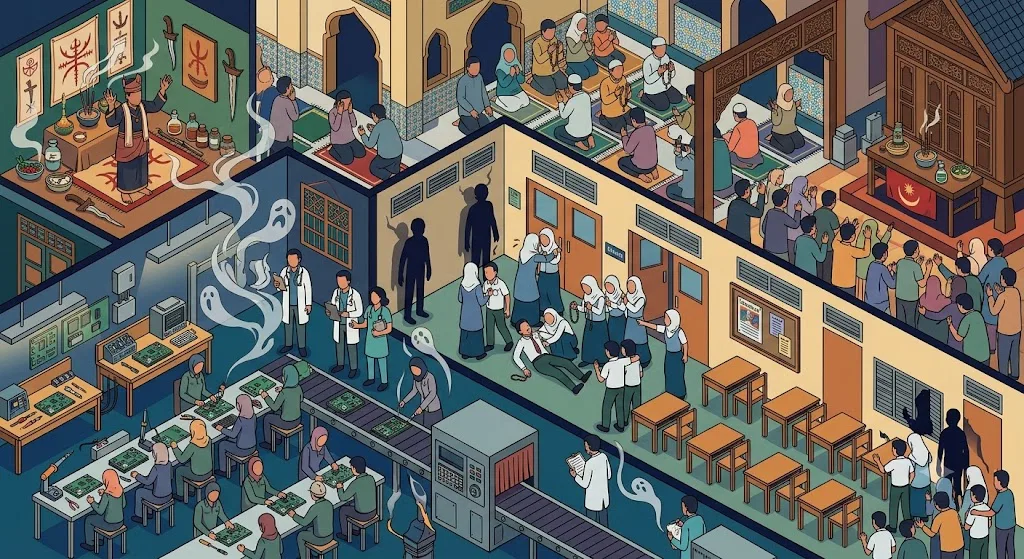
Malaysia’s history of cult scares and mass hysteria is best understood not as a catalogue of irrational beliefs, but as a series of encounters between supernatural traditions, rapid social change, religious regulation and modern institutions.
Page outline Jump by section
Introduction
The evidence points to several different phenomena that are often wrongly bundled together. School outbreaks are generally discussed by clinicians and social scientists as mass psychogenic illness: real, involuntary symptoms spreading through a close-knit group without an identified infectious or toxic cause. Movements such as Al-Arqam and the Sky Kingdom were organised religious communities whose treatment as dangerous sects also reflected arguments over state power and religious orthodoxy. Cases involving weapons, coercion or abuse require still another category. Keeping these distinctions clear reveals why Malaysia matters to the global history of contagious belief and collective fear.[lww.com]journals.lww.commass hysteria among secondary school students in.7.aspxLippincott JournalsMass Hysteria among Secondary School Students in…by NFA Saberi · 2025 — “mass psychogenic illness” or “contagious p…
Why “possession” spread through factories
One of the most influential studies of Malaysian collective behaviour began not in a shrine or isolated commune, but on the production floors of multinational factories. During Malaysia’s industrial expansion in the 1970s and 1980s, episodes of screaming, fainting, struggling, trance and apparent spirit possession were reported among groups of young Malay women employed in electronics and other manufacturing work.
Anthropologist Aihwa Ong argued that these episodes could not be explained simply as superstition carried into a modern workplace. Many workers had moved from rural communities into closely supervised factories governed by bells, targets, repetitive tasks and strict discipline. At home, they faced expectations concerning obedience, sexuality and family duty; at work, managers demanded speed, punctuality and emotional control. Possession offered a culturally recognisable form through which overwhelming strain could be expressed when direct protest was difficult.[wiley.com]anthrosource.onlinelibrary.wiley.comthe production of possession: spirits and the multinational…This essay explores different interpretations of spirit posses…
This does not mean that workers consciously invented symptoms as a labour tactic. Mass psychogenic illness and dissociative behaviour are generally understood as involuntary. Ong’s interpretation was social as well as psychological: distress took the form of spirits because spirits already provided a meaningful language for danger, moral disturbance and loss of control. Factory managers might describe an outbreak as a medical or productivity problem, while workers and relatives might understand the same event as an intrusion by unseen beings.
The response often combined several systems of authority. Affected workers might be removed from the production line, medically examined or sent home, while employers called religious specialists or traditional healers to cleanse the premises. Such rituals could reassure workers by acknowledging their interpretation of events, although concentrating attention on possession could also encourage fear and further cases. Research on occupational mass psychogenic illness more broadly distinguishes sudden anxiety outbreaks from longer motor or trance-like episodes associated with accumulated conflict and dissociation.[Sage Journals]journals.sagepub.comSage JournalsOccupational Mass Psychogenic Illness: A Transcultural…by RE Bartholomew · 2000 · Cited by 38 — Reports of occupational m…
The lasting importance of the factory cases lies in the argument they produced. A narrow account says that traditional belief disrupted modern industry. A more persuasive interpretation asks why modern industry placed particular groups under pressures that could be voiced only through an older supernatural vocabulary. Malaysia’s factory possessions therefore became a classic example of how gender, labour discipline and cultural expectation can shape the outward form of psychological distress.
Why Malaysian schools keep reporting mass hysteria
Schools later became the most visible setting for similar outbreaks. Students have suddenly screamed, fainted, cried, convulsed, reported frightening apparitions or behaved as though controlled by an outside force. Episodes are commonly described in news reports as “mass hysteria” or possession, especially when several pupils develop similar symptoms in quick succession.
A widely reported outbreak at SMK Pengkalan Chepa 2 in Kelantan in April 2016 affected students and members of staff and led to the temporary closure of the school. Witnesses described sightings of a dark figure or other supernatural experiences. Religious practitioners were brought in, prayers and cleansing rituals were conducted, and journalists outside the closed school reported hearing further screams. Reports placed the number affected at more than 100, although contemporary totals varied.[The Straits Times]straitstimes.comOpen source on straitstimes.com.
A later Malaysian study interviewed students who had directly experienced the 2016 outbreak. It found that their explanations were strongly shaped by information from teachers, respected adults and existing beliefs about spirits and forbidden places. This matters because collective illness does not spread through imitation alone. People also learn how to interpret unfamiliar sensations: dizziness may become evidence of possession once the group agrees that a threatening presence is nearby.[Lippincott Journals]journals.lww.commass hysteria among secondary school students in.7.aspxLippincott JournalsMass Hysteria among Secondary School Students in…by NFA Saberi · 2025 — “mass psychogenic illness” or “contagious p…
Kelantan has become especially associated with such incidents, but claims that the state is uniquely irrational should be treated cautiously. Its conservative religious environment, boarding-school discipline and familiar supernatural narratives may influence how distress is interpreted and displayed. They do not by themselves establish a single cause. Comparable outbreaks occur in schools worldwide, especially among adolescents living or studying in tightly regulated groups. Researchers stress that each event must first be investigated for infection, poisoning, heat, poor ventilation or another physical hazard before a psychogenic explanation is accepted.[PMC]pmc.ncbi.nlm.nih.govOpen source on nih.gov.
The pattern has not disappeared. In April 2024, 165 boarding students at SMK Batu Kikir in Negeri Sembilan were sent home for several days after an outbreak reportedly affected about 50 pupils. The decision reduced contact among students and allowed the dormitory to be cleaned, illustrating how school authorities continue to combine practical containment with responses shaped by local expectations.[NST Online]nst.com.myNST Online165 students sent home after mass hysteria in Jempol schoolNST Online165 students sent home after mass hysteria in Jempol school
What the diagnosis does and does not mean
“Mass psychogenic illness” describes the spread of genuine symptoms through psychological and social processes when no adequate organic cause has been found. It does not mean that pupils are pretending, that they share a psychiatric disorder or that supernatural belief alone caused the episode. Fear can alter breathing, balance, movement and perception; seeing a trusted classmate collapse can then heighten attention to similar sensations in others.
The older expression “mass hysteria” carries an additional problem. Historically, hysteria was often used to dismiss women’s suffering as emotional weakness. Malaysian outbreaks have disproportionately involved girls and young women, making careless use of the label particularly damaging. More neutral language encourages officials to acknowledge distress while continuing medical investigation.
Publicity also changes an outbreak. Repeated accounts of ghosts, cursed trees or possessed pupils can supply later students with an expected script. Conversely, a response that simply mocks supernatural explanations may increase distrust. Effective handling requires calm separation of affected individuals, medical assessment, reduced exposure to alarming rumours and culturally sensitive communication with families.
When a religious movement becomes a public threat
Malaysia’s religious-movement scares operate differently from school possession. Here the central issue is not contagious symptoms but the power to define acceptable belief. Islam is administered partly through state institutions, and Malaysian authorities have frequently prohibited teachings classified as deviant from officially recognised Sunni doctrine. This gives disputes over unusual movements a legal and political dimension that the casual word “cult” can conceal.[state.gov]2021-2025.state.govOpen source on state.gov.
Al-Arqam: commune, business network and banned movement
Al-Arqam began in 1968 under Ashaari Muhammad as a religious study circle and developed into a disciplined communal movement. It attracted urban Malays, operated schools and settlements, published religious material and built businesses in food, agriculture, retail and other sectors. By the early 1990s it had become a conspicuous social and economic network rather than a small secluded sect.[nii.ac.jp]icu.repo.nii.ac.jpアジア別冊15 04 Hassanアジア別冊15 04 Hassan
Authorities condemned teachings associated with Ashaari, including millenarian beliefs involving a coming divinely guided ruler and claims made by followers about their leader’s spiritual powers. In 1994 the movement was banned, its leadership was detained and its institutions were dismantled or absorbed. The official case presented Al-Arqam as both theologically deviant and potentially threatening to public order.[Cambridge University Press & Assessment]resolve.cambridge.orgThe state ultimately won as it was able to fashion a statist Islam that would ensure UMNO's relevance…
Scholars have questioned whether theology alone explains the timing and severity of the crackdown. Al-Arqam’s economic independence, disciplined membership and ability to attract educated Malays gave it influence outside the governing party’s religious structures. Ahmad Fauzi Abdul Hamid argues that the relationship deteriorated as the movement grew from a marginal devotional community into a possible rival source of Islamic authority. The ban can therefore be read as a mixture of genuine doctrinal conflict, fear of charismatic power and political containment.[Academia]academia.eduPDF) The Banning of Darul Arqam in MalaysiaPDF) The Banning of Darul Arqam in Malaysia
That distinction remains important because Al-Arqam did not vanish cleanly. Successor businesses and networks appeared under later names, including Rufaqa and Global Ikhwan Services and Business Holdings, or GISB. The continuity of personnel, teachings and economic organisation became a repeated subject of official scrutiny, while the companies themselves sought to present their activities as lawful commerce rather than a revival of a prohibited movement.
In 2024, police raids on children’s homes allegedly linked to GISB brought renewed attention to those roots. Authorities reported rescuing hundreds of children and investigated allegations including neglect, sexual abuse, exploitation, money laundering and organised crime. GISB disputed important parts of the allegations and denied operating the homes, while 22 people linked to the company, including senior figures, were later charged with organised crime. These were criminal allegations requiring evidence in court, not merely proof that the organisation descended from a banned religious movement.[Reuters]reuters.comAlleged child abuse case puts banned Malaysian sect back in spotlightAlleged child abuse case puts banned Malaysian sect back in spotlight
The episode illustrates why the language of panic must be used carefully. State hostility to an unconventional theology can threaten freedom of belief, but accusations of abuse or coercion should not be dismissed as moral panic simply because religious deviance is also alleged. The two questions — whether beliefs should be prohibited and whether crimes occurred — need separate evidence.
The Sky Kingdom and the giant teapot
The Sky Kingdom, associated with Ariffin Mohammed, commonly known as Ayah Pin, offered a more visibly unconventional form of belief. Its commune in Terengganu displayed monumental structures including a giant teapot, vase and umbrella. Followers treated the symbols as representations of spiritual ideas, while the group blended elements from several religious traditions.
Malaysian religious authorities declared the teachings deviant. Ayah Pin was convicted in 2001 for practices judged contrary to Islam, and followers faced continued legal pressure. In July 2005 masked attackers damaged and burned buildings at the commune. Authorities then arrested dozens of followers, and the remaining structures were demolished in August.[hrw.org]hrw.orgmalaysia protect freedom belief sky kingdomHuman Rights WatchMalaysia: Protect Freedom of Belief for Sky Kingdom21 Jul 2005 — In 2001, Ayah Pin himself was convicted and jailed for…
The giant teapot made the movement easy to ridicule, but the serious issue was whether the state could compel adults born as Muslims to accept officially approved doctrine. Human Rights Watch argued that the authorities should protect members’ freedom of belief and investigate the vigilante attack rather than prosecute peaceful religious activity. The case shows how public mockery, administrative enforcement and private violence can reinforce one another once a minority group is framed as both absurd and dangerous.[Human Rights Watch]hrw.orgmalaysia protect freedom belief sky kingdomHuman Rights WatchMalaysia: Protect Freedom of Belief for Sky Kingdom21 Jul 2005 — In 2001, Ayah Pin himself was convicted and jailed for…
Sky Kingdom was an organised new religious movement, not an outbreak of mass hysteria. Its destruction belongs in Malaysia’s history of collective fear because authorities and opponents presented unorthodox belief as a threat to communal order, while spectacular media imagery made the group a national symbol of religious deviance.
When belief crossed into armed violence
Some groups associated with supernatural or millenarian ideas did engage in documented violence. The clearest example is Al-Ma’unah, an organisation centred on martial arts, spiritual power and traditional healing. In July 2000, members deceived their way into military installations and seized weapons before retreating to a camp near Sauk in Perak.
The resulting siege involved hostages, negotiations and a major security operation. Two captives were killed before the group surrendered. The episode was therefore not simply a cult scare manufactured by the press: an organised group had acquired military weapons and caused deaths. At the same time, its beliefs about inner power and religious mission helped observers make sense of conduct that otherwise seemed extraordinary.[Wikipedia]WikipediaOpen source on wikipedia.org.
Al-Ma’unah demonstrates the danger of using either extreme interpretation. Treating every unconventional spiritual association as a potential armed conspiracy encourages indiscriminate repression. Treating all state concern as panic ignores cases in which leaders mobilise followers towards real violence. The necessary questions concern conduct: Were people coerced? Were weapons obtained? Were threats made? Were followers prevented from leaving? Belief may explain behaviour, but it does not by itself prove criminal danger.
Witchcraft, healers and media spectacle
Malaysia has no close equivalent to the large, court-driven European witch hunts of the early modern period. Belief in harmful magic, spirit attack and the powers of healers nevertheless remains part of popular culture across ethnic and religious communities. Accusations tend to appear in private disputes, healing practices, crime reporting and political gossip rather than in sustained judicial campaigns against large numbers of alleged witches.
The 1993 murder of politician Mazlan Idris became the country’s most notorious modern “black magic” case. Former singer and healer Maznah Ismail, widely known as Mona Fandey, was convicted with her husband and an assistant of killing him during what was presented as a ritual connected to promised political power. All three were executed in 2001. The crime’s combination of ambition, celebrity, occult claims and gruesome evidence produced decades of retelling.[Wikipedia]WikipediaMona FandeyMona Fandey
It would be misleading, however, to treat the case as proof of a widespread satanic conspiracy or national witch panic. It was a documented murder committed by a small number of people. Later popular culture transformed Mona Fandey into a supernatural celebrity, sometimes emphasising her appearance and courtroom behaviour more than the victim or evidence. The story reveals the appeal of occult crime narratives, but not the existence of an organised magical underground.
Traditional healers have also become lightning rods during national crises. After Malaysia Airlines flight MH370 disappeared in March 2014, a self-styled healer performed highly publicised rituals at Kuala Lumpur International Airport, using objects including coconuts in an attempt to locate the aircraft. The performance drew ridicule and official disapproval, while also opening a debate about who has the authority to define legitimate religion and acceptable healing.[Religion Dispatches]religiondispatches.orgReligion Dispatches Finding the Missing Airliner with CoconutsReligion Dispatches Finding the Missing Airliner with Coconuts
The incident was closer to a media spectacle than a mass delusion. Most Malaysians did not share the healer’s claim, and the rituals had no evidential value in the search. Their significance lay in the collision between private grief, desperate uncertainty, folk practice, religious policing and global news coverage. In a crisis with almost no reliable answers, an extravagant performance filled the information vacuum and became more visible than the ordinary uncertainty surrounding the investigation.
How rumours and authority intensify a scare
Across these cases, collective fear did not spread because Malaysians held one uniform set of supernatural beliefs. Malaysia is religiously and ethnically diverse, and even people who use the same language of possession or spiritual danger may interpret it differently. What the episodes share is a process through which ambiguous events acquire an agreed meaning.
Several forces repeatedly appear:
- Closed social environments. Boarding schools, factories and communes bring people into continuous contact, allowing emotion, symptoms and interpretations to travel quickly.
- Unequal power. Young workers, pupils and junior followers may have limited ways to question managers, teachers, parents or charismatic leaders.
- A familiar cultural script. Stories about spirits, forbidden places, occult attack or approaching religious transformation give frightening sensations a recognisable shape.
- Visible intervention. School closures, exorcisms, raids and sensational news reports can confirm that something extraordinary is happening, even when intended to restore order.
- Institutional competition. Doctors, religious authorities, healers, police, politicians and families may offer rival explanations, each carrying different consequences.
These factors do not create a universal formula. A school illness, an armed siege and an abuse investigation demand different responses. The useful lesson is that official action becomes part of the event. Cutting down a supposedly haunted tree, arresting believers or repeatedly broadcasting dramatic footage can reduce immediate anxiety, but it may also strengthen the underlying belief that an invisible danger was real.
What is documented, contested and exaggerated
Malaysia’s cases become clearer when separated by the kind of evidence available.
Strongly documented events include the 2016 Kelantan school closure, the 1994 ban on Al-Arqam, the legal campaign against the Sky Kingdom, the Al-Ma’unah weapons seizure and siege, and the conviction of Mona Fandey and her accomplices. Documents, court proceedings, reporting and academic research establish that these events occurred, even where motives remain disputed.
Plausible interpretations rather than proven causes include the claim that factory possession expressed resistance to industrial discipline, or that school outbreaks reflect academic pressure and restricted emotional expression. These explanations are supported by interviews and comparative research, but no single theory can account for every affected person.
Claims requiring caution include assertions that a spirit objectively entered a school, that a cursed tree caused illness or that a religious leader possessed supernatural powers. Such claims may be sincerely believed and socially influential without being independently verified.
Hostile labels also require examination. “Cult”, “deviant sect” and “hysteria” are not neutral descriptions. A movement may be authoritarian or abusive, but that must be shown through evidence about leadership, coercion, money, treatment of children or violence. Likewise, a psychogenic outbreak is not proof that a community is backward, gullible or mentally unstable.
This evidence-based separation protects people in two directions. It prevents genuine illness and abuse from being dismissed as superstition, while also preventing religious minorities or distressed pupils from being treated as dangerous merely because their beliefs or symptoms are unusual.

Why these episodes still matter
Malaysia’s collective-belief history captures a recurring tension between modernisation and moral order. Factories transformed rural family life; schools imposed intense discipline while preserving supernatural explanations; religious movements created alternative communities and economies; the state attempted to maintain doctrinal boundaries in a plural society. Episodes called possession, deviance or cult activity emerged where these pressures met.
The most memorable stories — screaming pupils, factory-floor spirits, a giant teapot, an armed spiritual brotherhood or a healer waving coconuts at an airport — can look bizarre when stripped of context. Restoring that context changes their meaning. They become accounts of constrained workers, frightened adolescents, charismatic authority, political competition, contested religious freedom and institutions trying, sometimes clumsily, to control uncertainty.
Malaysia therefore offers no single national story of “mass hysteria”. It offers several overlapping histories: psychogenic illness expressed through culturally familiar imagery; moral panics capable of stigmatising minorities; organised movements whose beliefs became politically contentious; and isolated cases where coercion, abuse or violence were real. The central task is not to decide whether Malaysia is modern or superstitious, but to understand how fear becomes believable, how belief acquires power and how the response can either reduce harm or deepen it.
Amazon book picks
Further Reading
Books and field guides related to Why Collective Fear Takes Hold in Malaysia. Use these as the next step if you want deeper reading beyond the article.
Extraordinary Popular Delusions and the Madness of Crowds
Rating: 4.0/5 from 5 Google Books ratings
Places collective fears into historical context.


Endnotes
1.
Source: resolve.cambridge.org
Link:https://resolve.cambridge.org/core/services/aop-cambridge-core/content/view/A8C783BF2BCE97D47FE04E90F70076AF/9789814379939c5_p103-132_CBO.pdf/legalbureaucratic_islam_in_malaysia_homogenizing_and_ringfencing_the_muslim_subject.pdf
Source snippet
The state ultimately won as it was able to fashion a statist Islam that would ensure UMNO's relevance...
2.
Source: pmc.ncbi.nlm.nih.gov
Link:https://pmc.ncbi.nlm.nih.gov/articles/PMC12710187/
Source snippet
by A Seale‐Feldman · 2025 — Since the 1970s, anthropologists have interpreted spirit possession as a gendered language of protest (Lew...
3.
Source: pmc.ncbi.nlm.nih.gov
Link:https://pmc.ncbi.nlm.nih.gov/articles/PMC7704439/
4.
Source: pmc.ncbi.nlm.nih.gov
Link:https://pmc.ncbi.nlm.nih.gov/articles/PMC4884863/
5.
Source: 2021-2025.state.gov
Link:https://2021-2025.state.gov/reports/2023-report-on-international-religious-freedom/malaysia/
6.
Source: resolve.cambridge.org
Link:https://resolve.cambridge.org/core/services/aop-cambridge-core/content/view/000CE81997E09B42A0D1E9CC4D8545FD/9789814519656c18_p359-378_CBO.pdf/deviant-muslims-the-plight-of-shias-in-contemporary-malaysia.pdf
7.
Source: resolve.cambridge.org
Link:https://resolve.cambridge.org/core/services/aop-cambridge-core/content/view/E043E116AB7E319C967D984BF94272F4/9789814881364c4_p81-112_CBO.pdf/intrareligious_expression.pdf
8.
Source: icu.repo.nii.ac.jp
Title: アジア別冊15 04 Hassan
Link:https://icu.repo.nii.ac.jp/record/3098/files/%E3%82%A2%E3%82%B8%E3%82%A2%E5%88%A5%E5%86%8A15-04-Hassan.pdf
9.
Source: jstor.org
Link:https://www.jstor.org/stable/10.2307/resrep05898.8
10.
Source: academia.edu
Title: (PDF) The Banning of Darul Arqam in Malaysia
Link:https://www.academia.edu/331972/The_Banning_of_Darul_Arqam_in_Malaysia
11.
Source: reuters.com
Title: Alleged child abuse case puts banned Malaysian sect back in spotlight
Link:https://www.reuters.com/world/asia-pacific/alleged-child-abuse-case-puts-banned-malaysian-sect-back-spotlight-2024-09-14/
12.
Source: reuters.com
Link:https://www.reuters.com/world/asia-pacific/malaysia-charges-22-people-linked-islamic-firm-gisb-with-organised-crime-2024-10-23/
13.
Source: reuters.com
Link:https://www.reuters.com/world/asia-pacific/malaysia-freezes-bank-accounts-linked-gisb-after-child-abuse-allegations-2024-09-17/
14.
Source: Wikipedia
Title: Sky Kingdom
Link:https://en.wikipedia.org/wiki/Sky_Kingdom
15.
Source: Wikipedia
Link:https://en.wikipedia.org/wiki/Al-Ma%27unah
16.
Source: Wikipedia
Title: Mona Fandey
Link:https://en.wikipedia.org/wiki/Mona_Fandey
17.
Source: reuters.com
Title: malaysias god problem erupts tarnishing moderate image id USDEEA0J023
Link:https://www.reuters.com/article/world/malaysias-god-problem-erupts-tarnishing-moderate-image-idUSDEEA0J023/
18.
Source: reuters.com
Title: malaysian hindus skewer themselves in penance rite idUSKLR2414
Link:https://www.reuters.com/article/world/malaysian-hindus-skewer-themselves-in-penance-rite-idUSKLR2414/
19.
Source: reuters.com
Title: malaysias islamic authorities seize bibles as allah row deepens id USBREA010C1
Link:https://www.reuters.com/article/world/malaysias-islamic-authorities-seize-bibles-as-allah-row-deepens-idUSBREA010C1/
20.
Source: reuters.com
Title: rise of islam rankles malaysias minority faiths idUSKLR197142
Link:https://www.reuters.com/article/world/rise-of-islam-rankles-malaysias-minority-faiths-idUSKLR197142/
21.
Source: reuters.com
Title: malaysia charges man linked islamic firm alleged child abuse scandal 2024 09 18
Link:https://www.reuters.com/world/asia-pacific/malaysia-charges-man-linked-islamic-firm-alleged-child-abuse-scandal-2024-09-18/
22.
Source: reuters.com
Link:https://www.reuters.com/world/asia-pacific/malaysia-arrests-ceo-islamic-firm-police-widen-raids-child-sex-abuse-case-2024-09-19/
23.
Source: reuters.com
Link:https://www.reuters.com/video/watch/idRW252726122025RP1/
24.
Source: reuters.com
Title: ceo malaysia firm accused child abuse says there were cases sodomy 2024 09 14
Link:https://www.reuters.com/world/asia-pacific/ceo-malaysia-firm-accused-child-abuse-says-there-were-cases-sodomy-2024-09-14/
25.
Source: Wikipedia
Link:https://en.wikipedia.org/wiki/Malaysia
26.
Source: Wikipedia
Title: Mass psychogenic illness
Link:https://en.wikipedia.org/wiki/Mass_psychogenic_illness
27.
Source: Wikipedia
Title: Al Arqam
Link:https://en.wikipedia.org/wiki/Al-Arqam
28.
Source: Wikipedia
Title: List of mass panic cases
Link:https://en.wikipedia.org/wiki/List_of_mass_panic_cases
29.
Source: Wikipedia
Title: Global Ikhwan child abuse scandal
Link:https://en.wikipedia.org/wiki/Global_Ikhwan_child_abuse_scandal
30.
Source: cambridge.org
Link:https://www.cambridge.org/core/books/law-and-development-and-the-global-discourses-of-legal-transfers/discordant-voices-on-the-status-of-islam-under-the-malaysian-constitution/E2F29D34413A07A1CB7D03B2FEB5193C
31.
Source: resolve.cambridge.org
Link:https://resolve.cambridge.org/core/services/aop-cambridge-core/content/view/0004C1F74E3AFD80A5D7547291F358AF/9789814379939ind_p377-401_CBO.pdf/index.pdf
32.
Source: cambridge.org
Link:https://www.cambridge.org/core/journals/asian-journal-of-law-and-society/article/beyond-the-sharia-state-public-celebrations-and-everyday-statemaking-in-the-malay-islamic-monarchy-of-brunei-darussalam/43BB9533520ABE4F0D49AD8E2975D855
33.
Source: assets.cambridge.org
Title: 9781107457119 index
Link:https://assets.cambridge.org/97811074/57119/index/9781107457119_index.pdf
34.
Source: cambridge.org
Link:https://www.cambridge.org/core/books/islam-and-asia/new-imaginations-of-piety-1960s-to-1990s/526427D205CE188649279E873C27F780
35.
Source: cambridge.org
Link:https://www.cambridge.org/core/services/aop-cambridge-core/content/view/D61D9B83F81F09C6B92DB5095E9667D8/S2194607800000168a.pdf/ideology-and-law-the-impact-of-the-mib-ideology-on-law-and-dispute-resolution-in-the-sultanate-of-brunei-darussalam.pdf
36.
Source: resolve.cambridge.org
Link:https://resolve.cambridge.org/core/services/aop-cambridge-core/content/view/5D36A1BF1DD85793D80650C2A207F489/9789814414579lst_pvii-xxiv_CBO.pdf/list_of_indonesian_muslim_organizations_and_institutions.pdf
37.
Source: malaysia.travel
Title: travel: Malaysia Truly Asia
Link:https://www.malaysia.travel/
38.
Source: academia.edu
Link:https://www.academia.edu/122345088/Spirits_of_Resistance_and_Capitalist_Discipline_Second_Edition_Factory_Women_in_Malaysia
39.
Source: jstor.org
Link:https://www.jstor.org/stable/645484
40.
Source: says.com
Link:https://says.com/my/news/al-arqam-links-to-gisb-holdings
41.
Source: journals.lww.com
Title: mass hysteria among secondary school students in.7.aspx
Link:https://journals.lww.com/mjp/fulltext/2025/07000/mass_hysteria_among_secondary_school_students_in.7.aspx
Source snippet
Lippincott JournalsMass Hysteria among Secondary School Students in...by NFA Saberi · 2025 — “mass psychogenic illness” or “contagious p...
42.
Source: hrw.org
Title: malaysia protect freedom belief sky kingdom
Link:https://www.hrw.org/news/2005/07/21/malaysia-protect-freedom-belief-sky-kingdom
Source snippet
Human Rights WatchMalaysia: Protect Freedom of Belief for Sky Kingdom21 Jul 2005 — In 2001, Ayah Pin himself was convicted and jailed for...
43.
Source: anthrosource.onlinelibrary.wiley.com
Link:https://anthrosource.onlinelibrary.wiley.com/doi/10.1525/ae.1988.15.1.02a00030
Source snippet
the production of possession: spirits and the multinational...This essay explores different interpretations of spirit posses...
44.
Source: anthropology.berkeley.edu
Title: spirits resistance and capitalist discipline factory women malaysia
Link:https://anthropology.berkeley.edu/spirits-resistance-and-capitalist-discipline-factory-women-malaysia
Source snippet
Spirits of Resistance and Capitalist Discipline: Factory Women...15 Jul 1987 — In this book, Aihwa Ong captures the disrupti...
45.
Source: journals.sagepub.com
Link:https://journals.sagepub.com/doi/10.1177/136346150003700402
Source snippet
Sage JournalsOccupational Mass Psychogenic Illness: A Transcultural...by RE Bartholomew · 2000 · Cited by 38 — Reports of occupational m...
46.
Source: straitstimes.com
Link:https://www.straitstimes.com/asia/se-asia/malaysian-school-hit-by-mass-hysteria-still-closed-but-journalists-hear-screams-from
47.
Source: nst.com.my
Title: mass hysteria global problem
Link:https://www.nst.com.my/news/2016/04/140969/mass-hysteria-global-problem
48.
Source: straitstimes.com
Link:https://www.straitstimes.com/asia/se-asia/mass-hysteria-incidents-in-malaysia-a-case-of-stress-or-spirits-unsolved-mysteries-of-south-east-asia-the-screaming-schoolgirls-of-kelantan
49.
Source: nst.com.my
Title: NST Online165 students sent home after mass hysteria in Jempol school
Link:https://www.nst.com.my/news/nation/2024/04/1041062/165-students-sent-home-after-mass-hysteria-jempol-school
50.
Source: theguardian.com
Link:https://www.theguardian.com/world/2005/jul/05/malaysia
51.
Source: religiondispatches.org
Title: Religion Dispatches Finding the Missing Airliner with Coconuts
Link:https://religiondispatches.org/2014/03/17/finding-missing-airliner-coconuts
52.
Source: facebook.com
Link:https://www.facebook.com/groups/897249687109503/posts/1300030606831407/
53.
Source: pmc.ncbi.nlm.nih.gov
Link:https://pmc.ncbi.nlm.nih.gov/articles/PMC12860665/
54.
Source: pubmed.ncbi.nlm.nih.gov
Link:https://pubmed.ncbi.nlm.nih.gov/1197502/
55.
Source: reutersconnect.com
Title: d GFn On Jld XRlcn Mu Y29t LDIw Mj Q6bm V3c21s X1JDMj FRQUFZQUl YQw
Link:https://www.reutersconnect.com/item/members-of-global-ikhwan-services-and-business-holdings-gisb-arrive-at-the-selayang-court-to-face-charges-in-selayang/dGFnOnJldXRlcnMuY29tLDIwMjQ6bmV3c21sX1JDMjFRQUFZQUlYQw
56.
Source: tourism.gov.my
Link:https://www.tourism.gov.my/
57.
Source: malaysia.gov.my
Title: My Government
Link:https://www.malaysia.gov.my/en
58.
Source: straitstimes.com
Link:https://www.straitstimes.com/asia/se-asia/8-more-students-struck-by-mass-hysteria-at-malaysian-school-despite-help-from-bomoh
59.
Source: straitstimes.com
Title: from the straits times archives past mass hysteria cases in singapore
Link:https://www.straitstimes.com/singapore/from-the-straits-times-archives-past-mass-hysteria-cases-in-singapore
60.
Source: straitstimes.com
Title: three gisb sect members charged in johor with human trafficking sexual assault
Link:https://www.straitstimes.com/asia/se-asia/three-gisb-sect-members-charged-in-johor-with-human-trafficking-sexual-assault
61.
Source: journals.sagepub.com
Link:https://journals.sagepub.com/doi/10.1177/136346158101800306
62.
Source: sajp.org.za
Link:https://sajp.org.za/index.php/sajp/article/view/1671/2648
Additional References
63.
Source: youtube.com
Link:https://www.youtube.com/watch?v=Zt11F5Ik8fA
Source snippet
100 Students And Teachers "POSSESSED" In Malaysia | Mysteries Of Asia...
64.
Source: youtube.com
Title: Malaysia child abuse cases: GISB CEO and wife among 22 charged
Link:https://www.youtube.com/watch?v=DhgwqyQMFWE
Source snippet
Life inside Al-Arqam: A former member describes what it's like to grow up in a banned Islamic sect...
65.
Source: youtube.com
Title: 100 Students And Teachers “POSSESSED” In Malaysia | Mysteries Of Asia
Link:https://www.youtube.com/watch?v=4nyhcZ97eV4
Source snippet
Mass hysteria causing students to simulate tiger-like behaviour...
66.
Source: youtube.com
Title: Massacre Survivors: Malaysia’s Secret Sect
Link:https://www.youtube.com/watch?v=OXPnKOE5PDw
Source snippet
Malaysia child abuse cases: GISB CEO and wife among 22 charged...
67.
Source: researchgate.net
Link:https://www.researchgate.net/publication/227768459_The_Production_of_Possession_Spirits_and_the_Multinational_Corporation_in_Malaysia
68.
Source: researchgate.net
Link:https://www.researchgate.net/publication/399421753_Mass_Hysteria_among_Secondary_School_Students_in_KelantanA_Phenomenological_Approach
69.
Source: reddit.com
Link:https://www.reddit.com/r/malaysia/comments/coq01v/bbc_the_mystery_of_screaming_schoolgirls_in/
70.
Source: instagram.com
Link:https://www.instagram.com/p/DYmz2W1gR_Y/
71.
Source: reddit.com
Link:https://www.reddit.com/r/Bolehland/comments/1kmyvnd/just_curious_why_didnt_we_have_witchhunt_in/
72.
Source: malaymail.com
Link:https://www.malaymail.com/
Topic Tree
Follow this branch
Related pages 192
- Antigua and Barbuda
- Argentina Belief Scares
- Azerbaijan Belief
- Bahrain Beliefs
- North Korea
- +187 more in sidebar