When Belief Became a Public Threat
Azerbaijan has no well-established equivalent of the Salem witch trials, the European dancing plagues or a famous nationwide outbreak of mass psychogenic illness.
Page outline Jump by section
Introduction
The central pattern is not a population suddenly losing touch with reality. It is a struggle over who may define legitimate belief. Governments have repeatedly divided religion into acceptable and dangerous forms; journalists and officials have sometimes portrayed minority communities as foreign, manipulative or socially disruptive; and genuine security threats have become entangled with broader restrictions on peaceful religious activity. At the same time, popular healing shrines and protective rituals have survived attempts to dismiss them as backward or irrational. Azerbaijan’s history therefore shows why “cult”, “panic” and “mass hysteria” must be used cautiously: the most dramatic stories often concern power, social pressure and hostile labelling rather than collective madness.
Why classic “mass hysteria” cases are hard to find
Searches of medical, historical and journalistic literature reveal no securely documented Azerbaijani school-fainting epidemic, possession outbreak, dance mania or comparable episode that specialists regularly classify as mass psychogenic illness. That absence matters. It prevents ordinary accidents, rumours or local folklore from being inflated into a national “hysteria” narrative simply because they sound strange.
Mass psychogenic illness is a specific public-health concept. It usually describes physical symptoms spreading through a connected group when investigators find no sufficient toxic, infectious or structural cause. Typical outbreaks involve dizziness, fainting, nausea, weakness or breathing difficulty, often in stressful settings such as schools or workplaces. Nothing in the accessible evidence justifies assigning that diagnosis retrospectively to a major Azerbaijani event.
The more useful Azerbaijani story concerns moral panic: situations in which a group, practice or idea is presented as a threat to social order and receives a response that may extend beyond the available evidence. Even here, the label should not be applied mechanically. Azerbaijan has faced real political violence, armed conflict and extremist recruitment. The question is whether specific responses distinguished credible threats from peaceful religious difference, or whether fear became a rationale for wider control.
When the Soviet state made religion a social danger
After Azerbaijan was incorporated into the Soviet system, communist authorities treated organised religion as a rival source of loyalty and religious custom as an obstacle to social transformation. Campaigns against Islam intensified during the 1920s, targeting clerics, mosques, religious education and public observances. Later Soviet anti-religious policy also promoted “scientific atheism” and frequently classified pilgrimage, healing rituals and sacred-site devotion as superstition rather than legitimate religious life.[sciencespo.fr]sciencespo.frsoviet rule islam and azerbaijanSciences PoSoviet rule, Islam and Azerbaijan.2 Oct 2024 — Yet in the beginning, the Soviets did not show open hostility toward Islam in p…
This was not a spontaneous public panic. It was an organised ideological campaign backed by law, propaganda and administrative power. Yet it used some of the same mechanisms found in moral panics: believers were represented as ignorant or politically suspect; customs were portrayed as contagious survivals from an unenlightened past; and institutions were encouraged to expose, re-educate or marginalise those who resisted.
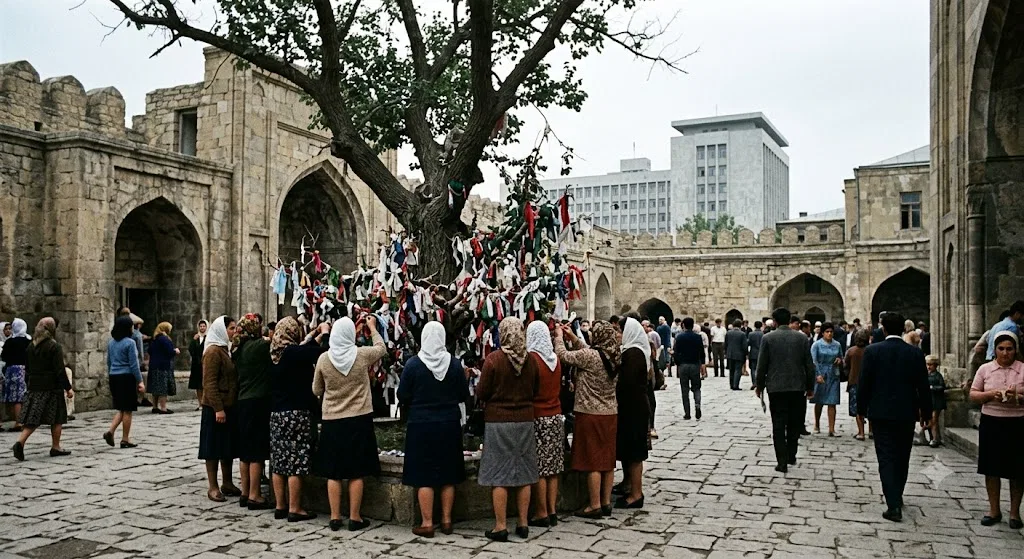
The campaign was especially disruptive because religion in Azerbaijan was not confined to formal mosque attendance. Shrines, family observances, mourning rituals and visits to the graves of revered figures could preserve religious identity even when official institutions were closed or tightly controlled. Anthropological research describes rural sacred places as durable centres of authority during periods when mosques, churches and synagogues were destroyed, closed or repurposed across the Soviet world.[Cambridge University Press & Assessment]cambridge.orgCambridge University Press & AssessmentShrines and Sovereigns: Life, Death, and Religion in Rural…by B Grant · 2011 · Cited by 62 — Ye…
The language of superstition concealed a deeper political issue. A shrine where people sought healing, fertility, protection or relief from misfortune might look irrational to an atheist official, but to visitors it could also provide continuity, social support and a connection to family history. Treating all such practice as deception or backwardness made it easier to ignore what those places actually did for their communities.
Healing shrines: contagious belief without a panic
Sacred healing sites remain among Azerbaijan’s most visible forms of popular belief. Visitors may pray at graves, tie cloth to trees or railings, make vows, distribute food or seek help with illness and family problems. These customs combine formal Islamic devotion with local traditions that have developed over long periods. Reports describe hundreds of such sites, although there is no definitive national inventory.[chaikhana.media]chaikhana.mediaThe healing powers of Azerbaijan's shrinesThey have a long history in the country…Read more…
It would be misleading to call this a miracle panic. There is no single sudden wave of apparitions or cures that swept the country. The beliefs are persistent rather than explosive. They spread through family testimony, local reputation and stories of answered prayers, not through a short-lived national emergency.
Nor should healing claims be accepted as medical evidence merely because they are culturally important. Personal improvement after a shrine visit may reflect natural recovery, expectation, emotional relief, simultaneous treatment or selective memory. But the opposite error is also common: assuming that anyone visiting a sacred place is gullible or mentally unwell. Such visits may provide ritual structure, hope and companionship even when their supernatural claims cannot be verified.
These sites reveal a recurring tension in Azerbaijani public life. State institutions often favour an orderly, officially supervised version of religion, while lived religion is more mixed, local and difficult to regulate. The same practice can therefore be described as heritage, faith, folklore, fraud or dangerous superstition depending on who is speaking.
The making of “traditional” and “non-traditional” religion
Independent Azerbaijan is constitutionally secular, but the state does not simply leave religion alone. It registers communities, regulates religious literature and education, and distinguishes between forms of religion regarded as historically rooted and those considered foreign or “non-traditional”. Scholars describe this as a shift from Soviet suppression towards active management: the government promotes a controlled idea of religious tolerance while remaining wary of unsupervised networks and outside influence.[zois-berlin.de]zois-berlin.desecularism and islam new religious education in azerbaijansecularism and islam new religious education in azerbaijan
That distinction can carry the emotional force of a moral panic. “Traditional” usually implies familiar, loyal and culturally Azerbaijani. “Non-traditional” may suggest missionary intrusion, sectarian manipulation or covert political influence even when a community has not engaged in violence. Academic work on Protestant groups in Baku shows that these communities negotiate not only formal regulation but everyday questions about nationality, conversion and whether an Azerbaijani can authentically belong to a newer Christian movement.[NEW DIVERSITIES]newdiversities.mmg.mpg.deNEW DIVERSITIESEveryday Nationalism and Non-Traditional ChristianNEW DIVERSITIESEveryday Nationalism and Non-Traditional Christian
Jehovah’s Witnesses and Protestant churches have repeatedly been accused in official or media commentary of disturbing social harmony, spreading religious hostility or operating improperly. Forum 18 documented television allegations against the Greater Grace Church and Jehovah’s Witnesses that the communities themselves denied. Raids, fines, confiscation of literature and legal-registration disputes became recurring features of their relationship with the state.[forum18.org]forum18.orgOpen source on forum18.org.
The European Court of Human Rights later examined several Azerbaijani cases involving bans on Jehovah’s Witness literature and sanctions for distributing religious texts. In one case, authorities argued that publications were hostile towards other religions; the community replied that the passages had not caused complaints or disorder. The importance of these cases lies less in the theology than in the evidential threshold: how much proof of actual harm should be required before unpopular belief is restricted?[HUDOC]hudoc.echr.coe.intOpen source on coe.int.
Calling such groups “cults” would obscure the dispute. The term is commonly used by opponents to imply brainwashing, exploitation or hidden control, but those claims require evidence about conduct. A minority religion can be socially unpopular, intensive in its commitments or eager to recruit without necessarily being coercive.
Nardaran and the fear of religious extremism
The most consequential modern confrontation between the Azerbaijani state and an independent religious movement took place in Nardaran, a strongly religious settlement near Baku. For years, Nardaran had been associated with public piety, economic neglect, political protest and resistance to official control. Its religious life made it stand out in a country whose governing culture strongly emphasises secular order.
In November 2015, police raided a gathering involving the Movement for Muslim Unity and its leader, Taleh Bagirzade. The operation led to a gun battle in which seven people, including two police officers, were killed. Authorities said they had disrupted a group planning terrorist acts and mass disorder. Residents and supporters disputed the official portrayal and said the crackdown was directed against religious and political opposition. Further raids, arrests and long prison sentences followed.[RadioFreeEurope/RadioLiberty]rferl.orgOpen source on rferl.org.
Nardaran cannot responsibly be reduced either to a fabricated panic or to a simple story of the state defeating a cult. People died, weapons were reportedly present and the government had legitimate duties to investigate violence. At the same time, rights monitors argued that Azerbaijan increasingly used the language of extremism to suppress independent religious activity more generally. The 2015 law on religious extremism expanded the legal framework through which authorities could act against groups portrayed as threats to constitutional order.[emerald.com]emerald.comPublishing Muslim radicals face crackdown in AzerbaijanPublishing Muslim radicals face crackdown in Azerbaijan
The episode became a struggle over narrative. In the official account, Nardaran represented radical religion threatening stability. In the opposition account, “extremism” was a politically useful label applied to a movement with grievances about corruption, inequality and authoritarianism. Neither broad narrative settles the facts of every arrest or defendant. The case demonstrates how quickly religious identity, security policy and dissent can collapse into a single threatening category.
This is where the moral-panic framework is useful but limited. It encourages scrutiny of inflated language, symbolic enemies and disproportionate responses. It must not be used to pretend that no security risk existed. The fair question is whether evidence was assessed individually, courts were independent and peaceful associates were separated from those responsible for violence.
The Gülen scare arrives from Turkey
A second important episode was imported through Azerbaijan’s close political relationship with Turkey. The transnational movement founded by Turkish preacher Fethullah Gülen built schools, businesses and educational networks in many countries, including Azerbaijan. Supporters generally called it Hizmet and emphasised education, professional advancement and interfaith engagement. Critics described it as a disciplined network seeking influence within state and social institutions.[Hudson Institute]hudson.orgOpen source on hudson.org.
After the relationship between Gülen and Turkish president Recep Tayyip Erdoğan collapsed, Turkey accused the movement of operating a parallel state. Even before the failed Turkish coup of July 2016, Azerbaijan had begun closing or reorganising Gülen-linked educational institutions. Following the coup attempt, pressure intensified: Qafqaz University severed its connections with the movement, a linked newspaper faced action and other institutions were closed or transferred.[ecoi.net]ecoi.netOpen source on ecoi.net.
The movement’s history contains genuine reasons for scrutiny. It developed extensive, sometimes opaque networks, and Turkish officials accused adherents in the police, judiciary and military of acting in a coordinated political project. Gülen denied directing the coup, and disputes over responsibility have continued. Outside Turkey, however, the category of “Gülenist” could expand beyond proven conspirators to include teachers, journalists, students or people with only indirect institutional links.[reuters.com]reuters.comOpen source on reuters.com.
For Azerbaijan, the episode illustrates how a political scare crosses borders. A network once valued for schools and elite education was reinterpreted through the language of infiltration, betrayal and hidden loyalty. Institutions did not suddenly change their everyday appearance; the frame around them changed. This is a classic mechanism of moral panic, although the unresolved political questions make it more complicated than a wholly imaginary threat.
Rumour, ethnic fear and the Baku pogrom
The gravest Azerbaijani example of contagious fear is not principally religious. It emerged from the Armenian–Azerbaijani conflict at the end of the Soviet period, when territorial claims, forced displacement, atrocity stories and collapsing state authority created a highly combustible environment.
In January 1990, anti-Armenian violence erupted in Baku. A Helsinki Watch and Memorial investigation reported that a mass rally preceded the attacks and that the crowd was angered by an inaccurate claim, broadcast by megaphone, that an Armenian had killed and wounded Azerbaijanis. The report found that attackers later used lists of Armenian residents and addresses, suggesting that the violence was not simply an unplanned crowd reaction. It documented killings, assaults, rapes, apartment raids and robberies, while criticising the failure of Soviet and local security forces to intervene effectively.[Human Rights Watch]hrw.orgHuman Rights Watch
This distinction is essential. Rumour may have helped mobilise anger, but the pogrom should not be softened into “mass hysteria”. That phrase can make organised persecution sound like an involuntary psychological episode for which nobody was responsible. The available evidence points instead to political incitement, pre-existing ethnic hostility, selective information, crowd mobilisation and institutional failure.
The wider conflict produced fear and displacement on both sides, including violence against Azerbaijanis in Armenia and attacks on Armenians in several Azerbaijani cities. Recognising this broader history does not erase the identity of particular victims or turn all crimes into equivalent abstractions. It shows how reciprocal atrocity narratives can create a security dilemma in which each population treats the other’s continued presence as evidence of danger. Contemporary accounts emphasised that the weakening Soviet state had released disputes and grievances that had long been suppressed rather than resolved.[The New Yorker]newyorker.comroots 2roots 2
The episode remains culturally important because national memory often separates January 1990 into competing stories. Azerbaijanis chiefly remember the Soviet military assault of 20 January, in which civilians were killed as troops entered Baku. Armenians remember the preceding pogrom and the flight of Baku’s Armenian population. A responsible account must hold both forms of violence in view without using one to excuse the other.
Superstition, fortune-telling and modern social anxiety
Belief in fortune-telling, harmful magic and spiritual healing continues to surface in Azerbaijani public debate. Recent media discussions have called for stronger penalties against practitioners and, in some proposals, against clients who seek their services. Supporters of restrictions argue that alleged sorcerers exploit vulnerable people, intensify family disputes and obtain money through deception. Some politicians have also linked such practices to social decline or religious radicalisation.[medianews.az]medianews.azThose who go to fortune tellers and witches will be finedThose who go to fortune tellers and witches will be fined
Fraud and coercion are legitimate concerns. A person who claims supernatural power in order to extract money, frighten a family or interfere with medical treatment may cause real harm. But laws aimed at deception should distinguish demonstrable conduct from private belief. Criminalising the idea of magic itself risks reviving the logic of a witch panic: the state appears to validate supernatural danger while punishing those associated with it.
The public language around fortune-tellers also reveals class and gender tensions. Practitioners and clients are often portrayed as uneducated, irrational or morally weak. Yet people commonly turn to divination during illness, relationship breakdown, unemployment or uncertainty—situations in which formal institutions may seem remote or unhelpful. Condemnation alone does little to explain why the services remain attractive.
What Azerbaijan’s record really shows
Azerbaijan’s history is best understood not as a catalogue of bizarre collective delusions but as a repeated contest over fear, legitimacy and social control.
Several patterns recur:
- Political authorities define acceptable belief. Soviet officials opposed religion in the name of atheism; the independent state more often promotes supervised “traditional” religion while restricting unsanctioned activity.
- Foreignness magnifies suspicion. Protestant missionaries, Jehovah’s Witnesses, Iranian-influenced Shiite networks and the Turkish Gülen movement have all been discussed through anxieties about outside control.
- Real threats and exaggerated categories coexist. Extremist violence and political conspiracy are possible, but broad labels can sweep in peaceful believers, relatives, readers or former students.
- Rumour is most dangerous when institutions fail. The Baku pogrom shows how an alarming false report can operate within an already organised environment of hostility, mobilisation and official inaction.
- Popular belief survives suppression. Sacred shrines and healing traditions endured Soviet atheism because they served emotional, communal and cultural functions that propaganda could not simply remove.
The main lesson is methodological. “Cult”, “sect”, “superstition”, “extremism” and “mass hysteria” are not neutral descriptions. Each can direct attention towards particular dangers while hiding others. A credible account asks who applied the label, what specific behaviour occurred, what evidence was produced, whether alternative explanations were considered and who suffered when fear became policy.
In Azerbaijan, the most important panics have rarely been about impossible monsters or dramatic visions. They have centred on hidden loyalty: the fear that a neighbour, preacher, student, minority congregation or political dissenter secretly belongs to a threatening network. That fear has sometimes reflected genuine conflict. It has also repeatedly provided a language through which unfamiliar belief and independent organisation could be treated as dangers before their conduct was fairly judged.

Amazon book picks
Further Reading
Books and field guides related to When Belief Became a Public Threat. Use these as the next step if you want deeper reading beyond the article.
The Great Transformation
Explores how states shape society, useful context for belief, authority and public fear.
Imagined communities
Provides context for nationalism, identity and official narratives.

The Soviet century
Helps explain the ideological setting behind campaigns against religion.

Endnotes
1.
Source: hudson.org
Title: islamic revival in azerbaijan
Link:https://www.hudson.org/national-security-defense/islamic-revival-in-azerbaijan
Source snippet
Hudson InstituteIslamic Revival in Azerbaijan11 Nov 2008 — One of the first targets of Soviet anti-Islam strategy in Azerbaijan in the 19...
2.
Source: cambridge.org
Link:https://www.cambridge.org/core/journals/comparative-studies-in-society-and-history/article/shrines-and-sovereigns-life-death-and-religion-in-rural-azerbaijan/B6F0E04567FD4F4848E71E5324D8232E
Source snippet
Cambridge University Press & AssessmentShrines and Sovereigns: Life, Death, and Religion in Rural...by B Grant · 2011 · Cited by 62 — Ye...
3.
Source: chaikhana.media
Title: The healing powers of Azerbaijan’s shrines
Link:https://chaikhana.media/en/stories/722/the-healing-powers-of-azerbaijans-shrines
Source snippet
They have a long history in the country...Read more...
4.
Source: eurasianet.org
Link:https://eurasianet.org/azerbaijan-religious-shrines-attracting-faithful
Source snippet
Azerbaijan: Religious Shrines Attracting Faithful27 Apr 2011 — The veneration of shrines honoring holy men is a key feature of...
5.
Source: zois-berlin.de
Title: secularism and islam new religious education in azerbaijan
Link:https://www.zois-berlin.de/en/publications/zois-spotlight/archiv-2019/secularism-and-islam-new-religious-education-in-azerbaijan
6.
Source: newdiversities.mmg.mpg.de
Title: NEW DIVERSITIESEveryday Nationalism and Non-Traditional Christian
Link:https://newdiversities.mmg.mpg.de/wp-content/uploads/2022/01/2021_23-02_04_Aliyeva.pdf
7.
Source: forum18.org
Link:https://www.forum18.org/archive.php?article_id=244
8.
Source: refworld.org
Link:https://www.refworld.org/reference/annualreport/usdos/2009/en/70387
9.
Source: ecoi.net
Link:https://www.ecoi.net/en/document/2111661.html
10.
Source: emerald.com
Title: Publishing Muslim radicals face crackdown in Azerbaijan
Link:https://www.emerald.com/insight/content/doi/10.1108/oxan-db207143
11.
Source: uprdoc.ohchr.org
Link:https://uprdoc.ohchr.org/uprweb/downloadfile.aspx?file=EnglishTranslation&filename=4880
12.
Source: refworld.org
Link:https://www.refworld.org/reference/annualreport/uscirf/2017/116560
13.
Source: hudson.org
Link:https://www.hudson.org/node/37210
14.
Source: reuters.com
Link:https://www.reuters.com/world/us/turkish-us-based-cleric-gulen-has-died-media-says-2024-10-21/
15.
Source: ecoi.net
Link:https://www.ecoi.net/en/document/274142
16.
Source: eurasianet.org
Title: azerbaijan marching lockstep turkey cracking down gulen
Link:https://eurasianet.org/azerbaijan-marching-lockstep-turkey-cracking-down-gulen
17.
Source: hrw.org
Title: Human Rights Watch
Link:https://www.hrw.org/reports/pdfs/u/ussr/ussr915.pdf
18.
Source: medianews.az
Title: Those who go to fortune tellers and witches will be fined
Link:https://medianews.az/en/falci-ve-caduger-yanina-gedenler-cerimelenecek
19.
Source: medianews.az
Title: cadu piti eden de cezalansin etdiren de
Link:https://medianews.az/en/cadu-piti-eden-de-cezalansin-etdiren-de
20.
Source: state.gov
Link:https://www.state.gov/report/custom/3c94c53251-2
21.
Source: state.gov
Link:https://www.state.gov/reports/2022-report-on-international-religious-freedom/azerbaijan
22.
Source: 2021-2025.state.gov
Link:https://2021-2025.state.gov/reports/2016-report-on-international-religious-freedom/azerbaijan/
23.
Source: uprdoc.ohchr.org
Link:https://uprdoc.ohchr.org/uprweb/downloadfile.aspx?file=EnglishTranslation&filename=5310
24.
Source: tbinternet.ohchr.org
Title: Download Draft.aspx
Link:https://tbinternet.ohchr.org/_layouts/15/TreatyBodyExternal/DownloadDraft.aspx?key=RtRD01XC4gjf1IxT9pqjGsJPSEsvytHE4SrUhOYHazP8dy09KaXi3rZIOo%2Fsc%2FZ+
25.
Source: tbinternet.ohchr.org
Link:https://tbinternet.ohchr.org/_layouts/15/TreatyBodyExternal/DownloadDraft.aspx?key=rW4NuKKgp%2FKIWeFigTHUtIBrI3iIkCpjg4LfBI0+ifKiG8E8mhb3RMpykrR+Tfk4
26.
Source: history.com
Title: what was satanic panic 1980s
Link:https://www.history.com/articles/what-was-satanic-panic-1980s
27.
Source: azerbaijan.az
Link:https://azerbaijan.az/en/information/108
28.
Source: eurasianet.org
Title: azerbaijan evaluating bakus attitude toward the gulen movement
Link:https://eurasianet.org/azerbaijan-evaluating-bakus-attitude-toward-the-gulen-movement
29.
Source: ecoi.net
Link:https://www.ecoi.net/en/document/2012180.html
30.
Source: visions.az
Title: Dreams are Coming True in Azerbaijan
Link:https://www.visions.az/en/news/766/44d5c0c2/
31.
Source: sciencespo.fr
Title: soviet rule islam and azerbaijan
Link:https://www.sciencespo.fr/ceri/en/news/soviet-rule-islam-and-azerbaijan/
Source snippet
Sciences PoSoviet rule, Islam and Azerbaijan.2 Oct 2024 — Yet in the beginning, the Soviets did not show open hostility toward Islam in p...
32.
Source: bakuresearchinstitute.org
Title: the campaign against religion and the promotion of atheism in the soviet union
Link:https://bakuresearchinstitute.org/en/the-campaign-against-religion-and-the-promotion-of-atheism-in-the-soviet-union/
Source snippet
Baku Research InstituteThe Campaign Against Religion and the Promotion of...22 Sept 2025 — Moreover, in Azerbaijan there persists a perc...
33.
Source: jordanrussiacenter.org
Link:https://jordanrussiacenter.org/blog/the-boundaries-of-religious-freedom-transformation-of-state-religion-relations-in-azerbaijan
34.
Source: hudoc.echr.coe.int
Link:https://hudoc.echr.coe.int/eng?i=001-201087
35.
Source: hudoc.echr.coe.int
Title: HUDOCNASIROV AND OTHERS v. AZERBAIJAN
Link:https://hudoc.echr.coe.int/fre?i=001-201088
36.
Source: hudoc.echr.coe.int
Title: HUDOCTAGIYEV AND OTHERS v. AZERBAIJAN
Link:https://hudoc.echr.coe.int/fre?i=001-206116
37.
Source: rferl.org
Link:https://www.rferl.org/a/azerbaijan-nardaran-raid/27400436.html
38.
Source: rferl.org
Link:https://www.rferl.org/a/azerbaijan-nardaran-case-another-group-jailed/28944008.html
39.
Source: apnews.com
Link:https://apnews.com/article/d41050930ec515ce8291fd91c84b25a6
40.
Source: newyorker.com
Link:https://www.newyorker.com/magazine/2016/10/17/turkeys-thirty-year-coup
41.
Source: newyorker.com
Title: roots 2
Link:https://www.newyorker.com/magazine/1991/04/15/roots-2
42.
Source: Wikipedia
Title: Mass psychogenic illness
Link:https://en.wikipedia.org/wiki/Mass_psychogenic_illness
43.
Source: Wikipedia
Title: Baku pogrom
Link:https://en.wikipedia.org/wiki/Baku_pogrom
44.
Source: hudoc.echr.coe.int
Link:https://hudoc.echr.coe.int/eng?i=001-204942
45.
Source: hudoc.echr.coe.int
Link:https://hudoc.echr.coe.int/eng?i=001-200434
46.
Source: hudoc.echr.coe.int
Title: int ALAKBARO V AND OTHERS v. AZERBAIJAN
Link:https://hudoc.echr.coe.int/eng?i=001-210328
47.
Source: hudoc.echr.coe.int
Title: int ACHMADO V AND BAGUROVA v. SWEDEN
Link:https://hudoc.echr.coe.int/fre?i=001-82113
48.
Source: ks.echr.coe.int
Title: int Article 9
Link:https://ks.echr.coe.int/web/echr-ks/article-9-all-updates
49.
Source: hudoc.echr.coe.int
Link:https://hudoc.echr.coe.int/eng?i=001-216366
50.
Source: hudoc.echr.coe.int
Link:https://hudoc.echr.coe.int/app/conversion/pdf/?filename=Judgments+and+decisions+of.02.2020.pdf&id=003-6644397-8826922&library=ECHR
51.
Source: sajp.org.za
Link:https://sajp.org.za/index.php/sajp/article/view/1671/2648
52.
Source: sciencespo.hal.science
Title: 2026 goyushov article OIR bulletin 59
Link:https://sciencespo.hal.science/hal-05657785/file/2026_goyushov_article_OIR_bulletin-59.pdf
53.
Source: sciencespo.fr
Title: analysing azerbaijan how can a secular state manage a revival of religion
Link:https://www.sciencespo.fr/recherche/en/news/analysing-azerbaijan-how-can-a-secular-state-manage-a-revival-of-religion/
54.
Source: conference.sciencespo.fr
Link:https://conference.sciencespo.fr/content/2024-10-25/analysing-azerbaijan-how-can-a-secular-state-manage-a-revival-of-religion_na6QGpcEuKkKPPKdVFwW
Additional References
55.
Source: youtube.com
Link:http://www.youtube.com/watch?v=dLIUsfgS8N0
Source snippet
An Islamic revival in Azerbaijan: The Road to Hajj | Featured Documentary...
56.
Source: youtube.com
Title: VILLAGE HIGHLIGHTS TROUBLED LINKS BETWEEN NEIGHBOURS
Link:http://www.youtube.com/watch?v=zOyS0M0yKHU
Source snippet
Azerbaijan Blocks Protestant Church Registrations, Highlights Worsening Religious Climate for Christ...
57.
Source: youtube.com
Link:http://www.youtube.com/watch?v=jzdlakG7e0c
Source snippet
Nardaran Azerbaijan clashes Security Forces Seal Off Restive Azerbaijani Village Of Nardaran Radio Free Europe/Radio Liberty...
58.
Source: uscirf.gov
Link:https://www.uscirf.gov/sites/default/files/2025-08/2025%20Azerbaijan%20Country%20Update.pdf
59.
Source: youtube.com
Title: Security Forces Seal Off Restive Azerbaijani Village Of Nardaran
Link:http://www.youtube.com/watch?v=Bu8KEvKMjUg
Source snippet
VILLAGE HIGHLIGHTS TROUBLED LINKS BETWEEN NEIGHBOURS...
60.
Source: academia.edu
Link:https://www.academia.edu/38990185/ANAR_AL%C4%B0ZADE_CHRISTIANITY_IN_AZERBAIJAN_FROM_PAST_TO_PRESENT
61.
Source: academia.edu
Link:https://www.academia.edu/1118433/Azerbaijan_Islam_in_a_post_soviet_republic
62.
Source: researchgate.net
Link:https://www.researchgate.net/publication/268694182_Outbreak_of_Mass_Psychogenic_Illness_at_a_High_School_Amhara_Region_Ethiopia_April_2010
63.
Source: historysnob.com
Link:https://www.historysnob.com/war-and-historical-events/20-famous-examples-of-moral-panic
64.
Source: littleatoms.com
Link:https://littleatoms.com/article/azerbaijan-attacks-gulen-movement-ahead-referendum
Topic Tree
Follow this branch
Related pages 192
- Antigua and Barbuda
- Argentina Belief Scares
- Bahrain Beliefs
- North Korea
- Bosnia and Herzegovina
- +187 more in sidebar