Within Malaysia
Why Malaysia Banned the Al Arqam Movement
The rise and banning of Al-Arqam shows how religious authority, political power and public fear shaped Malaysia's treatment of unusual movements.
On this page
- From study circle to national network
- Why authorities classified the movement as deviant
- What the crackdown reveals about religious power
Page outline Jump by section
Introduction
The Al-Arqam movement occupies a distinctive place in Malaysia’s modern religious history because it was not simply a small fringe group. Beginning as an Islamic study circle, it developed into a large communal network with schools, farms, businesses and international links before being banned by Malaysian authorities in 1994. The case illustrates how questions of religious authority, state power and public concern became closely intertwined. For supporters, Al-Arqam represented an attempt to build a disciplined Islamic way of life. For Malaysia’s religious authorities, however, some of its teachings challenged accepted Sunni doctrine and the state’s authority to define religious orthodoxy. The resulting crackdown became one of the country’s most influential examples of how governments respond to movements labelled “deviant”, and it continues to shape debates over religious regulation today.[Cambridge University Press & Assessment]cambridge.orgCambridge University Press & AssessmentLegal-Bureaucratic Islam in Malaysia: Homogenizing and Ringfencing the Muslim Subject (Chapter 5)…
From study circle to national network
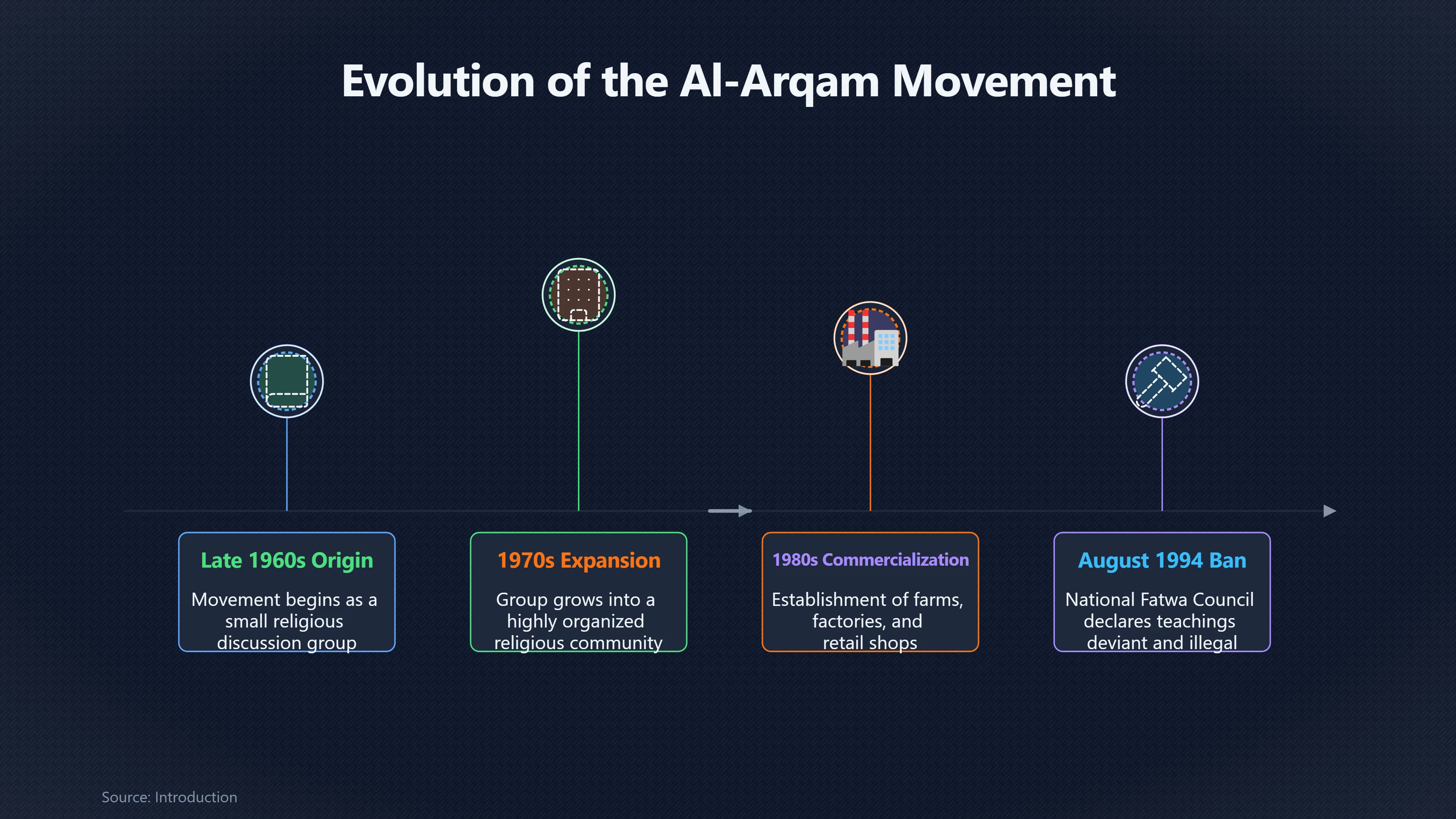
Al-Arqam was founded in the late 1960s by Ashaari Muhammad, initially as a religious discussion group. During the 1970s and especially the 1980s, it expanded far beyond a study circle into a highly organised religious community. Members established farms, factories, restaurants, retail shops, publishing houses, schools, clinics and manufacturing companies, aiming to create a self-sufficient Islamic society that reduced dependence on mainstream economic structures. Estimates of its following varied widely, ranging from around 10,000 to many tens of thousands of supporters.[Taylor & Francis Online]tandfonline.comTaylor & Francis OnlineIslamization in Malaysia: processes and dynamics: Contemporary Politics: Vol 16, No 2May 21, 2010…
Its economic success helped distinguish Al-Arqam from many other revivalist movements. Rather than existing only as a preaching organisation, it created a recognisable commercial network whose businesses became familiar to many Malaysians. Members often wore distinctive clothing, lived communally and promoted a shared religious identity that reinforced loyalty to the movement. Academic studies note that its appeal extended beyond rural communities to professionals, civil servants, doctors, teachers and university graduates, reflecting wider Islamic revival trends during the 1970s and 1980s.[Taylor & Francis Online]tandfonline.comTaylor & Francis OnlineIslamization in Malaysia: processes and dynamics: Contemporary Politics: Vol 16, No 2May 21, 2010…
The movement’s rapid growth also made it increasingly visible to both political leaders and state religious institutions. As Malaysia expanded its own Islamic bureaucracy during the same period, Al-Arqam represented an influential religious network operating partly outside official structures. That institutional context would become central to its eventual suppression.[Cambridge University Press & Assessment]cambridge.orgCambridge University Press & AssessmentLegal-Bureaucratic Islam in Malaysia: Homogenizing and Ringfencing the Muslim Subject (Chapter 5)…
Why authorities classified the movement as deviant
The prohibition of Al-Arqam did not rest simply on its communal lifestyle or business empire. Malaysian religious authorities argued that certain teachings promoted by Ashaari Muhammad departed from accepted Sunni Islam. Among the most controversial claims were beliefs surrounding the spiritual status of the founder and millenarian expectations connected with Islamic renewal. Authorities concluded that these doctrines contradicted recognised religious teaching and risked misleading Muslim believers.[Kokugakuin University]www2.kokugakuin.ac.jpKokugakuin University RMA Newsletter: NewsKokugakuin UniversityRMA Newsletter: News - Islamic Cult Banned in Malaysia (Malaysia, Dec 1, 1994)…
Malaysia’s National Fatwa Council declared the movement’s teachings deviant in August 1994. Soon afterwards, the government banned Al-Arqam under the Societies Act. Security agencies also treated the organisation as a potential threat to public order, arguing that its organisational strength and religious authority could undermine state institutions. Ashaari Muhammad and several senior leaders were detained under the Internal Security Act (ISA), which at the time permitted detention without trial on security grounds.[kokugakuin.ac.jp]www2.kokugakuin.ac.jpKokugakuin University RMA Newsletter: NewsKokugakuin UniversityRMA Newsletter: News - Islamic Cult Banned in Malaysia (Malaysia, Dec 1, 1994)…
The crackdown extended beyond organisational prohibition. Hundreds of members were questioned or arrested, publications were seized, and followers faced pressure to renounce the movement’s teachings publicly. Amnesty International criticised the use of preventive detention, noting that it had found no evidence that Al-Arqam had advocated or used violence. This distinction remains important: the government’s case centred primarily on alleged religious deviation and security concerns rather than accusations of armed rebellion.[Refworld]refworld.orgAmnesty International Report 1995 - Malaysia | Refworld…
Why the ban was about more than theology
The Al-Arqam episode is often interpreted through two overlapping but distinct lenses.
The first concerns religious doctrine. Malaysia’s constitutional system gives state Islamic authorities significant responsibility for regulating Islamic teaching among Muslims. Once official fatwa bodies determined that Al-Arqam’s doctrines lay outside accepted Sunni belief, legal action became much easier to justify within Malaysia’s religious framework.[UUM Repository]repo.uum.edu.myUUM RepositorySejarah ajaran sesat di Malaysia: analisis terhadap faktor-faktor kemunculan dan langkah-langkah menangani = The history of…
The second concerns political authority. Scholars argue that the movement emerged during a period when the Malaysian state was expanding its own Islamic institutions and seeking greater control over religious life. Al-Arqam’s combination of charismatic leadership, economic independence and extensive membership created an alternative source of religious authority that officials increasingly regarded as incompatible with that project. Rather than viewing the ban solely as a response to disputed theology, many researchers see it as part of a broader process in which the state consolidated its position as the principal arbiter of Islamic legitimacy.[Cambridge University Press & Assessment]cambridge.orgCambridge University Press & AssessmentLegal-Bureaucratic Islam in Malaysia: Homogenizing and Ringfencing the Muslim Subject (Chapter 5)…
These explanations are not mutually exclusive. Religious concerns and political considerations reinforced one another, making Al-Arqam a defining example of how doctrinal disputes and state governance became intertwined in modern Malaysia.
What the crackdown reveals about religious power
The Al-Arqam case illustrates several broader features of Malaysia’s approach to religious movements.
Official religious authority carries legal weight. Once a movement is declared deviant by recognised Islamic authorities, that judgment can lead to restrictions on publications, organisations and public preaching.
Economic success does not shield a movement from intervention. Al-Arqam’s commercial achievements arguably increased official concern because they strengthened the movement’s organisational independence.
Security laws became part of religious regulation. The use of the Internal Security Act demonstrated that authorities framed the issue not only as a theological dispute but also as one involving national stability and public order.[Refworld]refworld.orgAmnesty International Report 1995 - Malaysia | Refworld…
Public perception was shaped by state messaging. Official statements frequently described the movement as dangerous or misleading, encouraging many Malaysians to associate “deviant teachings” with wider risks to social harmony. That language became influential in later public discussions about other religious groups.
Legacy and continuing influence
Although Al-Arqam itself was dismantled, its legacy did not disappear. Former members later became involved in successor organisations, including Rufaqa Corporation and, later, Global Ikhwan Services and Business Holdings (GISB). Authorities repeatedly argued that these organisations preserved elements of Al-Arqam’s teachings, while the organisations themselves denied reviving the banned movement in the form alleged by the government.[Refworld]refworld.orgUSCIRF Annual Report 2008 - Malaysia | RefworldMay 1, 2008…
In 2024, investigations into GISB over allegations including child abuse, labour exploitation and financial offences renewed public attention to Al-Arqam’s history because of acknowledged historical links between the businesses and the original movement. Those criminal investigations are legally distinct from the 1994 ban, but they revived debate about how successor organisations developed after the original crackdown and whether earlier concerns had been adequately addressed.[Reuters]reuters.comAuthorities rescued hundreds of children and youths suspected of being abused, bringing attention to the firm's association with the bann…
For historians and scholars of religion, Al-Arqam remains significant because it demonstrates that not every movement labelled a “cult” or “deviant sect” fits the same pattern. It was neither simply a moral panic nor merely a theological disagreement. Instead, it sat at the intersection of charismatic leadership, communal religious life, economic organisation, state-building and the institutional regulation of Islam. Understanding that combination helps explain why the movement continues to occupy such an important place in Malaysia’s social and religious history.


Endnotes
1.
Source: cambridge.org
Link:https://www.cambridge.org/core/books/abs/encountering-islam/legalbureaucratic-islam-in-malaysia-homogenizing-and-ringfencing-the-muslim-subject/A8C783BF2BCE97D47FE04E90F70076AF
Source snippet
Cambridge University Press & AssessmentLegal-Bureaucratic Islam in Malaysia: Homogenizing and Ringfencing the Muslim Subject (Chapter 5)...
2.
Source: refworld.org
Link:https://www.refworld.org/reference/annualreport/amnesty/1995/en/23467
Source snippet
Amnesty International Report 1995 - Malaysia | Refworld...
3.
Source: refworld.org
Link:https://www.refworld.org/reference/annualreport/uscirf/2008/en/59301
Source snippet
USCIRF Annual Report 2008 - Malaysia | RefworldMay 1, 2008...
Published: May 1, 2008
4.
Source: reuters.com
Link:https://www.reuters.com/world/asia-pacific/alleged-child-abuse-case-puts-banned-malaysian-sect-back-spotlight-2024-09-14/
Source snippet
Authorities rescued hundreds of children and youths suspected of being abused, bringing attention to the firm's association with the bann...
5.
Source: reuters.com
Link:https://www.reuters.com/world/asia-pacific/malaysia-charges-22-people-linked-islamic-firm-gisb-with-organised-crime-2024-10-23/
Source snippet
Authorities are investigating the firm for alleged money laundering, human trafficking, and sexual offenses against children, following t...
6.
Source: cambridge.org
Link:https://www.cambridge.org/core/services/aop-cambridge-core/content/view/A8C783BF2BCE97D47FE04E90F70076AF/9789814379939c5_p103-132_CBO.pdf/legalbureaucratic_islam_in_malaysia_homogenizing_and_ringfencing_the_muslim_subject.pdf
7.
Source: refworld.org
Link:https://www.refworld.org/reference/annualreport/usdos/2007/en/49173
8.
Source: amnesty.org
Link:https://www.amnesty.org/en/documents/asa28/008/1994/en/
9.
Source: amnesty.org
Link:https://www.amnesty.org/ar/documents/asa28/008/1994/en/
10.
Source: repo.uum.edu.my
Link:https://repo.uum.edu.my/id/eprint/32712/
Source snippet
UUM RepositorySejarah ajaran sesat di Malaysia: analisis terhadap faktor-faktor kemunculan dan langkah-langkah menangani = The history of...
11.
Source: tandfonline.com
Link:https://www.tandfonline.com/doi/abs/10.1080/13569771003783851
Source snippet
Taylor & Francis OnlineIslamization in Malaysia: processes and dynamics: Contemporary Politics: Vol 16, No 2May 21, 2010...
Published: May 21, 2010
12.
Source: www2.kokugakuin.ac.jp
Title: Kokugakuin University RMA Newsletter: News
Link:https://www2.kokugakuin.ac.jp/ijcc/asia-nl/news/news000040.html
Source snippet
Kokugakuin UniversityRMA Newsletter: News - Islamic Cult Banned in Malaysia (Malaysia, Dec 1, 1994)...
13.
Source: tandfonline.com
Link:https://www.tandfonline.com/doi/abs/10.1080/0951274042000233332
Additional References
14.
Source: youtube.com
Link:https://www.youtube.com/watch?v=2tOmg5A24zg
Source snippet
5 Life inside Al-Arqam: A former member describes what it's like to grow up in a banned Islamic sect...
15.
Source: youtube.com
Title: [Special Report] A look at the history of GISBH, Al-Arqam and Abuya
Link:https://www.youtube.com/watch?v=4pXZ3q_WelI
Source snippet
4 Beaten and raped 4-5 times a day: Former GISB member on life in the cult-linked group...
16.
Source: youtube.com
Title: Al-Arqam: deviant sect or political threat?
Link:https://www.youtube.com/watch?v=QMfEJikrrKU
Source snippet
3 [Special Report] A look at the history of GISBH, Al-Arqam and Abuya...
17.
Source: muftiselangor.gov.my
Link:https://www.muftiselangor.gov.my/category/keputusan-fatwa-diwartakan/page/20/
18.
Source: muftiselangor.gov.my
Link:https://www.muftiselangor.gov.my/2023/10/28/pindaan-fatwa-tentang-fahaman-dan-ajaran-yang-dipegang-oleh-kumpulan-al-arqam-pimpinan-haji-ashaari-muhammad/
19.
Source: said.johor.gov.my
Link:https://said.johor.gov.my/perkhidmatan/paparan_detail_fatwa.php?id=1549
20.
Source: emusykil.muftiselangor.gov.my
Link:https://emusykil.muftiselangor.gov.my/index.php/site/jawapan?id=2523
21.
Source: emusykil.muftiselangor.gov.my
Link:https://emusykil.muftiselangor.gov.my/index.php/site/jawapan?id=3809
22.
Source: youtube.com
Title: The Malaysian Government’s Tight Control on Religion
Link:https://www.youtube.com/watch?v=G3GG43JsSQE
Source snippet
2 Al-Arqam: deviant sect or political threat?...
23.
Source: rmp.gov.my
Link:https://www.rmp.gov.my/arkib-berita/keratan-akhbar/2024/10/29/update-keratan-akhbar-pilihan-wanita-mengaku-tak-bersalah-miliki-bahan-berkaitan-al-arqam
Topic Tree