Within Germany's Strange Panics
How Germany's Witch Hunts Became So Deadly
Germany's worst witch hunts grew through torture, forced accusations and courts that treated imagined conspiracy as proven fact.
On this page
- Why trials spread unevenly across German territories
- How torture and forced naming multiplied cases
- Victims, executions and the collapse of legal restraint
Page outline Jump by section
Introduction
Germany’s witch hunts became some of the deadliest in European history not because belief in witchcraft was uniquely German, but because many early modern German territories combined fear of diabolical conspiracy with legal systems that encouraged torture, forced confessions and repeated accusations. Between the late sixteenth and mid-seventeenth centuries, thousands of people were executed across the fragmented states of the Holy Roman Empire, although neighbouring jurisdictions often experienced dramatically different levels of persecution. Modern historians argue that these were not spontaneous outbreaks of mass hysteria. They were judicial processes in which courts, rulers and local elites transformed rumour into criminal evidence, allowing one accusation to generate many more until entire communities were caught in self-perpetuating hunts.[oup.com]academic.oup.comOUP AcademicThe German Witch Trials | The Oxford Handbook of Witchcraft in Early Modern Europe and Colonial America | Oxford AcademicMay…
Why trials spread unevenly across German territories
The German lands formed the political core of the Holy Roman Empire, a patchwork of hundreds of principalities, bishoprics, imperial cities and lordships. Each territory controlled its own courts and criminal procedure. This fragmented political landscape helps explain why Germany became the centre of Europe’s witch persecutions while neighbouring communities sometimes escaped with relatively few trials.
Historians estimate that between 30,000 and 45,000 of Europe’s roughly 90,000 known witchcraft prosecutions took place in the German lands, with perhaps 22,000 to 30,000 executions. Yet these totals conceal enormous regional variation. Some territories pursued only a handful of cases, while others experienced devastating waves of executions.[OUP Academic]academic.oup.comOUP AcademicThe German Witch Trials | The Oxford Handbook of Witchcraft in Early Modern Europe and Colonial America | Oxford AcademicMay…
Several factors influenced whether persecutions escalated:
- Political fragmentation. Local rulers could pursue aggressive prosecutions without interference from a strong central authority.
- Judicial autonomy. Some courts adopted exceptionally harsh procedures, while neighbouring jurisdictions imposed stricter evidential standards.
- Religious conflict. Both Catholic and Protestant territories conducted witch trials. Confessional rivalry intensified anxiety in many regions, but no single denomination can explain the pattern on its own.
- Periods of crisis. Crop failures, disease, war and economic hardship encouraged communities to seek human causes for misfortune, making accusations more persuasive during times of stress.[history.org.uk]history.org.ukwhy did regional variations exist in the prosecutiHistorical AssociationWhy did regional variations exist in the prosecution of witches between 1580-1650 / Historical Association…
The most notorious centres included the prince-bishoprics of Würzburg and Bamberg during the 1620s and 1630s, where prosecutions reached extraordinary levels. Elsewhere, however, rulers actively restrained witch trials or demanded stronger legal evidence, preventing similar panics from taking hold.[Historical Association]history.org.ukwhy did regional variations exist in the prosecutiHistorical AssociationWhy did regional variations exist in the prosecution of witches between 1580-1650 / Historical Association…
How torture and forced naming multiplied cases
The defining mechanism behind Germany’s largest witch hunts was not simply belief in witches but the way legal procedure produced new suspects.
Early modern courts frequently treated witchcraft as an exceptional crime requiring extraordinary methods of investigation. Under inquisitorial criminal procedure, judges sought confessions, and torture could be authorised when sufficient preliminary suspicion existed. Once torture began, accused people were expected not only to confess but also to identify accomplices.
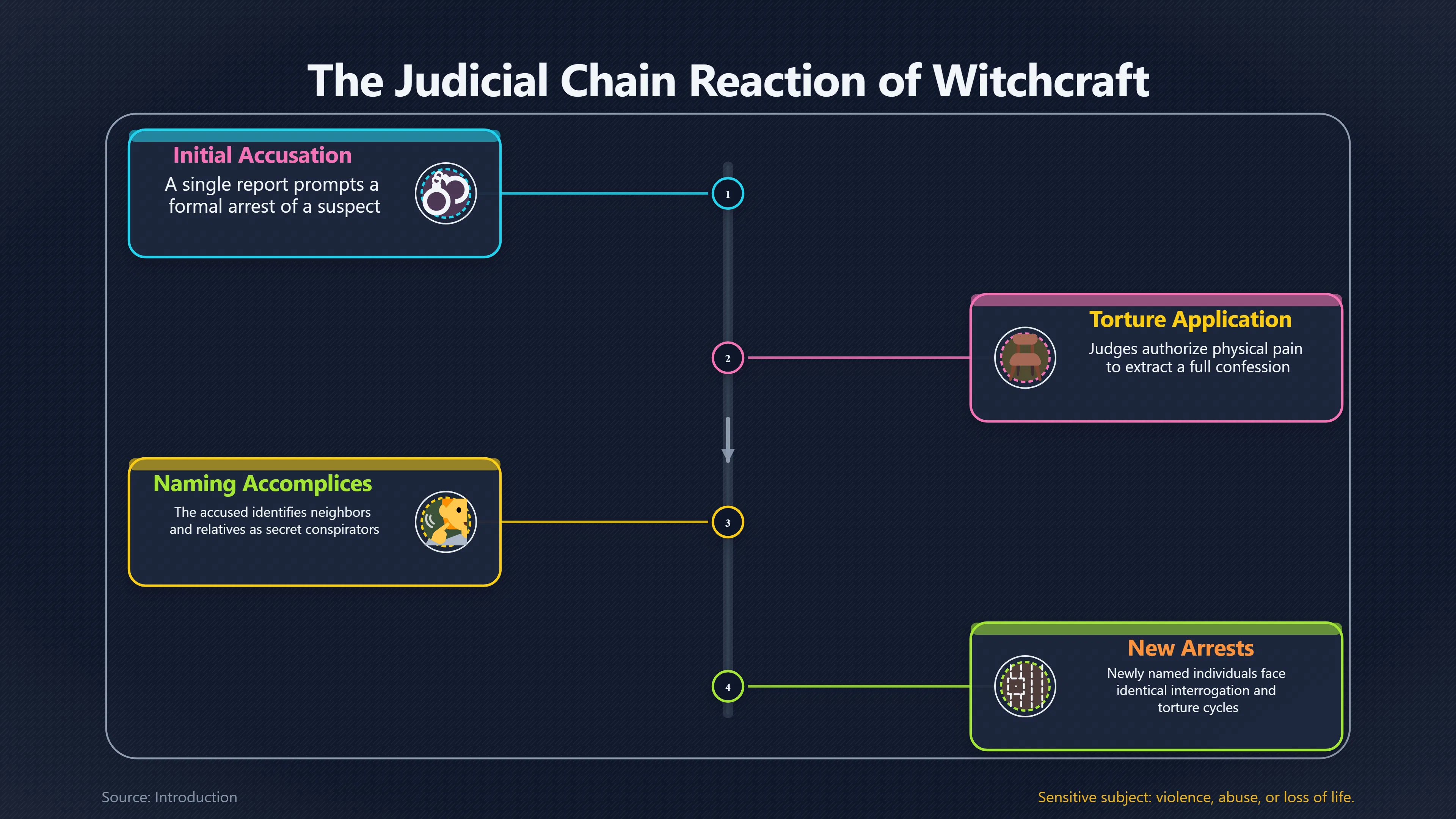
This created a destructive chain reaction.
A prisoner under unbearable pain might admit attending imaginary gatherings with the Devil and provide the names of neighbours, relatives or local officials. Those newly accused individuals were then arrested, interrogated and tortured in turn. Each confession expanded the supposed conspiracy, convincing authorities that the growing number of accusations proved the existence of a vast network rather than exposing the unreliability of evidence extracted under torture.[history.org.uk]history.org.ukwhy did regional variations exist in the prosecutiHistorical AssociationWhy did regional variations exist in the prosecution of witches between 1580-1650 / Historical Association…
Instead of ending investigations, confessions fuelled them. Entire communities became trapped in cycles where:
- A single accusation prompted an arrest.
- Torture produced a confession.
- The confession identified additional “witches”.
- New arrests generated further confessions.
- Courts interpreted the expanding list of suspects as confirmation that the conspiracy was real.
Modern historians describe this as one reason some German territories experienced explosive “chain-reaction” persecutions while others did not. The judicial process itself continually manufactured new evidence.[Historical Association]history.org.ukwhy did regional variations exist in the prosecutiHistorical AssociationWhy did regional variations exist in the prosecution of witches between 1580-1650 / Historical Association…
Victims, executions and the collapse of legal restraint
Women formed the majority of victims, particularly older women, widows and those already living on the margins of village society. However, German witch hunts also claimed large numbers of men and children. In the biggest persecutions, accusations spread so widely that social status provided little protection.
Officials, clergy, merchants, councillors and members of prominent families were sometimes arrested after appearing in earlier confessions. In places such as Bamberg, leading citizens were imprisoned and executed alongside poorer villagers, illustrating how rapidly legal restraint could disappear once authorities accepted the existence of a hidden conspiracy.[Cambridge University Press & Assessment]cambridge.orgCambridge University Press & AssessmentThe Persecution of Witches as Restoration of Order: The Case of Germany, 1590s–1650s | Central Eur…
The human cost extended far beyond those executed.
Families lost parents, children and property. Imprisonment often ruined households financially because prisoners had to pay many legal costs themselves. Communities endured years of fear in which ordinary disagreements, failed harvests, illness or unexplained deaths could become evidence of witchcraft. Trust between neighbours deteriorated as everyone recognised that one accusation might trigger many more.
Although exact numbers remain uncertain because records are incomplete, historians agree that the German territories suffered more executions than any other part of Europe and that the largest hunts represented catastrophic failures of criminal justice rather than isolated miscarriages of justice.[oup.com]academic.oup.comOUP AcademicThe German Witch Trials | The Oxford Handbook of Witchcraft in Early Modern Europe and Colonial America | Oxford AcademicMay…
Why the hunts eventually ended
The decline of the major German witch hunts was gradual rather than sudden.[youtube.com]youtube.comThe Horrors of the German Witch Hunts | Human Voiced, No AdsThe Horrific Prison Built for Witches in 1627…
Some rulers became alarmed by the widening circles of accusation and the damage inflicted on their territories. Appeals courts increasingly questioned convictions based on tortured confessions, while legal scholars criticised procedural abuses and demanded stronger standards of proof. As scepticism grew among judges and administrators, the chain reaction that had driven mass prosecutions became harder to sustain.
The experience demonstrated an important lesson: the most dangerous ingredient was not belief alone but institutions willing to treat coerced confessions as reliable evidence. Once courts became more cautious about torture, anonymous accusations and fantastical testimony, the largest witch hunts largely collapsed.[cambridge.org]cambridge.orgCambridge University Press & AssessmentThe Persecution of Witches as Restoration of Order: The Case of Germany, 1590s–1650s | Central Eur…
Why the German witch hunts still matter
The German witch hunts remain one of history’s clearest examples of how legal systems can amplify collective fear instead of restraining it.
Modern scholarship rejects older explanations that blamed simple superstition or irrational crowds. Instead, historians point to the interaction between local crises, religious tension, fragmented government and criminal procedures that rewarded confession over verification. The result was a self-reinforcing process in which imagined conspiracies appeared increasingly real because every interrogation generated more names.
Within Germany’s broader history of collective fears and moral panics, the witch hunts stand apart because they combined popular suspicion with state power. Their enduring significance lies not only in the thousands who died, but in the demonstration of how ordinary judicial institutions can become engines of persecution when safeguards against coerced evidence and contagious accusation break down.[oup.com]academic.oup.comOUP AcademicThe German Witch Trials | The Oxford Handbook of Witchcraft in Early Modern Europe and Colonial America | Oxford AcademicMay…

Amazon book picks
Further Reading
Books and field guides related to How Germany's Witch Hunts Became So Deadly. Use these as the next step if you want deeper reading beyond the article.
The witch-hunt in early modern Europe
Directly addresses the causes and spread of German witch hunts.


Endnotes
1.
Source: academic.oup.com
Link:https://academic.oup.com/edited-volume/34335/chapter-abstract/291369814
Source snippet
OUP AcademicThe German Witch Trials | The Oxford Handbook of Witchcraft in Early Modern Europe and Colonial America | Oxford AcademicMay...
2.
Source: cambridge.org
Link:https://www.cambridge.org/core/journals/central-european-history/article/abs/persecution-of-witches-as-restoration-of-order-the-case-of-germany-1590s1650s/7BBF4F4B7E804E4464DF4667FD5ED352
Source snippet
Cambridge University Press & AssessmentThe Persecution of Witches as Restoration of Order: The Case of Germany, 1590s–1650s | Central Eur...
3.
Source: academic.oup.com
Link:https://academic.oup.com/jsh/article-pdf/56/4/719/50501804/shac066.pdf
4.
Source: academic.oup.com
Link:https://academic.oup.com/edited-volume/34335/chapter-abstract/291369814?login=true
5.
Source: cambridge.org
Link:https://www.cambridge.org/core/journals/continuity-and-change/article/abs/devils-children-child-witchtrials-in-early-modern-germany/196AE61299E6FB7203FA863971A4CD63
6.
Source: cambridge.org
Link:https://www.cambridge.org/core/journals/continuity-and-change/article/devils-children-child-witchtrials-in-early-modern-germany/196AE61299E6FB7203FA863971A4CD63
7.
Source: history.org.uk
Title: why did regional variations exist in the prosecuti
Link:https://www.history.org.uk/publications/resource/626/why-did-regional-variations-exist-in-the-prosecuti
Source snippet
Historical AssociationWhy did regional variations exist in the prosecution of witches between 1580-1650 / Historical Association...
8.
Source: germanhistorydocs.org
Title: the bavarian witchcraft law 1611
Link:https://germanhistorydocs.org/en/from-the-reformations-to-the-thirty-years-war-1500-1648/the-bavarian-witchcraft-law-1611
Source snippet
German History in Documents and ImagesThe Bavarian Witchcraft Law (1611) | German History in Documents and Images...
9.
Source: politischeverfolgung.de
Title: witch hunts
Link:https://www.politischeverfolgung.de/en/witch-hunts/
Additional References
10.
Source: politischeverfolgung.de
Title: Strongholds of the Witch Hunts: Regional Centers of Persecution
Link:https://www.politischeverfolgung.de/en/witch-hunts/strongholds/
Source snippet
March 2026 * Witch Hunts Image: Strongholds of the Witch Hunts: Regional Centers of Persecution 1An illustrative image of a his...
Published: March 2026
11.
Source: encyclopedia.com
Title: Witch Trials, Europe | Encyclopedia.com
Link:https://www.encyclopedia.com/social-sciences/encyclopedias-almanacs-transcripts-and-maps/witch-trials-europe
Source snippet
June 23, 2026 — WITCH TRIALS, EUROPE views 2,720,082 updated WITCH TRIALS, EUROPE As Jared Diamond notes in his bestselling Collapse (200...
Published: June 23, 2026
12.
Source: psi-encyclopedia.spr.ac.uk
Title: spr.ac.uk Witchcraft – Psi Encyclopedia
Link:https://psi-encyclopedia.spr.ac.uk/articles/witchcraft-0/
Source snippet
Psi EncyclopediaFebruary 4, 2026 — EARLY MODERN PERIOD TORTURE AND EXECUTIONS The use of torture was not unique to the witch trials, al...
Published: February 4, 2026
13.
Source: historisches-lexikon-bayerns.de
Title: E N:Persecution of witches
Link:https://www.historisches-lexikon-bayerns.de/Lexikon/EN%3APersecution_of_witches
Source snippet
EN:Persecution of witches - Historisches Lexikon BayernsFebruary 25, 2025 — EN * Revision History * * * # EN:Persecution of witches FROM...
Published: February 25, 2025
14.
Source: youtube.com
Title: The Horrors of the German Witch Hunts | Human Voiced, No Ads
Link:https://www.youtube.com/watch?v=NvEzvu_uYEI
Source snippet
The Horrific Prison Built for Witches in 1627...
15.
Source: routledgetextbooks.com
Link:https://routledgetextbooks.com/textbooks/9781138808102/
16.
Source: youtube.com
Title: Bamberg Witch Trials
Link:https://www.youtube.com/watch?v=CnAF1zdED0A
Source snippet
The Book That Launched a Thousand Witch Hunts | The Malleus Maleficarum | Human Voiced, No Ads...
17.
Source: youtube.com
Link:https://www.youtube.com/watch?v=XJJW7xe788U
Source snippet
Europe's Witch Trials: Deadlier Than Salem...
18.
Source: youtube.com
Link:https://www.youtube.com/watch?v=BXA0HvV7xhg
19.
Source: youtube.com
Title: Europe’s Witch Trials: Deadlier Than Salem
Link:https://www.youtube.com/watch?v=Bt1dlKN_LF0
Source snippet
Bamberg Witch Trials...
Topic Tree