Within Dutch Panics
Why Forty Rebels Frightened an Entire Republic
The violent seizure of Amsterdam's city hall in 1535 made one radical faction define a far more diverse religious movement.
On this page
- From failed prophecy to the New Jerusalem
- The seizure of Amsterdam city hall
- How revolt shaped fear of Anabaptists
Page outline Jump by section
Introduction
In May 1535, around forty armed Anabaptist rebels briefly seized Amsterdam’s medieval city hall in one of the most dramatic episodes of religious unrest in Dutch history. Although the occupation lasted only a short time before being crushed, its psychological impact was enormous. Coming at the height of the apocalyptic crisis surrounding the nearby city of Münster, the revolt convinced many officials that radical religious enthusiasm could suddenly erupt into armed revolution. For generations afterwards, this small uprising shaped how Dutch authorities and much of the public viewed Anabaptists, despite the fact that the overwhelming majority rejected violence and soon developed strongly pacifist traditions. The Amsterdam revolt therefore matters less because of its military significance than because it transformed a diverse religious movement into an object of lasting fear.

From failed prophecy to the New Jerusalem
The Amsterdam revolt cannot be understood without the wider wave of millenarian expectation that swept parts of northern Europe during the early 1530s. Radical followers of the Anabaptist movement believed that adult baptism marked the true Christian community and that the corrupt churches of Europe would soon be replaced by God’s kingdom. Among the more extreme prophets influenced by Melchior Hoffman and later by leaders in Münster, the expectation of Christ’s imminent return became increasingly urgent.
The German city of Münster became the symbolic centre of these hopes. Radical leaders declared it the “New Jerusalem”, expecting divine intervention to establish God’s kingdom on earth. As the city came under siege in 1534–35, supporters elsewhere believed that decisive action might help fulfil prophecy or trigger God’s final judgement. These expectations inspired small militant groups across the Low Countries, including the faction that acted in Amsterdam. Modern historians emphasise that this represented one revolutionary current within a much broader Anabaptist movement rather than its defining character.[Cambridge University Press & Assessment]cambridge.orgCambridge University Press & AssessmentThe Münster Rising, Memories of Violence, and Perceptions of Dissent in Restoration England | The…
This distinction is important because later memories often merged all Anabaptists with the violence associated with Münster. In reality, the movement included many communities that neither accepted revolutionary prophecy nor supported armed resistance.
The seizure of Amsterdam city hall
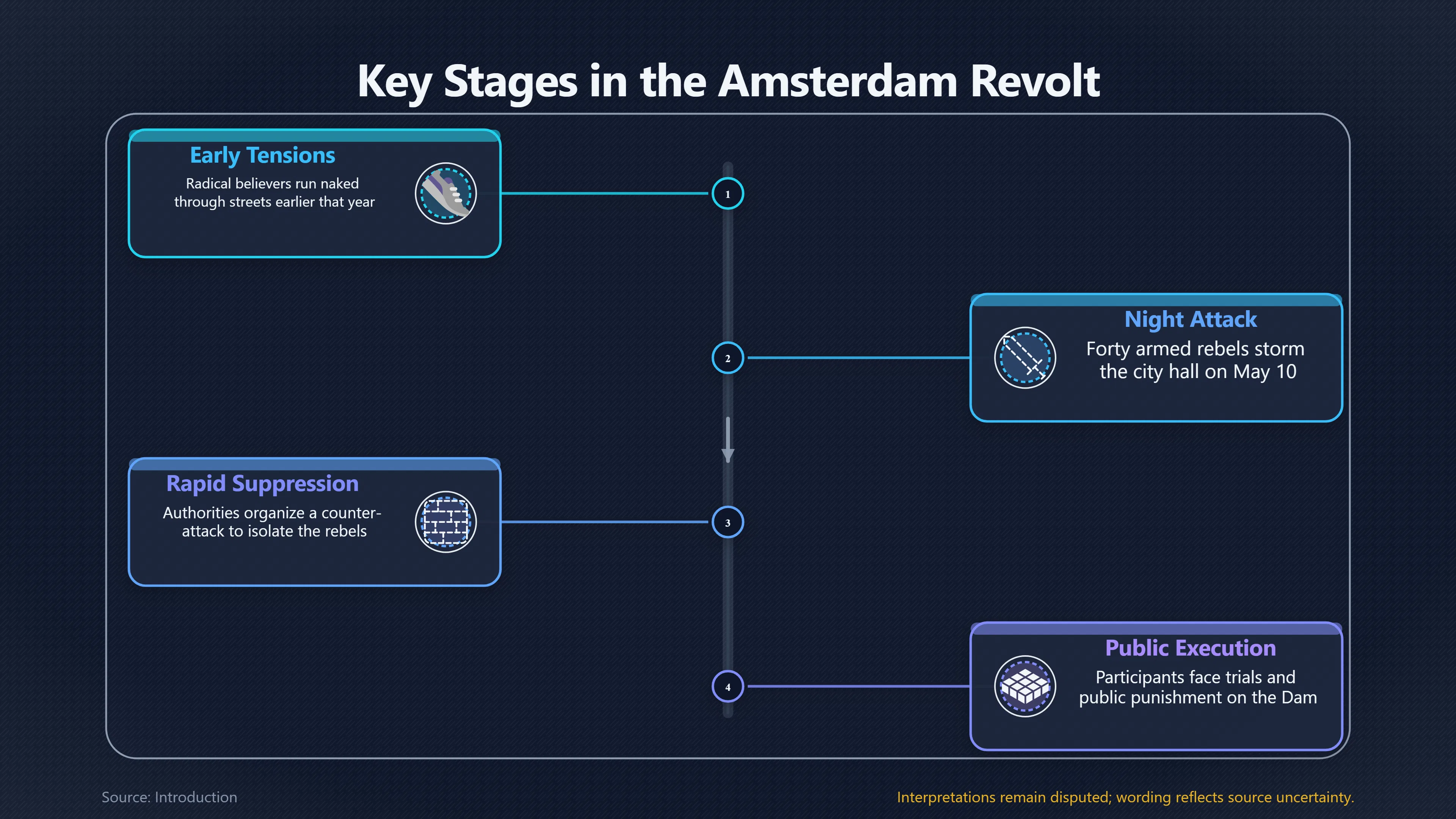
On the night of 10 May 1535, approximately forty armed Anabaptists stormed Amsterdam’s city hall on the Dam. Carrying swords and halberds, they killed several guards and briefly secured the building while attempting to spark a broader uprising. Instead, city authorities quickly organised a counter-attack, isolating the rebels before any wider mobilisation could occur. Contemporary civic records describe the attack as a determined but ultimately hopeless attempt to seize political power.[Amsterdam.nl]assets.amsterdam.nlnl The AmsterdamJanuary 29, 2024…
The city had already experienced signs of growing religious tension. Earlier that year, groups of radical believers had publicly run naked through Amsterdam’s streets, convinced that the Last Judgement was imminent. To contemporaries these acts appeared to confirm that apocalyptic expectation had progressed from strange public demonstrations to armed rebellion. Although modern readers may see the nudity as symbolic religious performance, many sixteenth-century observers interpreted it as evidence that divine and social order were collapsing.[Amsterdam.nl]assets.amsterdam.nlnl The AmsterdamJanuary 29, 2024…
The occupation itself lasted only briefly. Once surrounded, the rebels were overwhelmed. Their failure contrasted sharply with Münster, where radicals had held an entire city for many months. Amsterdam’s rising demonstrated how limited militant support actually was within the city.
Why forty rebels frightened an entire republic
Numerically, the revolt was tiny. Politically, however, it arrived at exactly the wrong moment.
Authorities across the Low Countries were already alarmed by reports from Münster. News travelled through merchants, official correspondence, printed pamphlets and religious networks. Stories of prophets, communal property, armed believers and the expectation of the world’s end convinced many magistrates that apparently isolated religious groups might rapidly become revolutionary conspiracies.
Amsterdam’s attack seemed to confirm those fears. If a handful of believers could seize the city’s government building, officials wondered whether similar plots existed elsewhere. The revolt therefore acquired a symbolic importance far greater than its practical consequences. It became proof, in the minds of many rulers, that radical religious dissent threatened not only theological order but civil government itself.[cambridge.org]cambridge.orgCambridge University Press & AssessmentThe Münster Rising, Memories of Violence, and Perceptions of Dissent in Restoration England | The…
Emperor Charles V reacted harshly. Contemporary civic accounts state that he ensured Amsterdam’s magistracy remained firmly in the hands of loyal Catholics after the uprising, reflecting wider Habsburg determination to prevent further religious rebellion.[Amsterdam.nl]assets.amsterdam.nlnl The AmsterdamJanuary 29, 2024…

Punishment as a warning
The suppression of the revolt was deliberately public.
Leading participants were executed after trials intended not merely to punish individuals but to discourage imitation. Contemporary and later prints show executions taking place on the Dam before large crowds, while some prisoners endured exceptionally brutal punishments typical of sixteenth-century political justice. The authorities intended these spectacles to demonstrate that rebellion against both Church and state would meet overwhelming force.[Rijksmuseum.nl]rijksmuseum.nlTerechtstelling van de wederdopers op het schavot op de Dam, 1535 - Rijksmuseum…
Such images circulated for generations in illustrated histories and religious polemics. They helped preserve the memory of the revolt long after the event itself had faded, reinforcing the association between Anabaptism and violent insurrection.
How the revolt shaped fear of Anabaptists
The greatest historical consequence of the Amsterdam revolt was reputational rather than military.
For Catholic rulers, the failed seizure reinforced arguments that Anabaptists represented a dangerous revolutionary movement requiring strict suppression. Many Protestant reformers reached similar conclusions, fearing that association with radical millenarianism would discredit the wider Reformation. As a result, Anabaptists faced persecution from multiple directions. Memories of Münster and Amsterdam became standard examples in anti-Anabaptist literature throughout Europe.[Cambridge University Press & Assessment]cambridge.orgCambridge University Press & AssessmentThe Münster Rising, Memories of Violence, and Perceptions of Dissent in Restoration England | The…
Yet this public image increasingly diverged from reality. After the collapse of Münster in 1535, many Dutch Anabaptists consciously rejected revolutionary politics. Leaders such as Menno Simons promoted non-violence, adult baptism, disciplined congregations and separation from worldly government. Over time these peaceful communities developed into the Mennonite tradition, whose identity was shaped partly by a determination never to repeat the catastrophes associated with Münster and Amsterdam.
This transformation illustrates an important historical lesson. A brief episode involving a radical minority came to define public perceptions of an entire religious movement whose later development moved in almost the opposite direction.

What historians see today
Modern historians generally reject older interpretations that portrayed the Amsterdam revolt as evidence that Anabaptism was inherently violent. Instead, they place the uprising within a specific moment of millenarian crisis during 1534–35, when extraordinary expectations surrounding Münster encouraged a small number of believers to believe that divine intervention was imminent.
The revolt is therefore interpreted as an episode of apocalyptic collective belief rather than a representative expression of Dutch Anabaptism. It also demonstrates how spectacular acts by a determined minority can reshape public attitudes towards a much larger and more diverse community.
For the Netherlands’ wider history of collective fear, Amsterdam’s Anabaptist revolt shows how rumours, prophecy, political instability and dramatic public violence combined to create a lasting moral panic. The city’s authorities were responding to a genuine armed assault, yet the resulting fear expanded far beyond the rebels themselves, influencing official policy and popular memory long after the immediate danger had disappeared.
Amazon book picks
Further Reading
Books and field guides related to Why Forty Rebels Frightened an Entire Republic. Use these as the next step if you want deeper reading beyond the article.


The Embarrassment of Riches
Provides cultural context for religious fear and identity.


Endnotes
1.
Source: cambridge.org
Link:https://www.cambridge.org/core/journals/historical-journal/article/munster-rising-memories-of-violence-and-perceptions-of-dissent-in-restoration-england/83F9CBE990B7CA3D2BCE2F680CC83F01
Source snippet
Cambridge University Press & AssessmentThe Münster Rising, Memories of Violence, and Perceptions of Dissent in Restoration England | The...
2.
Source: assets.amsterdam.nl
Title: nl The Amsterdam
Link:https://assets.amsterdam.nl/publish/pages/943399/schatkamerbrochure_2023_a4_eng.pdf
Source snippet
January 29, 2024...
Published: January 29, 2024
3.
Source: rijksmuseum.nl
Link:https://www.rijksmuseum.nl/en/collection/object/Terechtstelling-van-de-wederdopers-op-het-schavot-op-de-Dam-1535–6785ea2352369c820545ee62c40575e3
Source snippet
Terechtstelling van de wederdopers op het schavot op de Dam, 1535 - Rijksmuseum...
4.
Source: rijksmuseum.nl
Title: RP P OB 44.423
Link:https://www.rijksmuseum.nl/collectie/RP-P-OB-44.423
Source snippet
Jacob van Campen met mijter op hoofd op het schavot te Amsterdam, 1535 - Rijksmuseum...
5.
Source: rijksmuseum.nl
Title: De Amsterdamse Stedenmaagd en andere fragmenten
Link:https://www.rijksmuseum.nl/nl/collectie/BK-AM-51-1-I
Source snippet
1650 - ca. 1653 De voor- en achtergevel van het stadhuis worden gedomineerd door twee marmeren timpanen, elk zo’n twintig me...
6.
Source: cambridge.org
Link:https://www.cambridge.org/core/books/abs/reformation-in-the-low-countries-15001620/inchoate-reformation/0BD23B91E867E2A480F3310B55826080
Source snippet
Inchoate Reformation (Chapter 2) - Reformation in the Low Countries, 1500-1620June 2, 2022 — Reformist ideas coming out of the Holy Roman...
Published: June 2, 2022
7.
Source: rijksmuseum.nl
Link:https://www.rijksmuseum.nl/en/collection/object/Jacob%2Bvan%2BCampen%2Bmet%2Bmijter%2Bop%2Bhoofd%2Bop%2Bhet%2Bschavot%2Bte%2BAmsterdam%2C%2B1535–3290e61aa75b565e08c642a6cb9de6e8
8.
Source: rijksmuseum.nl
Link:https://www.rijksmuseum.nl/nl/collectie/object/Jacob-van-Campen-met-mijter-op-hoofd-op-het-schavot-te-Amsterdam-1535–3290e61aa75b565e08c642a6cb9de6e8
9.
Source: rijksmuseum.nl
Link:https://www.rijksmuseum.nl/nl/collectie/object/Jacob%2Bvan%2BCampen%2Bmet%2Bmijter%2Bop%2Bhoofd%2Bop%2Bhet%2Bschavot%2Bte%2BAmsterdam%2C%2B1535–428ea3594bc6fb29d907be79b3e54f01
10.
Source: rijksmuseum.nl
Link:https://www.rijksmuseum.nl/nl/collectie/object/Jacob%2Bvan%2BCampen%2Bmet%2Bmijter%2Bop%2Bhoofd%2Bop%2Bhet%2Bschavot%2Bte%2BAmsterdam%2C%2B1535–3290e61aa75b565e08c642a6cb9de6e8
11.
Source: rijksmuseum.nl
Link:https://www.rijksmuseum.nl/en/collection/object/Jacob%2Bvan%2BCampen%2Bmet%2Bmijter%2Bop%2Bhoofd%2Bop%2Bhet%2Bschavot%2Bte%2BAmsterdam%2C%2B1535–428ea3594bc6fb29d907be79b3e54f01
12.
Source: catholic.org
Link:https://www.catholic.org/encyclopedia/view.php?id=691
13.
Source: dutchdissenters.net
Link:https://dutchdissenters.net/wp/2015/05/10may1535/
Additional References
14.
Source: deanderekaart.amsterdam
Title: The Other Map of Amsterdam | Map | The Naked Runners in Amsterdam
Link:https://deanderekaart.amsterdam/en/map/ZOU01-the-naked-runners-in-amsterdam
Source snippet
September 26, 2025 — Image Christianity Protestant Engraving of the Naked Runners in Amsterdam 1614 A small group of Anabaptists gathered...
Published: September 26, 2025
15.
Source: youtube.com
Title: Anabaptist History (Day 15) The Munster Tragedy and Melchior Hoffman
Link:https://www.youtube.com/watch?v=sIwGzkz8tA0
Source snippet
Monster of Münster | Jan Van Leiden | Church History 91...
16.
Source: youtube.com
Title: How Did The Munster Rebellion Affect The Wider Reformation?
Link:https://www.youtube.com/watch?v=XeFzIcE91KM
Source snippet
Who was Menno Simons? Founder of the Mennonites (1496-1561)...
17.
Source: ejournals.uni-muenster.de
Link:https://ejournals.uni-muenster.de/index.php/zpth/article/view/2218
Source snippet
Zeitschrift für Pastoraltheologie (ZPTh)January 16, 2018 — DIE ENTSTEHUNG DER TÄUFERISCHEN SCHRECKENSHERRSCHAFT VON MÜNSTER (1530-1535)...
Published: January 16, 2018
18.
Source: youtube.com
Title: Monster of Münster | Jan Van Leiden | Church History 91
Link:https://www.youtube.com/watch?v=dSqO7-dJr9c
Source snippet
Münster 1534: When a Cult Took Over a City...
19.
Source: brill.com
Link:https://brill.com/display/book/9789004381926/BP000009.pdf
20.
Source: cabinet.ox.ac.uk
Link:https://www.cabinet.ox.ac.uk/anabaptism-early-modern-europe
21.
Source: youtube.com
Link:https://www.youtube.com/watch?v=moVfBPKxliY
Source snippet
How Did The Munster Rebellion Affect The Wider Reformation?...
22.
Source: arthistoriesroom.wordpress.com
Title: jacob cornelisz van oostsanen c 1475 c 1533 1 the other amsterdam
Link:https://arthistoriesroom.wordpress.com/2014/06/01/jacob-cornelisz-van-oostsanen-c-1475-c-1533-1-the-other-amsterdam/
23.
Source: isj.org.uk
Title: The Dutch Revolt: a social analysis • International Socialism
Link:https://isj.org.uk/the-dutch-revolt-a-social-analysis/
Topic Tree