Within El Salvador
Who Decided Indigenous Belief Was Dangerous?
Colonial authorities recast Indigenous ceremonies and healers as superstition or devilry, turning religious difference into a tool of control.
On this page
- Sacred traditions before Spanish rule
- Missionaries, idolatry and colonial authority
- Adaptation, survival and modern mislabelling
Page outline Jump by section
Introduction
Spanish colonial rule in what is now El Salvador did not simply replace one religion with another. It also created a powerful idea that Indigenous beliefs were inherently dangerous. Missionaries, colonial officials and church courts commonly described Native ceremonies, sacred places and ritual specialists as forms of “idolatry”, superstition or even the work of the devil. Those labels helped justify colonial control, but they also shaped later generations’ understanding of Indigenous religion.
Modern historians take a different view. Rather than treating Indigenous practices as evidence of irrationality or hidden cults, they examine how colonial authorities used accusations of idolatry to dismantle existing systems of authority while Indigenous communities adapted, concealed and blended many traditions into new forms of religious life. In El Salvador, this story is less about spectacular witch hunts than about the long-term transformation of religious difference into a political problem—and the remarkable survival of Indigenous traditions despite that pressure.[Teaching Central America]teachingcentralamerica.orgTeaching Central America The Pipils of El Salvador — Teaching Central AmericaTeaching Central America The Pipils of El Salvador — Teaching Central America
Who Decided Indigenous Belief Was Dangerous?
Before the Spanish conquest, western and central El Salvador were home primarily to Nahua-speaking Pipil communities, alongside Lenca, Maya Ch’orti’ and other Indigenous peoples. Their religious life revolved around sacred landscapes, agricultural ceremonies, seasonal calendars and ritual specialists who acted as healers, advisers and intermediaries with spiritual forces. Religion was woven into everyday life rather than separated into a distinct institution.[Teaching Central America]teachingcentralamerica.orgTeaching Central America The Pipils of El Salvador — Teaching Central AmericaTeaching Central America The Pipils of El Salvador — Teaching Central America
Spanish missionaries interpreted these traditions through Christian theological categories that had developed in Europe. Instead of recognising Indigenous religions as alternative belief systems, they commonly described them as “idolatry”—the worship of false gods—or as forms of demonic deception. This language mattered because it converted cultural difference into moral and legal wrongdoing. A ceremony that had once marked the agricultural year could become evidence of spiritual rebellion against Christian rule.[Coventry University]pureportal.coventry.ac.ukOpen source on coventry.ac.uk.
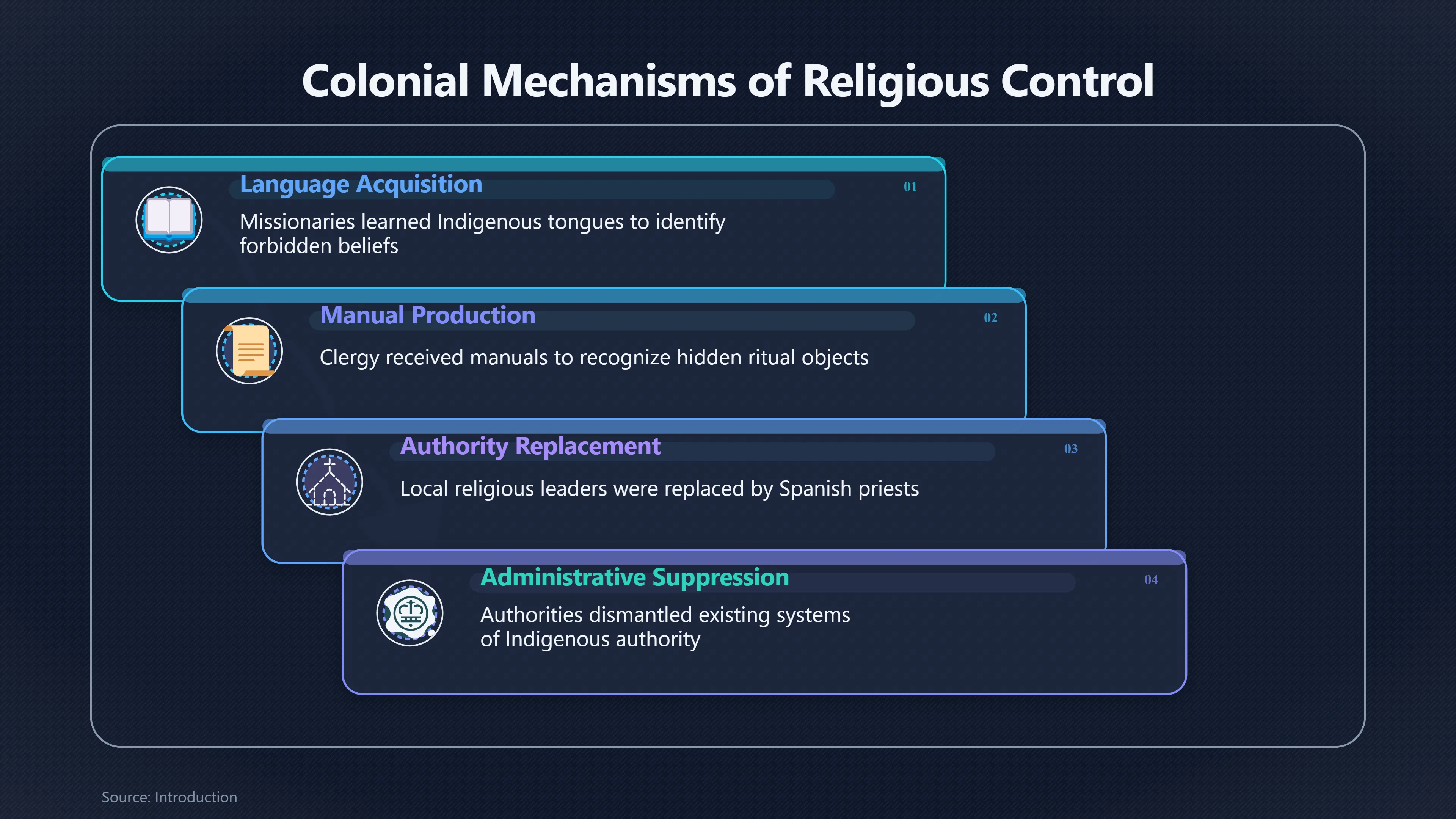
The result was not simply religious disagreement. The campaign against “idolatry” became part of colonial governance. Destroying temples, suppressing rituals and replacing local religious authorities with priests also weakened existing political leadership and strengthened Spanish authority over Indigenous communities.[OUP Academic]academic.oup.comOUP AcademicIndigenous Intellectuals in Colonial Latin America | Oxford Research Encyclopedia of Latin American History | Oxford Academic…
Sacred Traditions Before Spanish Rule
Although surviving evidence is incomplete, archaeology and colonial-era descriptions reveal a sophisticated religious world connected to the wider Mesoamerican cultural sphere.
Among Pipil communities, religion included:
- Priests responsible for public ceremonies and ritual knowledge.
- A ceremonial calendar linked to agriculture and seasonal cycles.
- Sacred places where offerings and communal rituals took place.
- Healing traditions and divination alongside public worship.
- Reverence for deities closely related to those known elsewhere in the Nahua world.[Teaching Central America]teachingcentralamerica.orgTeaching Central America The Pipils of El Salvador — Teaching Central AmericaTeaching Central America The Pipils of El Salvador — Teaching Central America
Lenca communities likewise maintained an animistic religious tradition centred on relationships between people, ancestors, animals and the natural world. Oral traditions and later ethnographic work suggest that women often held important ritual roles, challenging later colonial assumptions that Indigenous religious authority was exclusively male.[Minority Rights Group]minorityrights.orgMinority Rights Group Lencas in El SalvadorMinority Rights GroupLencas in El Salvador - Minority Rights Group…
Modern historians stress that much of what is known comes from Spanish observers whose primary goal was conversion. Their accounts therefore require careful reading. Descriptions of “devil worship” often reveal more about missionary fears than about Indigenous beliefs themselves.[Coventry University]pureportal.coventry.ac.ukOpen source on coventry.ac.uk.
Missionaries, Idolatry and Colonial Authority
The campaign against idolatry was not a single event but an ongoing colonial project.
Missionaries learned Indigenous languages partly so they could identify beliefs they regarded as unacceptable and replace them with Christian teaching. Manuals produced across Spanish America instructed clergy how to recognise hidden ceremonies, ritual specialists and sacred objects that might indicate continued Indigenous religious practice.[Coventry University]pureportal.coventry.ac.ukOpen source on coventry.ac.uk.
Colonial officials were especially concerned because many ceremonies were held away from Spanish settlements or continued inside Indigenous communities beyond regular clerical supervision. Ritual specialists could therefore be portrayed as preserving forbidden knowledge or encouraging resistance to Christian authority.
This did not mean that every Indigenous ceremony led to formal prosecution. Unlike some regions of colonial Mexico or the Andes, El Salvador has relatively little surviving evidence of extensive idolatry trials or organised witch persecutions. The broader pattern was administrative and pastoral: repeated efforts to discourage, redefine or replace Indigenous religious life rather than sustained judicial campaigns against large numbers of accused practitioners.[OUP Academic]academic.oup.comOUP AcademicIndigenous Intellectuals in Colonial Latin America | Oxford Research Encyclopedia of Latin American History | Oxford Academic…
Adaptation Rather Than Disappearance
One of the most important findings of modern scholarship is that suppression did not eliminate Indigenous religion.
Instead, many traditions survived through adaptation:
- Sacred places were incorporated into Christian landscapes.
- Community festivals blended Catholic saints’ days with older seasonal observances.
- Healing practices continued while adopting Christian prayers or symbols.
- Indigenous understandings of the landscape remained embedded in local custom even after public ceremonies changed.
This process is often described as religious syncretism, although some scholars prefer to emphasise Indigenous creativity rather than suggesting two traditions simply merged. Communities selectively adopted elements of Catholicism while preserving aspects of older beliefs in forms that colonial authorities sometimes tolerated and sometimes failed to recognise.[ppg.pueblosoriginarios.com]ppg.pueblosoriginarios.comReligión y Ceremonial LencaReligión y Ceremonial Lenca
The survival of these traditions also depended on oral transmission within families and communities. Practices that no longer existed as public institutions could continue privately through healing knowledge, local customs and community memory.
Why Modern Readers Should Be Careful with Colonial Sources
Colonial records are invaluable because they preserve information that might otherwise have been lost. At the same time, they reflect the priorities of the people who wrote them.
Missionaries often recorded Indigenous ceremonies only because they wished to eradicate them. Their descriptions therefore mixed careful observation with theological interpretation. When they identified local spirits as demons or ceremonies as satanic, modern historians treat those claims as evidence of missionary belief rather than objective descriptions of Indigenous religion.[Coventry University]pureportal.coventry.ac.ukOpen source on coventry.ac.uk.
This distinction helps avoid a common misunderstanding. References to “idolatry” in colonial documents do not demonstrate that Indigenous communities belonged to dangerous cults or irrational movements. They show how colonial power classified religious difference in ways that justified conversion, surveillance and social control.
Why This History Still Matters
The colonial language of idolatry has had a remarkably long afterlife. Indigenous ceremonies, traditional healers and local religious customs have sometimes continued to be dismissed as superstition or treated as remnants of forbidden belief long after Spanish rule ended.
Today, Indigenous organisations in El Salvador work to preserve languages, ceremonies and cultural memory that survived centuries of colonial pressure. Their efforts remind historians that the story is not simply one of religious destruction but of resilience. Many traditions endured because communities adapted them rather than abandoning them altogether.[Minority Rights Group]minorityrights.orgMinority Rights Group Lencas in El SalvadorMinority Rights GroupLencas in El Salvador - Minority Rights Group…
Within the wider history of collective fears in El Salvador, colonial idolatry scares are significant because they illustrate how official narratives can transform cultural difference into perceived danger. Rather than documenting a classic episode of mass hysteria, they reveal how accusations of forbidden belief became instruments of colonial authority—and how Indigenous communities found ways to preserve important parts of their spiritual heritage despite those pressures.
Amazon book picks
Further Reading
Books and field guides related to Who Decided Indigenous Belief Was Dangerous?. Use these as the next step if you want deeper reading beyond the article.


1491: New Revelations of the Americas Before Columbus
Introduces Indigenous societies before European conquest.
Endnotes
1.
Source: academic.oup.com
Link:https://academic.oup.com/edited-volume/61800/chapter/546417133?searchresult=1
Source snippet
OUP AcademicIndigenous Intellectuals in Colonial Latin America | Oxford Research Encyclopedia of Latin American History | Oxford Academic...
2.
Source: ppg.pueblosoriginarios.com
Title: Religión y Ceremonial Lenca
Link:https://ppg.pueblosoriginarios.com/meso/maya/lenca/religion.html
3.
Source: academic.oup.com
Link:https://academic.oup.com/stanford-scholarship-online/book/29689/chapter/250255425
4.
Source: teachingcentralamerica.org
Title: Teaching Central America The Pipils of El Salvador — Teaching Central America
Link:https://www.teachingcentralamerica.org/pipils-el-salvador
5.
Source: pureportal.coventry.ac.uk
Link:https://pureportal.coventry.ac.uk/en/publications/domesticating-the-nahuas-fray-bernardino-de-sahag%C3%BAns-cultural-tra/
6.
Source: minorityrights.org
Title: Minority Rights Group Lencas in El Salvador
Link:https://minorityrights.org/communities/lencas/
Source snippet
Minority Rights GroupLencas in El Salvador - Minority Rights Group...
Additional References
7.
Source: doi.org
Link:https://doi.org/10.1163/9789004506824_010
Source snippet
January 25, 2022 — OPINION, IDOLATRY, AND INDIGENOUS CONSCIOUSNESS: BARTOLOMÉ DE LAS CASAS’ APPROACH TO HUMAN SACRIFICE In: Casuistry and...
Published: January 25, 2022
8.
Source: revistas.usal.es
Link:https://revistas.usal.es/dos/index.php/1576-7914/article/view/31722
Source snippet
ideología lingüística de superioridad del español frente a las lenguas indígenas de el Salvador en el siglo XVIII | Cuadernos Dieciochist...
9.
Source: refworld.org
Title: World Directory of Minorities and Indigenous Peoples
Link:https://www.refworld.org/reference/countryrep/mrgi/2008/en/64495
Source snippet
World Directory of Minorities and Indigenous Peoples - El Salvador: Indigenous peoples | Refworld...
10.
Source: refworld.org
Title: World Directory of Minorities and Indigenous Peoples
Link:https://www.refworld.org/reference/countryrep/mrgi/2017/en/64857
Source snippet
World Directory of Minorities and Indigenous Peoples - El Salvador: Pipils | Refworld...
11.
Source: youtube.com
Title: Christianity in the New World: Spanish & Portuguese Missions in the Americas
Link:https://www.youtube.com/watch?v=Z6VpY1D5tJ8
Source snippet
The Secret Hidden Above This Colonial Town | Panchimalco, El Salvador...
12.
Source: youtube.com
Link:https://www.youtube.com/watch?v=nQ23QHVDgDM
Source snippet
Nahuatl Pipil Dance in Nahuizalco, El Salvador...
13.
Source: youtube.com
Title: The Secret Hidden Above This Colonial Town | Panchimalco, El Salvador
Link:https://www.youtube.com/watch?v=5Y0XooIl26Q
Source snippet
Election info changes quickly. Verify responses with official sources...
14.
Source: youtube.com
Title: The Nahuat of El Salvador & Central American Lenca
Link:https://www.youtube.com/watch?v=-kBuZZkxCjo
Source snippet
Christianity in the New World: Spanish & Portuguese Missions in the Americas...
15.
Source: tandfonline.com
Link:https://www.tandfonline.com/doi/abs/10.1179/174581509X455123
16.
Source: cambridge.org
Link:https://www.cambridge.org/core/journals/americas/article/abs/persistence-of-native-values-the-inquisition-and-the-indians-of-colonial-mexico/C6809F66F13C1A6745D002C5B0D811E6
Topic Tree