When Fear Becomes Belief in Guinea Bissau
Guinea-Bissau does not have a well-documented history of classic “mass hysteria” episodes such as school fainting waves, dance plagues or nationwide satanic scares.
Page outline Jump by section
Introduction
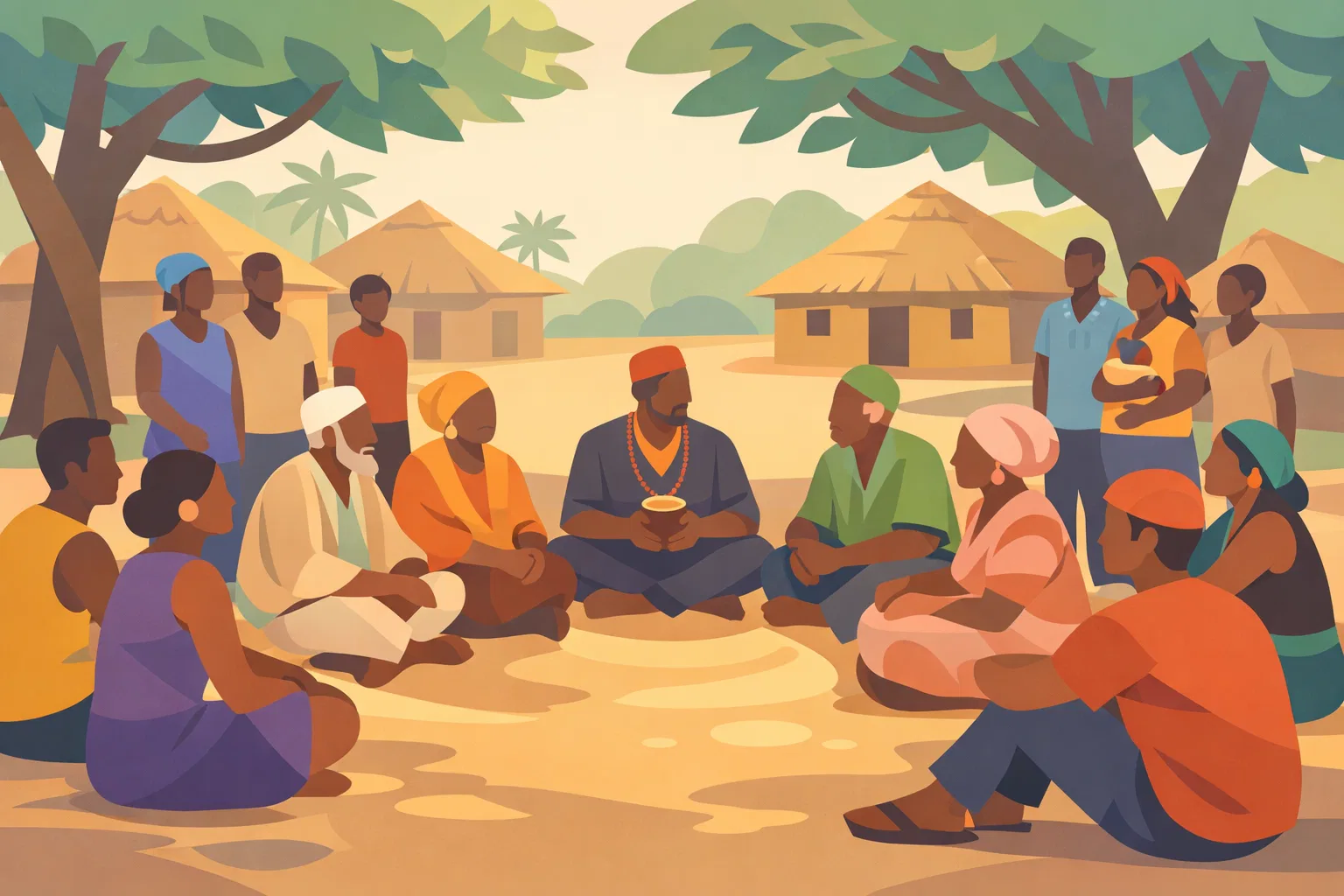
The most serious recent episode occurred in February 2024, when eight older people died after being forced to drink a toxic substance in Culadje, in the northern Cacheu region. They had been blamed after the sudden illness and deaths of two young people. Twenty-one other accused villagers required hospital treatment. The case shows how bereavement, uncertainty and communal suspicion can turn a supernatural explanation into organised violence.[channelstv.com]channelstv.comChannels Television Eight Women Accused Of Witchcraft Killed In Guinea-BissauChannels TelevisionEight Women Accused Of Witchcraft Killed In Guinea-BissauFebruary 22, 2024 — 22 Feb 2024 — After a sudden illness took…
The Culadje poison ordeal
Reports from Culadje describe a process closer to a witch panic than to spontaneous crowd madness. Following the unexplained deaths of two young people, suspicion settled on older members of the community. Twenty-nine people were reportedly compelled to consume a preparation administered as a test: survival or bodily reaction was supposed to reveal whether an accused person possessed harmful supernatural powers. Eight died, and the remainder were taken to hospital in São Domingos.[modernghana.com]modernghana.comModern Ghana Stop Witchcraft Accusations and Trial by Ordeal in GuineaModern GhanaStop Witchcraft Accusations and Trial by Ordeal in Guinea…February 23, 2024 — 23 Feb 2024 — The Advocacy for Alleged Witch…
Calling this a “trial” can be misleading. It did not resemble a court hearing in which evidence was examined and a defendant could challenge an accusation. A poison ordeal assumes that an invisible power, deity or ritual mechanism will expose guilt through the drink’s effects. In practice, its outcome depends on toxicity, dosage, health and chance. The ceremony therefore gives physical danger the appearance of supernatural proof: poisoning can be interpreted not as the cause of illness or death, but as confirmation that the victim was guilty.
The people who died were initially described inconsistently in international coverage. Some reports referred specifically to eight women over the age of 50, while Portuguese-language accounts described eight older people. This difference matters because gendered persecution should not be asserted more strongly than the available reporting permits. What is clear is that age made the accused vulnerable and that a collective response to two deaths placed an entire group in danger.[channelstv.com]channelstv.comChannels Television Eight Women Accused Of Witchcraft Killed In Guinea-BissauChannels TelevisionEight Women Accused Of Witchcraft Killed In Guinea-BissauFebruary 22, 2024 — 22 Feb 2024 — After a sudden illness took…
The Guinea-Bissau Public Prosecutor’s Office later brought accusations against 23 people in connection with the deaths. That legal response distinguishes the Culadje case from an incident that authorities simply tolerated as customary practice. It also suggests that the episode involved identifiable organisers and participants rather than an uncontrollable, anonymous crowd.[Lusa]lusa.pt23 acusados da morte de oito idosos por alegada feitiçaria na guiné bissau23 acusados da morte de oito idosos por alegada feitiçaria…2 May 2024 — Um total de 23 pessoas foram constituídas arguidas e acusa…
Why the fear spread
The central belief in Culadje was that illness and death could be caused intentionally through invisible means. Such an explanation can become persuasive when a community faces a sudden loss without a trusted medical account. It identifies an agent, supplies a reason for apparently arbitrary suffering and promises a procedure for restoring order. The ordeal then transforms suspicion into a public event: accusations are shared, ritual specialists gain authority, and the accused are placed under pressure to submit.
This does not mean that indigenous religion itself caused the killings. Guinea-Bissau is religiously plural, and formal religious identities do not neatly separate people who accept biomedical treatment from those who consult healers, ancestors or diviners. The country’s constitution protects freedom of conscience and worship, while observers describe Muslims, Christians and practitioners of indigenous traditions living in overlapping social worlds. Treating “animism” as a single violent belief system would flatten this complexity and wrongly associate ordinary ritual life with criminal acts.[State Department]state.govDepartment Guinea-BissauDepartment Guinea-Bissau
Anthropological work in Guinea-Bissau describes witchcraft not simply as fantasy but as a social language for discussing hidden aggression, envy, illness and damaged relationships. In this framework, an accusation may express a real conflict even when the supernatural allegation cannot be demonstrated. It can crystallise tensions involving inheritance, age, authority, family disputes or unexplained misfortune. That helps explain why disbelief in magical causation does not by itself explain away the episode: the accusation may still reveal a struggle over trust and power.[ResearchGate]researchgate.netResearch Gate Contracts with spirits and crocodiles magically transformedResearch Gate Contracts with spirits and crocodiles magically transformed
Material pressures can intensify that mechanism. Guinea-Bissau has weak health and justice infrastructure in many rural areas, while repeated political crises have limited confidence in state institutions. When medical diagnosis is difficult to obtain and formal justice feels remote, a ritual expert may appear to offer a faster and more culturally intelligible answer. This does not make violence inevitable, but it helps explain why accusations can acquire authority before police, doctors or courts intervene. Guinea-Bissau’s own conflict research has repeatedly linked insecurity and impunity to the weakness of institutions outside the capital.[Interpeace]interpeace.orgRoots of Conflicts in Guinea-Bissau: The voice of the peopleRoots of Conflicts in Guinea-Bissau: The voice of the people
A recurring pattern, not an isolated tragedy
The 2024 deaths were not the first warning. The Guinea-Bissau Human Rights League recorded 50 reported cases of witchcraft accusation between 2019 and 2021; 20 reportedly ended in killings. Six of those deaths occurred in 2021. Because these figures come from reported cases in a country where incidents may never reach national organisations, they should be treated as documented minimums rather than a complete national count.[state.gov]state.govDepartment Guinea-BissauDepartment Guinea-Bissau
Human-rights campaigners stated after Culadje that at least 37 people had died in Guinea-Bissau in connection with anti-witchcraft ordeals since 2020. The League called for a national plan rather than isolated reactions after each killing. Its demand reflected a concern that arrests alone would not address the social conditions that allow accusations, coercive testing and punishment to recur.[RTP]rtp.ptLGDH pede ao Governo medidas contra mortes porLGDH pede ao Governo medidas contra mortes por
The Covid-19 period supplied an especially dangerous setting for supernatural blame. Reporting on the Culadje case recalled that four people had died in similar circumstances in the same region in 2021, when residents attributed the epidemic to witchcraft. Epidemics encourage rumours because the cause is invisible, infection appears unpredictable and ordinary social contact becomes threatening. In such circumstances, a familiar neighbour can be recast as the secret source of collective suffering.[Correio Braziliense]correiobraziliense.com.br6807264 oito mulheres acusadas de bruxaria morrem envenenadas em guine bissauCorreio BrazilienseOito mulheres acusadas de bruxaria morrem envenenadas…22 Feb 2024 — As mulheres, maiores de 50 anos morreram após c…
These incidents are better understood as witchcraft-related persecution and moral panic than as mass psychogenic illness. The victims were not displaying symptoms that spread through suggestion in the absence of a physical cause. They were accused of creating real illness, and the communal response then produced real poisoning, assault or death. The contagious element lay in the certainty of the accusation and the willingness to act upon it.
The Kyangyang movement and the fear of religious upheaval
A different form of collective belief emerged among Balanta farmers in southern Guinea-Bissau in 1984. Known as Kyangyang, the prophetic movement began under the leadership of a woman and attracted young women and men. Its adherents challenged the authority of elders, condemned sorcery and sought a purer relationship with a supreme God. They adopted organised prayer and other practices that observers associated with Islam and Christianity while remaining rooted in Balanta religious experience.[Lund University]lunduniversity.lu.seOpen source on lu.se.
Kyangyang should not be casually called a cult. The word can imply fraud, brainwashing or criminality without evidence. Scholars more often describe it as a prophetic or religious reform movement. Its participants were not merely swept up in irrational excitement: they were creating new institutions, moral rules and forms of worship in response to their position within a rapidly changing postcolonial society.
The movement nevertheless spread with striking speed and generated alarm. Possession, revelation and prophetic communication gave followers a sense that divine authority had entered ordinary life. Kyangyang questioned gerontocracy—the dominance of senior men—and opposed ritual systems through which elders exercised influence. Its promise was therefore religious and social at once: young and marginal people could speak with an authority that did not depend on age, established initiation or official office.[Lund University]lunduniversity.lu.seOpen source on lu.se.
The state responded repressively in 1985. Academic accounts say the government sent forces to apprehend leaders, some of whom were imprisoned, while Kyangyang communities were broken up and adherents pushed back into their villages. The crackdown occurred during wider political anxiety about supposed Balanta agitation and an alleged coup attempt. The movement’s religious novelty became entangled with the government’s fear of ethnic and political mobilisation.[univie.ac.at]stichproben.univie.ac.atNr5 Gaillard RezNr5 Gaillard Rez
This is an important distinction. The authorities’ alarm did not prove that Kyangyang was preparing an insurrection. Religious movements that reorganise loyalty, place young people outside established hierarchies and spread across villages can look politically threatening even when their primary aims are spiritual and moral. In Guinea-Bissau, the state’s interpretation was shaped by a period of intense repression in which Balanta officers and political figures were already suspected of challenging President João Bernardo Vieira’s rule.[Interpeace]interpeace.orgRoots of Conflicts in Guinea-Bissau: The voice of the peopleRoots of Conflicts in Guinea-Bissau: The voice of the people
Kyangyang survived the crackdown in altered form. Later research found followers living alongside Muslims, Christians and practitioners of other Balanta traditions rather than maintaining completely separate communities. What initially appeared to officials as a destabilising wave became part of Guinea-Bissau’s continuing religious landscape. The case therefore illustrates how a movement can be labelled dangerous at the moment of rapid expansion but later understood as a durable form of religious innovation.[Oxford University Research Archive]ora.ox.ac.ukOpen source on ox.ac.uk.
Belief, accusation and hostile labelling
The witchcraft killings and the Kyangyang crackdown both involved collective belief, but they should not be collapsed into the same category. In witchcraft accusations, a person is blamed for secretly causing harm and may be punished without reliable evidence. In Kyangyang, participants themselves embraced a new religious identity, while outsiders and the state treated its expansion as socially or politically dangerous.
This distinction also clarifies the limits of the term “panic”. Culadje fits the concept because sudden deaths produced escalating suspicion, collective accusation and extreme action against a vulnerable group. Kyangyang was not itself a panic; rather, it became the object of official and social alarm. Its followers’ revelations and possession experiences were meaningful religious events to participants, while authorities interpreted the organised movement through the lens of security.
Nor should every belief in spirits or witchcraft be treated as evidence of hysteria. Such beliefs can coexist with scepticism, medical care and peaceful ritual practice. The threshold is crossed when claims of invisible wrongdoing are used to remove rights, compel an ordeal, justify violence or deny an accused person any meaningful way to establish innocence. Human-rights analysis of traditional justice systems similarly recognises that customary mechanisms vary widely, but identifies witchcraft ordeals and coercive practices as areas in which serious abuse can occur.[OHCHR]ohchr.orgOpen source on ohchr.org.
What remains uncertain
Reliable documentation is still thin. Guinea-Bissau has no comprehensive public database of witchcraft accusations, and many reports depend on human-rights groups, regional officials or news agencies reaching isolated communities after an incident. Numbers from different periods may overlap, and the outcome of criminal proceedings is not always reported internationally. It is therefore possible to establish a recurring pattern, but not to calculate its full scale with confidence.
The evidence also does not support claims of a nationwide witch craze involving every region or religious group. The best-recorded lethal cases are concentrated in particular northern communities, while Kyangyang arose among Balanta populations in the south. Country-level discussion must therefore avoid turning local events into a stereotype about Guinea-Bissau as a whole.
What is well supported is the mechanism linking unexplained misfortune to accusation. Sudden illness creates a demand for explanation; existing ideas about hidden aggression identify possible offenders; ritual testing makes the allegation appear verifiable; and weak protection allows collective certainty to become coercion. In the Kyangyang case, the sequence was different but related: rapid religious innovation challenged accepted authority, political insecurity encouraged officials to see spiritual mobilisation as a security threat, and repression converted social anxiety into state action.

Why these cases matter
Guinea-Bissau’s history shows that collective belief is not always spectacular. It can appear in a village decision to seek a supernatural cause for two deaths, in the forced swallowing of a supposedly truth-revealing liquid, or in a government’s fear that an unfamiliar prayer movement masks political rebellion.
The lasting issue is not whether every participant was simply credulous. It is how uncertainty became certainty, how certainty acquired public authority and why the people with the least power bore the greatest risk. Older accused villagers could be forced into lethal ordeals, while young religious innovators could be imprisoned when their movement unsettled established hierarchies.
The most promising responses therefore combine criminal accountability with prevention. Prosecution can establish that poisoning and killing are crimes regardless of the explanation offered for them. Accessible healthcare can reduce the vacuum in which sudden illness acquires a supernatural culprit. Local education and mediation can challenge coercive ordeals without portraying entire communities or indigenous religions as primitive. Above all, accused people need protection before communal suspicion hardens into a public test from which innocence may be impossible to prove.
Amazon book picks
Further Reading
Books and field guides related to When Fear Becomes Belief in Guinea-Bissau. Use these as the next step if you want deeper reading beyond the article.
African Religions A Very Short Introduction
Explains indigenous belief systems often misunderstood by colonial authorities.
Witchcraft, Violence, and Democracy in South Africa
Explains how fear, accusation and uncertainty become collective violence in African societies.
The fate of Africa
Places Guinea-Bissau within wider historical and political developments.
African Religions: A Very Short Introduction
Provides accessible background on African religious beliefs and practices.
Endnotes
1.
Source: rtp.pt
Title: oito pessoas morreram na guine bissau acusadas da pratica de feiticaria n1552340
Link:https://www.rtp.pt/noticias/mundo/oito-pessoas-morreram-na-guine-bissau-acusadas-da-pratica-de-feiticaria_n1552340
Source snippet
Oito pessoas morreram na Guiné-Bissau acusadas da...22 Feb 2024 — Oito idosos morreram na aldeia de Culadje, norte da Guiné-Bissau, a...
2.
Source: lusa.pt
Title: 23 acusados da morte de oito idosos por alegada feitiçaria na guiné bissau
Link:https://www.lusa.pt/lusofonia/guine-bissau/article/2024-05-02/42785584/23-acusados-da-morte-de-oito-idosos-por-alegada-feiti%C3%A7aria-na-guin%C3%A9-bissau
Source snippet
23 acusados da morte de oito idosos por alegada feitiçaria...2 May 2024 — Um total de 23 pessoas foram constituídas arguidas e acusa...
Published: May 2024
3.
Source: state.gov
Title: Department Guinea-Bissau
Link:https://www.state.gov/reports/2023-report-on-international-religious-freedom/guinea-bissau
4.
Source: state.gov
Title: Department Guinea-Bissau
Link:https://www.state.gov/reports/2021-report-on-international-religious-freedom/guinea-bissau
5.
Source: researchgate.net
Title: Research Gate Contracts with spirits and crocodiles magically transformed
Link:https://www.researchgate.net/publication/289900655_Contracts_with_spirits_and_crocodiles_magically_transformed_Witchcraft_in_Guinea-Bissau
6.
Source: interpeace.org
Title: Roots of Conflicts in Guinea-Bissau: The voice of the people
Link:https://www.interpeace.org/wp-content/uploads/2010/08/2010_GB_Interpeace_Voz_Di_Paz_The_Voice_Of_The_People_EN.pdf
7.
Source: 2021-2025.state.gov
Title: U.S. Department of State Guinea-Bissau
Link:https://2021-2025.state.gov/reports/2021-report-on-international-religious-freedom/guinea-bissau/
8.
Source: rtp.pt
Title: LGDH pede ao Governo medidas contra mortes por
Link:https://www.rtp.pt/noticias/mundo/lgdh-pede-ao-governo-medidas-contra-mortes-por-feiticaria-na-guine-bissau_n1552434
9.
Source: researchgate.net
Link:https://www.researchgate.net/publication/236789810_From_the_Margins_of_the_State_to_the_Presidential_Palace_The_Balanta_Case_in_Guinea-Bissau
10.
Source: ohchr.org
Link:https://www.ohchr.org/sites/default/files/Documents/Publications/HR%20PUB_16_2_HR_and_Traditional_Justice_Systems_in_Africa.pdf
11.
Source: 2021-2025.state.gov
Title: guinea bissau
Link:https://2021-2025.state.gov/reports/2023-country-reports-on-human-rights-practices/guinea-bissau/
12.
Source: state.gov
Link:https://www.state.gov/reports/2022-report-on-international-religious-freedom/guinea-bissau
13.
Source: 2021-2025.state.gov
Link:https://2021-2025.state.gov/report/custom/a48a642035/
14.
Source: 2021-2025.state.gov
Link:https://2021-2025.state.gov/report/custom/236e893b1d/
15.
Source: 2021-2025.state.gov
Link:https://2021-2025.state.gov/reports/2023-report-on-international-religious-freedom/tanzania/
16.
Source: 2021-2025.state.gov
Link:https://2021-2025.state.gov/reports/2021-report-on-international-religious-freedom/liberia/
17.
Source: 2021-2025.state.gov
Link:https://2021-2025.state.gov/reports/2023-report-on-international-religious-freedom/kenya/
18.
Source: 2021-2025.state.gov
Link:https://2021-2025.state.gov/reports/2023-report-on-international-religious-freedom/zambia/
19.
Source: 2021-2025.state.gov
Link:https://2021-2025.state.gov/reports/2023-report-on-international-religious-freedom/namibia/
20.
Source: ohchr.org
Title: cedaw chapter book faith 1 en
Link:https://www.ohchr.org/sites/default/files/documents/hrbodies/cedaw/cedaw-chapter-book-faith-1-en.pdf
21.
Source: ohchr.org
Link:https://www.ohchr.org/sites/default/files/Documents/HRBodies/SP/recommendations2008.pdf
22.
Source: docstore.ohchr.org
Title: Files Handler.ashx
Link:https://docstore.ohchr.org/SelfServices/FilesHandler.ashx?enc=XbvV0sDcayihHRSwz5%2BmkgAK9f%2F%2Bk7R03fyAl1OPKfQNz3R4cz8AFc%2FBx1aYMU97ogALqbN2aP0iVGg9AkumzQ%3D%3D
23.
Source: ohchr.org
Title: Moving Away from the Death Penalty 2015 web
Link:https://www.ohchr.org/en/newyork/Documents/Moving-Away-from-the-Death-Penalty-2015-web.pdf
24.
Source: ohchr.org
Title: droits de l’homme
Link:https://www.ohchr.org/sites/default/files/Documents/Publications/HR_PUB_16_2_HR_and_Traditional_Justice_Systems_in_Africa_FR.pdf
25.
Source: researchgate.net
Link:https://www.researchgate.net/publication/301725636_Witchcraft_beliefs_and_the_erosion_of_social_capital_Evidence_from_Sub-Saharan_Africa_and_beyond
26.
Source: researchgate.net
Link:https://www.researchgate.net/publication/233500477_What_Happened_to_Cargo_Cults_Material_Religions_in_Melanesia_and_the_West
27.
Source: researchgate.net
Link:https://www.researchgate.net/publication/343525006_The_shade_of_religion_Kyangyang_and_the_works_of_prophetic_imagination_in_Guinea-Bissau
28.
Source: researchgate.net
Title: 355590097 Chasing Shadows
Link:https://www.researchgate.net/publication/355590097_Chasing_Shadows
29.
Source: channelstv.com
Title: Channels Television Eight Women Accused Of Witchcraft Killed In Guinea-Bissau
Link:https://www.channelstv.com/2024/02/22/eight-women-accused-of-witchcraft-killed-in-guinea-bissau/
Source snippet
Channels TelevisionEight Women Accused Of Witchcraft Killed In Guinea-BissauFebruary 22, 2024 — 22 Feb 2024 — After a sudden illness took...
Published: February 22, 2024
30.
Source: correiobraziliense.com.br
Title: 6807264 oito mulheres acusadas de bruxaria morrem envenenadas em guine bissau
Link:https://www.correiobraziliense.com.br/mundo/2024/02/6807264-oito-mulheres-acusadas-de-bruxaria-morrem-envenenadas-em-guine-bissau.html
Source snippet
Correio BrazilienseOito mulheres acusadas de bruxaria morrem envenenadas...22 Feb 2024 — As mulheres, maiores de 50 anos morreram após c...
31.
Source: modernghana.com
Title: Modern Ghana Stop Witchcraft Accusations and Trial by Ordeal in Guinea
Link:https://www.modernghana.com/news/1294828/stop-witchcraft-accusations-and-trial-by-ordeal.html
Source snippet
Modern GhanaStop Witchcraft Accusations and Trial by Ordeal in Guinea...February 23, 2024 — 23 Feb 2024 — The Advocacy for Alleged Witch...
Published: February 23, 2024
32.
Source: lunduniversity.lu.se
Link:https://www.lunduniversity.lu.se/publication/620e8935-476f-4dd5-8b9d-18bcde08455f
33.
Source: ora.ox.ac.uk
Link:https://ora.ox.ac.uk/objects/uuid%3A4af7ea19-6501-4676-b648-e21a432cc922
34.
Source: stichproben.univie.ac.at
Title: Nr5 Gaillard Rez
Link:https://stichproben.univie.ac.at/fileadmin/user_upload/p_stichproben/Artikel/Nummer05/Nr5_Gaillard_Rez.pdf
35.
Source: ora.ox.ac.uk
Link:https://ora.ox.ac.uk/objects/uuid%3A4af7ea19-6501-4676-b648-e21a432cc922/files/m35dff582eba89eb3de57f87d8c9be672
36.
Source: lgdh.org
Link:https://www.lgdh.org/p/relatorios.html
Additional References
37.
Source: voaportugues.com
Link:https://www.voaportugues.com/a/pgr-da-guin%C3%A9-bissau-formaliza-acusa%C3%A7%C3%A3o-contra-23-pessoas-pela-morte-de-oito-alegados-feiticeiros/7595243.html
Source snippet
Voice of AmericaPGR da Guiné-Bissau formaliza acusação contra 23...2 May 2024 — Oito pessoas foram mortas em na localidade de Culadje em...
Published: May 2024
38.
Source: academia.edu
Link:https://www.academia.edu/4593752/Of_Women_and_Witches_A_Case_Study_in_Moral_Panics
39.
Source: instagram.com
Link:https://www.instagram.com/reel/CMKmMV9g3fW/
40.
Source: kaowarsom.be
Link:https://www.kaowarsom.be/documents/BULLETINS_MEDEDELINGEN/2001-SUPPLEMENT.pdf
41.
Source: facebook.com
Link:https://www.facebook.com/amnestyafrica/posts/most-women-accused-of-witchcraft-do-not-turn-to-the-police-out-of-fear-or-a-lack/1406528778169694/
42.
Source: fecongd.org
Link:https://www.fecongd.org/pdf/EN_NofirmapanoDritusBolama.pdf
43.
Source: facebook.com
Link:https://www.facebook.com/humanistsinternational/posts/new-the-advocacy-for-alleged-witches-has-launched-a-nationwide-intervention-prog/1365172322317726/
44.
Source: scribd.com
Link:https://www.scribd.com/document/752056716/The-Way-of-the-Prophets-History-Structure-Imagination
45.
Source: humanists.international
Link:https://humanists.international/wp-content/uploads/2020/11/Report-to-ACHPR67_Witchcraft.pdf
46.
Source: medium.com
Link:https://medium.com/%40jamiestantonian/witch-hunts-and-the-weaponisation-of-moral-panic-892e6be0c82d
Topic Tree
Follow this branch
Related pages 192
- Antigua and Barbuda
- Argentina Belief Scares
- Azerbaijan Belief
- Bahrain Beliefs
- North Korea
- +187 more in sidebar