Within China
When Promises of Salvation Became Civil Wars
Promises of divine protection and a purified new order became engines of war when they met poverty, foreign intrusion and failing authority.
On this page
- How the Taiping built a rival sacred state
- Why Boxer possession rituals promised invulnerability
- When millenarian belief turns into organised violence
Page outline Jump by section
Introduction
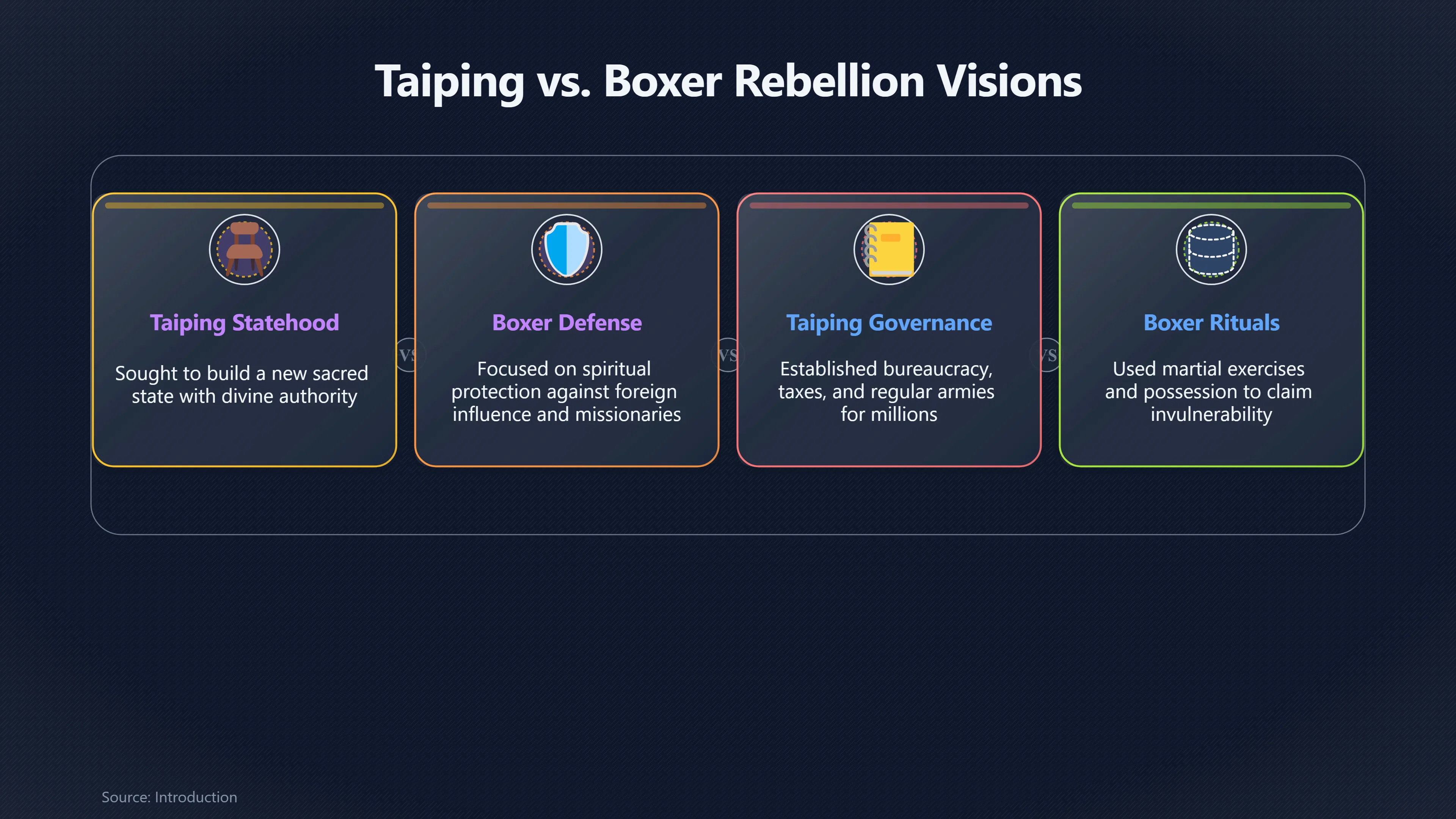
The Taiping Rebellion (1850–1864) and the Boxer Uprising (1899–1901) are often remembered as military conflicts, but they were also powerful examples of millenarian movements: movements that promised the arrival of a radically transformed world through divine intervention, moral purification and the destruction of an unjust order. In both cases, religious expectations became inseparable from political violence. Yet they represented very different visions of salvation. The Taiping sought to build an entirely new sacred state inspired by a distinctive interpretation of Christianity, while the Boxers believed that ritual possession and spiritual protection would enable ordinary villagers to resist foreign domination and Chinese converts to Christianity.

These movements cannot be understood simply as episodes of irrational enthusiasm. They emerged during periods of severe economic hardship, population pressure, official corruption, military weakness and growing foreign intrusion. Their religious beliefs gave meaning to suffering, created strong collective identities and encouraged extraordinary risks that many followers would otherwise have found unimaginable. Historians therefore study them not merely as rebellions but as examples of how apocalyptic hope can become a force in mass mobilisation and civil war.[degruyterbrill.com]degruyterbrill.comDe Gruyter Brill The Taiping Heavenly KingdomDe Gruyter BrillThe Taiping Heavenly Kingdom…December 11, 2024…
How the Taiping built a rival sacred state
The Taiping movement began with Hong Xiuquan, a failed examination candidate from southern China. After experiencing visions and reading Christian missionary literature, Hong concluded that he was the younger brother of Jesus Christ, chosen by God to destroy demons, overthrow the Qing dynasty and establish the “Heavenly Kingdom of Great Peace” on earth. His teachings combined Protestant ideas, Chinese concepts of heavenly order and older traditions of millenarian expectation rather than reproducing orthodox Christianity.[degruyterbrill.com]degruyterbrill.comDe Gruyter Brill The Taiping Heavenly KingdomDe Gruyter BrillThe Taiping Heavenly Kingdom…December 11, 2024…
This message proved attractive because it offered far more than personal salvation. Followers believed they were participating in the creation of a completely new society. The movement rejected many established religious practices, destroyed temples regarded as idolatrous, enforced strict moral rules and attempted to reorganise landholding, taxation and administration under divine authority. In 1853 the Taiping captured Nanjing, renamed it their Heavenly Capital and ruled large parts of central China as a rival government for more than a decade.[De Gruyter Brill]degruyterbrill.comDe Gruyter Brill The Taiping Heavenly KingdomDe Gruyter BrillThe Taiping Heavenly Kingdom…December 11, 2024…
The Taiping state demonstrated how millenarian belief could become an organised political system. Its leaders appointed officials, collected taxes, raised armies and governed millions of people while claiming heavenly legitimacy rather than merely earthly authority. The rebellion eventually cost tens of millions of lives, making it one of the deadliest conflicts in human history. Internal struggles among Taiping leaders, military pressure from Qing forces and foreign-supported regional armies ultimately destroyed the movement in 1864.[De Gruyter Brill]degruyterbrill.comDe Gruyter Brill The Taiping Heavenly KingdomDe Gruyter BrillThe Taiping Heavenly Kingdom…December 11, 2024…
Why Boxer possession rituals promised invulnerability
Unlike the Taiping, the Boxers did not attempt to found a new religious kingdom. Instead, they emerged in northern China during the late nineteenth century amid drought, economic disruption, missionary expansion and foreign military intervention. Their central promise was not the construction of a heavenly state but the spiritual defence of China against foreign influence.[Cambridge University Press & Assessment]cambridge.orgCambridge University Press & AssessmentCross-Cultural Perceptions of Technology and Magic in the Ghost Dance, Boxer Uprising, and Maji Ma…
Boxer practitioners performed martial exercises, recited incantations and underwent possession rituals through which spirits, gods or legendary heroes were believed to enter the body. Many participants became convinced that these rituals rendered them immune to bullets or other modern weapons. Such beliefs gave young recruits remarkable confidence in battle despite overwhelming military disadvantages. Contemporary observers often dismissed these convictions as simple superstition, but historians argue that they also reflected deeply rooted traditions of spirit possession, martial ritual and communal religion that became fused with anti-foreign nationalism.[Cambridge University Press & Assessment]cambridge.orgCambridge University Press & AssessmentCross-Cultural Perceptions of Technology and Magic in the Ghost Dance, Boxer Uprising, and Maji Ma…
Belief in supernatural protection also strengthened group cohesion. If survival depended upon moral purity and proper ritual performance, doubt itself could become dangerous. Confidence spread collectively through ceremonies, shared expectations and the visible courage of fellow believers, making extraordinary claims appear increasingly credible within the movement.
Why these beliefs spread so widely
Neither rebellion spread because of religious ideas alone. Both flourished where social and political institutions had lost legitimacy.
Several pressures repeatedly appear in historical research:
- Economic insecurity. Population growth, poverty and local hardship left many communities searching for alternative sources of hope.
- Weak confidence in government. The Qing state struggled to maintain order across large regions, creating opportunities for rival movements to organise.
- Foreign pressure. Military defeats and unequal treaties intensified fears that traditional society was collapsing.
- Local religious traditions. Existing beliefs about divine intervention, spirit possession and cosmic renewal provided familiar frameworks into which new movements could fit.
- Strong collective identity. Shared rituals, moral discipline and sacred narratives created unusually resilient organisations capable of sustained resistance.[ixtheo.de]ixtheo.deDescription: Reconsiderations the Taiping Rebellion of the Early Modern China: From the Perspective of Millenarianism:: IxTheo…
In both movements, religious conviction transformed personal suffering into participation in a larger cosmic struggle. Followers believed they were living through an exceptional historical moment in which ordinary rules no longer applied.

When millenarian belief turns into organised violence
The Taiping and Boxer movements illustrate different pathways by which religious expectation can become military action.
The Taiping leadership developed a centralised bureaucracy, regular armies and an alternative government claiming universal authority. Violence became part of an ambitious revolutionary project intended to replace the Qing dynasty completely.
The Boxers, by contrast, remained a looser popular movement rooted in village organisations and martial societies. Their violence focused on perceived enemies of the community, particularly foreign missionaries, Chinese Christians and symbols of foreign influence. As the crisis intensified, elements within the Qing court decided to support the Boxers against foreign powers, helping transform a regional uprising into an international conflict that ended with intervention by the Eight-Nation Alliance.[Cambridge University Press & Assessment]cambridge.orgCambridge University Press & AssessmentCross-Cultural Perceptions of Technology and Magic in the Ghost Dance, Boxer Uprising, and Maji Ma…
These contrasting cases remind historians that millenarian movements are not uniform. Some seek to construct entirely new political orders, while others aim to defend an existing society that they believe has become spiritually endangered.
How historians interpret the sacred rebellions
Modern scholarship generally rejects older explanations that reduced these movements to outbreaks of irrational fanaticism. Instead, historians place religion alongside social, political and economic conditions.
Several themes recur across the literature:
- Millenarian beliefs gave followers a coherent explanation for widespread suffering and uncertainty.
- Religious narratives helped create disciplined organisations capable of extraordinary collective action.
- Supernatural claims cannot be separated from the practical realities of poverty, ethnic tension, foreign intervention and weakening state authority.
- Colonial observers often exaggerated or simplified religious beliefs, presenting them as evidence of cultural backwardness while overlooking the political pressures that produced them.[cambridge.org]cambridge.orgCambridge University Press & AssessmentCross-Cultural Perceptions of Technology and Magic in the Ghost Dance, Boxer Uprising, and Maji Ma…
Researchers also stress that the Taiping should not be understood as simply a Christian movement transplanted into China. Rather, it represented a distinctive synthesis of biblical themes with Chinese religious traditions and utopian ideas. Likewise, Boxer beliefs about spirit possession were not isolated inventions but drew upon long-established forms of popular religion that acquired new meaning during the crisis of foreign encroachment.[ixtheo.de]ixtheo.deDescription: Reconsiderations the Taiping Rebellion of the Early Modern China: From the Perspective of Millenarianism:: IxTheo…
Why these rebellions still matter
The Taiping Rebellion and the Boxer Uprising remain central to understanding China’s history of collective belief because they reveal how hopes of divine transformation can become engines of mass mobilisation when ordinary institutions lose credibility.
They also demonstrate the limits of labels such as “mass hysteria”. Millions of participants were not merely swept away by irrational emotion. They acted within coherent religious worldviews that addressed genuine experiences of insecurity, injustice and national humiliation. Their beliefs proved historically significant not because they were universally accepted, but because they enabled large numbers of people to organise, sacrifice and fight for visions of a radically different future.
For historians of religion, psychology and social movements, these sacred rebellions therefore stand as enduring examples of how millenarian expectation can fuse with political crisis, creating movements capable of reshaping societies long after their military defeat.

Endnotes
1.
Source: cambridge.org
Link:https://www.cambridge.org/core/journals/comparative-studies-in-society-and-history/article/crosscultural-perceptions-of-technology-and-magic-in-the-ghost-dance-boxer-uprising-and-maji-maji-rebellion/807DCE404D0A367FE16046C6B80246F9
Source snippet
Cambridge University Press & AssessmentCross-Cultural Perceptions of Technology and Magic in the Ghost Dance, Boxer Uprising, and Maji Ma...
2.
Source: ixtheo.de
Link:https://ixtheo.de/Record/1842710621
Source snippet
Description: Reconsiderations the Taiping Rebellion of the Early Modern China: From the Perspective of Millenarianism:: IxTheo...
3.
Source: degruyterbrill.com
Title: De Gruyter Brill The Taiping Heavenly Kingdom
Link:https://www.degruyterbrill.com/document/doi/10.1515/9780295801926/html?lang=en
Source snippet
De Gruyter BrillThe Taiping Heavenly Kingdom...December 11, 2024...
Published: December 11, 2024
4.
Source: wisdomlib.org
Title: Wisdom Library The Millenarianism of the Taiping
Link:https://www.wisdomlib.org/science/journal/archives-of-social-sciences-of-religions/d/doc1447969.html
Source snippet
The Millenarianism of the TaipingAugust 11, 2024 — THE MILLENARIANISM OF THE TAIPING < Previous parent: Volume 16 (1963) Next > Last Upda...
Published: August 11, 2024
Additional References
5.
Source: ibiblio.org
Link:https://www.ibiblio.org/chinesehistory/contents/03pol/c03s02.html
Source snippet
The Manchus were "demons fighting against the true God"^{10}. Although they held Confucian and other traditional beliefs t...
6.
Source: davidpublisher.com
Link:https://www.davidpublisher.com/index.php/Home/Article/index?id=48207.html
Source snippet
XML 1205 Views DOI:10.17265/2328-2177/2022.10.002 A...
7.
Source: drandrewhuang.wordpress.com
Title: notes on the boxer rebellion
Link:https://drandrewhuang.wordpress.com/2020/12/31/notes-on-the-boxer-rebellion/
Source snippet
on the Boxer Rebellion – Dr Andrew Huang's BlogDecember 31, 2020 — NOTES ON THE BOXER REBELLION Posted on December 31, 2020December 30, 2...
Published: December 31, 2020
8.
Source: persee.fr
Title: Le millénarisme des Taïping
Link:https://www.persee.fr/doc/assr_0003-9659_1963_num
Source snippet
Archives de Sciences Sociales des Religions Année 1963 16 pp. 122-124 * Référence bibliographique Chesneaux Jean. Le millénarisme des Taï...
9.
Source: youtube.com
Title: The Imperial Chinese War That KILLED 30 MILLION People: Taiping Rebellion
Link:https://www.youtube.com/watch?v=zX8kI48Y7uo
Source snippet
The Tennessee Farm Boy Who Accidentally Started The 2nd Bloodiest War Ever...
10.
Source: youtube.com
Title: The Tennessee Farm Boy Who Accidentally Started The 2nd Bloodiest War Ever
Link:https://www.youtube.com/watch?v=gQCoLatBV4Y
Source snippet
The Boxer Uprising – The Chinese Revolt against Foreign Invasion...
11.
Source: youtube.com
Title: The Boxer Uprising – The Chinese Revolt against Foreign Invasion
Link:https://www.youtube.com/watch?v=1r-uVZiNCCo
Source snippet
Hollywood vs. History: '55 Days at Peking'...
12.
Source: compass.onlinelibrary.wiley.com
Link:https://compass.onlinelibrary.wiley.com/doi/10.1111/rec3.70056
Source snippet
Utopianism: A Historical Overview - Tavor - 2026 - Religion Compass - Wiley Online LibraryJune 10, 2026 — 3 MILLENARIAN UTOPIANISM The id...
Published: June 10, 2026
13.
Source: youtube.com
Title: The Taiping Rebellion: Rise of Hong Rengan!
Link:https://www.youtube.com/watch?v=eeEtjCPDupg
Source snippet
The Imperial Chinese War That KILLED 30 MILLION People: Taiping Rebellion...
14.
Source: thetbs.org
Title: Encyclopedia of Millennialism and Mlllennial Movements
Link:https://www.thetbs.org/study-materials/wp-content/uploads/2023/03/Encyclopedia-of-Millennialism-and-Millennial-Movements-by-Richard-Landes-z-lib.org_.pdf
Topic Tree