When Fear and Hope Gripped Estonia
Estonia’s history of collective fear and contagious belief is not dominated by one famous episode of “mass hysteria”.
Page outline Jump by section
Introduction
The clearest cases are the witch trials and the Maltsvetian religious movement. Both grew from genuine hardship, but neither is well explained as simple irrational frenzy. Witch accusations arose from disputes over illness, livestock, healing and suspected harmful magic, then became deadly when courts imposed elite ideas about the Devil and used coercive interrogation. The Maltsvetians, meanwhile, combined religious expectation with peasant frustration and a practical plan to migrate. Later retellings turned their experience into the national symbol of the “white ship”: rescue that is longed for but may never arrive.[scholarlypublishingcollective.org]scholarlypublishingcollective.orgWitch Hunts in and around Parnuexecuted as witches underwent a sort of damnatio memoriae as proposed by the… Witch Trials of Estonia,” in Witchcraft Mythologies and…
Witch trials turned local suspicions into state violence
Witchcraft prosecutions in the territory of present-day Estonia occurred mainly during the sixteenth and seventeenth centuries, when the region was divided between changing political powers and governed through a hierarchy of German-speaking landlords, clergy and officials over an overwhelmingly peasant population. Surviving records are incomplete, especially because estate courts did not always preserve their proceedings. Published estimates based on documented material identify roughly 140 known cases between the early sixteenth century and 1725, but the real number cannot be recovered with confidence.[scholarlypublishingcollective.org]scholarlypublishingcollective.orgWitch Hunts in and around Parnuexecuted as witches underwent a sort of damnatio memoriae as proposed by the… Witch Trials of Estonia,” in Witchcraft Mythologies and…
The accusations usually began with an everyday disaster. A person or animal became ill, milk failed, crops suffered or someone died after an argument. Suspicion then fell upon a neighbour, healer or practitioner of magic who was believed to have caused the harm. This was closer to a prosecution for destructive sorcery than to the fully developed Western European image of a secret satanic conspiracy. Estonian trial material often shows villagers concerned with particular injuries, enchanted food or drink, healing knowledge and transformations into animals, rather than with organised devil worship.[folklore.ee]folklore.eeOpen source on folklore.ee.
Court officials could radically change the story. Clergy and judges were familiar with European demonological writings that described pacts with Satan, witches’ gatherings and organised attacks on Christian society. During interrogation, particularly when torture or its threat was used, local allegations could be forced into this imported framework. A dispute about a child’s death or a cow’s sickness might therefore end with a confession involving the Devil, shape-shifting or supernatural instruction received in a dream.[folklore.ee]folklore.eeOpen source on folklore.ee.
This distinction matters. The trials were not proof that hidden communities of witches existed. Nor were they merely spontaneous explosions of peasant superstition. They were legal processes in which neighbourhood hostility, sincere belief in harmful magic, religious discipline and unequal political power reinforced one another.
Pärnu and the violence of local hierarchy
The witch hunt in and around Pärnu in 1641–42 is among the best-documented Estonian examples. Its records show how accusations developed within tense economic and social relationships rather than appearing from nowhere. Researchers have interpreted the proceedings against the background of a rigid hierarchy in which landlords and officials possessed enormous power over peasants and servants. The trials became a means through which anger, dependency and suspicion could be translated into criminal charges.[Scholarly Publishing Collective]scholarlypublishingcollective.orgWitch Hunts in and around Parnuexecuted as witches underwent a sort of damnatio memoriae as proposed by the… Witch Trials of Estonia,” in Witchcraft Mythologies and…
The Pärnu material is particularly valuable because it preserves than many estate prosecutions. Yet even detailed testimony must be treated cautiously. Statements produced in a coercive court do not provide direct access to what defendants privately believed. They show what an accused person, interrogator and legal system jointly produced under pressure.
Healers were both needed and feared
People accused in Estonia were not exclusively women. Men and recognised magical practitioners appear unusually prominently compared with the heavily female pattern familiar from some Western European regions. Many suspects seem to have been known as healers, diviners or specialists whose skills were sought in ordinary life but became dangerous to possess when treatment failed or a relationship deteriorated.[folklore.ee]folklore.eeNEWS IN BRIEF:It is interesting that in Russia and Estonia, males and magical practitioners (such as healers, diviners, and sorcerers) fi…
Kongla Ann, a healer from the Viru-Nigula area who was executed in 1640, has become a modern symbol of this ambiguity. She was accused after the death of a manor lord’s child and was said to have confessed to harmful magic and transformation into a werewolf. The circumstances make any confession difficult to accept at face value. Her later commemoration reflects a reversal in cultural memory: a person once erased or dishonoured as a witch can now be remembered as a victim of persecution and unequal authority.[JSTOR]jstor.orgOpen source on jstor.org.
Why the persecutions ended
Witch trials declined as legal standards changed and torture was restricted. Torture was prohibited in Livonia in 1686 and in the northern Estonian province in 1699. A prosecution could still be brought in the eighteenth century, but courts became less willing to turn allegations of magic into executions.[Wikipedia]WikipediaWitch trials in Latvia and EstoniaWitch trials in Latvia and Estonia
The end of judicial persecution did not mean that belief in magic disappeared. Folklore collections show continuing ideas about healers, protective formulas, supernatural attack and ways of acquiring magical knowledge. What disappeared was the institutional machinery that had allowed courts to convert those beliefs into capital punishment.[folklore.ee]folklore.eeOpen source on folklore.ee.
The White Ship was faith, protest and migration
The most important Estonian millenarian movement formed around Juhan Leinberg, better known as Prophet Maltsvet, during the 1850s and early 1860s. His followers, the Maltsvetians, emerged from rural communities experiencing economic insecurity, social inequality and disappointment after the formal abolition of serfdom had failed to produce the freedom many peasants expected. The movement offered religious discipline, moral reform and the hope of a radically better life.[wikipedia.org]WikipediaJuhan LeinbergJuhan Leinberg
Maltsvet’s followers have often been called a “sect”, especially in older accounts. The word reflects both their separation from established Lutheran authority and the hostility of critics. “Millenarian religious movement” is more precise: they believed that present suffering was part of a larger sacred transformation and that deliverance was approaching.
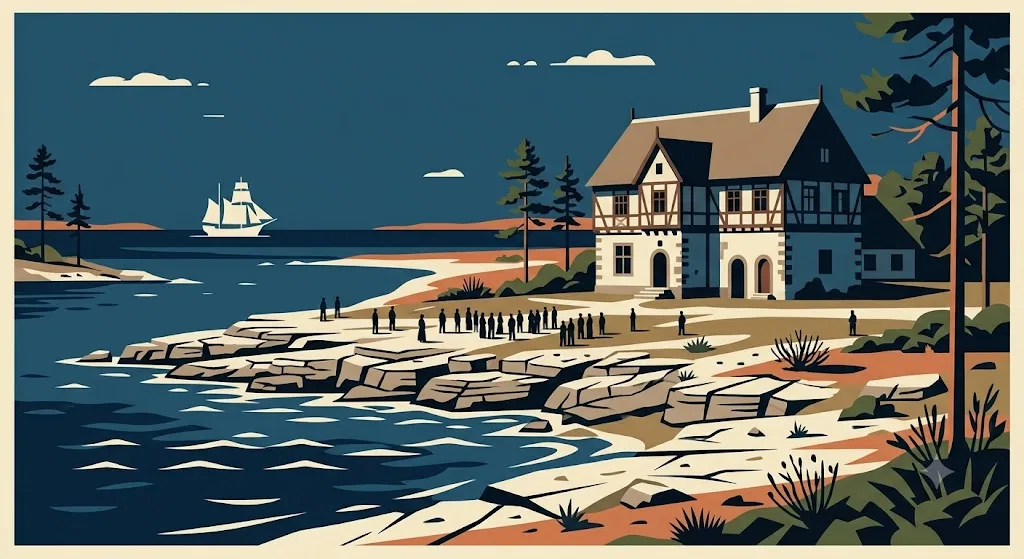
The movement’s best-known episode occurred in 1861, when several hundred followers gathered on the limestone heights of Lasnamäe near Tallinn. They expected a white ship to take them towards a promised land. The ship did not come. Some accounts present this as a straightforward failed prophecy, but the wider history was not simply one of believers standing passively on a shore. Maltsvetian families were also organising real migration to Crimea, where Estonian settlers hoped to obtain land and escape oppressive conditions at home.[folklore.ee]folklore.eeOpen source on folklore.ee.
The white ship therefore joined two kinds of hope. It was a religious image of miraculous rescue and a practical dream of emigration. That combination helps explain why the movement attracted followers. People were not merely persuaded by an eccentric prediction; they were responding to limited opportunities, class subordination and a plausible belief that life elsewhere might be better.
Authorities treated the gatherings as a threat to order. Large assemblies of peasants, independent preaching and refusal to accept established religious authority could look politically dangerous in the Russian Empire even when the participants were not planning an armed revolt. The movement illustrates a recurring feature of moral panics around unconventional religion: officials may describe dissenters as fanatics because their behaviour challenges social hierarchy as much as theology.
How literature reshaped the episode
Later writers transformed the Maltsvetians into a national story. Eduard Vilde’s historical novel about Prophet Maltsvet presented the movement through the lens of peasant oppression and social protest. Scholars warn that the novel should not be mistaken for a neutral reconstruction; it selected and shaped events according to the political and literary concerns of its time.[ResearchGate]researchgate.netResearch Gate History of maltsvet's religion and emigration to the crimeamovements are born as a result of socio-economic factors. "The Prophet Maltsvet" can truly be called a description of the Estonian histor…
The image of the white ship subsequently outgrew the original movement. It came to signify hoped-for rescue from foreign domination, exile or political repression. During the Soviet period it could represent the expectation that the West would eventually free Estonia. In later culture it has retained a more ambiguous meaning: hope can sustain people, but waiting for an external saviour can also postpone action.[etera.ee]etera.eeOpen source on etera.ee.
This is why the Maltsvetian story remains more than an obscure religious episode. It became a flexible national metaphor for deliverance, disappointment and the dangers of trusting promises that cannot be verified.
Prophets and clairvoyants survived modernisation
Estonia’s reputation as a highly secular society can obscure the persistence of vernacular spirituality. Formal church membership may be limited, but divination, healing, astrology, esoteric teaching and personal spiritual practice have continued to attract interest. Researchers describe this not as the rise of one tightly controlled movement but as a broad cultural “toolbox” from which individuals select ideas and practices.[researchgate.net]researchgate.netResearch Gate(PDF) A Hundred Forms of Spirituality in the LeastResearch Gate(PDF) A Hundred Forms of Spirituality in the Least
Twentieth-century Estonia produced several locally recognised prophets whose warnings were shaped by war, occupation and social upheaval. Studies of figures including Aleksander Toom, Karl Reits, Aleksei Aav and Priskilla Mändmets show that prophetic activity often developed from existing Christian revival traditions rather than from isolated delusion. Their messages interpreted national crisis through biblical language and were preserved through stories, manuscripts and later folklore.[folklore.ee]folklore.eeOpen source on folklore.ee.
The clairvoyant Hermine Elisabeth Jürgens, remembered as the Witch of Äksi, became another prominent figure. Stories about her connected supernatural knowledge with the turbulence of the twentieth century, including migration, war and Soviet rule. The label “witch” in this context did not carry the same legal danger as it had in the seventeenth century. It could mean clairvoyant, healer, uncanny personality or cultural celebrity.[folklore.ee]folklore.eeThe Witch of Äksi – Clairvoyant Person and Soviet TimeThe Witch of Äksi – Clairvoyant Person and Soviet Time
Under Soviet atheism, official institutions restricted organised religious life, but they did not eliminate private belief. Magic and esoteric ideas could circulate informally, while educated people sometimes approached them through parapsychology, alternative medicine or speculation presented as scientific inquiry. After independence was restored in 1991, previously restricted religious and spiritual markets expanded rapidly.[mnemosyne.ee]mnemosyne.eeOpen source on mnemosyne.ee.
It would be misleading to describe this whole field as a “cult boom”. Most participants did not enter closed, authoritarian communities. Estonia’s post-Soviet landscape was characterised more by fluid networks, seminars, books, healers and individual experimentation than by a single dominant organisation. The history is important precisely because it shows how belief can flourish outside conventional churches without necessarily producing panic or coercion.
Crisis rumours travel faster than formal belief
Estonia does not appear to have a nationally famous, well-documented outbreak of mass psychogenic illness comparable with school fainting epidemics reported elsewhere. Applying the term retrospectively to unexplained historical behaviour would therefore be speculative. The stronger Estonian evidence concerns rumours, legends and conspiracy narratives: beliefs transmitted through conversation, journalism and digital media rather than shared physical symptoms.
Folklorists have documented how modern Estonian legends recycle older supernatural structures in new settings. Soviet and post-Soviet stories combined military secrecy, unexplained technology, paranormal intervention and everyday danger. Such narratives were not always literally believed, but their circulation helped people express anxieties that official information could not resolve.[folklore.ee]folklore.eePerspectives on Contemporary LegendPerspectives on Contemporary Legend
The COVID-19 emergency produced a particularly visible wave of crisis folklore. Researchers began collecting Estonian-language jokes, memes, personal stories, rumours and conspiracy claims almost as soon as restrictions were introduced in March 2020. Much of this material served harmless purposes: humour reduced tension, improvised proverbs made unfamiliar rules memorable and stories gave shape to the disruption of ordinary life.[folklore.ee]folklore.eeOpen source on folklore.ee.
Other narratives expressed distrust of vaccines, medicine or political authority. Research on Estonian vaccine hesitancy suggests that sceptics should not be treated as a single irrational bloc. Some fundamentally distrusted mainstream medicine, while others accepted medical authority in general but had particular doubts about vaccines. This difference matters because moralising labels can deepen suspicion rather than correct it.[Nature]nature.comOpen source on nature.com.
Estonian responses also included organised attempts to challenge conspiracy material through reporting, ridicule and online activism. A study of an Estonian-language Facebook group created during the pandemic shows how humour itself became a countermeasure against disinformation. Yet mockery has limits: it may strengthen solidarity among critics while convincing few committed believers.[European Journal of Humour]europeanjournalofhumour.orgOpen source on europeanjournalofhumour.org.
The Estonia disaster and the persistence of conspiracy
The sinking of the passenger ferry Estonia on 28 September 1994 killed 852 people. The official joint investigation concluded that the bow visor failed in heavy seas, opening the vehicle ramp and allowing water to flood the car deck. Only 137 people survived.[apnews.com]apnews.comOpen source on apnews.com.
Alternative explanations have circulated ever since, including claims of an explosion, a collision with a submarine, secret military cargo or a state cover-up. These theories cannot be dismissed simply as products of foolishness. The disaster was sudden, traumatic and technically complex; many bodies were never recovered; the wreck was protected as a grave site; and later confirmation that military equipment had previously been transported on the ferry encouraged suspicion even though authorities denied such a cargo was present on the final voyage.[AP News]apnews.comOpen source on apnews.com.
A 2020 documentary renewed the controversy by showing previously unpublicised damage to the hull. Estonia, Finland and Sweden reopened underwater examination rather than treating every question as illegitimate. Preliminary findings released in 2023 attributed the visible hull damage to contact with the seabed and found no evidence of an explosion or collision. Investigators also identified construction and inspection failures that reinforced the original explanation centred on the bow structure.[theguardian.com]theguardian.comOpen source on theguardian.com.
The investigation published in December 2025 reported no new cause that displaced the established account and again described the vessel as unseaworthy. That does not erase every uncertainty surrounding decisions made before and after the sinking. It does, however, weaken the claim that the known physical evidence requires a secret attack or explosion.[ERR]news.err.eeofficial investigation finds no new causes in 1994 estonia ferry sinkingofficial investigation finds no new causes in 1994 estonia ferry sinking
The case demonstrates why conspiracy narratives endure after public disasters. New fragments of information are interpreted within an existing story of concealment; genuine official errors make total deception appear more plausible; and technical findings rarely provide the emotional closure that bereaved families seek. The humane response is neither to endorse unsupported claims nor to ridicule people whose distrust emerged from profound loss.
What Estonia’s episodes have in common
Estonia’s witch trials, white-ship expectation, prophetic traditions and modern conspiracy narratives belong to different historical categories. Combining them under the loose label of “mass hysteria” would hide more than it reveals.
The witch trials were persecutions backed by courts and coercive law. The Maltsvetians were a religious and social movement responding to oppression and limited opportunity. Twentieth-century prophets and clairvoyants belonged to a continuing field of vernacular religion. Pandemic folklore included both coping humour and harmful misinformation. The Estonia theories are disaster conspiracies sustained by trauma, institutional distrust and incomplete public understanding of technical evidence.
Several recurring pressures nevertheless connect them:
- Uncertainty made personalised explanations attractive. Illness, crop failure, political occupation and maritime catastrophe were easier to narrate when given an intentional cause.
- Existing inequalities shaped who was believed. Landlords, clergy, judges, state officials and media institutions possessed greater power to define acceptable belief.
- Stories crossed between private experience and public culture. A neighbour’s suspicion could become a court case; a failed religious expectation could become a national metaphor; a documentary image could restart an international investigation.
- Suppression rarely destroyed belief. Ending witch trials did not end magic, and Soviet atheism did not remove prophecy or spiritual experimentation.
- Later retellings changed the meaning of events. Victims became cultural symbols, religious dissent became social protest and the white ship became an image of national rescue.
The central lesson is not that Estonians were unusually credulous. It is that collective beliefs become powerful when they explain real hardship, fit familiar cultural stories and are amplified by institutions capable of turning suspicion into action. Estonia’s history is most revealing when belief is studied alongside law, class, occupation, migration, media and memory—not when every strange episode is reduced to panic.

Amazon book picks
Further Reading
Books and field guides related to When Fear and Hope Gripped Estonia. Use these as the next step if you want deeper reading beyond the article.
Imagined communities
Useful for understanding how national memory reshapes historical events.
Europe's inner demons
Helps explain how elite beliefs shaped witch persecutions in Estonia.

Witchcraft in Europe,
Provides broad context for European witchcraft, belief and persecution relevant to Estonia.
The pursuit of the millennium
Explains mass religious expectation that parallels the White Ship movement.
Endnotes
1.
Source: folklore.ee
Link:https://www.folklore.ee/folklore/vol11/news.htm
Source snippet
NEWS IN BRIEF:It is interesting that in Russia and Estonia, males and magical practitioners (such as healers, diviners, and sorcerers) fi...
2.
Source: zfo-online.de
Title: Anzeige von Nylon Stockings and Samizdat
Link:https://www.zfo-online.de/portal/zfo/article/view/9707/9706
Source snippet
The “White...by LF Stöcker · 2014 · Cited by 6 — In early summer 1861, a few hundred Maltsvetians spent several weeks on the limestone p...
3.
Source: researchgate.net
Title: Research Gate History of maltsvet’s religion and emigration to the crimea
Link:https://www.researchgate.net/publication/296928524_History_of_maltsvet%27s_religion_and_emigration_to_the_crimea
Source snippet
movements are born as a result of socio-economic factors. "The Prophet Maltsvet" can truly be called a description of the Estonian histor...
4.
Source: researchgate.net
Title: 345478659 Witch Hunts in and around Parnu 1641 1642
Link:https://www.researchgate.net/publication/345478659_Witch_Hunts_in_and_around_Parnu
Source snippet
Witch Hunts in and around Pärnu 1641–1642ABSTRACT This article explores the shadowy Pärnu witch trials of 1641‒42, including...
5.
Source: Wikipedia
Title: Witch trials in Latvia and Estonia
Link:https://en.wikipedia.org/wiki/Witch_trials_in_Latvia_and_Estonia
6.
Source: folklore.ee
Link:https://www.folklore.ee/folklore/vol2/docdoc.htm
7.
Source: folklore.ee
Link:https://www.folklore.ee/~taive/Estonian_folklore/Folk_belief1.doc
8.
Source: folklore.ee
Link:https://www.folklore.ee/rl/pubte/ee/sator/sator5/doctor.pdf
9.
Source: sisu.ut.ee
Link:https://sisu.ut.ee/wp-content/uploads/sites/172/valk_discursive_shifts_in_legends_from.pdf
10.
Source: jstor.org
Link:https://www.jstor.org/stable/48650816
11.
Source: Wikipedia
Title: Kongla Ann
Link:https://en.wikipedia.org/wiki/Kongla_Ann
12.
Source: folklore.ee
Link:https://www.folklore.ee/rl/pubte/ee/sator/sator5/easter.pdf
13.
Source: folklore.ee
Link:https://www.folklore.ee/folklore/vol8/mare.htm
14.
Source: Wikipedia
Title: Juhan Leinberg
Link:https://en.wikipedia.org/wiki/Juhan_Leinberg
15.
Source: folklore.ee
Link:https://www.folklore.ee/rl/pubte/ee/sator/sator13/mare2.pdf
16.
Source: researchgate.net
Title: 43337055 The Last Minutes of Our Earth
Link:https://www.researchgate.net/publication/43337055_The_Last_Minutes_of_Our_Earth
17.
Source: etera.ee
Link:https://www.etera.ee/zoom/28491/view
18.
Source: etera.ee
Link:https://www.etera.ee/api/oai2/download/28491.pdf
19.
Source: researchgate.net
Title: Research Gate(PDF) A Hundred Forms of Spirituality in the Least
Link:https://www.researchgate.net/publication/352249236_A_Hundred_Forms_of_Spirituality_in_the_Least_Religious_Country_in_the_World
20.
Source: folklore.ee
Link:https://www.folklore.ee/balkan_baltic_yearbook/YBBS/article/download/127/156/458
21.
Source: folklore.ee
Title: The Witch of Äksi – Clairvoyant Person and Soviet Time
Link:https://www.folklore.ee/rl/pubte/ee/sator/sator13/witch.pdf
22.
Source: mnemosyne.ee
Link:https://mnemosyne.ee/wp-content/uploads/2022/10/Believers_Human_Rights_and_Freedom_of_Sp.pdf
23.
Source: researchgate.net
Link:https://www.researchgate.net/publication/233255993_Religious_change_in_Estonia_and_the_Baltic_states_during_the_Soviet_period_in_comparative_perspective
24.
Source: folklore.ee
Title: Perspectives on Contemporary Legend
Link:https://www.folklore.ee/rl/fo/konve/2016/legend/abstracts.pdf
25.
Source: folklore.ee
Link:https://www.folklore.ee/folklore/vol28/movement.pdf
26.
Source: folklore.ee
Link:https://www.folklore.ee/balkan_baltic_yearbook/YBBS/article/download/60/99/256
27.
Source: researchgate.net
Title: 350565685 Vernacular Reactions to COVID 19 in Estonia Crisis Folklore and Coping
Link:https://www.researchgate.net/publication/350565685_Vernacular_Reactions_to_COVID-19_in_Estonia_Crisis_Folklore_and_Coping
28.
Source: utupub.fi
Link:https://www.utupub.fi/bitstreams/4218c213-128c-4567-b46d-eaa4bc9d7cc4/download
29.
Source: nature.com
Link:https://www.nature.com/articles/s41599-025-05799-4
30.
Source: reuters.com
Link:https://www.reuters.com/world/sweden-allow-underwater-investigation-estonia-wreck-site-2020-12-18/
31.
Source: reuters.com
Link:https://www.reuters.com/world/europe/new-probe-into-estonia-ferry-sinking-reveals-construction-flaws-officials-2023-01-23/
32.
Source: shk.se
Link:https://shk.se/engelska/the-swedish-accident-investigation-authority/search-investigation/maritime-transport/2023-11-27-preliminary-assessment-of-new-information-on-the-sinking-of-the-passenger-ship-m-v-estonia
33.
Source: news.err.ee
Title: official investigation finds no new causes in 1994 estonia ferry sinking
Link:https://news.err.ee/1609886623/official-investigation-finds-no-new-causes-in-1994-estonia-ferry-sinking
34.
Source: Wikipedia
Title: List of mass panic cases
Link:https://en.wikipedia.org/wiki/List_of_mass_panic_cases
35.
Source: Wikipedia
Title: Satanic panic
Link:https://en.wikipedia.org/wiki/Satanic_panic
36.
Source: Wikipedia
Title: List of UFO religions
Link:https://en.wikipedia.org/wiki/List_of_UFO_religions
37.
Source: Wikipedia
Title: Witch trials in the early modern period
Link:https://en.wikipedia.org/wiki/Witch_trials_in_the_early_modern_period
38.
Source: Wikipedia
Title: Mass psychogenic illness
Link:https://en.wikipedia.org/wiki/Mass_psychogenic_illness
39.
Source: Wikipedia
Title: Sinking of the MS Estonia
Link:https://en.wikipedia.org/wiki/Sinking_of_the_MS_Estonia
40.
Source: researchgate.net
Link:https://www.researchgate.net/publication/313714001_Apocalypse_in_Early_UFO_and_Alien-Based_Religions_Christian_and_Theosophical_Themes
41.
Source: researchgate.net
Link:https://www.researchgate.net/publication/372510216_A_Systematic_Review_of_Research_Developments_in_Mass_Psychogenic_Illness
42.
Source: researchgate.net
Link:https://www.researchgate.net/publication/313970146_The_Collection_of_Norwegian_Witchcraft-trials_in_the_Norwegian_Folklore_Archives_Norsk_Folkeminnesamling
43.
Source: researchgate.net
Title: 360348683 The current state of biblical scholarship in Estonia
Link:https://www.researchgate.net/publication/360348683_The_current_state_of_biblical_scholarship_in_Estonia
44.
Source: researchgate.net
Link:https://www.researchgate.net/publication/337295375_Folkloristic_Contributions_towards_Religious_Studies_in_Estonia_A_Historical_Outline
45.
Source: researchgate.net
Title: 367478227 Covid 19 related Conspiracy Theories in the Baltic States
Link:https://www.researchgate.net/publication/367478227_Covid-19-related_Conspiracy_Theories_in_the_Baltic_States
46.
Source: facebook.com
Link:https://www.facebook.com/groups/113480959325980/posts/1901043577236367/
47.
Source: facebook.com
Link:https://www.facebook.com/Czechology/posts/bohemia-moravia-and-silesia-werent-spared-the-witch-trials-happening-in-europe-f/1271975514929862/
48.
Source: facebook.com
Title: the satanic panic of the 1980s still echoes in the modern day which makes unders
Link:https://www.facebook.com/hotdocscinema/posts/the-satanic-panic-of-the-1980s-still-echoes-in-the-modern-day-which-makes-unders/705496991623254/
49.
Source: facebook.com
Link:https://www.facebook.com/nativeeuropeanculture/posts/every-year-in-estonia-in-the-town-of-kilingi-n%C3%B5mme-witches-take-center-stage-at-/1315176977314982/
50.
Source: facebook.com
Link:https://www.facebook.com/chapnin/posts/%D1%80%D1%83%D1%81%D1%81%D0%BA%D0%B0%D1%8F-%D0%B2%D0%B5%D1%80%D1%81%D0%B8%D1%8F-%D0%BD%D0%B8%D0%B6%D0%B5the-last-few-days-ive-been-doing-nothing-but-writing-rewritin/10225999246846597/
51.
Source: news.err.ee
Title: how modern crisis communication can benefit from plague mythology
Link:https://news.err.ee/1610049640/how-modern-crisis-communication-can-benefit-from-plague-mythology
52.
Source: folklore.ee
Link:https://www.folklore.ee/FOAFtale/ftn37.htm
53.
Source: folklore.ee
Link:https://www.folklore.ee/folklore/sites/default/files/2025-07/fl_ejf_88x.pdf
54.
Source: folklore.ee
Link:https://www.folklore.ee/isfnr/prel_prog.html
55.
Source: folklore.ee
Link:https://www.folklore.ee/folklore/vol16/wailer.pdf
56.
Source: folklore.ee
Link:https://www.folklore.ee/FOAFtale/ftn43.htm
57.
Source: folklore.ee
Title: fl ejf 93x
Link:https://www.folklore.ee/folklore/sites/default/files/2025-07/fl_ejf_93x.pdf
58.
Source: folklore.ee
Link:https://www.folklore.ee/FOAFtale/ftn15.pdf
59.
Source: folklore.ee
Link:https://www.folklore.ee/tagused/nr34/summ.htm
60.
Source: folklore.ee
Title: FOAFTAL E NEWS ALEATE
Link:https://folklore.ee/FOAFtale/ftn20.pdf
61.
Source: folklore.ee
Link:https://www.folklore.ee/folklore/sites/default/files/2025-07/fl_ejf_83x.pdf
62.
Source: folklore.ee
Link:https://www.folklore.ee/FOAFtale/ftn79.htm
63.
Source: folklore.ee
Link:https://www.folklore.ee/folklore/sites/default/files/2025-07/fl_ejf_91x.pdf
64.
Source: folklore.ee
Link:https://www.folklore.ee/FOAFtale/ftn75.htm
65.
Source: folklore.ee
Link:https://www.folklore.ee/folklore/sites/default/files/2025-07/fl_ejf_69x.pdf
66.
Source: folklore.ee
Link:https://www.folklore.ee/rl/pubte/ee/sator/sator13/earth.pdf
67.
Source: folklore.ee
Title: 98 web
Link:https://folklore.ee/folklore/sites/default/files/2026-04/Folklore98_web.pdf
68.
Source: folklore.ee
Link:https://www.folklore.ee/FOAFtale/ftn83.pdf
69.
Source: folklore.ee
Link:https://www.folklore.ee/balkan_baltic_yearbook/YBBS/article/view/60/99
70.
Source: history.com
Title: what was satanic panic 1980s
Link:https://www.history.com/articles/what-was-satanic-panic-1980s
71.
Source: history.com
Title: mysterious illnesses mass hysteria
Link:https://www.history.com/articles/mysterious-illnesses-mass-hysteria
72.
Source: jstor.org
Link:https://www.jstor.org/stable/26803447
73.
Source: jstor.org
Link:https://www.jstor.org/stable/10.13110/narrcult.8.2.0218
74.
Source: jstor.org
Link:https://www.jstor.org/stable/43213130
75.
Source: scholarlypublishingcollective.org
Title: Witch Hunts in and around Parnu 1641 1642
Link:https://scholarlypublishingcollective.org/psup/preternature/article/8/1/35/199739/Witch-Hunts-in-and-around-Parnu
Source snippet
executed as witches underwent a sort of damnatio memoriae as proposed by the... Witch Trials of Estonia,” in Witchcraft Mythologies and...
76.
Source: dspace.ut.ee
Link:https://dspace.ut.ee/bitstreams/fa404498-e4aa-4812-adb1-df39ae7c52e1/download
77.
Source: europeanjournalofhumour.org
Link:https://europeanjournalofhumour.org/ejhr/article/view/1080
78.
Source: apnews.com
Link:https://apnews.com/article/2858981c601acf1036434174d42824be
79.
Source: theguardian.com
Link:https://www.theguardian.com/world/2023/jan/23/estonia-ferry-disaster-inquiry-backs-finding-bow-door-was-to-blame
80.
Source: dspace.ut.ee
Link:https://dspace.ut.ee/bitstreams/75df301f-7d27-4e4d-a33d-1c0df436076a/download
81.
Source: dspace.ut.ee
Link:https://dspace.ut.ee/bitstreams/84061ebd-b6fa-46e9-a838-54b7ffc8683f/download
82.
Source: ebsco.com
Link:https://www.ebsco.com/research-starters/social-sciences-and-humanities/mass-hysteria
83.
Source: theguardian.com
Title: was ripon school gripped by mass psychogenic illness
Link:https://www.theguardian.com/science/2015/nov/14/was-ripon-school-gripped-by-mass-psychogenic-illness
84.
Source: theguardian.com
Title: survey uncovers widespread belief dangerous covid conspiracy theories
Link:https://www.theguardian.com/world/2020/oct/26/survey-uncovers-widespread-belief-dangerous-covid-conspiracy-theories
85.
Source: theguardian.com
Title: Vaccine scepticism grows in line with rise of populism
Link:https://www.theguardian.com/world/2019/feb/25/vaccine-scepticism-rises-in-line-with-votes-for-populists-study-finds
86.
Source: academia.edu
Link:https://www.academia.edu/40007726/Introduction_the_Study_of_Religion_in_Estonia
87.
Source: sajp.org.za
Link:https://sajp.org.za/index.php/sajp/article/view/1671/2648
88.
Source: library.eshikshya.org
Title: Juhan Leinberg
Link:https://library.eshikshya.org/kiwix/content/wikipedia_en_all_maxi_2023-05/A/Juhan_Leinberg
89.
Source: religion.fandom.com
Title: Juhan Leinberg
Link:https://religion.fandom.com/wiki/Juhan_Leinberg
Additional References
90.
Source: academia.edu
Link:https://www.academia.edu/1075053/Aino_Kallas_Negotiations_with_Modernity
91.
Source: academia.edu
Link:https://www.academia.edu/2395018/Apocalypse_in_Early_UFO_and_Alien_Based_Religions_Christian_and_Theosophical_Themes
92.
Source: historysnob.com
Link:https://www.historysnob.com/war-and-historical-events/20-chilling-cases-mass-hysteria-throughout-history
93.
Source: reddit.com
Link:https://www.reddit.com/r/science/comments/1o2r7ct/a_study_in_estonia_found_two_main_kinds_of/
94.
Source: europeansocialsurvey.org
Link:https://www.europeansocialsurvey.org/docs/about/COVID-19-Conspiracy-Beliefs.pdf
95.
Source: populationmedicine.eu
Link:https://www.populationmedicine.eu/Covid-19-conspiracy-beliefs-government-legitimacy-and-societal-priorities-in-the%2C165690%2C0%2C2.html
96.
Source: reddit.com
Link:https://www.reddit.com/r/AskHistorians/comments/12jvlg0/did_people_actually_worry_about_the_occult_during/
97.
Source: nationalarchives.gov.uk
Link:https://www.nationalarchives.gov.uk/education/resources/early-modern-witch-trials/
98.
Source: ipen-network.org
Link:https://ipen-network.org/tag/estonia/
99.
Source: rongabutiik.ee
Link:https://rongabutiik.ee/en/eesti-rahvaparimus-noidus-ja-maagilised-praktikad-taielik-ulevaade/?srsltid=AfmBOopkKE8uZeZDxokGN_rYEAVBvWtcJQxAayb4TLZOJf9vemaaQlGJ
Topic Tree
Follow this branch
Related pages 192
- Antigua and Barbuda
- Argentina Belief Scares
- Azerbaijan Belief
- Bahrain Beliefs
- North Korea
- +187 more in sidebar