When Resistance, Ritual and Colonial Fear Collided
Antigua and Barbuda does not have a well-documented history of dance plagues, mass fainting outbreaks, UFO religions or modern destructive sects.
Page outline Jump by section
Introduction
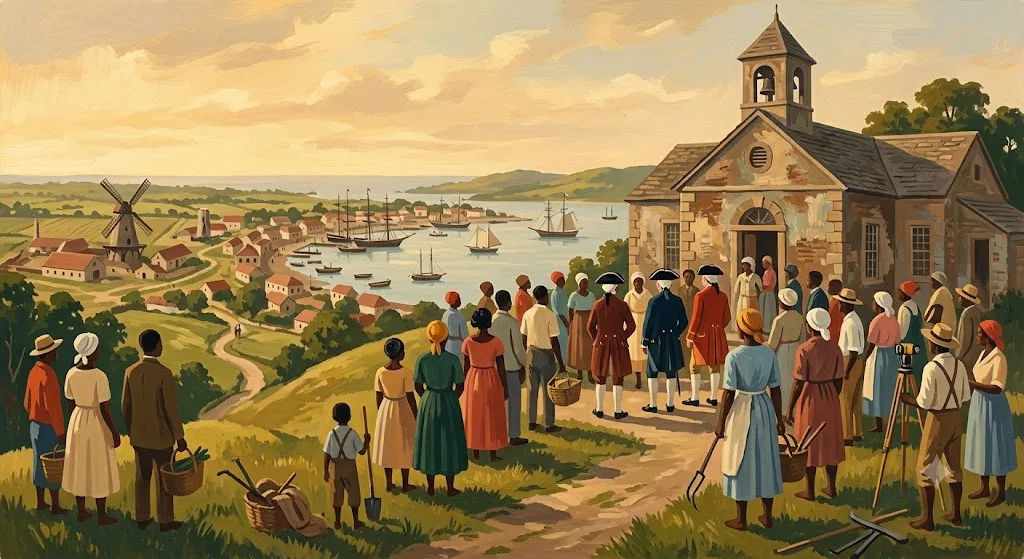
The central episode was both a possible liberation plot and a panic among slaveholders. Colonial authorities claimed that enslaved people led by Court, now commemorated as Prince Klaas, intended to destroy the white ruling population and establish African government. Dozens were executed after an investigation conducted within a violently unequal slave society. Historians agree that organised resistance existed, but disagree about whether officials uncovered the vast conspiracy described in the trials or enlarged a smaller plan through coercive questioning, frightened testimony and institutional self-interest.[smithsonianmag.com]smithsonianmag.comantiguas disputed slave conspiracy of 1736 117569Smithsonian MagazineAntigua's Disputed Slave Conspiracy of 1736January 2, 2013 — 2 Jan 2013 — Johnson showed that the very hideousness of…
That uncertainty makes the case especially important. It shows how genuine resistance, African-derived ritual, racial fear and state violence could become entangled until separating documented events from official panic became extremely difficult.
The 1736 conspiracy: rebellion, panic or both?
In October 1736, Antigua’s white population was told that enslaved Africans had planned a coordinated uprising. According to the prosecution’s version, the conspirators intended to use gunpowder to attack a major public gathering connected with celebrations for King George II, then kill other white inhabitants and take control of the island. Court, an enslaved man later known as Prince Klaas, was presented as the movement’s principal leader. Tomboy and several other people with unusual freedom of movement or influence within the slave system were also implicated.[enslaved.org]enslaved.orgPrince Klaas and TomboyPrince Klaas (Court) and Tomboy were central figures in the 1736 conspiracy of slaves and free people in Antigua…
The alleged plot did not arise in an ordinary community suddenly overcome by an irrational rumour. Antigua was a plantation colony built on forced labour, corporal punishment and an enormous imbalance between a small ruling minority and a much larger enslaved population. Resistance was therefore entirely plausible. Enslaved people escaped, sabotaged plantation work, preserved independent networks and sometimes planned revolt. Slaveholders, meanwhile, lived with a persistent fear that the system they maintained by violence could be overturned by violence.
The resulting trials lasted for more than seven months. At least 88 enslaved people were executed, while many others were convicted or punished. Recorded methods included burning, gibbeting and breaking on the wheel. The scale and theatrical cruelty of the punishments were intended not only to kill particular defendants but to terrorise the surviving population and demonstrate the colonial state’s power.[royallhouse.org]royallhouse.orgthe royalls and the antigua slave conspiracy of 1736The Royall House and Slave QuartersThe Royalls and the Antigua Slave Conspiracy of 1736May 6, 2016 — A total of 132 enslaved persons were…
Calling the episode simply a “mass hysteria” would therefore be misleading. The enslaved had powerful reasons to rebel, and the authorities may have uncovered some real organisation. Yet it would be equally misleading to treat every confession and accusation as straightforward evidence. Testimony was gathered in a system where defendants had few protections, witnesses faced severe pressure and slaveholders received compensation when people they legally owned were executed. The investigation could consequently reward an expanding list of suspects.
Why historians dispute the official story
The most influential modern interpretation, associated with historian David Barry Gaspar, treats the affair as an extensively organised conspiracy rooted in the social connections, political ambitions and African cultural knowledge of Antigua’s enslaved population. In this reading, the case reveals sophisticated collective resistance rather than a spontaneous disturbance or a fantasy created by frightened planters.[JSTOR]jstor.orgBarry Gaspar's Bondmen and Rebels is a monumental work of…July 12, 1995 — It centers on the 1736 slave conspiracy in Antigua, a c…
Other researchers have questioned whether the surviving records support the full colonial narrative. The problem is not that rebellion was impossible. It is that the evidence was produced by the people suppressing it. Depositions could change, accusations could multiply after arrests, and defendants might implicate others in the hope of avoiding torture or execution. Later accounts also tended to repeat the authorities’ most elaborate allegations as settled fact.[Smithsonian Magazine]smithsonianmag.comantiguas disputed slave conspiracy of 1736 117569Smithsonian MagazineAntigua's Disputed Slave Conspiracy of 1736January 2, 2013 — 2 Jan 2013 — Johnson showed that the very hideousness of…
The safest conclusion lies between complete acceptance and complete dismissal. There was probably a serious current of resistance, with Court and others occupying important positions within it. What remains uncertain is the plot’s exact size, timetable and operational readiness. A colonial investigation may have begun with a genuine threat and then transformed it into an island-wide conspiracy through fear, coercion and the logic of exemplary punishment.
This distinction matters because “panic” does not always mean that nothing happened. Moral and political panics often grow around a real incident. Their defining feature is disproportion: ambiguous conduct becomes proof of a vast hidden network, the number of supposed participants expands, normal restraints weaken, and punishment reaches well beyond what can be securely demonstrated.
Spiritual power at the centre of the fear
Religious ceremony was central to the authorities’ interpretation of the conspiracy. Court was reportedly installed as a king during an African-derived ritual. A spiritual adviser named Quawcoo was said to have administered oaths, practised divination and helped select a favourable moment for action. Historian Diana Paton identifies Quawcoo as one of several eighteenth-century ritual specialists connected in colonial records with resistance movements across the Caribbean.[Cambridge University Press & Assessment]cambridge.orgOpen source on cambridge.org.
These practices were later grouped under the broad label “obeah”, although the people involved would not necessarily have regarded themselves as members of a single religion. Obeah is better understood as a shifting Caribbean category covering forms of healing, protection, divination, spiritual intervention and, in hostile accounts, cursing or poisoning. Its boundaries varied between islands and changed over time. Scholars Kenneth Bilby and Jerome Handler stress that many practices described as obeah were intended to heal illness, secure good fortune, protect people from danger or redress wrongdoing, not simply to harm enemies.[Jerome S. Handler]jeromehandler.comJerome S. Handler ObeahJerome S. Handler Obeah
For enslaved communities, ceremonies and oaths could serve practical as well as spiritual purposes. They might build trust, create solidarity, validate leaders or give frightened participants confidence. For slaveholders, the same activities appeared secretive, incomprehensible and politically dangerous. Colonial observers often interpreted African-derived ritual through Christian ideas of witchcraft and diabolism, or treated spiritual specialists as poisoners capable of controlling large numbers of enslaved people.
The result was a recurring pattern: political resistance made spiritual practices appear more threatening, while fear of spiritual practices made rumours of political resistance seem more credible. In Antigua, the alleged conspiracy became part of a wider British Caribbean belief that African ritual specialists could organise rebellion by commanding supernatural loyalty.
How “obeah” became a criminal category
The law did not simply respond to a clearly defined religion called obeah. Colonial legislation helped create the category by gathering many poorly understood practices under one suspicious name. Across the British Caribbean, authorities alternately portrayed obeah as witchcraft, poisoning, political sedition, fraudulent performance or an obstacle to Christian civilisation. Paton’s research shows how legal definitions turned diverse African-derived practices into what officials treated as a single dangerous phenomenon.[ed.ac.uk]research.ed.ac.ukwitchcraft poison law and atlantic slaverywitchcraft poison law and atlantic slavery
The Leeward Islands Obeah Act of 1904, inherited by Antigua and Barbuda’s legal system, described its target as “vulgar frauds” involving supposed supernatural or occult powers. Its provisions criminalised practising obeah, consulting practitioners in certain circumstances and possessing objects interpreted as instruments of obeah. A consolidated Obeah Act remains published among the Laws of Antigua and Barbuda as Chapter 298.[laws.gov.ag]laws.gov.agOpen source on laws.gov.ag.
The language of fraud marked a change from earlier fears of rebellion and diabolical power, but it did not make enforcement neutral. Prosecutors could decide that one person’s prayer or accepted religious ritual was legitimate while another person’s healing objects, charms or claims of spiritual power were criminal deception. Legal scholar Danielle Boaz argues that such laws drew unstable boundaries between protected religion, prohibited supernatural practice and vagrancy-style control of socially marginal people.[JSTOR]jstor.orgOpen source on jstor.org.
This history complicates any simple claim that the state was protecting credulous residents from con artists. Fraud certainly could occur, as it can in conventional religious, medical and commercial settings. But anti-obeah laws also carried assumptions inherited from slavery: African-derived spirituality was irrational, socially backward and potentially subversive, while officially recognised forms of supernatural belief were treated as religion.
Belief, fear and everyday social pressure
Obeah has endured in the Caribbean imagination partly because it addresses problems that formal institutions have often failed to resolve: unexplained illness, interpersonal conflict, betrayal, insecurity and the wish for protection. It may involve herbal knowledge, prayer, material objects or claims about invisible influence. It has never been a uniform creed with a central hierarchy, fixed scripture or agreed membership.[Jerome S. Handler]jeromehandler.comJerome S. Handler ObeahJerome S. Handler Obeah
Fear of obeah can nevertheless become socially powerful even among people who deny believing in it. An unexplained illness, an unfamiliar object left near a doorway or a conflict with a neighbour may be interpreted as evidence that somebody has “worked” against a victim. Once that interpretation circulates, ordinary coincidences can appear connected. Anxiety may intensify physical symptoms, while rumours damage reputations or direct suspicion towards outsiders and unpopular individuals.
Such cases should not automatically be classified as mass psychogenic illness. That term is most useful when groups develop real physical symptoms without an identified toxic or infectious cause, often through stress and social contagion. Antigua and Barbuda’s available historical record does not offer a securely documented national example comparable with famous school fainting outbreaks elsewhere. The stronger evidence concerns moral and political fear: beliefs about hidden spiritual harm, official suspicion of practitioners and the use of law to police culturally marginal forms of healing and ritual.
From condemned conspirator to national hero
The meaning of 1736 has changed dramatically. Colonial authorities portrayed Court as a traitor responsible for a murderous conspiracy. Modern Antigua and Barbuda honours him as King Court or Prince Klaas, a national hero who resisted enslavement. The government’s public account recognises him as a recipient of the country’s highest national honour, while museums, monuments and commemorative events place his story within the history of liberation rather than criminality.[gis.gov.ag]gis.gov.agOpen source on gis.gov.ag.
This transformation does not settle every factual dispute about the conspiracy. National commemoration tends to produce a clear heroic narrative, just as colonial records produced a clear criminal one. Names, proposed tactics and the scale of organisation remain subjects for historical scrutiny. Yet the reversal reveals something fundamental about collective memory: the same ritual and political acts can be labelled witchcraft, terrorism, rebellion or freedom struggle depending on who possesses the authority to describe them.
Prince Klaas’s commemoration also restores agency to people whom the trial records often reduced to property, suspects or examples for punishment. The modern story asks readers to see the fear of Antigua’s planter class from the other side. What slaveholders experienced as a terrifying secret threat could represent, for the enslaved, hope that an apparently permanent order might be overthrown.
What the Antiguan case teaches
Antigua and Barbuda’s history warns against treating every collective fear as either entirely imaginary or entirely justified. The 1736 crisis contained several realities at once: an oppressive plantation regime, plausible resistance, African-derived political and spiritual organisation, genuine fear among colonists, unreliable judicial procedures and a punishment campaign vastly more certain than the details of the alleged plot.
It also shows why the word “cult” is of little help here. The people associated with Court were not members of a documented cult in the modern sense. Nor was obeah a single secret organisation directing believers across the island. Those labels reproduce the colonial tendency to turn unfamiliar practices and dispersed networks into a unified hidden enemy.
The more useful questions are who defined the danger, how accusations spread, what evidence authorities accepted and who suffered when uncertainty was resolved through force. In Antigua, the clearest documented harm came not from an outbreak of irrational symptoms or an apocalyptic sect, but from a slave society’s response to suspected rebellion. Spiritual belief helped bind resistance together, but fear of that belief also helped justify executions and a legal stigma that survived long after emancipation.
That combination gives the country’s history wider significance. It demonstrates that collective panic can be manufactured from above as well as spread through crowds. Courts, legislatures and respectable elites may amplify fear just as readily as rumours do—and when they possess the machinery of punishment, the consequences can last for centuries.
Amazon book picks
Further Reading
Books and field guides related to When Resistance, Ritual and Colonial Fear Collided. Use these as the next step if you want deeper reading beyond the article.
The Black Jacobins
First published 1935. Subjects: History, Biography, Revolutionaries, Generals, Revolution, 1791-1804.

The fear of French negroes
First published 2012. Subjects: Blacks, Influence, Migrations, Race identity, History.
Endnotes
1.
Source: academic.oup.com
Title: Academic Slave Conspiracies in the British Colonies
Link:https://academic.oup.com/edited-volume/61644/chapter/539849199?searchresult=1
Source snippet
OUP AcademicSlave Conspiracies in the British Colonies - Oxford Academic21 Jun 2023 — During the Antigua conspiracy trials (1736–1737), w...
2.
Source: enslaved.org
Link:https://enslaved.org/fullStory/16-23-126812/
Source snippet
Prince Klaas and TomboyPrince Klaas (Court) and Tomboy were central figures in the 1736 conspiracy of slaves and free people in Antigua...
3.
Source: jstor.org
Link:https://www.jstor.org/content/pdf/oa_book_monograph/10.2307/jj.28833774.pdf
Source snippet
Teaching Slavery... Antigua, in which are represented the process of sugar making, and the... 1736, five men were broken on the whe...
4.
Source: jstor.org
Link:https://www.jstor.org/stable/40653953
Source snippet
Barry Gaspar's Bondmen and Rebels is a monumental work of...July 12, 1995 — It centers on the 1736 slave conspiracy in Antigua, a c...
Published: July 12, 1995
5.
Source: jstor.org
Link:https://www.jstor.org/stable/40653550
Source snippet
The act awarded full reimbursement "out of the Common Stocke" to owners of executed fugitives...
6.
Source: cambridge.org
Link:https://www.cambridge.org/core/books/cultural-politics-of-obeah/emergence-of-caribbean-spiritual-politics/FC51D36577DC37AC641288F0AC718D28
7.
Source: jstor.org
Link:https://www.jstor.org/stable/10.5309/willmaryquar.69.2.0235
8.
Source: laws.gov.ag
Link:https://laws.gov.ag/wp-content/uploads/2018/08/cap-298.pdf
9.
Source: jstor.org
Link:https://www.jstor.org/stable/26855622
10.
Source: cambridge.org
Link:https://www.cambridge.org/core/journals/journal-of-law-and-religion/article/obeah-vagrancy-and-the-boundaries-of-religious-freedom-analyzing-the-proscription-of-pretending-to-possess-supernatural-powers-in-the-anglophone-caribbean/11EEE1AD5948F72F423FE174FFE61F87
11.
Source: gis.gov.ag
Link:https://gis.gov.ag/?page_id=98
12.
Source: cambridge.org
Link:https://www.cambridge.org/core/books/cultural-politics-of-obeah/index/49376339E2F8CAAF8B91464ACD9F6E0C
13.
Source: assets.cambridge.org
Title: 9781107025653 index
Link:https://assets.cambridge.org/97811070/25653/index/9781107025653_index.pdf
14.
Source: jstor.org
Link:https://www.jstor.org/stable/41849060
15.
Source: jstor.org
Link:https://www.jstor.org/stable/26907764
16.
Source: jstor.org
Link:https://www.jstor.org/stable/2668016
17.
Source: jstor.org
Link:https://www.jstor.org/stable/23428062
18.
Source: jstor.org
Title: gli svedesi a saint-barthélemy
Link:https://www.jstor.org/stable/45096193
19.
Source: jstor.org
Link:https://www.jstor.org/stable/45096589
20.
Source: legislation.gov.uk
Title: uksi 19811106 en
Link:https://www.legislation.gov.uk/uksi/1981/1106/pdfs/uksi_19811106_en.pdf
21.
Source: history.com
Title: mysterious illnesses mass hysteria
Link:https://www.history.com/articles/mysterious-illnesses-mass-hysteria
22.
Source: gis.gov.ag
Link:https://gis.gov.ag/?page_id=79
23.
Source: smithsonianmag.com
Title: antiguas disputed slave conspiracy of 1736 117569
Link:https://www.smithsonianmag.com/history/antiguas-disputed-slave-conspiracy-of-1736-117569/
Source snippet
Smithsonian MagazineAntigua's Disputed Slave Conspiracy of 1736January 2, 2013 — 2 Jan 2013 — Johnson showed that the very hideousness of...
Published: January 2, 2013
24.
Source: royallhouse.org
Title: the royalls and the antigua slave conspiracy of 1736
Link:https://royallhouse.org/the-royalls-and-the-antigua-slave-conspiracy-of-1736/
Source snippet
The Royall House and Slave QuartersThe Royalls and the Antigua Slave Conspiracy of 1736May 6, 2016 — A total of 132 enslaved persons were...
Published: May 6, 2016
25.
Source: jeromehandler.com
Title: Jerome S. Handler Obeah
Link:https://jeromehandler.com/wp-content/uploads/Obeah_healing_Bilby-04.pdf
26.
Source: research.ed.ac.uk
Title: witchcraft poison law and atlantic slavery
Link:https://www.research.ed.ac.uk/en/publications/witchcraft-poison-law-and-atlantic-slavery/
27.
Source: obeahhistories.org
Title: 1904 leeward islands act
Link:https://obeahhistories.org/1904-leeward-islands-act/
28.
Source: vam.ac.uk
Title: the life and times of a national heroa prince klaas mar 19
Link:https://www.vam.ac.uk/event/aKLyjm9k/the-life-and-times-of-a-national-heroa-prince-klaas-mar-19?srsltid=AfmBOooQrSQFRelPhvh4_5MHezyGEf8RrEz6eNXNw2JCnKQjX0zLhUDc
29.
Source: obeahhistories.org
Link:https://obeahhistories.org/
30.
Source: Wikipedia
Link:https://en.wikipedia.org/wiki/Obeah
31.
Source: Wikipedia
Title: Prince Klaas
Link:https://en.wikipedia.org/wiki/Prince_Klaas
32.
Source: healthline.com
Title: mass hysteria
Link:https://www.healthline.com/health/mental-health/mass-hysteria
33.
Source: abcnews.com
Link:https://abcnews.com/Health/story?id=5513713&page=1
Additional References
34.
Source: youtube.com
Title: History of Antigua and Barbuda: The Islands Britain Feared Would Rise
Link:https://www.youtube.com/watch?v=cWRXd8zOEOI
Source snippet
Moira Stuart: Tracking Slave Owners in Antigua | Who Do You Think You Are...
35.
Source: youtube.com
Title: The history of Prince Klass/Klaas. Antigua’s national hero
Link:https://www.youtube.com/watch?v=TJ3u8-QPiDY
Source snippet
THE MAN WHO WHO PLANNED TO MAKE ANTIGUA AN AFRICAN STATE...
36.
Source: youtube.com
Title: Prince Klass & Kingdom of Antigua & Barbuda
Link:https://www.youtube.com/watch?v=dGPDLq4eQTw
Source snippet
History of Antigua and Barbuda: The Islands Britain Feared Would Rise...
37.
Source: youtube.com
Title: THE MAN WHO WHO PLANNED TO MAKE ANTIGUA AN AFRICAN STATE
Link:https://www.youtube.com/watch?v=kSWKw8U1RYQ
Source snippet
Prince Klass & Kingdom of Antigua & Barbuda...
38.
Source: researchgate.net
Link:https://www.researchgate.net/publication/329127593_The_spirituality_of_apocalyptic_and_millenarian_groups_The_case_of_the_Branch_Davidians_in_Waco
39.
Source: mikedashhistory.com
Link:https://mikedashhistory.com/a-little-bit-of-background/
40.
Source: bwcimplementation.org
Link:https://bwcimplementation.org/sites/default/files/resource/AABPublicHealthAct.pdf
41.
Source: facebook.com
Link:https://www.facebook.com/thetudorintruders/posts/throughout-history-there-have-been-several-events-known-as-mass-hysteria-one-suc/1457585109344571/
42.
Source: encyclopedia.com
Link:https://www.encyclopedia.com/religion/encyclopedias-almanacs-transcripts-and-maps/millenarianism-and-millenarian-movements
43.
Source: theguardian.com
Link:https://www.theguardian.com/news/2026/jun/17/why-does-the-often-maligned-caribbean-obeah-tradition-endure
Topic Tree
Follow this branch
Related pages 192
- Argentina Belief Scares
- Azerbaijan Belief
- Bahrain Beliefs
- North Korea
- Bosnia and Herzegovina
- +187 more in sidebar