Within Micronesian Beliefs
Did an Earthquake Spark Prophecy on Yap?
After an 1889 earthquake, Yapese ritual specialists renewed fertility rites and predicted that foreign missionaries would be expelled.
On this page
- The earthquake, missionaries and colonial pressure
- What the seven ritual specialists promised
- Why the movement was not a cargo cult
Page outline Jump by section
Introduction
In 1889, a series of earthquakes on Yap gave rise to one of the best-documented prophetic religious movements in the history of the Federated States of Micronesia. The movement did not emerge from panic alone. Instead, it combined an unusual natural event with growing resentment at Spanish colonial rule and the rapid expansion of Catholic missions. Seven Yapese ritual specialists declared that local spiritual powers would expel the foreign missionaries and restore the authority of traditional religion. They also revived fertility ceremonies intended to demonstrate that ancestral ritual remained effective.[micsem.org]micsem.orgCatholic Church in Micronesia: YapCatholic Church in Micronesia: Yap
Although later writers have occasionally compared the episode with Pacific millenarian or “cargo cult” movements, that comparison is misleading. The Yap revival focused on defending an existing religious system rather than expecting miraculous foreign wealth or a transformed modern world. It is better understood as an indigenous religious revival that used prophecy to resist colonial and missionary pressure.[DOI]doi.orgThe Old Religion of Yap | Summoning the Powers Beyond: Traditional Religions in Micronesia | Hawai'i Scholarship Online | Oxford Academic…
The earthquake, missionaries and colonial pressure
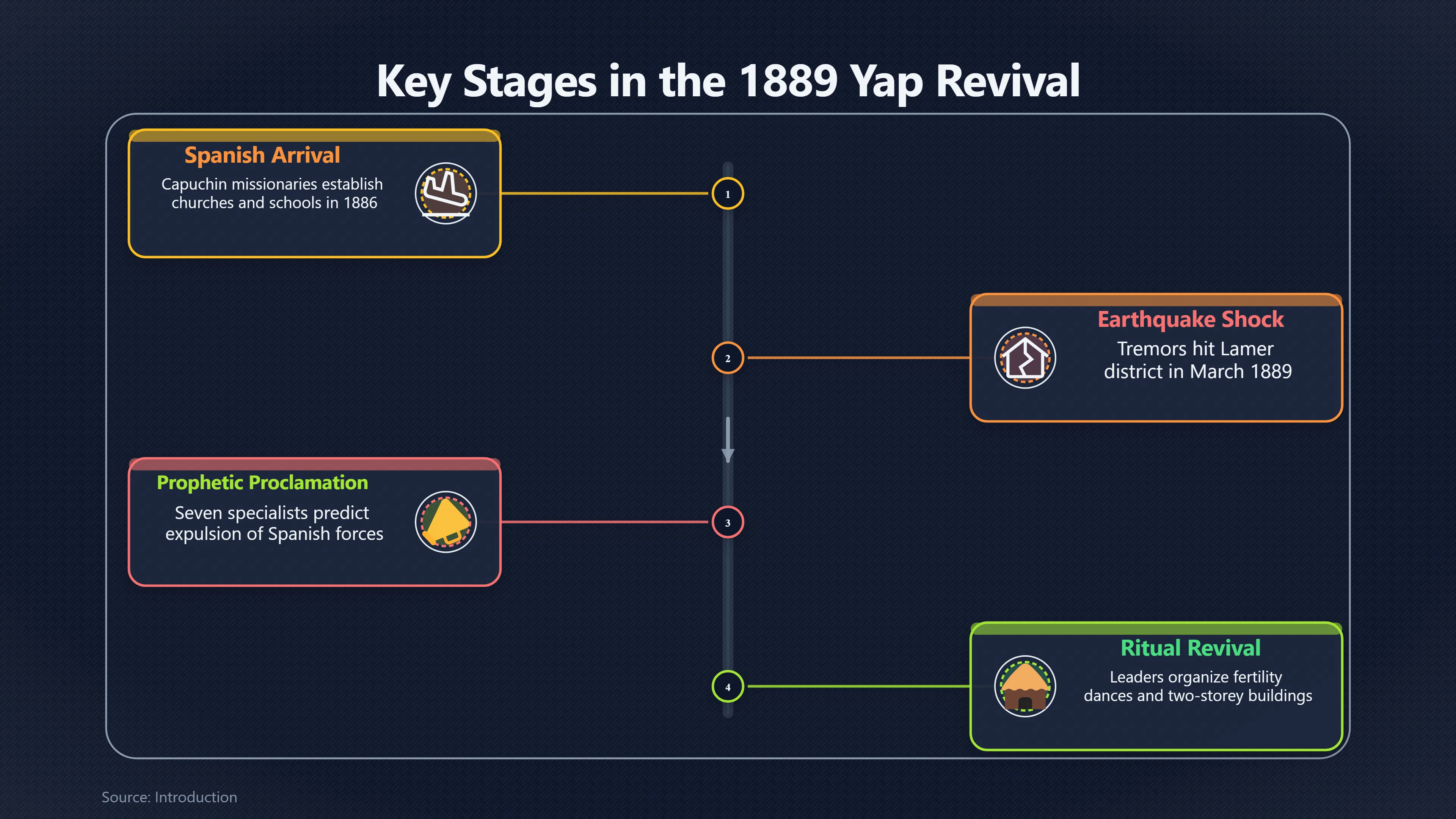
The revival took place only a few years after Spain had strengthened its presence on Yap. Capuchin missionaries arrived in 1886, established churches and schools, and sought to replace long-established religious practices with Catholic teaching. Their work was closely associated with the Spanish colonial administration, making political and religious authority appear closely linked in the eyes of many Yapese.[micsem.org]micsem.orgCatholic Church in Micronesia: YapCatholic Church in Micronesia: Yap
In March 1889, an earthquake affected the district of Lamer. Missionary accounts describe it as the first earthquake remembered by local people and report that tremors continued over an extended period, making the event especially unsettling. Whether or not the duration was remembered precisely, the earthquake clearly became a powerful sign that ordinary relationships between people, spirits and the landscape had been disturbed.[micsem.org]micsem.orgCatholic Church in Micronesia: YapCatholic Church in Micronesia: Yap
Rather than creating an entirely new religion, the earthquake provided an opportunity for defenders of Yap’s traditional priesthood to argue that ancestral spiritual powers were responding to foreign intrusion. The disaster therefore acted as a catalyst for a conflict that was already developing over religious authority.[DOI]doi.orgThe Old Religion of Yap | Summoning the Powers Beyond: Traditional Religions in Micronesia | Hawai'i Scholarship Online | Oxford Academic…
What the seven ritual specialists promised
According to the Capuchin missionaries’ reports, seven ritual specialists from Lamer began collecting traditional forms of Yapese money as offerings to the local spirit, or kan. They proclaimed that the spirit would drive away—or destroy—the Spaniards, including the missionaries, and warned that Yapese who accepted Christianity would share their fate unless they abandoned the new religion.[micsem.org]micsem.orgCatholic Church in Micronesia: YapCatholic Church in Micronesia: Yap
These predictions had practical consequences. Missionaries recorded that many people who had been attending Christian instruction stopped coming, apparently fearing that the prophecy might prove true. The revival therefore represented a genuine challenge to the fragile Catholic mission, whose number of converts remained very small during its first years on the island.[micsem.org]micsem.orgCatholic Church in Micronesia: YapCatholic Church in Micronesia: Yap
The movement was eventually confronted by one of the priests, identified in missionary sources as Father Daniel. The missionaries claimed that when challenged to demonstrate the power of the spirit directly, the prophets withdrew their threats. Because almost all surviving detailed descriptions come from Catholic observers, historians treat this account cautiously. It reflects the missionaries’ perspective and naturally portrays the confrontation as a victory for Christianity.[micsem.org]micsem.orgCatholic Church in Micronesia: YapCatholic Church in Micronesia: Yap
The revival of fertility rites
Alongside the prophecies, the same seven leaders reportedly revived an older fertility observance. They cleared a ceremonial area, constructed an unusually large two-storey Yapese building, and organised frequent dances designed to strengthen traditional religious practice. Women were told that participation would increase their chances of becoming pregnant.[micsem.org]micsem.orgCatholic Church in Micronesia: YapCatholic Church in Micronesia: Yap
Missionary narratives state that enthusiasm collapsed after several apparent misfortunes, including deaths among the leaders’ wives and pregnancy complications affecting some participants. These events were interpreted by the missionaries as proof that the traditional rites had failed and that Christianity had triumphed.[micsem.org]micsem.orgCatholic Church in Micronesia: YapCatholic Church in Micronesia: Yap
Modern historians approach these stories more carefully. The reported deaths and miscarriages come from missionary correspondence rather than independent local testimony, and they probably served as moral lessons within missionary literature. Even if the incidents occurred, they cannot simply be read as objective evidence that the movement collapsed because its prophecies were disproved.[micsem.org]micsem.orgCatholic Church in Micronesia: YapCatholic Church in Micronesia: Yap
Why the movement was not a cargo cult
The Yap revival is sometimes grouped loosely with Pacific prophetic movements, but it differs in important ways from the classic cargo cults that appeared elsewhere in Melanesia decades later.
Several features distinguish it:
- It sought to restore established religious traditions, not create a radically new religious system.
- It centred on fertility rites, ancestral spirits and ritual authority, rather than expectations of manufactured goods or European wealth.
- Its principal aim was the expulsion of missionaries and defence of local spiritual authority, not the arrival of a transformed economic order.
- It developed during the earliest phase of Spanish colonial rule, well before the twentieth-century cargo movements that emerged under very different historical conditions.[DOI]doi.orgThe Old Religion of Yap | Summoning the Powers Beyond: Traditional Religions in Micronesia | Hawai'i Scholarship Online | Oxford Academic…
For these reasons, scholars generally describe it as an indigenous prophetic or anti-missionary revival rather than a cargo cult. The movement belongs within a broader pattern of religious resistance to colonial expansion found in many parts of the world, where established ritual specialists attempted to defend their authority against missionary religions.[DOI]doi.orgThe Old Religion of Yap | Summoning the Powers Beyond: Traditional Religions in Micronesia | Hawai'i Scholarship Online | Oxford Academic…
What the episode reveals about belief under colonial rule
The earthquake prophecy illustrates how natural disasters can acquire political and religious meaning during periods of rapid social change. The tremors themselves did not automatically produce collective belief. Instead, they were interpreted through an existing religious framework in which spirits remained active participants in community life.
Equally important is the relationship between mission and government. Spanish officials often supported the Catholic mission through schools and administrative authority, making conversion appear tied to colonial power. Opposition to missionaries therefore also expressed resistance to foreign political control.[micsem.org]micsem.orgCatholic Church in Micronesia: YapCatholic Church in Micronesia: Yap
This helps explain why the revival attracted followers despite the limited success of its prophecies. The movement offered a way to reaffirm Yapese identity and religious continuity at a moment when long-established institutions faced unprecedented external pressure.

How historians interpret the revival today
Modern scholarship generally rejects simple explanations that portray the episode as either irrational panic or straightforward proof of missionary success. Instead, historians place it within the wider encounter between indigenous religion, colonial government and Christian evangelisation.
They also stress the limitations of the evidence. Nearly all detailed contemporary descriptions were written by Capuchin missionaries whose purpose was partly to document the progress of evangelisation. Their reports preserve invaluable historical information but also present events through a religious lens that emphasised the defeat of traditional beliefs and the moral authority of Christianity.[micsem.org]micsem.orgCatholic Church in Micronesia: YapCatholic Church in Micronesia: Yap
Despite these limitations, the 1889 Yap revival remains one of the clearest examples in Micronesian history of a prophetic movement emerging from the intersection of environmental shock, colonial expansion and religious competition. Rather than illustrating “mass hysteria”, it demonstrates how communities under pressure can reinterpret dramatic natural events as evidence that older spiritual traditions still possess authority and the power to shape the future.[DOI]doi.orgThe Old Religion of Yap | Summoning the Powers Beyond: Traditional Religions in Micronesia | Hawai'i Scholarship Online | Oxford Academic…
Amazon book picks
Further Reading
Books and field guides related to Did an Earthquake Spark Prophecy on Yap?. Use these as the next step if you want deeper reading beyond the article.

The trumpet shall sound
Useful comparative background despite the article distinguishing Yap from cargo cults.
The Elementary Forms Of Religious Life
Background for ritual, prophecy and collective belief.

Endnotes
1.
Source: micsem.org
Title: Catholic Church in Micronesia: Yap
Link:https://www.micsem.org/pubs/books/catholic/yap/index.htm
2.
Source: doi.org
Link:https://doi.org/10.21313/hawaii/9780824832032.003.0007
Source snippet
The Old Religion of Yap | Summoning the Powers Beyond: Traditional Religions in Micronesia | Hawai'i Scholarship Online | Oxford Academic...
3.
Source: micsem.org
Link:https://micsem.org/print/?id=2072
5.
Source: micsem.org
Link:https://micsem.org/article/distribution-of-spirit-possession-and-trance-in-micronesia/
6.
Source: history.state.gov
Link:https://history.state.gov/historicaldocuments/frus1892/d340
7.
Source: habeleinstitute.org
Link:https://habeleinstitute.org/wiki/Yap
Source snippet
Habele InstituteJune 19, 2026 — SPANISH ERA in 1886, the Spanish dispatched nine priests and monks of the Capuchin order to found mission...
Published: June 19, 2026
Additional References
8.
Source: catholicsandcultures.org
Title: A population that could have been larger th
Link:https://www.catholicsandcultures.org/micronesia-cultural-traditions-and-catholicism-guide-life-yap
Source snippet
Cultural traditions and Catholicism guide life on Yap, Micronesia | Catholics & CulturesApril 15, 2019 — HISTORICAL BACKGROUND For centur...
Published: April 15, 2019
9.
Source: bu.edu
Title: Prautch failed to appear at serv
Link:https://www.bu.edu/missiology/2020/02/28/zamora-nicolas/
Source snippet
Zamora, Nicolas | History of MissiologyFebruary 28, 2020 — ZAMORA, NICOLAS FIRST INDIGENOUS FILIPINO MISSIONARY AND FOUNDER OF INDEPENDEN...
Published: February 28, 2020
10.
Source: encyclopedia.adventist.org
Link:https://encyclopedia.adventist.org/article?highlight=church%7Cconver&id=67U3
Source snippet
Photo courtesy of Barry Oliver. CARGO CULTS IN MELANESIA AND THE SEVENTH-DAY ADVENTIST CHURCH BY MILTON HOOK Milton Hook...
11.
Source: academic.oup.com
Title: Login Handler.ashx
Link:https://academic.oup.com/HTTPHandlers/Sigma/LoginHandler.ashx?error=login_required&state=9b6d10d6-1ef0-4cec-8a83-110a2855e3f8redirecturl%3Dhttpszazjzjacademiczwoupzwcomzjhawaiizyscholarshipzyonlinezjbookzj18329zjchapterzj176367078
Source snippet
Old Religion of Yap | Summoning the Powers Beyond: Traditional Religions in Micronesia | Hawai'i Scholarship Online | Oxford AcademicSept...
12.
Source: degruyterbrill.com
Link:https://www.degruyterbrill.com/document/doi/10.1515/9780824860110-007/html?lang=en
13.
Source: degruyterbrill.com
Link:https://www.degruyterbrill.com/de/document/doi/10.1515/9780824860110-007/html
14.
Source: cambridge.org
Link:https://www.cambridge.org/core/journals/comparative-studies-in-society-and-history/article/abs/confession-conversion-and-reciprocity-in-early-tagalog-colonial-society/8FE0480E6B3DC4F42C84D9103DBA99D0
15.
Source: pacificworlds.com
Link:https://www.pacificworlds.com/yap/visitors/mission.cfm
16.
Source: youtube.com
Title: Deities, Gods & Spirits of Pre-Christian Micronesia
Link:https://www.youtube.com/watch?v=sFJUMazwSUY
Source snippet
History of Micronesia Part I: Early Encounters...
17.
Source: youtube.com
Title: History of Micronesia Part I: Early Encounters
Link:https://www.youtube.com/watch?v=qKe-X1OtrXQ
Source snippet
History of Micronesia Part II: Foreign Flag...
Topic Tree