Within Singapore Panics
How a Custody Case Sparked Religious Riots
A child-custody dispute became a religious crisis when sensational reporting and colonial mistrust transformed grievance into deadly unrest.
On this page
- The custody battle and competing loyalties
- How reporting intensified communal anger
- Why the riots still matter
Page outline Jump by section
Introduction
The Maria Hertogh case is one of the clearest examples in Singapore’s history of how a deeply personal legal dispute can become a wider crisis when it intersects with religion, colonial politics and inflammatory reporting. What began as a custody battle over a 13-year-old girl ended in three days of communal violence in December 1950 that left 18 people dead, 173 injured and much of Singapore shaken. The riots were not the inevitable result of religious differences. Rather, historians argue that they emerged from a combination of genuine grievances, widespread mistrust of British colonial rule, sensational media coverage and political mobilisation that transformed a family dispute into a symbolic struggle over faith and identity.[NUS Faculty of Arts & Social Sciences]fass.nus.edu.sgNUS Faculty of Arts & Social SciencesRethinking riots in colonial South East Asia: The case of the Maria Hertogh controversy in Singapore…
The episode remains significant because it illustrates how rumours, emotionally charged imagery and perceptions of injustice can rapidly turn local disputes into collective unrest. It also influenced later thinking in Singapore about communal harmony, crisis communication and the handling of sensitive religious issues.
The custody battle and competing loyalties
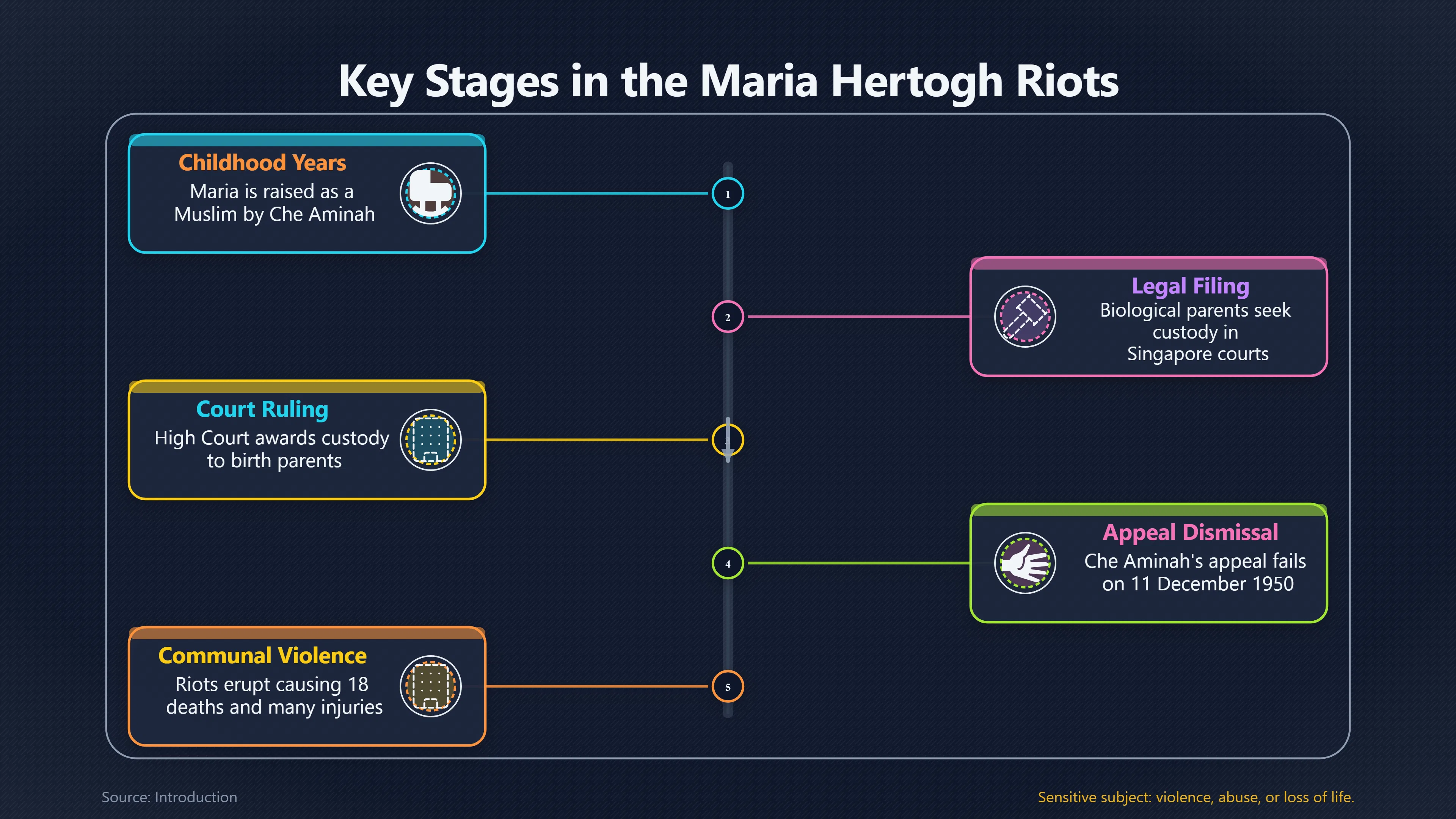
Maria Hertogh was born in 1937 to a Dutch-Eurasian Catholic family in the Dutch East Indies. During the Second World War, her parents were separated from her when the Japanese occupied the region. She was entrusted to Che Aminah, a Malay Muslim woman, who raised her as a Muslim under the name Nadra.
After the war, Maria’s biological parents sought to reclaim her through the courts. By the time legal proceedings began in Singapore in 1950, Maria had spent most of her childhood in a Malay Muslim household. She identified with that community, spoke Malay and had entered into a marriage recognised under local Muslim custom, although she was still only thirteen years old.[NUS Faculty of Arts & Social Sciences]fass.nus.edu.sgNUS Faculty of Arts & Social SciencesRethinking riots in colonial South East Asia: The case of the Maria Hertogh controversy in Singapore…
The legal dispute therefore involved more than questions of guardianship. Different groups interpreted the case through entirely different frameworks:
- Maria’s biological parents viewed the case as the restoration of their lawful parental rights.
- Che Aminah and many Muslims regarded Maria as a Muslim girl whose upbringing and marriage deserved recognition.
- The British colonial courts treated the matter primarily through Dutch civil law and guardianship principles, rather than Islamic family law.
When the High Court awarded custody to Maria’s birth parents and later rejected Che Aminah’s appeal, many Muslims believed the decision demonstrated that colonial institutions neither respected Islamic family life nor understood local religious customs. Whether or not that interpretation reflected the judges’ intentions, it became the dominant public perception among many protesters.[NUS Faculty of Arts & Social Sciences]fass.nus.edu.sgNUS Faculty of Arts & Social SciencesRethinking riots in colonial South East Asia: The case of the Maria Hertogh controversy in Singapore…
How reporting intensified communal anger
The legal judgement alone does not fully explain why violence followed. Historians consistently identify the public presentation of the case as a crucial factor.
The dispute attracted extraordinary international press attention. Newspapers in Singapore, Malaya and beyond covered every stage of the proceedings, often emphasising its dramatic and emotional aspects rather than its legal complexities. Political activists also reframed the case as evidence that Christianity was attempting to take a Muslim girl away from her faith.[SG101]sg101.gov.sgonthisday maria hertogh riotsMaria Hertogh Riots on 11 Dec 1950 | SG101…
One particularly powerful moment came after the initial custody ruling, when Maria was temporarily placed in the Roman Catholic Convent of the Good Shepherd while legal proceedings continued. Newspapers published photographs showing her apparently surrounded by Christian religious symbols.
For many Muslim readers, these images appeared to confirm fears that she was being forcibly converted or separated from Islam, even though the legal purpose of the convent placement was temporary accommodation rather than religious re-education. The photographs became far more influential than detailed explanations of the court’s reasoning.[SG101]sg101.gov.sgonthisday maria hertogh riotsMaria Hertogh Riots on 11 Dec 1950 | SG101…
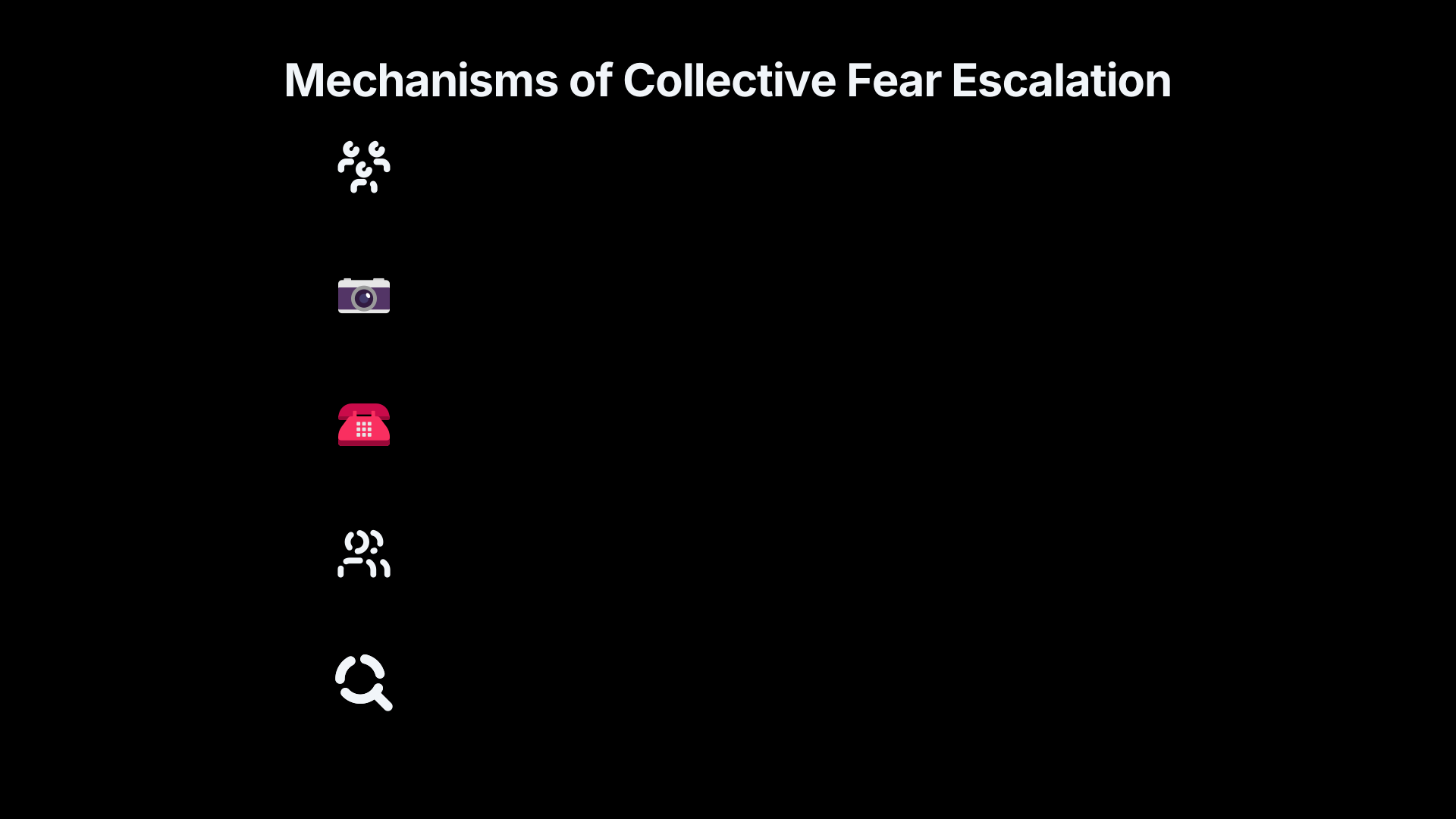
The episode demonstrates several mechanisms commonly seen in episodes of collective fear:
- Symbolic framing: A custody dispute became interpreted as an attack on an entire religious community.
- Selective reporting: Dramatic images proved more persuasive than legal arguments.
- Rumour amplification: Stories spread rapidly through newspapers, meetings and personal networks, often without correction reaching equally wide audiences.
- Political mobilisation: Activists used the controversy to rally supporters around broader anti-colonial and religious grievances.[NUS Faculty of Arts & Social Sciences]fass.nus.edu.sgNUS Faculty of Arts & Social SciencesRethinking riots in colonial South East Asia: The case of the Maria Hertogh controversy in Singapore…
Modern historians therefore tend to reject simple explanations that describe the riots as spontaneous religious hatred. Instead, they emphasise how media narratives, political actors and colonial tensions combined to reshape public understanding of the case.

Why the riots erupted
On 11 December 1950, the day Che Aminah’s appeal was dismissed, several thousand people gathered outside Singapore’s Supreme Court.
The demonstration initially centred on demands that Maria be removed from the convent and that the custody decision be reconsidered. After the appeal failed, tensions escalated rapidly. Violence spread from the court area into other parts of Singapore over the following three days.[SG101]sg101.gov.sgonthisday maria hertogh riotsMaria Hertogh Riots on 11 Dec 1950 | SG101…
The disturbances resulted in:
- 18 deaths.
- Around 173 injuries.
- Extensive destruction of vehicles, shops and other property.
- Hundreds of arrests before order was restored.[SG101]sg101.gov.sgonthisday maria hertogh riotsMaria Hertogh Riots on 11 Dec 1950 | SG101…
Victims included civilians from several communities as well as police and other officials. Although the violence is commonly described as communal or religious, it also reflected broader frustrations with colonial authority during a period of growing political change across Southeast Asia.[Routledge]routledge.comColonialism, Violence and Muslims in Southeast Asia: The Maria HertoghColonialism, Violence and Muslims in Southeast Asia: The Maria Hertogh…
Why historians avoid calling it simply “mass hysteria”
The Maria Hertogh riots are sometimes mentioned alongside episodes of collective fear, but they differ from classic examples of mass psychogenic illness or panic.
The participants were responding to events that had genuinely occurred: a court judgement, a custody transfer and highly publicised photographs. The critical issue was not imaginary events but the interpretation of those events.
Most historians instead describe the episode as a mixture of:
- communal mobilisation;
- political protest;
- rumour-driven escalation;
- media sensationalism;
- colonial mistrust; and
- emotionally charged religious symbolism.
The fears were real even where some factual assumptions were mistaken. Many Muslims sincerely believed that Maria’s faith was under threat, while colonial officials viewed themselves as enforcing legal principles rather than attacking religion. Those competing interpretations proved impossible to reconcile once public emotions had become inflamed.[NUS Faculty of Arts & Social Sciences]fass.nus.edu.sgNUS Faculty of Arts & Social SciencesRethinking riots in colonial South East Asia: The case of the Maria Hertogh controversy in Singapore…
Why the riots still matter
The Maria Hertogh riots became a lasting reference point in Singapore’s understanding of racial and religious harmony.
Subsequent official accounts have repeatedly highlighted two interconnected lessons. First, disputes involving religion require exceptional sensitivity from governments, courts and community leaders. Secondly, distorted or sensational reporting can dramatically increase the risk of violence by transforming individual disputes into perceived attacks on entire communities.[SG101]sg101.gov.sgonthisday lessons maria hertogh riotsLessons from Maria Hertogh Riots (11 Dec 1950) | SG101…
The riots also prompted institutional changes. The police reviewed their riot-control capabilities, while colonial authorities investigated the causes of the violence through a formal commission of inquiry. Later scholarship has argued that the crisis influenced how both colonial and post-colonial governments approached religious administration, public order and intercommunal relations.[Roots]roots.gov.sgRoots First Police Office (demolishedRoots First Police Office (demolished
Today, the case continues to be discussed in Singapore not simply as a historical tragedy but as a warning about how legal disputes can become symbols of wider cultural conflict. In an age of instant communication and social media, its central lesson remains strikingly modern: emotionally powerful images, selective reporting and rapidly spreading rumours can reshape public perception far faster than careful legal explanation or official clarification.[SG101]sg101.gov.sgonthisday lessons maria hertogh riotsLessons from Maria Hertogh Riots (11 Dec 1950) | SG101…
Amazon book picks
Further Reading
Books and field guides related to How a Custody Case Sparked Religious Riots. Use these as the next step if you want deeper reading beyond the article.
Extraordinary Popular Delusions and the Madness of Crowds
Rating: 4.0/5 from 5 Google Books ratings
Useful for understanding rumour-driven unrest.
From Third World to First : The Singapore Story
Places communal tensions in broader national history.

Gustave Bon Classics: the Crowd a Study of the Popular Mind
Background on collective behaviour.
Endnotes
1.
Source: fass.nus.edu.sg
Link:https://fass.nus.edu.sg/srn/2019/12/16/rethinking-riots-in-colonial-south-east-asia-the-case-of-the-maria-hertogh-controversy-in-singapore-1950-54/
Source snippet
NUS Faculty of Arts & Social SciencesRethinking riots in colonial South East Asia: The case of the Maria Hertogh controversy in Singapore...
2.
Source: sg101.gov.sg
Title: onthisday maria hertogh riots
Link:https://www.sg101.gov.sg/resources/archives/onthisday-maria-hertogh-riots/
Source snippet
Maria Hertogh Riots on 11 Dec 1950 | SG101...
3.
Source: routledge.com
Title: Colonialism, Violence and Muslims in Southeast Asia: The Maria Hertogh
Link:https://www.routledge.com/9780415485944
Source snippet
Colonialism, Violence and Muslims in Southeast Asia: The Maria Hertogh...
4.
Source: sg101.gov.sg
Title: onthisday lessons maria hertogh riots
Link:https://www.sg101.gov.sg/resources/archives/onthisday-lessons-maria-hertogh-riots/
Source snippet
Lessons from Maria Hertogh Riots (11 Dec 1950) | SG101...
5.
Source: biblioasia.nlb.gov.sg
Title: Biblio Asia What You Didn’t Know About the Straits Times | Biblio Asia
Link:https://biblioasia.nlb.gov.sg/all-sections/vol-21-issue-4-jan-mar-2026-straits-times-180-anniversary/
Source snippet
It looked neither like the newspaper of today nor the prewar version. This...
6.
Source: roots.gov.sg
Title: Roots First Police Office (demolished)
Link:https://www.roots.gov.sg/places/places-landing/Places/landmarks/police-heritage-trail/first-police-office-demolished
7.
Source: exhibitions.nlb.gov.sg
Title: A news story might seem like a mere account of an incident or d
Link:https://exhibitions.nlb.gov.sg/newsgallery/virtual-gallery/behind-every-story/
Source snippet
Every StoryJune 18, 2026 — BEHIND EVERY STORY Behind Every Story * The News Gallery: Beyond Headlines * * Early Editions * Behind Every S...
Published: June 18, 2026
8.
Source: biblioasia.nlb.gov.sg
Title: nlb.gov.sg A History of The Padang | Biblio Asia
Link:https://biblioasia.nlb.gov.sg/all-sections/vol-18-issue-1-apr-to-jun-2022-history-padang/
Source snippet
History of The Padang | BiblioAsiaApril 1, 2022 — OF CONTESTATION AND CONFRONTATION Given the Padang’s role at the heart of British colon...
Published: April 1, 2022
Additional References
9.
Source: youtube.com
Link:https://www.youtube.com/watch?v=1AFynSxj6ZI
Source snippet
The Nadra Tragedy: The Maria Hertogh Controversy...
Published: December 1950
10.
Source: tandfonline.com
Link:https://www.tandfonline.com/doi/abs/10.5367/000000010790959866
Source snippet
Taylor & Francis OnlineRethinking Riots in Colonial South East Asia: The Case of the Maria Hertogh Controversy in Singapore, 1950–54: Sou...
11.
Source: youtube.com
Title: The Nadra Tragedy: The Maria Hertogh Controversy
Link:https://www.youtube.com/watch?v=2SEHiXyZ-Ac
Source snippet
Tragic History of Kampong Glam | Haunting History S2 EP5...
12.
Source: researchgate.net
Link:https://www.researchgate.net/publication/350687221_Colonialism_Violence_and_Muslims_in_Southeast_Asia
13.
Source: scribd.com
Link:https://www.scribd.com/document/515270114/Living-History
14.
Source: researchgate.net
Link:https://www.researchgate.net/publication/233518861_Rethinking_Riots_in_Colonial_South_East_Asia_The_Case_of_the_Maria_Hertogh_Controversy_in_Singapore
15.
Source: scribd.com
Link:https://www.scribd.com/document/785917889/history
16.
Source: upr.lse.ac.uk
Link:https://upr.lse.ac.uk/articles/38
17.
Source: youtube.com
Link:https://www.youtube.com/watch?v=tw1xeroJYt0
Source snippet
Days of Rage: Nadra...
18.
Source: youtube.com
Title: Days of Rage: Nadra
Link:https://www.youtube.com/watch?v=DdFtO6aOH_k
Source snippet
Diary of a Nation (SBC 1988) - 11 December 1950: Maria Hertogh Riots...
Published: December 1950
Topic Tree