Within Spain's Strange Beliefs
How Spain's Witch Panic Manufactured Its Own Evidence
Spain's witch hunts reveal how accusations spread, why local courts escalated them and how sceptical inquiry helped halt mass trials.
On this page
- The Zugarramurdi accusations and mass trial
- How Salazar tested confessions and physical claims
- Catalan prosecutions, gendered scapegoating and rehabilitation
Page outline Jump by section
Introduction
Spain’s best-known witch panic is important not because it confirms every stereotype about the early modern witch hunts, but because it demonstrates how a determined investigation exposed the weakness of the evidence that had fuelled the panic. The accusations centred on the Basque village of Zugarramurdi and neighbouring communities between 1608 and 1614. Confessions, rumours and denunciations spread rapidly, producing what appeared to be overwhelming proof of a vast satanic conspiracy. Yet when inquisitor Alonso de Salazar Frías systematically tested those claims against observable facts, he found contradictions, suggestive questioning, unreliable testimony and no independent evidence that the alleged crimes had occurred. His investigation helped reshape Spanish policy, making Spain one of the earliest European states to impose far stricter evidential standards in witchcraft cases. That change did not end every witch prosecution, especially in Catalonia, but it sharply reduced the likelihood that another inquisitorial panic would spiral into mass convictions.[ResearchGate]researchgate.netOpen source on researchgate.net.
How the Zugarramurdi accusations became a self-reinforcing panic
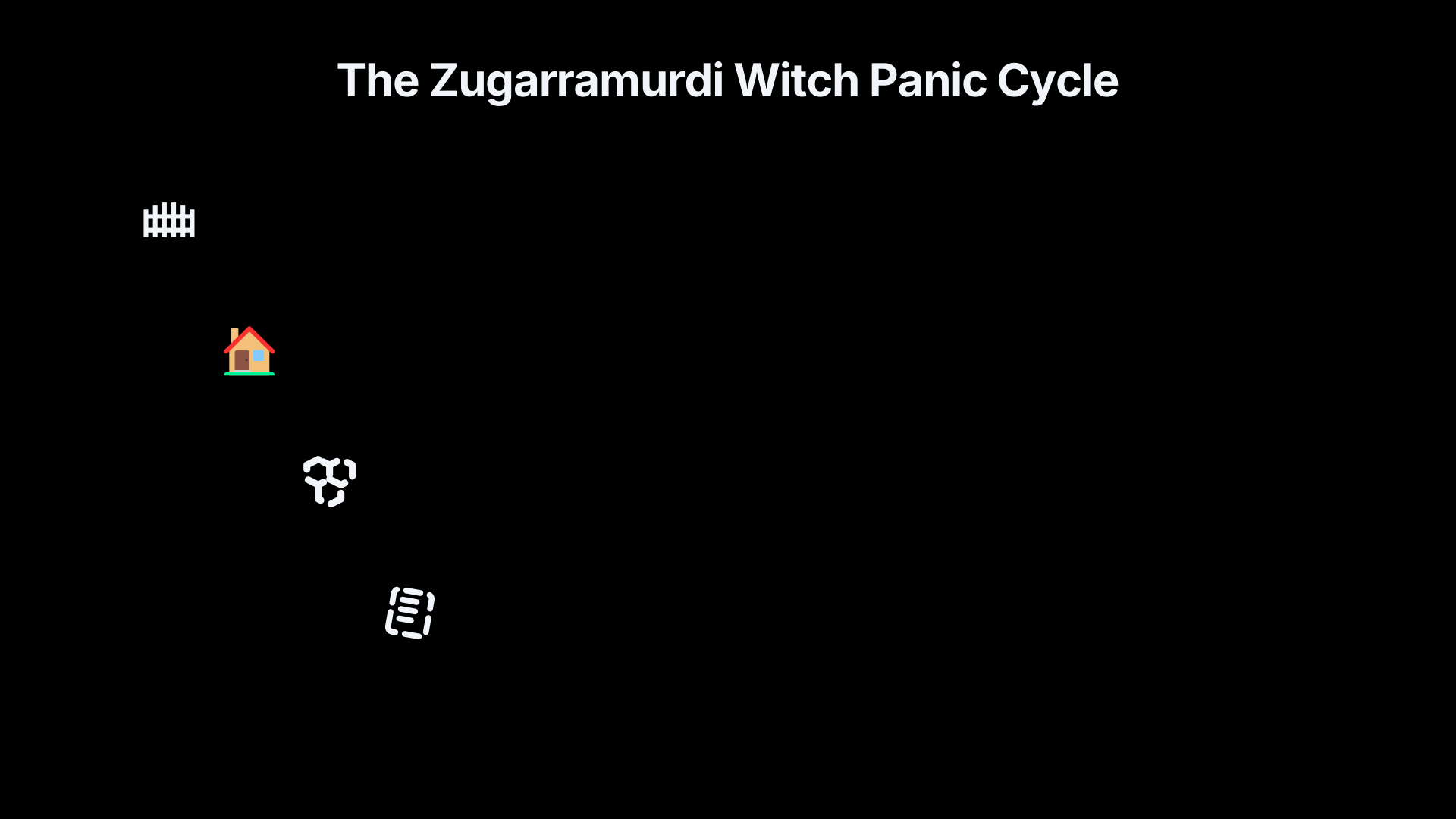
The panic developed in the Basque-Navarre frontier, where news of severe French witch persecutions had already crossed the border. Stories of secret nocturnal meetings, pacts with the Devil and magical flight circulated through villages already under social and religious strain. Children and adults alike began identifying neighbours as witches, while suspects implicated relatives and acquaintances during interrogations. Each confession appeared to confirm earlier accusations, encouraging investigators to seek more admissions and prompting still more denunciations.[ResearchGate]researchgate.netOpen source on researchgate.net.
The Tribunal of Logroño initially treated many of these statements as credible. In 1610 it staged a large public auto-da-fé in which numerous defendants were sentenced, with several executed and others condemned after dying in prison. Public ceremonies, printed accounts and repeated questioning reinforced the impression that a vast conspiracy had been uncovered. Rather than checking whether the accusations independently matched reality, the investigation increasingly relied on suspects confirming details already circulating within the community. Historians regard this as a classic example of a feedback loop in which belief generated further “evidence” for itself.[Atlante]atlante.univ-lille.fr05. Scandale et controverse autour des sorcières de Zugarramurdi (1609-1619): un observatoire pour l’intime? - Atlante - Revue d…
How Alonso de Salazar tested the claims instead of repeating them
The turning point came when inquisitor Alonso de Salazar Frías refused to assume that repeated accusations automatically proved guilt. Instead of concentrating on extracting more confessions, he travelled widely through the affected villages, interviewing hundreds of people and comparing their accounts against one another.[ResearchGate]researchgate.netOpen source on researchgate.net.
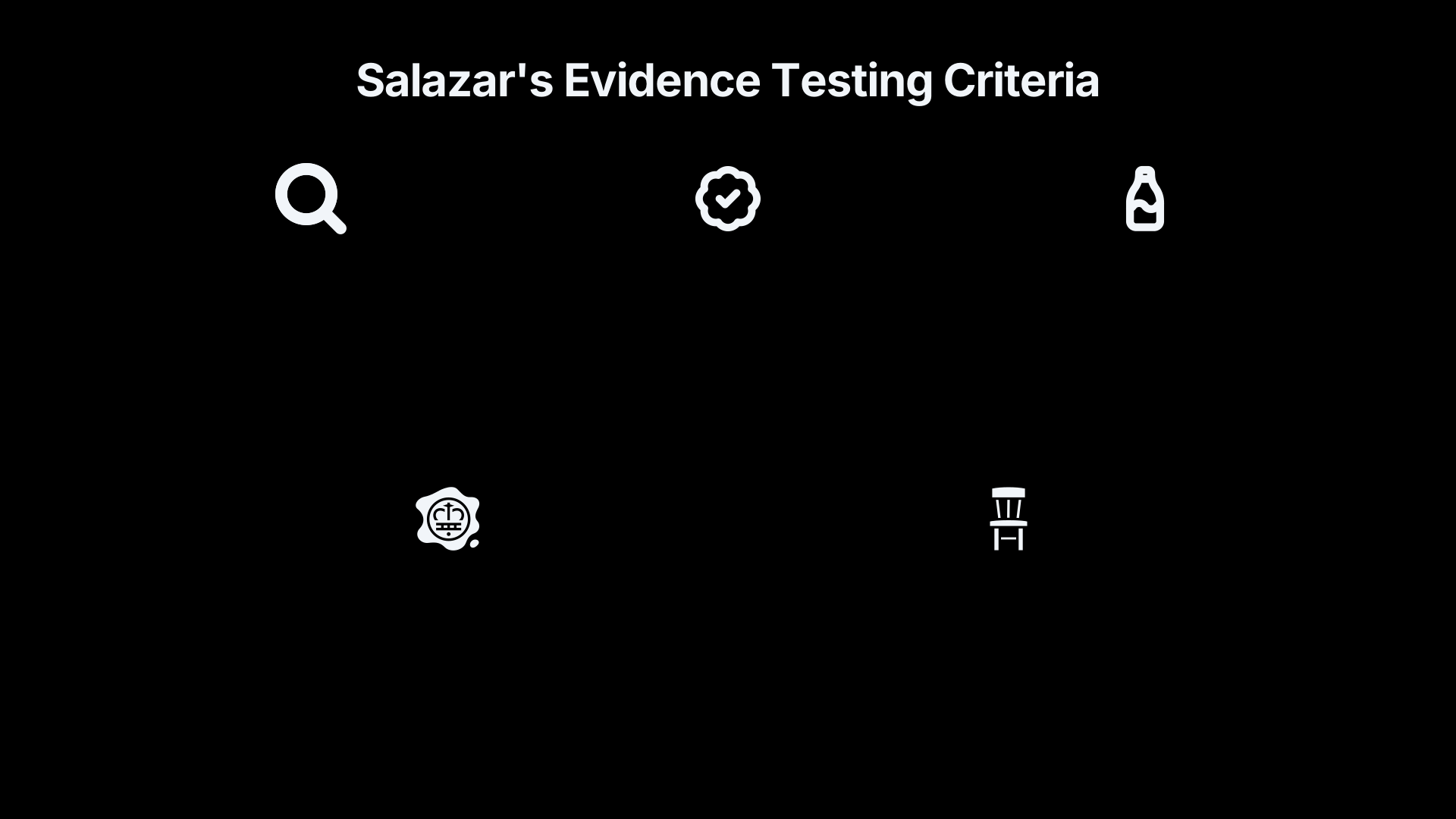
His investigation differed from many contemporary witch inquiries because it asked practical questions.
- Were independent witnesses describing the same events without influencing one another?
- Could alleged journeys or gatherings actually be verified?
- Did physical traces support claims of supernatural activity?
- Were confessions stable when suspects were no longer under pressure?
- Did children repeat stories they had already heard from adults or investigators?
Repeatedly, Salazar found that the evidence failed these tests. Witnesses contradicted one another on basic details. Many confessors later withdrew their admissions. Alleged magical substances behaved like ordinary materials. Claims about flights, sabbaths and transformations could not be independently corroborated. He concluded that fear, repeated interrogation, expectation and communal suggestion had encouraged people to describe experiences they increasingly believed—or felt obliged—to report.[ResearchGate]researchgate.netOpen source on researchgate.net.
His famous conclusion has often been summarised by historians as a warning that there were neither witches nor bewitched people until people began discussing and believing such stories. Although modern scholars avoid treating this as a psychological theory in the modern sense, they regard it as an unusually sophisticated recognition that social pressure can manufacture apparently convincing testimony.[ResearchGate]researchgate.netOpen source on researchgate.net.
Why the 1614 reforms mattered
Salazar’s findings persuaded the Supreme Council of the Spanish Inquisition to revise its approach in 1614. Rather than encouraging aggressive witch prosecutions, new instructions required much stronger evidence before convictions could proceed. Officials were warned against relying solely on confessions or rumours and were discouraged from public discussions that might spread further accusations. Greater emphasis was placed on corroboration, consistency and material proof.[ResearchGate]researchgate.netOpen source on researchgate.net.
These reforms did not reflect disbelief in every form of witchcraft. Many church officials still accepted that witchcraft might exist in principle. The crucial change lay elsewhere: extraordinary allegations required convincing evidence rather than mutually reinforcing testimony. That distinction transformed inquisitorial practice.
Historians frequently describe the Spanish response as unusual within early modern Europe because central authorities reacted to an episode of mass accusation by tightening evidential standards instead of expanding prosecutions. The reforms therefore represent an early institutional attempt to interrupt the social dynamics that allowed witch panics to escalate.[ResearchGate]researchgate.netOpen source on researchgate.net.
Why Catalonia followed a different path
The Basque reforms did not end witch hunting everywhere in Spain because legal authority was not uniform. In Catalonia, many prosecutions remained under local secular courts rather than the Inquisition. Between roughly 1614 and 1622, local judges conducted one of the harshest periods of witch persecution in Spanish history, with hundreds executed according to the strongest current historical estimates.[Dialnet]dialnet.unirioja.esThe Catalan Church and the Witch Hunt: the Royal Survey of 1621 - DialnetJanuary 1, 1970…
Several factors made Catalonia different.
- Local courts operated under different legal traditions.
- Communities facing economic hardship or social conflict often looked for individual scapegoats.
- Women, especially older, poorer or socially marginal women, were disproportionately accused.
- Local authorities proved more willing than the Inquisition to accept neighbourhood rumours and reputation as evidence.
The contrast demonstrates that Spain did not experience a single national witch-hunting policy. Whether someone faced execution often depended on which court claimed jurisdiction rather than on the accusation itself.[Dialnet]dialnet.unirioja.esThe Catalan Church and the Witch Hunt: the Royal Survey of 1621 - DialnetJanuary 1, 1970…
Growing concern within the monarchy, the Church and some bishops eventually led to intervention. A royal survey in 1621 considered transferring witchcraft jurisdiction to the Inquisition and explored the possibility of broader pardons. The Royal Audience of Catalonia subsequently assumed control over many cases, bringing the major wave of executions to an end.[Dialnet]dialnet.unirioja.esThe Catalan Church and the Witch Hunt: the Royal Survey of 1621 - DialnetJanuary 1, 1970…
What the evidence reveals about collective fear
The Spanish witch panic illustrates several mechanisms recognised by modern historians and social scientists studying collective belief.
First, accusations spread through ordinary social networks rather than through a single organised conspiracy. Families, neighbours and children repeated stories that became increasingly detailed through retelling.
Second, interrogation methods could unintentionally shape testimony. Once investigators expected certain answers, suspects often supplied them, whether from fear, suggestion or attempts to satisfy authority.
Third, repeated confessions did not necessarily increase reliability. When witnesses influenced one another, apparent agreement could simply reflect shared stories rather than independent observation.
Finally, institutional scepticism mattered. Salazar’s investigation did not rely on philosophical arguments against witchcraft alone. It relied on comparing statements with observable reality and rejecting conclusions unsupported by consistent evidence. That procedural change proved more effective than simply urging people to be less superstitious.[ResearchGate]researchgate.netOpen source on researchgate.net.
Gender, memory and modern reassessment
Although men were sometimes accused, the overwhelming majority of those executed in Catalonia were women. Modern historians emphasise that accusations often targeted individuals who were already socially vulnerable because of poverty, widowhood, age or local disputes. Witchcraft allegations therefore became a means of explaining misfortune while also reinforcing existing inequalities.[Dialnet]dialnet.unirioja.esThe Catalan Church and the Witch Hunt: the Royal Survey of 1621 - DialnetJanuary 1, 1970…
Recent historical work has increasingly focused on restoring the identities of those prosecuted rather than treating them merely as examples of superstition. In Catalonia, public institutions have formally acknowledged many of the accused as victims of injustice and encouraged educational initiatives examining misogyny, legal failure and historical memory. These efforts reflect a broader shift away from sensational stories of witches towards understanding how ordinary legal systems and communities could become convinced by evidence that later proved deeply unreliable.[Dialnet]dialnet.unirioja.esThe Catalan Church and the Witch Hunt: the Royal Survey of 1621 - DialnetJanuary 1, 1970…
Why the Spanish case remains distinctive
Spain’s witch panics were undeniably destructive, and innocent people were imprisoned, executed and publicly disgraced. Yet the Spanish experience also produced one of early modern Europe’s clearest demonstrations that legal institutions could learn from failure. Alonso de Salazar Frías did not end belief in witchcraft overnight, nor did he prevent every later prosecution. What he demonstrated was that extraordinary accusations collapse when they are tested against consistent evidence rather than accepted because many frightened people repeat them.
That lesson gives the Zugarramurdi investigations an enduring place in the history of collective fear. They show that rumours can generate convincing-looking proof, that confessions are not always reliable indicators of truth, and that careful, sceptical inquiry can stop a panic from manufacturing its own evidence.[researchgate.net]researchgate.netOpen source on researchgate.net.
Amazon book picks
Further Reading
Books and field guides related to How Spain's Witch Panic Manufactured Its Own Evidence. Use these as the next step if you want deeper reading beyond the article.
The witch-hunt in early modern Europe
Explains how legal procedure, interrogation, confession and institutional incentives transformed accusations into large-scale European wi...

The witch
Provides the wider intellectual and cultural history of witch beliefs, helping readers understand the stereotypes and fears that made fab...

The witches' advocate
Directly examines the Basque accusations, Logroño trial, unreliable confessions and Salazar's evidence-testing investigation.
WITCHES AND NEIGHBOURS: THE SOCIAL AND CULTURAL CONTEXT OF EU...
Shows how rumours, interpersonal tensions, denunciations and community beliefs created self-reinforcing accusations like those seen aroun...
Endnotes
1.
Source: researchgate.net
Link:https://www.researchgate.net/publication/254958023_The_Salazar_Documents_Inquisitor_Alonso_de_Salazar_FrA-as_and_Others_on_the_Basque_Witch_Persecution_review
2.
Source: researchgate.net
Link:https://www.researchgate.net/publication/304560597_De_Sant_Hilari_a_Arbucies_dotze_cases_tretze_bruixes_la_persecucion_de_las_brujas_en_la_Cataluna_moderna
3.
Source: researchgate.net
Link:https://www.researchgate.net/publication/259713547_Sortilegas_divinatrices_et_fetilleres_Les_origines_de_la_sorcellerie_en_Catalogne
4.
Source: atlante.univ-lille.fr
Link:https://atlante.univ-lille.fr/05-scandale-et-controverse-autour-des-sorcieres-de-zugarramurdi-1609-1619-un-observatoire-pour-lintime.html
Source snippet
05. Scandale et controverse autour des sorcières de Zugarramurdi (1609-1619): un observatoire pour l’intime? - Atlante - Revue d...
5.
Source: dialnet.unirioja.es
Link:https://dialnet.unirioja.es/servlet/articulo?codigo=5562702
Source snippet
The Catalan Church and the Witch Hunt: the Royal Survey of 1621 - DialnetJanuary 1, 1970...
Published: January 1, 1970
6.
Source: dialnet.unirioja.es
Link:https://dialnet.unirioja.es/servlet/articulo?codigo=8036276
Additional References
7.
Source: espanaenlahistoria.org
Link:https://espanaenlahistoria.org/episodios/la-verdad-sobre-el-proceso-inquisitorial-a-las-brujas-de-zugarramurdi/
Source snippet
April 28, 2023 — LA VERDAD SOBRE EL PROCESO INQUISITORIAL A LAS BRUJAS DE ZUGARRAMURDI * Jesús Caraballo * 28/04/2023 * Un comentario Ima...
Published: April 28, 2023
8.
Source: revistas.navarra.es
Title: es Los documentos de Alonso de Salazar Frías
Link:https://revistas.navarra.es/index.php/PV/article/view/1714
Source snippet
Una polémica sobre la brujería en España, 1610-1614 | Príncipe de VianaAugust 25, 2021 — LOS DOCUMENTOS DE ALONSO DE SALAZAR FRÍAS. UNA P...
Published: August 25, 2021
9.
Source: youtube.com
Link:https://www.youtube.com/watch?v=35qty0-iH2U
Source snippet
Secrets of the Basque Witch Hunt with Jan Machielsen...
10.
Source: youtube.com
Title: The Dark Secret Behind the Basque Witch Trials
Link:https://www.youtube.com/watch?v=NLbTdv1Lip0
Source snippet
The Witches of Spain: True Stories from Zugarramurdi and Healers the Inquisition Could Not Silence...
11.
Source: youtube.com
Title: Why didn’t Spain burn thousands of witches like the rest of Europe?
Link:https://www.youtube.com/watch?v=kpLHHQIuliw
Source snippet
The Dark Secret Behind the Basque Witch Trials...
12.
Source: diposit.ub.edu
Link:https://diposit.ub.edu/items/f5b159a7-80b8-48e2-9d42-04aa895e5aff
Source snippet
cacera de bruixes al Vallès (1619-1622): processos locals i causa generalJanuary 1, 2020 — FITXERS 700288.pdf (165.45 KB) DATA DE PUBLICA...
Published: January 1, 2020
13.
Source: turismozugarramurdi.com
Link:https://www.turismozugarramurdi.com/historia/
Source snippet
Turismo ZugarramurdiApril 28, 2023 — 1609-1610 Diciembre de 1609 y marzo 1610: 17 personas más son enviadas a las cárceles del Tribunal d...
Published: April 28, 2023
14.
Source: academic.oup.com
Link:https://academic.oup.com/jaar/article/90/3/780/7128018
Source snippet
Lu Ann Homza | Journal of the American Academy of Religion | Oxford AcademicApril 18, 2023 — Journal Article VILLAGE INFERNOS AND WITCHES...
Published: April 18, 2023
15.
Source: ub.edu
Link:https://www.ub.edu/duoda/diferencia/html/en/secundario7.html
16.
Source: eusko-ikaskuntza.eus
Link:https://www.eusko-ikaskuntza.eus/es/publicaciones/los-otros-abogados-de-las-brujas-el-debate-sobre-la-caza-de-brujas-en-cataluna/art-21917/
Topic Tree