Within Honduras Panics
What Caused the Lempira Schoolgirls to Faint?
The 2008 collapse of schoolgirls in Lempira shows how real symptoms, medical uncertainty and local legends can reinforce one another.
On this page
- What happened at Miguel Morazan school
- Why doctors considered collective illness
- How fear and folklore shaped the response
Page outline Jump by section
Introduction
In July 2008, a cluster of unexplained fainting episodes among schoolgirls at the Miguel Morazán Basic Education Centre in the western Honduran department of Lempira became one of the country’s best-known cases of a suspected mass psychogenic illness. The pupils experienced repeated collapses over several days, prompting hospital visits, the suspension of classes and widespread anxiety within the community. Because doctors did not identify an obvious physical disease, many residents turned to familiar local legends about evil spirits and supernatural forces. The episode remains significant because it illustrates how genuine physical symptoms, medical uncertainty and deeply rooted folklore can reinforce one another during a frightening public event.[www.laprensa.hn]laprensa.hnwww.laprensa.hn Masivo desmayo de alumnas en colegiodesmayo de alumnas en colegioJuly 8, 2008…
What happened at Miguel Morazán school?
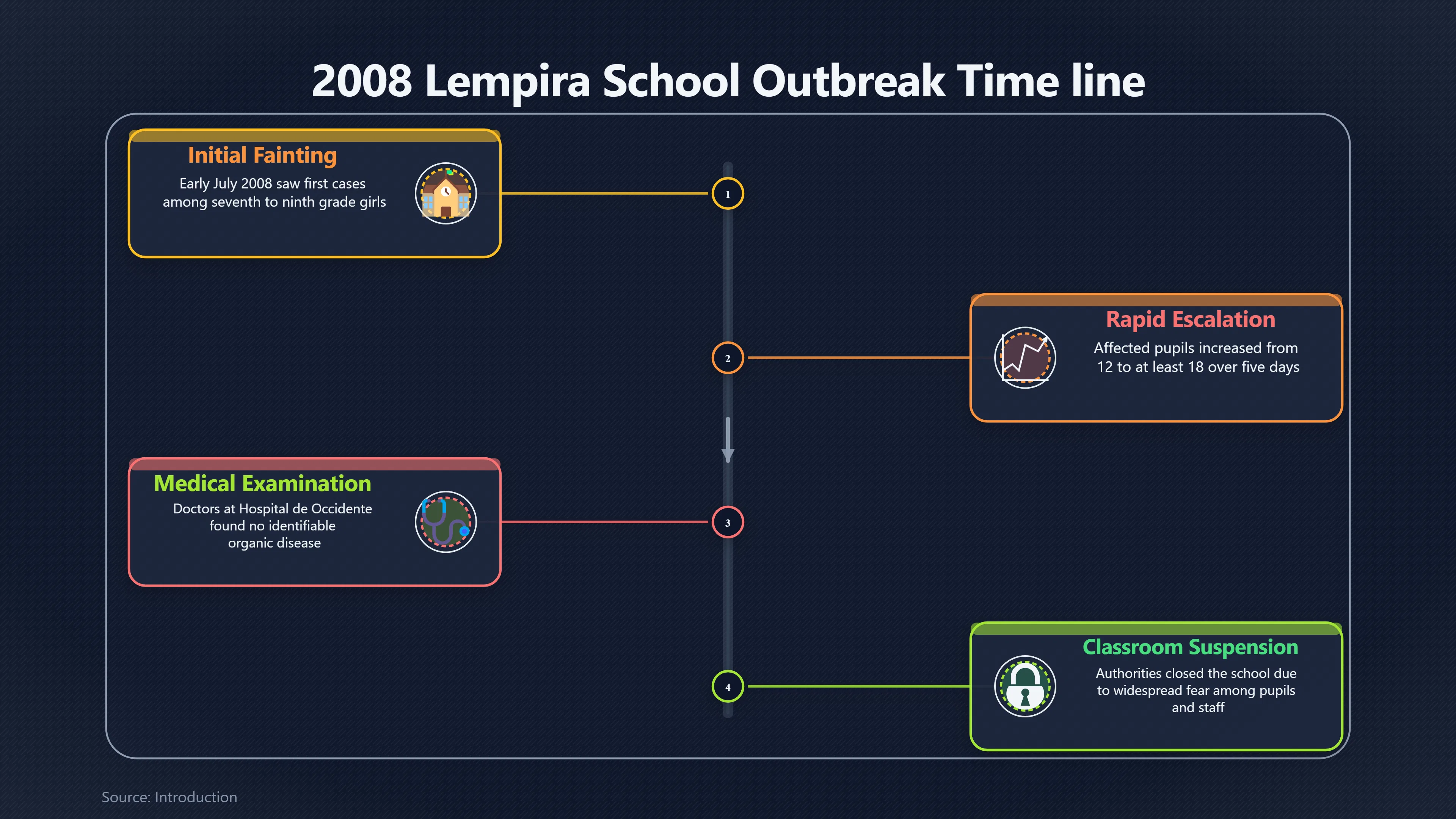
According to contemporary reporting, the first cases appeared in early July 2008 at the Miguel Morazán Basic Education Centre. The initial group consisted mainly of girls in the seventh to ninth grades who suddenly fainted during the school day. Local reports stated that the incidents continued for around five days and spread from 12 pupils to at least 18 affected young women.
The situation escalated quickly. Twelve pupils were transported to the Hospital de Occidente in Santa Rosa de Copán for examination. Doctors reportedly found no identifiable illness and suggested the possibility of a case of “collective hysteria”, although they could not explain why the symptoms had begun. Parents initially hoped the problem had been resolved after the girls returned home, but further collapses followed. Eventually, reports indicated that young women outside the school also began experiencing similar episodes, increasing fears that something was spreading through the community rather than remaining confined to the classroom. School authorities suspended lessons because both pupils and teachers were frightened by the continuing incidents.[www.laprensa.hn]laprensa.hnwww.laprensa.hn Masivo desmayo de alumnas en colegiodesmayo de alumnas en colegioJuly 8, 2008…
Why doctors considered collective illness
The available public record is remarkably limited. No detailed epidemiological investigation, laboratory findings or comprehensive medical follow-up has been published. That means there is no definitive proof that the outbreak was an example of mass psychogenic illness, and it would be misleading to present the diagnosis as settled fact. A responsible investigation of any such cluster would first consider infectious disease, environmental contamination, neurological disorders or toxic exposure before concluding that psychological and social mechanisms were primarily responsible.[www.laprensa.hn]laprensa.hnwww.laprensa.hn Masivo desmayo de alumnas en colegiodesmayo de alumnas en colegioJuly 8, 2008…
Nevertheless, several features reported from Lempira resemble patterns documented in school-based episodes of mass psychogenic illness around the world:
- The outbreak centred on a closely connected group of pupils.
- Most reported cases involved adolescent girls.
- Symptoms appeared to spread after classmates witnessed earlier collapses.
- Doctors did not identify an organic disease explaining the cluster.
- The episode caused major disruption despite limited objective medical findings.[laprensa.hn]laprensa.hnwww.laprensa.hn Masivo desmayo de alumnas en colegiodesmayo de alumnas en colegioJuly 8, 2008…
Medical research describes mass psychogenic illness as the rapid spread of genuine physical symptoms within a group when no single medical cause can be demonstrated. The symptoms are real to those experiencing them and are not considered deliberate acting or fabrication. Common features include dizziness, fainting, headaches, weakness, nausea and hyperventilation, particularly in schools and other close-knit communities.[nejm.org]nejm.orgOpen source on nejm.org.
How fear and folklore shaped the response
The absence of a clear medical explanation created space for alternative interpretations. Local newspaper coverage reported that many residents believed an evil spirit was attacking the girls. Older regional legends, including stories associated with the “Brujos de Talgua”, a mischievous supernatural figure known as El Duende, and a landmark called the Devil’s Kick Stone, were revived as possible explanations. These stories were already part of local cultural memory, making them readily available when families searched for meaning in an alarming event.[www.laprensa.hn]laprensa.hnwww.laprensa.hn Masivo desmayo de alumnas en colegiodesmayo de alumnas en colegioJuly 8, 2008…
This does not mean folklore caused the fainting. Instead, beliefs about supernatural forces helped shape how the community understood events after they had begun. When doctors could only say that no disease had been found, some families regarded that as an incomplete answer rather than reassurance.
Psychological research suggests several mechanisms that can reinforce outbreaks of this kind:
- Observation increases expectation. Watching classmates collapse can make ordinary sensations such as dizziness feel more threatening.
- Anxiety produces physical symptoms. Fear may lead to rapid breathing, light-headedness, tingling and even fainting.
- Shared explanations reinforce transmission. Rumours and repeated discussion can encourage people to interpret similar bodily sensations in the same way.
- Close social networks accelerate spread. Schools provide constant face-to-face contact, allowing concern to circulate rapidly.[nejm.org]nejm.orgOpen source on nejm.org.
None of these mechanisms requires anyone to be pretending or consciously influencing others. Modern psychological research consistently emphasises that the distress experienced during mass psychogenic illness is authentic.
Why uncertainty mattered so much
One of the most revealing aspects of the Lempira outbreak is not simply that pupils fainted, but that nobody could provide an explanation accepted by everyone involved.
Medical uncertainty can unintentionally increase anxiety. Studies of similar outbreaks have shown that prolonged investigations, conflicting messages and continuing rumours may sustain public concern even after serious environmental hazards have been excluded. Communities may interpret extensive testing itself as evidence that authorities believe something dangerous exists but have not yet found it.[New England Journal of Medicine]nejm.orgOpen source on nejm.org.
In Lempira, this uncertainty coincided with an environment in which local supernatural traditions remained culturally meaningful. Rather than competing with medicine, these traditions supplied an explanation where medicine appeared unable to provide one.

What can and cannot be concluded today
The Lempira school outbreak should not be presented as a mystery solved. The surviving public evidence leaves important questions unanswered.
What is reasonably supported includes:
- A documented cluster of repeated fainting episodes among schoolgirls in July 2008.
- Hospital examinations that reportedly found no identifiable physical illness.
- Temporary school closure because of fear among pupils and staff.
- The rapid spread of supernatural interpretations within the local community.[www.laprensa.hn]laprensa.hnwww.laprensa.hn Masivo desmayo de alumnas en colegiodesmayo de alumnas en colegioJuly 8, 2008…
What remains uncertain includes:
- Whether every possible medical or environmental cause was thoroughly investigated.
- The precise symptoms experienced by every affected pupil.
- Whether all reported cases represented the same underlying condition.
- Whether additional episodes occurred after the initial cluster.
For these reasons, historians and psychologists generally treat the event as a probable example of mass psychogenic illness rather than a conclusively proven case.
Why the Lempira outbreak remains important
Although it never became internationally famous, the 2008 Lempira episode has become the best-known Honduran example of how collective fear can emerge around unexplained illness.
It demonstrates several recurring themes found in school outbreaks worldwide: genuine physical suffering, rapid spread within close social groups, uncertainty among medical authorities, and the powerful role of local culture in shaping public understanding. Rather than showing irrationality, the episode illustrates how communities attempt to make sense of frightening events when evidence is incomplete.
Within Honduras’ broader history of collective fears and unusual social episodes, the Lempira school fainting outbreak stands as a reminder that public reactions are rarely driven by a single factor. Physical symptoms, psychological stress, social relationships, media reporting and longstanding local beliefs all interacted to produce an event that remains both medically intriguing and culturally revealing.[laprensa.hn]laprensa.hnwww.laprensa.hn Masivo desmayo de alumnas en colegiodesmayo de alumnas en colegioJuly 8, 2008…
Amazon book picks
Further Reading
Books and field guides related to What Caused the Lempira Schoolgirls to Faint?. Use these as the next step if you want deeper reading beyond the article.
Extraordinary Popular Delusions and the Madness of Crowds
Rating: 4.0/5 from 5 Google Books ratings
Introduces mechanisms behind contagious belief and public panic.


The Serpent and the Rainbow
Provides background on supernatural interpretations in the wider region.

The Psychology of Pandemics
Explains how uncertainty amplifies social contagion and anxiety.
Endnotes
1.
Source: laprensa.hn
Title: www.laprensa.hn Masivo desmayo de alumnas en colegio
Link:https://www.laprensa.hn/sucesos/masivo-desmayo-de-alumnas-en-colegio-BDLP661110
Source snippet
desmayo de alumnas en colegioJuly 8, 2008...
Published: July 8, 2008
2.
Source: laprensa.hn
Title: En terrible abandono hospitales de Occidente
Link:https://www.laprensa.hn/honduras/en-terrible-abandono-hospitales-de-occidente-CDLP553919
3.
Source: laprensa.hn
Title: Hospitales claman por médicos internos
Link:https://www.laprensa.hn/honduras/hospitales-claman-por-medicos-internos-PDLP553738
4.
Source: laprensa.hn
Title: Primera víctima por huelga
Link:https://www.laprensa.hn/honduras/primera-victima-por-huelga-OGLP560349
5.
Source: laprensa.hn
Title: Maratón de la solidaridad
Link:https://www.laprensa.hn/honduras/maraton-de-la-solidaridad-OTLP693793
6.
Source: laprensa.hn
Title: Se intoxican 36 niños en escuela
Link:https://www.laprensa.hn/honduras/se-intoxican-36-ninos-en-escuela-FTLP694706
7.
Source: pubmed.ncbi.nlm.nih.gov
Link:https://pubmed.ncbi.nlm.nih.gov/40537604/
Source snippet
Factors related to the occurrence of mass psychogenic illness in schools: a systematic review - PubMed...
8.
Source: nejm.org
Link:https://www.nejm.org/doi/abs/10.1056/NEJM200001133420206
9.
Source: nejm.org
Link:https://www.nejm.org/doi/full/10.1056/NEJM200001133420206
10.
Source: pubmed.ncbi.nlm.nih.gov
Link:https://pubmed.ncbi.nlm.nih.gov/18387030/
11.
Source: pubmed.ncbi.nlm.nih.gov
Link:https://pubmed.ncbi.nlm.nih.gov/28398195/
Additional References
12.
Source: dergipark.org.tr
Link:https://dergipark.org.tr/tr/pub/jnbs/article/1741021
Source snippet
Institutional Context, Triggers and Symptoms of Mass Psychogenic Illness: A Literature-Based Content Analysis - The Journal of N...
13.
Source: pmc.ncbi.nlm.nih.gov
Title: MPI, also known by other names, incl
Link:https://pmc.ncbi.nlm.nih.gov/articles/PMC7704439/
Source snippet
of Adolescents Affected by Mass Psychogenic Illness Outbreaks in Schools in Nepal: A Case-Control Study - PMCNovember 17, 2020 — INTRODUC...
Published: November 17, 2020
14.
Source: eric.ed.gov
Link:https://eric.ed.gov/?id=EJ812012
Source snippet
EJ812012 - An Outbreak of Itching in an Elementary School--A Case of Mass Psychogenic Response, Journal of School Health, 2008-May...
15.
Source: youtube.com
Title: Mass Hysteria in Le Roy, New York? | Mass Psychogenic Illness
Link:https://www.youtube.com/watch?v=gmK2hTmlaEQ
Source snippet
High School Epidemic: The Tourette Syndrome Outbreak...
16.
Source: youtube.com
Title: The Town That Caught Tourettes?
Link:https://www.youtube.com/watch?v=RbTq6p88tok
Source snippet
The Town That Caught Tourettes | Thursday, 9pm | Channel 4...
17.
Source: taipeitimes.com
Title: Gripped by a frenzy, dancing to the death: a history of hysteria
Link:https://www.taipeitimes.com/News/editorials/archives/2008/09/23/2003423948
18.
Source: nchr.elsevierpure.com
Link:https://nchr.elsevierpure.com/en/publications/factors-related-to-the-occurrence-of-mass-psychogenic-illness-in-/
19.
Source: irishexaminer.com
Title: Schoolgirls in hospital after ‘mass hysteria’ outbreak
Link:https://www.irishexaminer.com/world/arid-30358389.html
20.
Source: youtube.com
Title: High School Epidemic: The Tourette Syndrome Outbreak
Link:https://www.youtube.com/watch?v=DOH1gqrw9UI
Source snippet
The Town That Caught Tourettes?...
21.
Source: theguardian.com
Title: Falling down | Psychology | The Guardian
Link:https://www.theguardian.com/science/2008/sep/18/psychology
Topic Tree