Within Kyrgyzstan Panics
How Did Rumours Help Ignite Osh?
Rumours, ethnic fear and political breakdown helped mobilise crowds during the deadly violence in Osh and neighbouring areas.
On this page
- What happened in June 2010
- How fear and unverified claims spread
- Violence, displacement and disputed responsibility
Page outline Jump by section
Introduction
The June 2010 violence in the southern Kyrgyz city of Osh was not caused by rumours alone. It emerged from a volatile mix of political upheaval, long-standing ethnic tensions, organised violence and the near-collapse of state authority. Yet rumours played a crucial role in turning local confrontations into a far larger disaster. Within hours, unverified stories of killings, rape and attacks on members of one ethnic community spread by telephone, text messages, word of mouth and local networks. Many of these claims were later shown to be false or impossible to verify, but they convinced thousands of people that their relatives and communities faced an immediate existential threat. In that atmosphere of fear, rumours became a powerful force for mobilisation, helping transform isolated clashes into widespread communal violence.

The events remain one of the clearest examples in modern Central Asia of how collective fear and misinformation can accelerate violence without being its original cause.
What happened in June 2010?
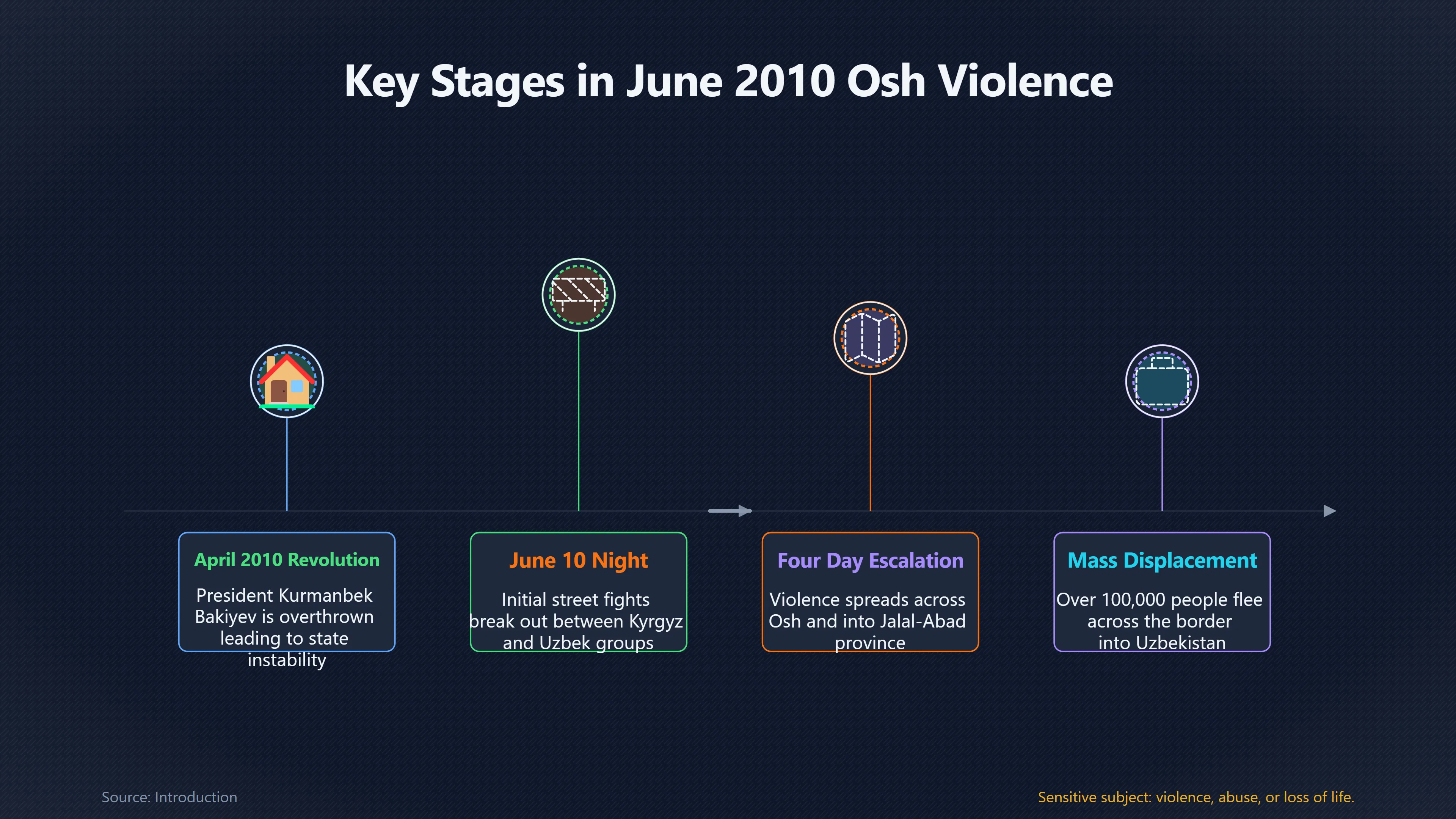
The violence began on the night of 10 June 2010 after clashes between small groups of ethnic Kyrgyz and ethnic Uzbeks in central Osh. Initial street fights rapidly escalated into larger confrontations, while the security forces struggled to restore order. Over the next four days, violence spread across Osh and into parts of Jalal-Abad province.
Independent investigations agree that atrocities were committed by members of both ethnic communities. However, they also conclude that Uzbek neighbourhoods suffered the greatest destruction. Hundreds of people were killed, thousands were injured, and approximately 2,000 homes were destroyed. More than 100,000 people fled across the border into Uzbekistan while hundreds of thousands more became internally displaced.[hrw.org]hrw.orgwhere justice 0Human Rights Watch“Where is the Justice?”: Interethnic Violence in Southern Kyrgyzstan and its Aftermath | HRWAugust 16, 2010…
Several investigations also found evidence that some attacks were organised rather than purely spontaneous. Witnesses described coordinated assaults on neighbourhoods, armed groups moving between districts and allegations that military vehicles were used to remove barricades before attackers entered residential areas. The precise degree of organisation remains debated, but most major inquiries reject the idea that the violence consisted solely of uncontrolled rioting.[Human Rights Watch]hrw.orgwhere justice 0Human Rights Watch“Where is the Justice?”: Interethnic Violence in Southern Kyrgyzstan and its Aftermath | HRWAugust 16, 2010…
How fear and unverified claims spread
Rumours spread exceptionally quickly because southern Kyrgyzstan was already experiencing profound political instability. Two months earlier, President Kurmanbek Bakiyev had been overthrown, leaving weakened state institutions and widespread uncertainty over who controlled security forces.
As fighting began, reports circulated that members of one ethnic group had committed shocking atrocities against the other. Among the most influential stories was the claim that Uzbek men had raped a young Kyrgyz woman in a student dormitory after murdering students. Human Rights Watch found that this allegation, despite later proving false, spread rapidly during the night and became one of the principal stories mobilising large numbers of Kyrgyz men from villages surrounding Osh.[Human Rights Watch]hrw.orgwhere justice 0Human Rights Watch“Where is the Justice?”: Interethnic Violence in Southern Kyrgyzstan and its Aftermath | HRWAugust 16, 2010…
Other rumours alleged massacres, mass rapes, attacks on schools and coordinated assaults that were either greatly exaggerated or entirely unverified. In an environment where mobile phones transmitted alarming messages faster than official information could appear, many people accepted these stories as fact because they came from relatives, neighbours or trusted acquaintances.
The rumours mattered not because every participant believed every story, but because they reinforced an existing expectation that one’s own community was under attack. Once that perception took hold, many individuals felt they were responding defensively, even when joining offensive attacks elsewhere.
Why rumours became so influential
Rumours are most persuasive when they fit fears that people already possess. In Osh, several conditions made this especially likely.
First, ethnic Kyrgyz and Uzbeks had experienced decades of political and economic competition over land, employment, business and local influence. Although many communities had long coexisted peacefully, unresolved grievances remained beneath the surface.
Second, government authority had weakened dramatically after the April 2010 revolution. Police responses were inconsistent, emergency information was unreliable and many residents no longer trusted official statements.
Third, communication networks relied heavily on personal contacts rather than verified news. Information often travelled through relatives, village networks and mobile phones, making emotional accounts appear more credible than official denials.
Finally, genuine violence was occurring at the same time. Because real killings, fires and attacks were visible throughout the city, fabricated stories blended easily with authentic reports. Distinguishing verified information from invention became almost impossible during the crisis.
Researchers studying collective violence frequently note that rumours become especially dangerous when they appear to explain confusing events during periods of institutional collapse. Osh closely matched this pattern.

Violence, displacement and disputed responsibility
Although rumours helped mobilise crowds, they do not fully explain what happened. International investigations concluded that organised attacks, failures by security forces and political instability all contributed substantially to the scale of the violence.
The Kyrgyzstan Inquiry Commission, established with international support, concluded that some attacks on Uzbek neighbourhoods may amount to crimes against humanity if proven before a court. The commission also criticised failures by state institutions and security services to prevent or halt the violence. The report itself became politically controversial inside Kyrgyzstan, where some officials rejected parts of its findings and argued that it underplayed Kyrgyz suffering.[OSCE PA]oscepa.orgOSCE PAProbe into Kyrgyzstan violence finds 'serious' crimesMay 3, 2011…
Subsequent investigations by Human Rights Watch also criticised the criminal investigations that followed the violence. While crimes had been committed by members of both communities, prosecutions disproportionately targeted ethnic Uzbeks, despite their communities suffering much of the destruction. Human rights organisations documented allegations of torture, coerced confessions and unequal treatment before the courts, arguing that these practices hindered reconciliation and deepened mistrust.[Human Rights Watch]hrw.orgkyrgyzstans flawed investigations and trials 2010 violenceHuman Rights WatchDistorted Justice: Kyrgyzstan’s Flawed Investigations and Trials on the 2010 Violence | HRW…
These continuing disputes over responsibility have made the events of 2010 politically sensitive and have complicated efforts to establish a shared historical narrative.
What the Osh rumours reveal about collective fear
The Osh violence illustrates an important distinction between rumours and conspiracy theories. Most rumours that circulated during the crisis were not elaborate ideological narratives. Instead, they were immediate claims that another community had just committed atrocities and that urgent retaliation or self-defence was necessary.
Psychologically, such rumours were effective because they appealed to fear for family members rather than abstract political beliefs. A dramatic but false report could trigger mobilisation within minutes, especially when it appeared to come from trusted local sources.
The episode also demonstrates that rumours rarely create violence where no tensions exist. Instead, they amplify existing distrust, justify action already contemplated by some participants and accelerate the breakdown of social restraint once violence has begun.
Why the events remain important
The 2010 violence is remembered in Kyrgyzstan primarily as a human tragedy rather than simply a case of misinformation. Nevertheless, the role of rumours remains central to understanding how rapidly communal violence escalated.
For historians and scholars of collective behaviour, Osh demonstrates several recurring features of rumour-driven violence:
- False atrocity stories can spread faster than official corrections during political crises.
- Existing ethnic or political tensions determine which rumours people find believable.
- The collapse of trusted institutions allows informal communication networks to become the dominant source of information.
- Rumours alone rarely explain mass violence, but they can dramatically increase its speed, scale and intensity once conflict has begun.
Within the wider history of collective fear in Kyrgyzstan, the Osh rumours stand as a powerful example of how misinformation, genuine insecurity and political breakdown can reinforce one another. They are best understood not as an instance of irrational “mass hysteria” in isolation, but as a case in which unverified claims became deadly because they emerged amid real violence, institutional failure and deep social divisions.

Amazon book picks
Further Reading
Books and field guides related to How Did Rumours Help Ignite Osh?. Use these as the next step if you want deeper reading beyond the article.
Thinking, Fast and Slow
Useful for understanding rapid judgments and rumor-driven behavior.


Endnotes
1.
Source: hcnm.osce.org
Link:https://hcnm.osce.org/hcnm/124326
Source snippet
osce.orgSpravedlivost: defending justice and equality | OSCE High Commissioner on National MinoritiesSeptember 25, 2014 — STORY SPRAVEDLI...
Published: September 25, 2014
2.
Source: oscepa.org
Title: OSCE PAProbe into Kyrgyzstan violence finds ‘serious’ crimes
Link:https://www.oscepa.org/en/news-a-media/press-releases/press-2011/probe-into-kyrgyzstan-violence-finds-serious-crimes
Source snippet
May 3, 2011...
Published: May 3, 2011
3.
Source: youtube.com
Title: Kyrgyzstan | Unhealed Wounds of Osh | 101 East
Link:https://www.youtube.com/watch?v=bE6Jk0xNNh4
Source snippet
Kyrgyzstan inter-ethnic violence enters courts...
4.
Source: hrw.org
Title: where justice 0
Link:https://www.hrw.org/reports/2010/08/16/where-justice-0
Source snippet
Human Rights Watch“Where is the Justice?”: Interethnic Violence in Southern Kyrgyzstan and its Aftermath | HRWAugust 16, 2010...
Published: August 16, 2010
5.
Source: hrw.org
Title: kyrgyzstans flawed investigations and trials 2010 violence
Link:https://www.hrw.org/report/2011/06/08/distorted-justice/kyrgyzstans-flawed-investigations-and-trials-2010-violence
Source snippet
Human Rights WatchDistorted Justice: Kyrgyzstan’s Flawed Investigations and Trials on the 2010 Violence | HRW...
6.
Source: hrw.org
Link:https://www.hrw.org/news/2011/05/03/kyrgyzstan-investigate-systematic-ethnic-attacks
7.
Source: hrw.org
Link:https://www.hrw.org/news/2010/06/01/need-international-action-southern-kyrgyzstan
8.
Source: hrw.org
Title: Kyrgyzstan: Probe Forces’ Role in June Violence | Human Rights Watch
Link:https://www.hrw.org/news/2010/08/16/kyrgyzstan-probe-forces-role-june-violence
9.
Source: oscepa.org
Title: OSC E Foreign Ministers Meet In Almaty On Kyrgyzstan
Link:https://www.oscepa.org/en/news-a-media/press-releases/press-2010/osce-foreign-ministers-meet-in-almaty-on-kyrgyzstan
10.
Source: oscepa.org
Title: Kyrgyzstan requests $500 mln to rebuild ruined south
Link:https://www.oscepa.org/en/news-a-media/press-releases/press-2010/kyrgyzstan-requests-500-mln-to-rebuild-ruined-south
11.
Source: hrw.org
Title: Kyrgyzstan: New Evidence Emerges on Brutality of Attacks | Human Rights Watch
Link:https://www.hrw.org/news/2010/06/25/kyrgyzstan-new-evidence-emerges-brutality-attacks
Additional References
12.
Source: youtube.com
Title: About 400,000 flee homes to escape violence, refugees, camps
Link:https://www.youtube.com/watch?v=MuE6wqu2KYg
Source snippet
Kyrgyzstan | Unhealed Wounds of Osh | 101 East provides first-hand investigative context on the inter-communal friction, political manipu...
13.
Source: ecoi.net
Link:https://www.ecoi.net/en/document/1310041.html
Source snippet
HRW – Human Rights Watch (Author): “Distorted Justice; Kyrgyzstan’s Flawed Investigations and Trials of the June 2010 Violence”, Document...
Published: June 2010
14.
Source: youtube.com
Title: Spravedlivost: Justice in Jalal-Abad
Link:https://www.youtube.com/watch?v=uNvP-e8qwL0
Source snippet
About 400,000 flee homes to escape violence, refugees, camps...
15.
Source: youtube.com
Title: Kyrgyzstan inter-ethnic violence enters courts
Link:https://www.youtube.com/watch?v=gqf6SztlXpc
Source snippet
Ethnic Violence in Kyrgyzstan...
16.
Source: youtube.com
Title: Ethnic Violence in Kyrgyzstan
Link:https://www.youtube.com/watch?v=942roKSoL1o
Source snippet
Spravedlivost: Justice in Jalal-Abad...
17.
Source: ecoi.net
Link:https://www.ecoi.net/en/document/1189825.html
Topic Tree