Within Equatorial Guinea
When Witchcraft Accusations Became a Public Danger
Fang communities used witchcraft accusations and protective movements to explain misfortune, restore order and identify hidden enemies.
On this page
- Why illness and misfortune prompted accusations
- How anti witchcraft movements promised protection
- Colonial suppression, religious change and real violence
Page outline Jump by section
Introduction
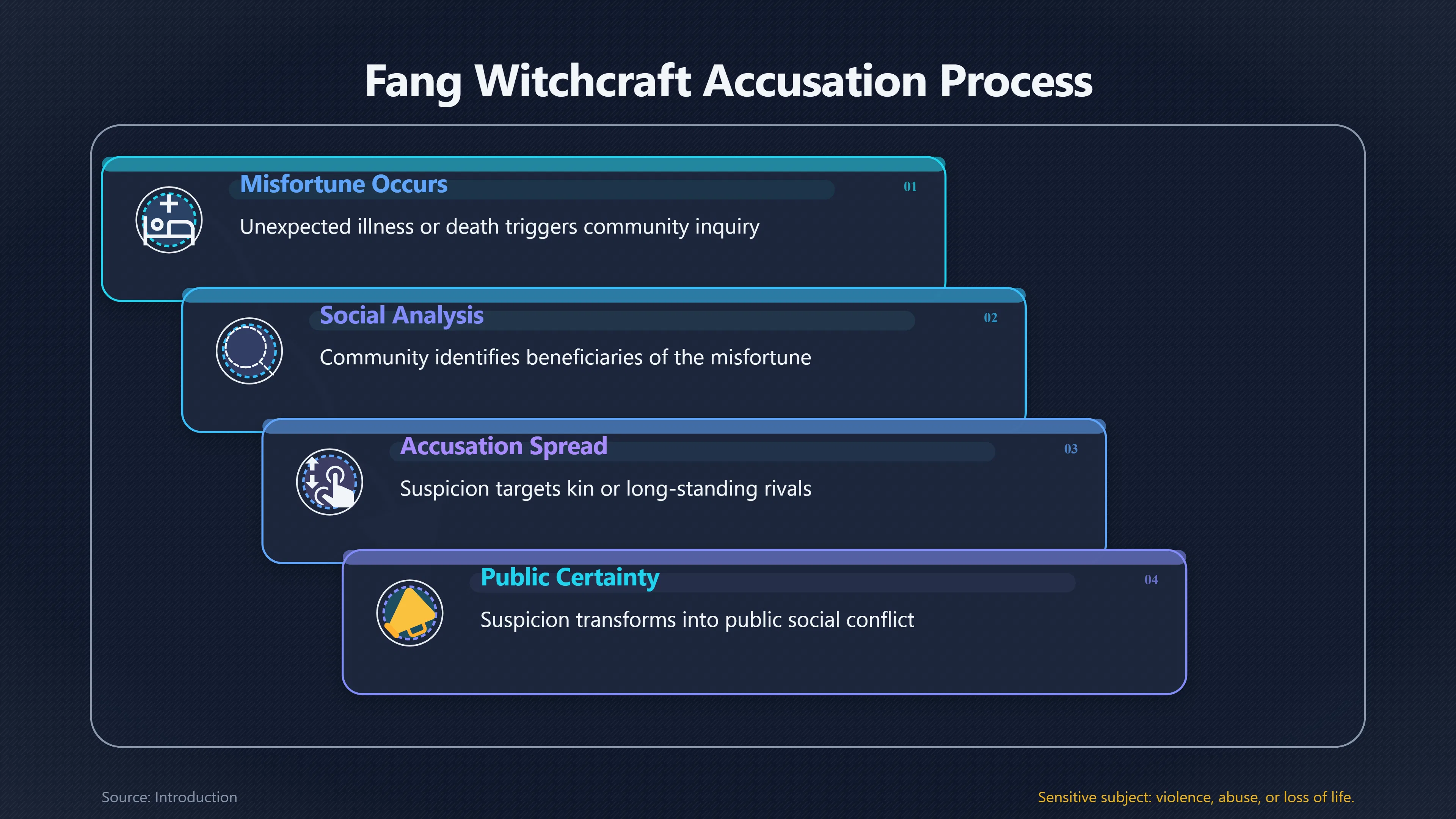
Among the Fang people of mainland Equatorial Guinea, witchcraft has long been understood as a way of explaining unexpected illness, death, infertility, economic inequality and other forms of misfortune. These beliefs were not simply matters of private faith. At times they shaped public accusations, inspired organised campaigns against supposed hidden evil, and influenced relations between families, churches and colonial authorities. Rather than producing a single dramatic “witch panic”, Fang history reveals repeated periods in which fear of invisible harm became intertwined with rapid social change, Christian conversion and colonial rule. Understanding these movements helps explain why accusations could spread, why anti-witchcraft organisations attracted followers, and why similar fears continue to influence social life in parts of Equatorial Guinea today.[Persée]persee.frPersée Christian Acculturation and Fang WitchcraftPerséeChristian Acculturation and Fang Witchcraft - Persée…
Why illness and misfortune prompted accusations
Traditional Fang ideas about witchcraft were rooted in social relationships rather than random supernatural attacks. Misfortune rarely appeared meaningless. A serious illness, repeated family deaths or unexplained prosperity might lead people to ask who had benefited or who secretly wished them harm. The suspected source was often someone already connected through kinship, inheritance disputes or long-standing jealousy.
Anthropologist James W. Fernandez argued that Fang ideas about witchcraft reflected a moral understanding of society. Wealth and success were expected to exist within limits. When one individual appeared to prosper unusually while others suffered, hidden supernatural aggression could become a convincing explanation. Witchcraft therefore became less a theory about magic than a language for discussing broken trust, social inequality and moral disorder.[Persée]persee.frPersée Christian Acculturation and Fang WitchcraftPerséeChristian Acculturation and Fang Witchcraft - Persée…
This helps explain why accusations could spread during periods of uncertainty. They were rarely random. Instead, they tended to emerge where ordinary explanations seemed inadequate and where existing tensions already divided families or communities.
How anti-witchcraft movements promised protection
Fear of witchcraft did not simply produce accusations. It also encouraged organised efforts to identify, neutralise or remove hidden dangers. These anti-witchcraft movements promised protection through ritual, confession, purification and moral reform.
Many colonial officials misunderstood such organisations. European administrators often grouped together anyone involved with ritual specialists, whether they were accused witches or people attempting to combat witchcraft. From the perspective of many Fang participants, however, these movements were protective rather than threatening. They claimed to restore communal balance by exposing hidden sources of misfortune before greater harm occurred.[Scribd]fr.scribd.comExtraversion and Clothing in Equatorial Guinea | PDFExtraversion and Clothing in Equatorial Guinea | PDF…
Fernandez described several reform movements that blended older Fang religious ideas with Christian concepts of confession, repentance and individual responsibility. Rather than rejecting Christianity outright, many movements selectively adopted Christian language while preserving older understandings of invisible spiritual conflict. This produced new religious forms instead of a simple replacement of traditional belief.[Persée]persee.frPersée Christian Acculturation and Fang WitchcraftPerséeChristian Acculturation and Fang Witchcraft - Persée…
The popularity of these movements reflected practical concerns:
- rapid economic and social change under colonial rule;
- population resettlement and the weakening of older village authority;
- labour migration and changing family structures;
- growing inequality associated with cash-crop production;
- uncertainty created by missionary influence alongside older religious practices.
Fernandez argued that these pressures created what he described as an “apotheosis of evil”: an unprecedented increase in witchcraft accusations alongside expanding anti-witchcraft campaigns during the mid-twentieth century.[Scribd]fr.scribd.comExtraversion and Clothing in Equatorial Guinea | PDFExtraversion and Clothing in Equatorial Guinea | PDF…

Colonial suppression, religious change and real violence
Spanish colonial officials generally regarded both witchcraft beliefs and anti-witchcraft organisations as obstacles to modern administration. Missionaries likewise condemned many traditional practices while attempting to redirect concerns about evil towards Christian teaching.
Yet suppression rarely eliminated belief. Instead, Christian and Fang ideas increasingly interacted. Fernandez observed that Christianity shifted attention towards personal sin and moral accountability, while Fang traditions continued to emphasise hidden social aggression and secret enemies. Rather than replacing one worldview with another, colonial rule encouraged new mixtures of both.[Persée]persee.frPersée Christian Acculturation and Fang WitchcraftPerséeChristian Acculturation and Fang Witchcraft - Persée…
Colonial governments also viewed organised anti-witchcraft movements with suspicion because they operated outside official authority. Ritual gatherings, initiation ceremonies and charismatic leaders could appear politically disruptive even when their primary purpose was spiritual protection. As a result, administrative repression sometimes targeted reform movements without fully understanding why local communities supported them.[Scribd]fr.scribd.comExtraversion and Clothing in Equatorial Guinea | PDFExtraversion and Clothing in Equatorial Guinea | PDF…
Although many anti-witchcraft movements emphasised healing and communal protection, accusations could have severe consequences. Individuals identified as witches could be ostracised, forced to confess, deprived of property or subjected to violence. The danger lay not in shared belief itself but in converting suspicion into public certainty without evidence.
Why collective fear spread during colonial change
Historians generally interpret the rise in accusations through social and historical change rather than assuming widespread irrationality.
Several reinforcing pressures appeared simultaneously:
- Economic disruption: Cash-crop agriculture altered patterns of wealth and dependence, making unequal success more visible.
- Family fragmentation: Labour migration and colonial resettlement weakened traditional mechanisms for resolving disputes.
- Missionary influence: Christian teaching challenged older religious authority while leaving many existing fears unresolved.
- Administrative centralisation: Colonial intervention disrupted established institutions without necessarily replacing them with locally trusted alternatives.
- Expanding horizons: Greater awareness of outside societies increased both aspiration and frustration, making hidden explanations for unequal fortune more persuasive.[Scribd]fr.scribd.comExtraversion and Clothing in Equatorial Guinea | PDFExtraversion and Clothing in Equatorial Guinea | PDF…
Seen from this perspective, anti-witchcraft movements were not isolated outbreaks of collective irrationality. They represented attempts to restore moral certainty during periods when everyday life was changing rapidly.

Lasting influence in Equatorial Guinea
Belief in witchcraft has not disappeared from Equatorial Guinea, although its expression has changed considerably. Modern researchers describe witchcraft as remaining an important social framework through which some communities interpret illness, unexplained deaths and other crises. Human rights organisations have also documented continuing concerns about violence linked to accusations in parts of Central Africa, including reports involving Equatorial Guinea, although reliable documentation is often difficult because of limited press freedom and political restrictions.[ecoi.net]ecoi.netIRB – Immigration and Refugee Board of Canada (Author): “Equatorial Guinea: Targeted ritual killings and dismemberment of children by sta…
Modern discussions increasingly distinguish between cultural belief and harmful persecution. Anthropologists emphasise that understanding Fang concepts of witchcraft does not require accepting supernatural claims as factual. Instead, these beliefs can be studied as systems for interpreting misfortune, regulating social behaviour and expressing anxieties created by inequality, rapid change and uncertainty.
For that reason, Fang witchcraft fears occupy an important place in the social history of Equatorial Guinea. They illustrate how collective beliefs about hidden danger can reshape communities, inspire reform movements, provoke state intervention and, under particular social pressures, transform private suspicion into public conflict.
Amazon book picks
Further Reading
Books and field guides related to When Witchcraft Accusations Became a Public Danger. Use these as the next step if you want deeper reading beyond the article.

The state of Africa
First published 2005. Subjects: History, Politics and government, Africa, history, Africa, politics and government.
The fate of Africa
First published 2004. Subjects: Politics and government, Social conditions, Economic conditions, Politique et gouvernement, Conditions so...
Persuasions and performances
First published 1986. Subjects: Ethnology, Philosophy, Rites and ceremonies, Social life and customs, Symbolism.
Witchcraft, Oracles and Magic Among the Azande
Essential comparative framework for African witchcraft accusations.
Endnotes
1.
Source: fr.scribd.com
Title: Extraversion and Clothing in Equatorial Guinea | PDF
Link:https://fr.scribd.com/document/706748547/AVM-PhD-THESIS
Source snippet
Extraversion and Clothing in Equatorial Guinea | PDF...
2.
Source: ecoi.net
Link:https://www.ecoi.net/en/document/2064771.html
Source snippet
IRB – Immigration and Refugee Board of Canada (Author): “Equatorial Guinea: Targeted ritual killings and dismemberment of children by sta...
3.
Source: persee.fr
Title: Persée Christian Acculturation and Fang Witchcraft
Link:https://www.persee.fr/doc/cea_0008-0055_1961_num
Source snippet
PerséeChristian Acculturation and Fang Witchcraft - Persée...
Additional References
4.
Source: uvaafrica.uva.es
Link:https://uvaafrica.uva.es/2022/05/09/formas-de-resistencia-cultural-los-fang-en-la-guinea-espanola/
Source snippet
de resistencia cultural: los fang en la Guinea Española – Observatorio de Estudios Africanos UVaÁfricaMay 9, 2022 — 9 de mayo de 2022 por...
Published: May 9, 2022
5.
Source: anthrosource.onlinelibrary.wiley.com
Title: Anthro Source Symbolic Consensus in a Fang Reformative Cult1
Link:https://anthrosource.onlinelibrary.wiley.com/doi/abs/10.1525/aa.1965.67.4.02a00030
Source snippet
Symbolic Consensus in a Fang Reformative Cult1 - FERNANDEZ - 1965 - American Anthropologist - Wiley Online Library...
6.
Source: irb-cisr.gc.ca
Title: IRB-CISRResponses to Information Requests
Link:https://www.irb-cisr.gc.ca/en/country-information/rir/Pages/index.aspx?doc=458409
Source snippet
Responses to Information Requests - Immigration and Refugee Board of CanadaSeptember 8, 2021 — 8 September 2021 GNQ200758.E Equatorial Gu...
Published: September 8, 2021
7.
Source: africabib.org
Title: Africa Bib | Christian Acculturation and Fang Witchcraft
Link:https://www.africabib.org/rec.php?RID=192878905
Source snippet
AfricaBib | Christian Acculturation and Fang Witchcraft...
8.
Source: academicjournals.org
Title: African Journal of Political Science and International Relations
Link:https://academicjournals.org/journal/AJPSIR/article-full-text/0157F9467035
9.
Source: youtube.com
Title: Meet the anti-witch hunter
Link:https://www.youtube.com/watch?v=yzBi8KVSwlY
10.
Source: youtube.com
Title: Fang Rituals and Witchcraft | Marshall’s Masquerade
Link:https://www.youtube.com/watch?v=eqFHkyg4lfc
Source snippet
Obangō Dance...
11.
Source: youtube.com
Title: Minkin Song (1)
Link:https://www.youtube.com/watch?v=k_oFRCnR7hk
Source snippet
Meet the anti-witch hunter - BBC Trending podcast, BBC World Service...
12.
Source: youtube.com
Title: 8 Mwanga Songs / 4 Prayer Songs
Link:https://www.youtube.com/watch?v=hDkEFlZhVrI
Source snippet
Minkin Song (1)...
13.
Source: pmc.ncbi.nlm.nih.gov
Link:https://pmc.ncbi.nlm.nih.gov/articles/PMC4847413/
Topic Tree