How Fear and Belief Shaped Slovenia
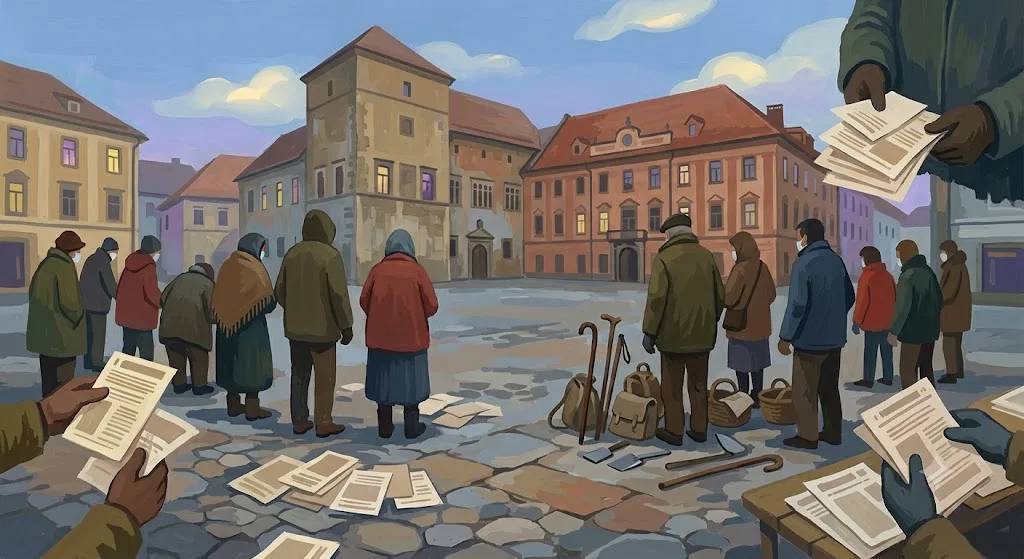
Slovenia’s history of collective fear is not dominated by one famous “mass hysteria” episode. Its strongest documented cases form a longer pattern: early modern witch prosecutions, modern suspicion of unfamiliar religious minorities, and media-driven scares in which migrants or Roma communities were portrayed as threats to social order.
Page outline Jump by section
Introduction
The country also offers an unusual counter-example. During anti-corruption protests in 2012–13, demonstrators turned the language used to stigmatise them into the deliberately theatrical Zombie Church. Rather than illustrating blind collective belief, it showed how parody, ritual and invented religion can expose the mechanics of political labelling.[sistory.si]sistory.siSlovenska zgodovina ENGA SLOVENE HISTORYDecember 8, 2009 —… witch trials was in the wine-growing districts of Slovenske. Gorice and Haloze. Trials bef…
The evidence is uneven. Witch trials are supported by court records and historical research, while later claims about “sects”, apparitions or hidden dangerous groups are often harder to separate from polemic, folklore and sensational journalism. There is also no comparably well-documented Slovenian outbreak of school fainting, contagious convulsions or unexplained mass illness that can confidently be placed alongside classic cases of mass psychogenic illness elsewhere.
When witchcraft became a crime
The witch persecutions in the lands that now form Slovenia were part of the wider European hunts, but their timing and geography were local. The first known witchcraft prosecution associated with present-day Slovenia concerned Veronika of Desenice in the fifteenth century. She had married Frederick II of Celje against the wishes of his powerful father, Hermann II. Accused of using magic to seduce Frederick, she was acquitted by the court, yet was later killed on Hermann’s orders. The witchcraft charge therefore functioned less as proof of an organised magical threat than as a political weapon in a family and dynastic conflict.[Portal GOV.SI]gov.siPortal GOV.SIIN FOCUSAugust 3, 2015 — Veronika was accused of witchcraft on the grounds that she had seduced and enticed Frederick to the…
Large-scale prosecutions came later. Historical surveys place the main waves in the sixteenth, seventeenth and early eighteenth centuries, with especially intense activity during the second half of the seventeenth century. In Styria, many cases arose in the wine-growing districts of Slovenske Gorice and Haloze and were heard at courts including Ptuj, Ormož, Ljutomer, Maribor, Radgona and Hrastovec. Carniola experienced fewer prosecutions, although Ribnica became the setting for one of its best-known trials.[sistory.si]sistory.siSlovenska zgodovina ENGA SLOVENE HISTORYDecember 8, 2009 —… witch trials was in the wine-growing districts of Slovenske. Gorice and Haloze. Trials bef…
Precise totals remain uncertain. Public-history accounts commonly estimate that witch trials in the Slovenian lands lasted roughly two centuries, from the mid-sixteenth to the mid-eighteenth century, and caused hundreds of deaths. Some estimates range from about 500 to 1,000 victims, but surviving records are incomplete and the historic jurisdictions did not match the borders of modern Slovenia. Such figures should therefore be treated as informed estimates, not an exact national count.[wowplaces.fierce-women.net]wowplaces.fierce-women.netArchives: WomanArchives: Woman
The Ribnica trial
The Ribnica proceedings of 1700–01 provide the clearest view of how an accusation could grow into a supposedly organised conspiracy. Marina Češarek was accused of witchcraft and interrogated within a legal culture that accepted ideas of the witches’ sabbath, harmful magic and demonic association as potentially factual. The surviving case has become one of the most studied witch trials in Carniola.[Sistory]sistory.siOpen source on sistory.si.
As in other European trials, interrogation did not merely test an accusation. It could manufacture a wider narrative. Once authorities expected suspects to describe meetings, accomplices, harmful spells and relations with the Devil, coerced or guided testimony supplied the details needed to justify further prosecution. The resulting records tell historians much about judicial expectations and popular fears, but they do not demonstrate that secret witch organisations existed.
That distinction matters because modern retellings sometimes treat confessions as eyewitness reports. Historians instead read them alongside the law, the wording of questions, the use of torture and the social position of the accused. Research on eastern Slovenian witchcraft accusations also shows that gender shaped suspicion, although accusations cannot be reduced to a simple claim that every victim was a woman or that all prosecutions had the same cause.[dk.um.si]dk.um.siČAROVNIŠKI PROCESI NA GRADU HRASTOVEC V…V osrednjem delu diplomske naloge so predstavljeni čarovniški procesi, ki so potekali pred dež…
Why the persecutions spread
Belief in harmful magic was neither an isolated rural superstition nor simply a symptom of individual irrationality. It was supported by an official framework in which secular courts, legal specialists and religious concepts gave supernatural accusations institutional force. Crop damage, illness, livestock deaths, sexual conflict, inheritance disputes and neighbourhood quarrels could all be interpreted through a shared belief that misfortune might have a human, magical author.
The trials became especially dangerous when three layers reinforced one another:
- Everyday suspicion: a quarrel, curse, illness or unexplained loss identified a possible culprit.
- Learned demonology: officials connected local accusations to ideas about the Devil, conspiratorial gatherings and organised attacks on Christian society.
- Coercive procedure: interrogation and torture produced confessions and names, allowing one case to generate another.
This was not “mass psychogenic illness”, because the central phenomenon was not a contagious outbreak of physical symptoms. Nor was it merely a spontaneous crowd delusion. It was a persecution sustained by courts and accepted legal procedures. The term “witch panic” is useful only when it does not hide the organised power that turned fear into imprisonment, torture and execution.
Economic hardship and social conflict probably increased the appeal of accusations, but no single explanation fits every case. Regional variation was considerable: some courts prosecuted aggressively while neighbouring jurisdictions did not. Judicial scepticism eventually helped bring the persecutions to an end, as officials became less willing to accept spectral claims, torture-produced testimony and implausibly expanding conspiracies. The final known prosecutions in the Slovenian lands belong to the eighteenth century.[Sistory]sistory.siSlovenska zgodovina ENGA SLOVENE HISTORYDecember 8, 2009 —… witch trials was in the wine-growing districts of Slovenske. Gorice and Haloze. Trials bef…
From witches to “sects”
After Slovenia became independent in 1991, religious life became more visibly plural. Catholicism remained culturally influential, but small evangelical, eastern religious, esoteric and alternative spiritual communities could organise openly. Some observers described these communities collectively as “sects”, often implying manipulation, foreign intrusion or psychological danger even when the groups were small and legally operating. A 1997 discussion of proselytising noted that more than thirty new religious groups had been registered, generally with memberships ranging from only a handful of people to several hundred.[Digital Commons]digitalcommons.georgefox.eduOpen source on georgefox.edu.
The word “cult” is unreliable in this setting. It can refer to a genuinely coercive organisation, but it is also routinely used for any small or unfamiliar religion. Researchers of new religious movements therefore examine concrete behaviour—fraud, isolation, violence, exploitation, abusive leadership or restrictions on leaving—rather than assuming that unusual theology proves danger.
Slovenian scholars Aleš Črnič and Gregor Lesjak have treated new religious movements as part of the country’s changing religious landscape and have examined the tension between religious freedom and state control. Their work is important because it shifts the question from “Is this group strange?” to “What does it do, what evidence exists, and are comparable standards applied to majority and minority religions?”[academia.edu]academia.eduNew Religions in New EuropeAcademia(PDF) New Religions in "New Europe"Črnič, Aleš and Gregor Lesjak (2006): A Systematic Study of New Religious Movements - The Slov…
Slovenia’s legal development reflects the same tension. The 1991 constitution states that religious communities are separate from the state, possess equal rights and may operate freely. Yet the Yugoslav-era law on religious communities remained in place until the Religious Freedom Act of 2007. Registration gives a community legal advantages, but unregistered groups may still conduct religious activity. A Constitutional Court decision in 2010 subsequently reviewed important parts of the new framework.[cnrs.fr]eurel-info.cnrs.freurel-info La dynamique de la formation d'une position juridique deseurel-info La dynamique de la formation d'une position juridique des
This history did not produce a Slovenian equivalent of the largest North American or British Satanic-ritual-abuse panics. Claims about Satanism and dangerous sects circulated through the same international media environment, but the available evidence does not support describing Slovenia as the site of a major, substantiated conspiracy of ritual-abuse networks. The more revealing story is the persistent readiness to treat minority religion itself as evidence of manipulation.
Apparitions without a national panic
Slovenia has also hosted claims of visions, healings and mystical experiences. These belong to the history of collective belief, but they should not automatically be classified as panics. Religious devotion can spread through pilgrimage, testimony and hopes of healing without producing persecution or public disorder.
At Kurešček, a hill and Marian shrine near Ljubljana, followers of the priest Franc Špelič promoted messages attributed to the Virgin Mary. The site’s own organisation presents him as a visionary and publishes accounts supporting the claimed experiences. These are devotional sources rather than independent verification, and the claims have not achieved the broad ecclesiastical recognition associated with an officially authenticated apparition.[kurescek.org]kurescek.orgOpen source on kurescek.org.
The useful distinction is between permission to pray at a shrine, acceptance of a devotion and formal judgement that a supernatural event occurred. Catholic authorities can tolerate or regulate pilgrimages without declaring every reported message authentic. Confusing these categories allows supporters to claim stronger approval than exists, while hostile critics may wrongly portray all participants as members of a dangerous cult.
Magdalena Gornik, a nineteenth-century Slovenian mystic associated with visions, ecstatic states and reported stigmata, illustrates an older version of the same problem. Church and secular investigators disagreed over whether her experiences reflected sanctity, illness or deception. Her story remains culturally significant, but later devotional accounts cannot by themselves resolve what caused her reported physical and visionary phenomena.[Wikipedia]WikipediaMagdalena GornikMagdalena Gornik
How migrants became “folk devils”
Some of Slovenia’s clearest modern moral panics have concerned migration rather than supernatural belief. Around the turn of the twenty-first century, media researchers found that asylum seekers were frequently framed through illegality, control and national threat. One influential study argued that this discourse helped Slovenia imagine itself as part of a “civilised Europe” by presenting migrants as an external, disorderly other.[Helda]helda.helsinki.fiOpen source on helsinki.fi.
The mechanism resembled classic moral panic:
- A complicated social issue was reduced to a visible threatening group.
- Exceptional incidents were treated as representative.
- official and media language reinforced one another.
- Policies of control appeared to be common-sense responses to an emergency.
- The voices and individual circumstances of asylum seekers largely disappeared.
Calling this a moral panic does not mean that borders, housing or asylum systems present no genuine difficulties. It means the perceived threat can become disproportionate, simplified and attached to people as a category. The political result is a movement away from asking what protection, administration and integration require and towards asking how a suspect population should be contained.
The migration movements of 2015–16 intensified these patterns. Later research comparing Slovenian reporting about people displaced from Syria with coverage of Ukrainians after Russia’s full-scale invasion found unequal treatment. A computational study reported that the wider discourse about migration became more negative and emotionally intense, while Ukrainians were depicted in less dehumanising ways than other migrant groups. This contrast shows that public fear is not produced solely by the number of arrivals: racialisation, religion, geopolitical sympathy and ideas about cultural closeness shape who is imagined as a victim and who as a threat.[arXiv]arxiv.orgOpen source on arxiv.org.
Fear directed at Roma communities
Slovenian Roma have repeatedly been represented through crime, welfare dependence, disorder and incompatibility with the majority population. Research by the Peace Institute found that media coverage commonly discussed Roma in relation to problems supposedly troubling ethnic Slovenians, rather than portraying Roma people as varied citizens with their own perspectives. Academic analysis has likewise shown how headlines, story structure and evaluative language can make discriminatory assumptions seem natural.[mirovni-institut.si]mirovni-institut.siWe About the RomaWe About the Roma
This is a form of collective fear with real consequences. A dispute or criminal act involving an individual can be generalised to an ethnic community, while rumours and repeated stereotypes make extraordinary measures appear necessary. The process resembles witch-panic logic in one limited but important respect: suspicion moves from an alleged act to an imagined dangerous category.
The comparison must not be pushed too far. Roma marginalisation is rooted in documented discrimination, poverty, segregated schooling, insecure settlements and unequal access to services—not in a purely imaginary supernatural threat. Recent European monitoring continues to identify serious disadvantages and increasing hate speech directed at minorities in Slovenia.[Amnesty International]amnesty.orgOpen source on amnesty.org.
The language of moral panic is most useful here when it reveals disproportionality and collective blame. It should never be used to deny actual violence or social problems. The critical question is whether authorities investigate individual responsibility fairly or transform an event into a justification for treating an entire minority as inherently suspect.
The Zombie Church turns stigma into satire
Slovenia’s most distinctive recent religious movement emerged not from an apocalyptic prophecy but from political protest. Demonstrations began in Maribor in late 2012 amid anger about corruption, municipal government and traffic-enforcement cameras, then expanded into broader protests against the political establishment. After protesters were disparaged as “zombies”, participants adopted the insult as a public identity.[counterfire.org]counterfire.orgslovenias zombie uprisingslovenias zombie uprising
The resulting Trans-Universal Zombie Church of the Blissful Ringing developed rituals, symbols, gatherings and an institutional structure. It was registered as a religious community and claimed thousands of members. Pots, pans and bells—objects used to create noise at demonstrations—became part of its sacred language.[cambridge.org]cambridge.orgCambridge University Press & AssessmentInvented Religion, the Awakened Polis, and Sacred…by ND Wadsworth · 2021 · Cited by 1 — The Tra…
Researchers describe it as an “invented religion”: a movement whose participants openly create traditions while still using them to express identity, values and community. That does not necessarily make it fraudulent. All religious traditions develop through human interpretation, ritual innovation and institutionalisation; invented religions simply make the creative process unusually visible.
The Zombie Church also tested the boundary between parody and sincere religion. Some participants may have treated it chiefly as satire, while others found genuine community and ethical meaning in it. Its legal recognition challenged the assumption that the state can easily distinguish a “real” religion from an elaborate political performance without privileging familiar beliefs.[Cambridge University Press & Assessment]cambridge.orgCambridge University Press & AssessmentInvented Religion, the Awakened Polis, and Sacred…by ND Wadsworth · 2021 · Cited by 1 — The Tra…
Most importantly, the movement reversed the normal direction of a scare. Political rhetoric attempted to turn protesters into a frightening, dehumanised mass. The protesters then exaggerated that image until its absurdity became visible. Here contagious symbols and collective ritual did not create persecution; they became tools for resisting it.

What Slovenia’s cases show
Slovenia’s history does not support a simple national story of an unusually superstitious population. It shows how collective belief becomes dangerous when institutions remove the ordinary checks on accusation.
During the witch trials, courts converted misfortune and neighbourhood suspicion into prosecutable demonic conspiracy. In modern “sect” discourse, unfamiliarity could be mistaken for coercion. In reporting about asylum seekers and Roma, individual acts and administrative pressures were repeatedly expanded into stories about threatening populations. In each case, labels did much of the work: witch, sect member, illegal migrant, troublesome Roma or zombie.
The cases also show why evidence must be separated into different categories. A court confession obtained under coercion is not proof of a witches’ gathering. A religious group’s testimony proves what its members say they experienced, not that an apparition was supernatural. A frightening headline demonstrates that fear circulated, not that the alleged danger was proportionate. Registration as a religion proves legal recognition, not divine truth or harmlessness.
Slovenia’s most memorable contribution to the modern history of collective belief may therefore be the Zombie Church. It demonstrates that people are not merely passive victims of labels and contagious narratives. They can seize those narratives, reshape them and turn the machinery of stigma into a public lesson about who gets to define reality.
Amazon book picks
Further Reading
Books and field guides related to How Fear and Belief Shaped Slovenia. Use these as the next step if you want deeper reading beyond the article.
Religion and the Decline of Magic
Explains belief, magic and social change in early modern Europe.

Endnotes
1.
Source: sistory.si
Title: Slovenska zgodovina ENG
Link:https://www.sistory.si/cdn/publikacije/2001-3000/2250/Slovenska-zgodovina-ENG.pdf
Source snippet
A SLOVENE HISTORYDecember 8, 2009 —... witch trials was in the wine-growing districts of Slovenske. Gorice and Haloze. Trials bef...
Published: December 8, 2009
2.
Source: academia.edu
Title: New Religions in New Europe
Link:https://www.academia.edu/28592585/New_Religions_in_New_Europe_
Source snippet
Academia(PDF) New Religions in "New Europe"Črnič, Aleš and Gregor Lesjak (2006): A Systematic Study of New Religious Movements - The Slov...
3.
Source: cambridge.org
Link:https://www.cambridge.org/core/journals/politics-and-religion/article/invented-religion-the-awakened-polis-and-sacred-disestablishment-the-case-of-slovenias-zombie-church/703A38F23E5CCC9FEDB1A155CE64C2B8
Source snippet
Cambridge University Press & AssessmentInvented Religion, the Awakened Polis, and Sacred...by ND Wadsworth · 2021 · Cited by 1 — The Tra...
4.
Source: gov.si
Link:https://www.gov.si/assets/vladne-sluzbe/UKOM/Promocija-Slovenije/Sinfo/Sinfo-arhiv/Sinfo-7-8-2015.pdf
Source snippet
Portal GOV.SIIN FOCUSAugust 3, 2015 — Veronika was accused of witchcraft on the grounds that she had seduced and enticed Frederick to the...
Published: August 3, 2015
5.
Source: gov.si
Link:https://www.gov.si/assets/vladne-sluzbe/UKOM/Promocija-Slovenije/Sinfo/Sinfo-arhiv/Sinfo-7-8-2017.pdf
Source snippet
Portal GOV.SIIN FOCUS8 Jul 2017 — Veronica was accused of having seduced the man through witchcraft, and thus occured the first known wit...
6.
Source: dk.um.si
Link:https://dk.um.si/IzpisGradiva.php?id=45166&lang=eng
Source snippet
ČAROVNIŠKI PROCESI NA GRADU HRASTOVEC V...V osrednjem delu diplomske naloge so predstavljeni čarovniški procesi, ki so potekali pred dež...
7.
Source: sistory.si
Link:https://www.sistory.si/11686/44672
8.
Source: wowplaces.fierce-women.net
Title: Archives: Woman
Link:https://wowplaces.fierce-women.net/woman/
9.
Source: gov.si
Title: 2024 06 01 the devils killed marina the witch
Link:https://www.gov.si/en/news/2024-06-01-the-devils-killed-marina-the-witch/
10.
Source: scholar.google.com
Link:https://scholar.google.com/citations?hl=en&user=cme7BlQAAAAJ
11.
Source: 2009-2017.state.gov
Title: U.S. Department of State Slovenia
Link:https://2009-2017.state.gov/j/drl/rls/irf/2007/90200.htm
12.
Source: 2021-2025.state.gov
Link:https://2021-2025.state.gov/reports/2017-report-on-international-religious-freedom/slovenia/
13.
Source: kurescek.org
Link:https://www.kurescek.org/index.php?Itemid=71&catid=43%3Ao-vidcu&id=65%3Ao-vidcu-o-francetu-peliu&lang=en&option=com_content&view=article
14.
Source: kurescek.org
Link:https://www.kurescek.org/index.php?Itemid=71&catid=43%3Ao-vidcu&id=66%3Aintervju-z-o-francetom-peliem&lang=en&option=com_content&view=article
15.
Source: Wikipedia
Title: Magdalena Gornik
Link:https://en.wikipedia.org/wiki/Magdalena_Gornik
16.
Source: arxiv.org
Link:https://arxiv.org/abs/2404.07036
17.
Source: arxiv.org
Link:https://arxiv.org/abs/1906.02045
18.
Source: mirovni-institut.si
Title: We About the Roma
Link:https://www.mirovni-institut.si/wp-content/uploads/2014/08/we_about_the_roma.pdf
19.
Source: researchgate.net
Link:https://www.researchgate.net/publication/249712964_Media_Representation_of_the_Discrimination_against_the_Roma_in_Eastern_Europe_The_Case_of_Slovenia
20.
Source: amnesty.org
Link:https://www.amnesty.org/es/wp-content/uploads/2021/05/EUR6804762019ENGLISH.pdf
21.
Source: counterfire.org
Title: slovenias zombie uprising
Link:https://www.counterfire.org/article/slovenias-zombie-uprising/
22.
Source: researchgate.net
Link:https://www.researchgate.net/publication/345492122_Invented_Religion_the_Awakened_Polis_and_Sacred_Disestablishment_The_Case_of_Slovenia%27s_Zombie_Church
23.
Source: researchgate.net
Link:https://www.researchgate.net/publication/372510216_A_Systematic_Review_of_Research_Developments_in_Mass_Psychogenic_Illness
24.
Source: researchgate.net
Link:https://www.researchgate.net/publication/240708991_Nordic_Satanism_and_Satanism_Scares_The_Dark_Side_of_the_Secular_Welfare_State
25.
Source: researchgate.net
Title: 379814362 STATE OF HATE Far right Extremism in Europe
Link:https://www.researchgate.net/publication/379814362_STATE_OF_HATE_Far-right_Extremism_in_Europe
26.
Source: researchgate.net
Link:https://www.researchgate.net/publication/271759288_Mass_hysteria_among_South_African_primary_school_learners_in_Kwa-Dukuza_KwaZulu-Natal
27.
Source: researchgate.net
Title: 408469948 Media Events and Moral Panic
Link:https://www.researchgate.net/publication/408469948_Media_Events_and_Moral_Panic
28.
Source: researchgate.net
Link:https://www.researchgate.net/publication/230025950_The_Public_Perception_of_Cults_and_New_Religious_Movements
29.
Source: slovenia.info
Link:https://www.slovenia.info/uploads/publikacije/Zgodovinska%20mesta/2026_06_STO_ZGODOVINSKA_MESTA_ANG_lowres_SPREAD.pdf
30.
Source: 2009-2017.state.gov
Link:https://2009-2017.state.gov/documents/organization/171721.pdf
31.
Source: gov.si
Title: religious freedom
Link:https://www.gov.si/en/policies/state-and-society/human-rights-and-equal-opportunities/religious-freedom/
32.
Source: Wikipedia
Title: Witch trials in the early modern period
Link:https://en.wikipedia.org/wiki/Witch_trials_in_the_early_modern_period
33.
Source: Wikipedia
Title: List of mass panic cases
Link:https://en.wikipedia.org/wiki/List_of_mass_panic_cases
34.
Source: Wikipedia
Title: Satanic panic
Link:https://en.wikipedia.org/wiki/Satanic_panic
35.
Source: Wikipedia
Title: Mass psychogenic illness
Link:https://en.wikipedia.org/wiki/Mass_psychogenic_illness
36.
Source: Wikipedia
Title: Blood libel
Link:https://en.wikipedia.org/wiki/Blood_libel
37.
Source: Wikipedia
Title: Witch hunt
Link:https://en.wikipedia.org/wiki/Witch_hunt
38.
Source: Wikipedia
Title: Witch trials in the Netherlands
Link:https://en.wikipedia.org/wiki/Witch_trials_in_the_Netherlands
39.
Source: Wikipedia
Title: Moral panic
Link:https://en.wikipedia.org/wiki/Moral_panic
40.
Source: Wikipedia
Title: Universe People
Link:https://en.wikipedia.org/wiki/Universe_People
41.
Source: Wikipedia
Link:https://en.wikipedia.org/wiki/Ra%C3%ABlism
42.
Source: Wikipedia
Title: Our Lady of Medjugorje
Link:https://en.wikipedia.org/wiki/Our_Lady_of_Medjugorje
43.
Source: Wikipedia
Title: Kosovo student poisoning
Link:https://en.wikipedia.org/wiki/Kosovo_student_poisoning
44.
Source: Wikipedia
Title: Trans Universal Zombie Church of the Blissful Ringing
Link:https://en.wikipedia.org/wiki/Trans-Universal_Zombie_Church_of_the_Blissful_Ringing
45.
Source: Wikipedia
Title: Freedom of religion in Slovenia
Link:https://en.wikipedia.org/wiki/Freedom_of_religion_in_Slovenia
46.
Source: Wikipedia
Title: 2012–2013 Slovenian protests
Link:https://en.wikipedia.org/wiki/2012%E2%80%932013_Slovenian_protests
47.
Source: folklore.ee
Link:https://www.folklore.ee/FOAFtale/ftn37.htm
48.
Source: academia.edu
Link:https://www.academia.edu/46575744/Edited_by_Dark_Tourism_and_Pilgrimage
49.
Source: academia.edu
Link:https://www.academia.edu/Documents/in/Cults_and_New_Religious_Movements
50.
Source: history.com
Title: salem witch trials hysteria factors
Link:https://www.history.com/articles/salem-witch-trials-hysteria-factors
51.
Source: journals.sagepub.com
Title: Journal of Ethnic and Migration Studies 29(1): 83–
Link:https://journals.sagepub.com/doi/abs/10.1177/1748048518802237
Source snippet
Sage JournalsOthering the European Union through constructing moral...by J Tong · 2019 · Cited by 56 — Media construction of identity th...
52.
Source: digitalcommons.georgefox.edu
Link:https://digitalcommons.georgefox.edu/cgi/viewcontent.cgi?article=1737&context=ree
53.
Source: eurel-info.cnrs.fr
Title: eurel-info La dynamique de la formation d’une position juridique des
Link:https://www.eurel-info.cnrs.fr/spip.php?article3935=
54.
Source: helda.helsinki.fi
Link:https://helda.helsinki.fi/bitstreams/d5cde622-19da-41e2-b805-27f76142c146/download
55.
Source: wagingnonviolence.org
Title: slovenia rises in artful protest
Link:https://wagingnonviolence.org/2013/03/slovenia-rises-in-artful-protest/
56.
Source: scienceij.com
Link:https://www.scienceij.com/index.php/sij/article/view/94
57.
Source: researchportal.murdoch.edu.au
Link:https://researchportal.murdoch.edu.au/esploro/outputs/journalArticle/Stop-the-boats-Moral-panic-in/991005609665207891
58.
Source: eap-iea.org
Link:https://eap-iea.org/index.php/eap/article/view/814
59.
Source: frontiersin.org
Link:https://www.frontiersin.org/journals/psychiatry/articles/10.3389/fpsyt.2020.493094/full
60.
Source: frontiersin.org
Link:https://www.frontiersin.org/journals/communication/articles/10.3389/fcomm.2023.1143786/full
61.
Source: sajp.org.za
Link:https://sajp.org.za/index.php/sajp/article/view/1671/2648
62.
Source: schoolmealscoalition.org
Link:https://schoolmealscoalition.org/member/slovenia
63.
Source: ebsco.com
Title: mass hysteria
Link:https://www.ebsco.com/research-starters/social-sciences-and-humanities/mass-hysteria
64.
Source: digitalcommons.memphis.edu
Link:https://digitalcommons.memphis.edu/cgi/viewcontent.cgi?article=4629&context=etd
Additional References
65.
Source: youtube.com
Title: Veronika Deseniška / Veronica of Desenice (short animated documentary)
Link:https://www.youtube.com/watch?v=GH7WSzBYHzY
Source snippet
Raiven - Veronika (Slovenia Official Music Video)...
66.
Source: science.gov
Link:https://www.science.gov/topicpages/s/satanic%2Britual%2Babuse
67.
Source: youtube.com
Link:https://www.youtube.com/watch?v=uWcSsi7SliI
Source snippet
Veronika Deseniška ter vzpon in padec Celjskih grofov...
68.
Source: facebook.com
Link:https://www.facebook.com/Roma4Europe/posts/100-days-after-slovenia-adopted-the-%C5%A1utar-law-roma-communities-report-growing-pr/1356212656547781/
69.
Source: historysnob.com
Link:https://www.historysnob.com/war-and-historical-events/20-chilling-cases-mass-hysteria-throughout-history
70.
Source: fuds.si
Link:https://www.fuds.si/wp-content/uploads/2025/11/rsc_september_2015-popravljeno_0_0.pdf
71.
Source: instagram.com
Link:https://www.instagram.com/reel/DZq5D2tk1eI/?hl=en
72.
Source: portoroz.si
Link:https://www.portoroz.si/en/what-to-do/cultural-landmarks/sacred-sites/obj/13923-church-of-the-vision-of-st-mary-and-the-monastery-strunjan/
73.
Source: revija-pravnik.si
Link:https://revija-pravnik.si/constitutional-law-connection-between-the-state-and-church-in-the-republic-of-slovenia-03-02-2019.html
74.
Source: iahrweb.org
Link:https://www.iahrweb.org/crnic.php
Topic Tree
Follow this branch
Related pages 192
- Antigua and Barbuda
- Argentina Belief Scares
- Azerbaijan Belief
- Bahrain Beliefs
- North Korea
- +187 more in sidebar