Within Solomon Islands Belief
Was Maasina Rule Rebellion, Prophecy or Both?
Maasina Rule mixed political resistance, village reform and wartime hopes that colonial officials often dismissed as cargo belief.
On this page
- Wartime origins and returning labourers
- Self government, village reform and collective action
- Arrests, colonial panic and the road to independence
Page outline Jump by section
Introduction
Maasina Rule was the largest anti-colonial movement in the history of the British Solomon Islands, yet it has long been misunderstood through the misleading label of a “cargo cult”. Emerging during the closing years of the Second World War, it combined practical demands for self-government, economic reform and village reorganisation with prophetic expectations held by some supporters that dramatic political change and material prosperity would soon arrive. Rather than fitting neatly into either the category of nationalist movement or millenarian religious movement, Maasina Rule occupied the space between them. Modern historians generally argue that its political programme formed its core, while prophetic hopes reflected the extraordinary upheaval of wartime rather than defining the movement as a whole.[solomonencyclopaedia.net]solomonencyclopaedia.netMaasina RuleConcept - Solomon Islands Encyclopaedia, 1893-1978…
Understanding this balance matters because colonial officials often focused on rumours of miraculous beliefs while overlooking the movement’s coherent political organisation. The debate over whether Maasina Rule was primarily a rebellion, a prophetic movement or both continues to shape how the history of Solomon Islands’ road towards independence is interpreted.[solomonencyclopaedia.net]solomonencyclopaedia.netMaasina RuleConcept - Solomon Islands Encyclopaedia, 1893-1978…
Wartime origins and returning labourers
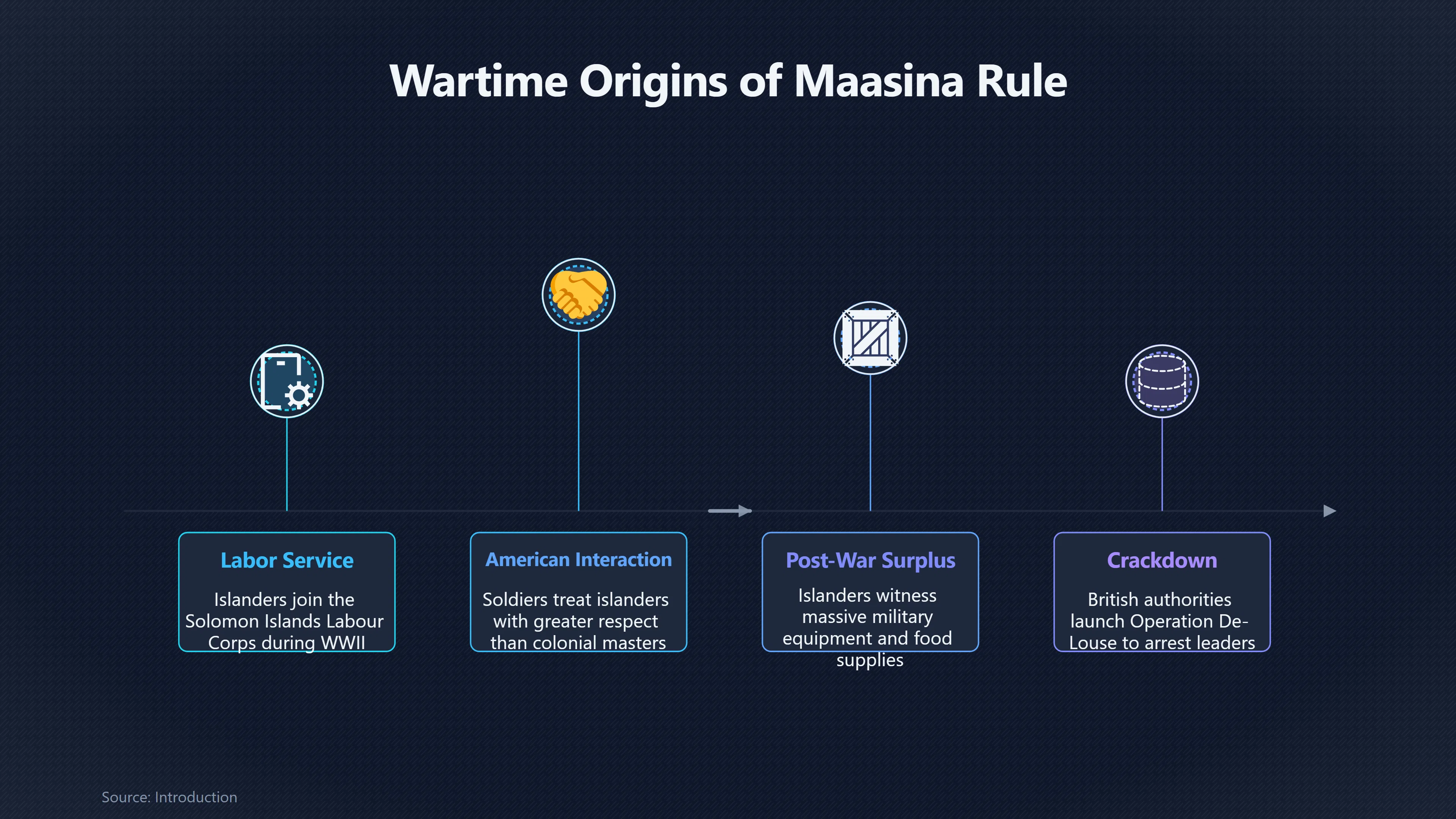
Maasina Rule emerged on Malaita in 1944 while thousands of Solomon Islanders were serving in the Solomon Islands Labour Corps alongside Allied forces. Wartime service exposed many islanders to wages, large-scale organisation, new technologies and, perhaps most importantly, different racial relationships. Many remembered that American servicemen, including African American troops, treated them with greater respect than they had experienced under colonial plantation society. This challenged long-standing assumptions about European superiority and convinced many that the colonial order could be changed.[solomonencyclopaedia.net]solomonencyclopaedia.netMaasina RuleConcept - Solomon Islands Encyclopaedia, 1893-1978…
Returning labourers also saw the immense quantities of military equipment, food and transport mobilised during the war. These experiences raised obvious political questions. If governments could organise such abundance during wartime, why did colonial authorities continue to provide so few services to Solomon Islanders after peace returned? Disappointment was intensified when British administrators quickly attempted to restore pre-war labour systems while preventing islanders from accessing much of the surplus military equipment left behind.[solomonencyclopaedia.net]solomonencyclopaedia.netMaasina RuleConcept - Solomon Islands Encyclopaedia, 1893-1978…
The movement’s founders—including Aliki Nono’oohimae, Hoasihau, Nori and later Timothy George Maharatta—built upon these wartime experiences rather than simply reacting to religious visions. Their aim was to reorganise Malaitan society around greater unity, stronger local leadership and indigenous political authority.[solomonencyclopaedia.net]solomonencyclopaedia.netMaasina RuleConcept - Solomon Islands Encyclopaedia, 1893-1978…
Why nationalism and prophecy became intertwined
One reason Maasina Rule has generated so much debate is that political goals and prophetic expectations existed alongside one another rather than as separate currents.
Its nationalist programme was concrete and highly organised. Leaders promoted:
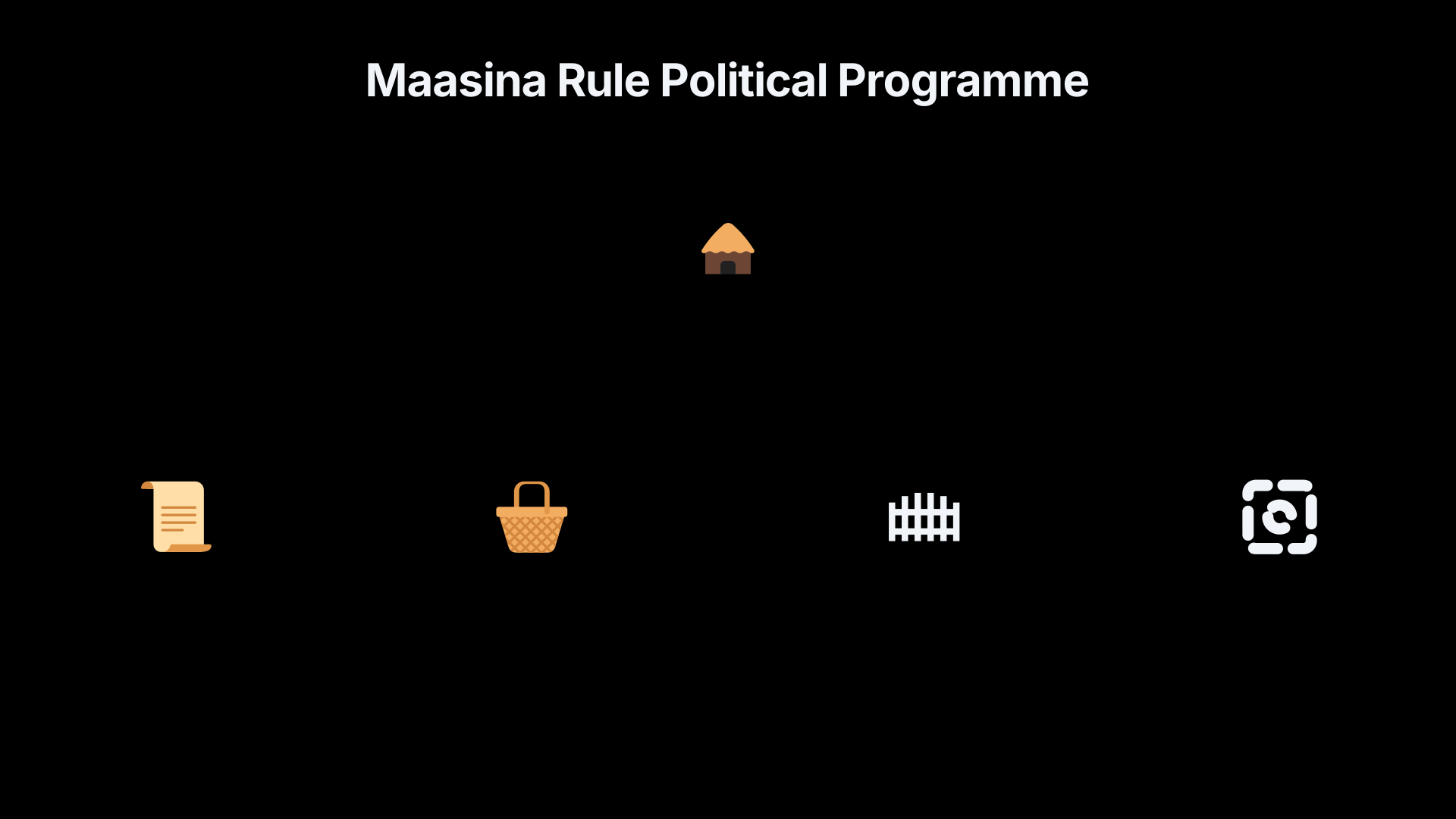
- indigenous self-government rather than rule by colonial officials;
- larger, cleaner and more cooperative villages;
- improved agriculture and collective economic development;
- recognition of local law and courts;
- greater control over labour and wages;
- unity across previously divided Malaitan communities.[solomonencyclopaedia.net]solomonencyclopaedia.netMaasina RuleConcept - Solomon Islands Encyclopaedia, 1893-1978…
At the same time, some supporters believed that Americans might return to replace British authority or that dramatic improvements in prosperity would accompany political liberation. These expectations reflected wartime experience, Christian ideas about renewal and hopes for justice after decades of colonial inequality. They were genuine among some followers but varied considerably between districts and over time.[solomonencyclopaedia.net]solomonencyclopaedia.netMaasina RuleConcept - Solomon Islands Encyclopaedia, 1893-1978…
Modern scholarship argues that colonial observers frequently exaggerated these prophetic elements because they fitted contemporary ideas about “cargo cults”. David Akin’s detailed historical study and Roger Keesing’s earlier work both show that reducing Maasina Rule to millenarian belief obscures its sophisticated political organisation and its role in creating an indigenous programme for self-rule.[hawaii.edu]uhpress.hawaii.eduOpen source on hawaii.edu.

Self-government, village reform and collective action
Far from waiting passively for supernatural intervention, Maasina Rule created functioning alternative institutions.
Communities established local courts based on kastom (customary law), appointed local officials, coordinated village construction, organised collective labour and attempted to regulate economic life independently of the colonial administration. Leaders also campaigned for substantial wage increases and sought formal recognition of indigenous legal institutions.[solomonencyclopaedia.net]solomonencyclopaedia.netMaasina RuleConcept - Solomon Islands Encyclopaedia, 1893-1978…
The movement deliberately encouraged people to withdraw cooperation from colonial structures where possible. Labour recruiting was resisted, taxes became contentious and local administration increasingly operated through Maasina Rule’s own hierarchy rather than government-appointed officials. These actions resembled organised civil resistance more than spontaneous religious revival.[libcom.org]libcom.org1944 52 solomon islanders establish autonomus village movement1944-52: Solomon Islanders Establish Autonomus Village Movement | libcom.org…
An important legacy was the development of kastom as a conscious political language. Rather than referring simply to inherited tradition, kastom became an argument that Solomon Islanders possessed legitimate systems of law, authority and identity that deserved recognition alongside—or instead of—colonial institutions. This idea would continue to influence politics in Solomon Islands long after Maasina Rule itself had declined.[solomonencyclopaedia.net]solomonencyclopaedia.netMaasina RuleConcept - Solomon Islands Encyclopaedia, 1893-1978…
Arrests, colonial panic and the road to independence
British administrators initially held discussions with Maasina Rule leaders but became increasingly alarmed as the movement expanded across Malaita and spread into neighbouring islands. Officials viewed its independent courts, tax collection, mass meetings and refusal to cooperate with government authority as a direct challenge to colonial rule.[solomonencyclopaedia.net]solomonencyclopaedia.netMaasina RuleConcept - Solomon Islands Encyclopaedia, 1893-1978…
In 1947 the administration launched a coordinated crackdown, commonly known as Operation De-Louse. Police arrested many senior leaders on charges connected with illegal courts, unlawful assemblies and obstruction of government administration. Rather than ending the movement, these arrests prompted widespread civil disobedience and mass imprisonment as supporters deliberately accepted arrest instead of abandoning the campaign.[Wikipedia]WikipediaSolomon IslandsSolomon Islands
The repression ultimately failed to restore unquestioned colonial authority. By the early 1950s the government increasingly recognised that some form of indigenous political participation was unavoidable. The establishment of the Malaita Council in 1953 reflected this shift, and later official assessments even acknowledged that Maasina Rule’s local administrative system had often functioned more effectively than the colonial structures intended to replace it.[solomonencyclopaedia.net]solomonencyclopaedia.netLocal Government CouncilsCorporate entry - Solomon Islands Encyclopaedia, 1893-1978…
Why historians reject the simple “cargo cult” label
The older description of Maasina Rule as a cargo cult survives in some popular accounts, but it has largely been abandoned by specialist historians.
Several reasons explain this reassessment:
- The movement maintained a detailed programme of political and economic reform rather than relying on supernatural expectations alone.
- Prophetic beliefs varied between communities and never represented the entirety of the movement.
- Colonial officials had practical reasons to portray organised political resistance as irrational or religiously misguided.
- Indigenous participants consistently described aims centred on self-government, dignity, fair wages and local authority.[hawaii.edu]uhpress.hawaii.eduOpen source on hawaii.edu.
This does not mean prophecy played no role. Millenarian hopes, rumours about American return and expectations of dramatic transformation formed one strand within Maasina Rule, particularly during the uncertain years immediately after the war. However, modern research suggests these beliefs should be understood as part of a broader anti-colonial movement responding to extraordinary social disruption rather than as evidence that the movement was primarily driven by irrational expectation.[solomonencyclopaedia.net]solomonencyclopaedia.netMaasina RuleConcept - Solomon Islands Encyclopaedia, 1893-1978…
Lasting significance
Maasina Rule occupies an important place in the history of collective belief in Solomon Islands because it demonstrates how political resistance, Christian ideas, indigenous custom and prophetic expectation could reinforce one another without becoming identical.
For historians of nationalism, it represents the first mass indigenous movement to demand meaningful self-government across much of the central Solomon Islands. For scholars of religion and collective belief, it illustrates why movements labelled as “cargo cults” often contained practical political programmes that colonial observers underestimated. Rather than choosing between nationalism and prophecy, the evidence suggests Maasina Rule drew strength from both, with its enduring legacy lying less in millenarian expectation than in its successful demonstration that Solomon Islanders could organise collectively outside colonial authority and imagine an alternative political future.[solomonencyclopaedia.net]solomonencyclopaedia.netMaasina RuleConcept - Solomon Islands Encyclopaedia, 1893-1978…
Amazon book picks
Further Reading
Books and field guides related to Was Maasina Rule Rebellion, Prophecy or Both?. Use these as the next step if you want deeper reading beyond the article.

The Cambridge history of the Pacific Islanders
Places Solomon Islands independence movements in context.
Social Change in Melanesia
First published 2000. Subjects: Melanesia, Social conditions, History, Conditions sociales, Histoire.
Endnotes
1.
Source: solomonencyclopaedia.net
Title: Maasina Rule
Link:https://www.solomonencyclopaedia.net/biogs/E000181b.htm
Source snippet
Concept - Solomon Islands Encyclopaedia, 1893-1978...
2.
Source: academic.oup.com
Link:https://academic.oup.com/hawaii-scholarship-online/book/20132/chapter-abstract/179128298
Source snippet
OUP AcademicIntroduction | Colonialism, Maasina Rule, and the Origins of Malaitan Kastom | Hawai'i Scholarship Online | Oxford Academic...
3.
Source: Wikipedia
Title: Maasina Rule
Link:https://en.wikipedia.org/wiki/Maasina_Rule
4.
Source: libcom.org
Title: 1944 52 solomon islanders establish autonomus village movement
Link:https://libcom.org/article/1944-52-solomon-islanders-establish-autonomus-village-movement
Source snippet
1944-52: Solomon Islanders Establish Autonomus Village Movement | libcom.org...
5.
Source: solomonencyclopaedia.net
Title: Local Government Councils
Link:https://www.solomonencyclopaedia.net/biogs/E000178b.htm
Source snippet
Corporate entry - Solomon Islands Encyclopaedia, 1893-1978...
6.
Source: Wikipedia
Title: Solomon Islands
Link:https://en.wikipedia.org/wiki/Solomon_Islands
7.
Source: solomonencyclopaedia.net
Link:https://www.solomonencyclopaedia.net/bib/P00000086.htm
Source snippet
Colonialism, Maasina Rule, and the Origins of Malaitan Kastom - Solomon Islands Encyclopaedia, 1893-1978...
8.
Source: academic.oup.com
Link:https://academic.oup.com/hawaii-scholarship-online/book/20132
9.
Source: academic.oup.com
Link:https://academic.oup.com/hawaii-scholarship-online/book/20132/chapter/179138728
10.
Source: academic.oup.com
Link:https://academic.oup.com/hawaii-scholarship-online/book/20132/chapter-abstract/179137709
11.
Source: academic.oup.com
Link:https://academic.oup.com/hawaii-scholarship-online/book/20132/chapter/179129883
12.
Source: academic.oup.com
Link:https://academic.oup.com/hawaii-scholarship-online/book/20132/chapter/179128029
13.
Source: academic.oup.com
Link:https://academic.oup.com/hawaii-scholarship-online/book/20132/chapter-abstract/179139501
14.
Source: academic.oup.com
Title: reference article
Link:https://academic.oup.com/reference/62334/reference-article-abstract/554061984?login=false
15.
Source: solomonencyclopaedia.net
Title: [Moro Movement]({{ ‘moro-movement/’ | relative_url }})
Link:https://www.solomonencyclopaedia.net/biogs/E000207b.htm
16.
Source: solomonencyclopaedia.net
Title: Book Section
Link:https://www.solomonencyclopaedia.net/bib/P00002000.htm
17.
Source: uhpress.hawaii.edu
Link:https://uhpress.hawaii.edu/title/colonialism-maasina-rule-and-the-origins-of-malaitan-kastom/
18.
Source: paulturnbull.org
Title: Paul Turnbull Second World War (Solomon Islands)
Link:https://paulturnbull.org/solomonencyclopaedia/biogs/E000272b.htm
Source snippet
Paul TurnbullSecond World War (Solomon Islands) - Event - Solomon Islands Encyclopaedia, 1893-1978...
19.
Source: uhpress.hawaii.edu
Title: colonialism maasina rule and the origins of malaitan kastom
Link:https://uhpress.hawaii.edu/colonialism-maasina-rule-and-the-origins-of-malaitan-kastom/
20.
Source: alamoana.net
Title: Solomon Islands
Link:https://alamoana.net/info/en/?search=Solomon_Islands
Additional References
21.
Source: cambridge.org
Link:https://www.cambridge.org/core/journals/african-studies-review/article/abs/prosecuting-a-prophet-justice-psychiatry-and-rebellion-in-colonial-kenya/2A28FE69036EF721F91431AADE61D8DD
Source snippet
June 29, 2020 — PROSECUTING A PROPHET: JUSTICE, PSYCHIATRY, AND REBELLION IN COLONIAL KENYA Published online by Cambridge University Pres...
Published: June 29, 2020
22.
Source: youtube.com
Title: Malaita: Preserving Kastom Culture in the Solomon Islands
Link:https://www.youtube.com/watch?v=gHof8qWVZNw
Source snippet
Solomon Islands Independence Anniversary 2026...
23.
Source: youtube.com
Title: Cargo Cults: When WWII Supplies Became a Religion
Link:https://www.youtube.com/watch?v=2cPKc-lH4No
Source snippet
Malaita: Preserving Kastom Culture in the Solomon Islands...
24.
Source: cambridge.org
Link:https://www.cambridge.org/core/journals/british-journal-of-political-science/article/abs/bureaucracy-and-incumbent-violence-colonial-administration-and-the-origins-of-the-mau-mau-emergency-in-kenya/71BFD4B561ED9840461578F6E59B3BA9
25.
Source: researchgate.net
Link:https://www.researchgate.net/publication/364753860_Colonialism_Maasina_Rule_and_the_Origins_of_Malaitan_Kastom
26.
Source: natlib.govt.nz
Link:https://natlib.govt.nz/records/36548844?search%5Bi%5D%5Bsubject%5D=Solomon+Islands+–+Malaita+Province&search%5Bpath%5D=items
27.
Source: tandfonline.com
Link:https://www.tandfonline.com/doi/full/10.1080/02757206.2012.649276
28.
Source: researchgate.net
Title: 290858788 Colonialism Maasina Rule and the origins of Malaitan kastom
Link:https://www.researchgate.net/publication/290858788_Colonialism_Maasina_Rule_and_the_origins_of_Malaitan_kastom
29.
Source: youtube.com
Title: Solomon Islands History
Link:https://www.youtube.com/watch?v=WmFMMhSKPh8
Source snippet
Cargo Cults: When WWII Supplies Became a Religion...
30.
Source: doi.org
Title: Cargo Cults and Discursive Madness
Link:https://doi.org/10.1002%2Fj.1834-4461.2000.tb03071.x
Topic Tree