Within New Zealand Belief
How Did a Youth Scare Grip New Zealand?
The 1954 panic over teenage behaviour reshaped public debate despite weak evidence of a nationwide moral collapse.
On this page
- The Hutt Valley alarm
- The Mazengarb Report
- Media, censorship and lasting myths
Page outline Jump by section
Introduction
The Mazengarb Report is the best-known example of a modern moral panic in New Zealand. Produced in 1954 after a series of highly publicised incidents involving teenagers, it convinced many adults that the country faced a national crisis of juvenile immorality. Although presented as an urgent investigation into the behaviour of young people, later historians have argued that the inquiry relied heavily on anecdote, reflected the anxieties of conservative post-war society, and exaggerated the scale of the problem. Even so, its influence was enormous. The report was delivered to households across the country, shaped censorship policy, restricted access to contraceptive advice for young people, and left a lasting mark on how New Zealand remembers the social tensions of the 1950s.[NZHistory]nzhistory.govt.nzNZHistory Mazengarb report released | NZ HistoryMazengarb report released | NZ HistorySeptember 20, 1954…

How did the Hutt Valley alarm become a national scare?
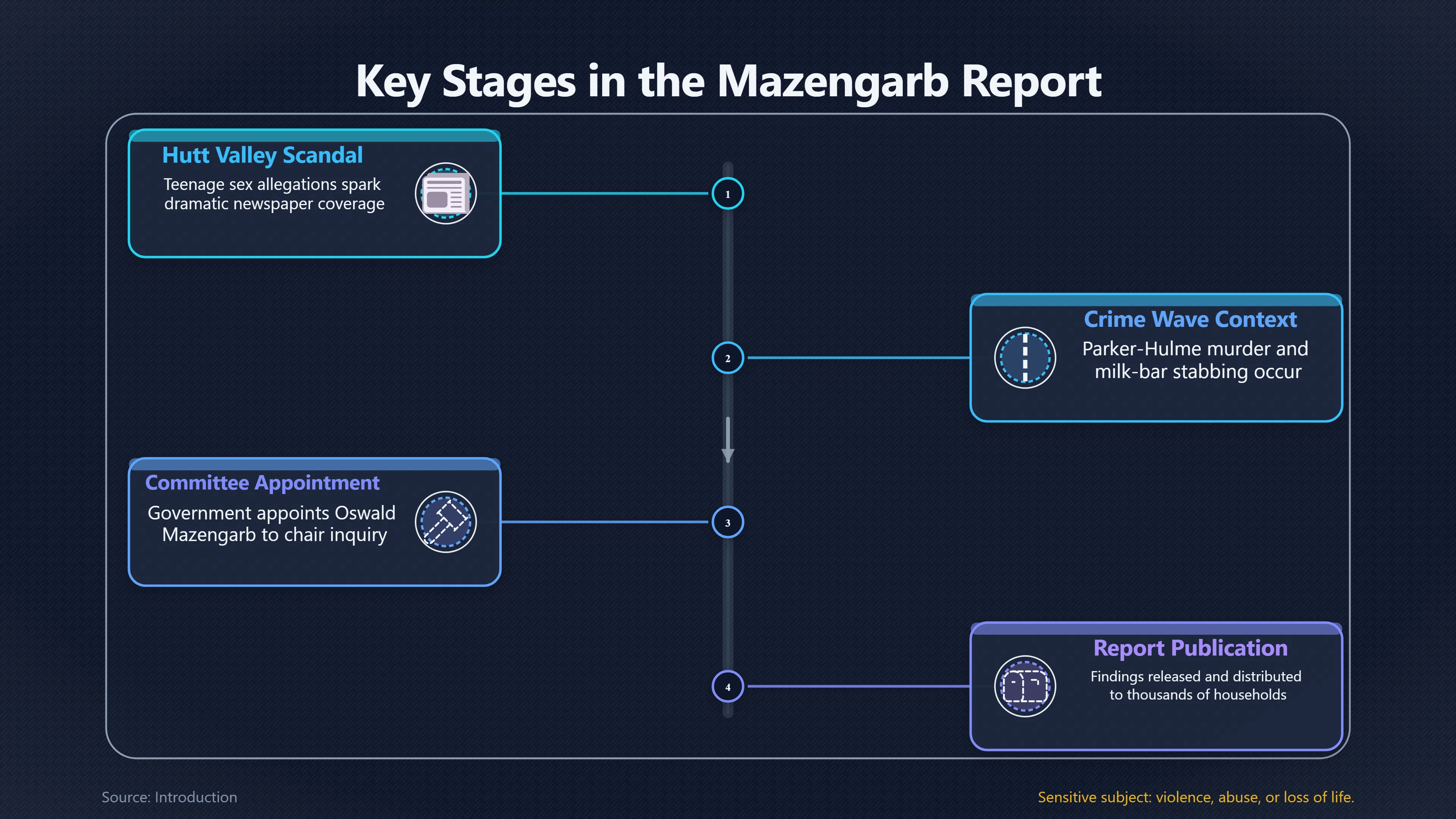
The immediate trigger for the inquiry was a teenage sex scandal in the Lower Hutt area, often called the “Petone incident”. Police investigations into a missing 15-year-old girl uncovered claims that groups of teenagers were gathering in milk bars and private homes for casual sexual encounters. Newspapers reported the affair in dramatic terms, presenting it as evidence that traditional standards of behaviour were collapsing.[NZHistory]nzhistory.govt.nz1954 key events1954 – key events | NZ HistorySeptember 10, 2025…
The timing made these reports especially powerful. During the same year, New Zealanders were shocked by other widely reported crimes involving young people, including the Parker–Hulme murder in Christchurch and a fatal milk-bar stabbing in Auckland. Although these events were unrelated, they became linked in the public imagination as signs that post-war youth culture had become dangerous.[NZHistory]nzhistory.govt.nz1954 key events1954 – key events | NZ HistorySeptember 10, 2025…
Post-war prosperity also contributed to adult unease. Teenagers had more disposable income than previous generations, spent more time outside the home, embraced American popular culture, and socialised in cafés, milk bars and dance venues. Many older New Zealanders interpreted these visible social changes as evidence of moral decline rather than ordinary generational change. Historians now describe this combination of isolated incidents, media amplification and broader cultural anxiety as a classic moral panic rather than proof of a nationwide collapse in behaviour.[NZHistory]nzhistory.govt.nzNZHistory Mazengarb report released | NZ HistoryMazengarb report released | NZ HistorySeptember 20, 1954…
What did the Mazengarb Report claim?
In July 1954 the government appointed lawyer Oswald Mazengarb to chair the Special Committee on Moral Delinquency in Children and Adolescents. The committee worked rapidly, gathering submissions and evidence before delivering its report only a few months later. Its speed reflected the political urgency surrounding the issue as much as any systematic research programme.[natlib.govt.nz]natlib.govt.nzOpen source on govt.nz.
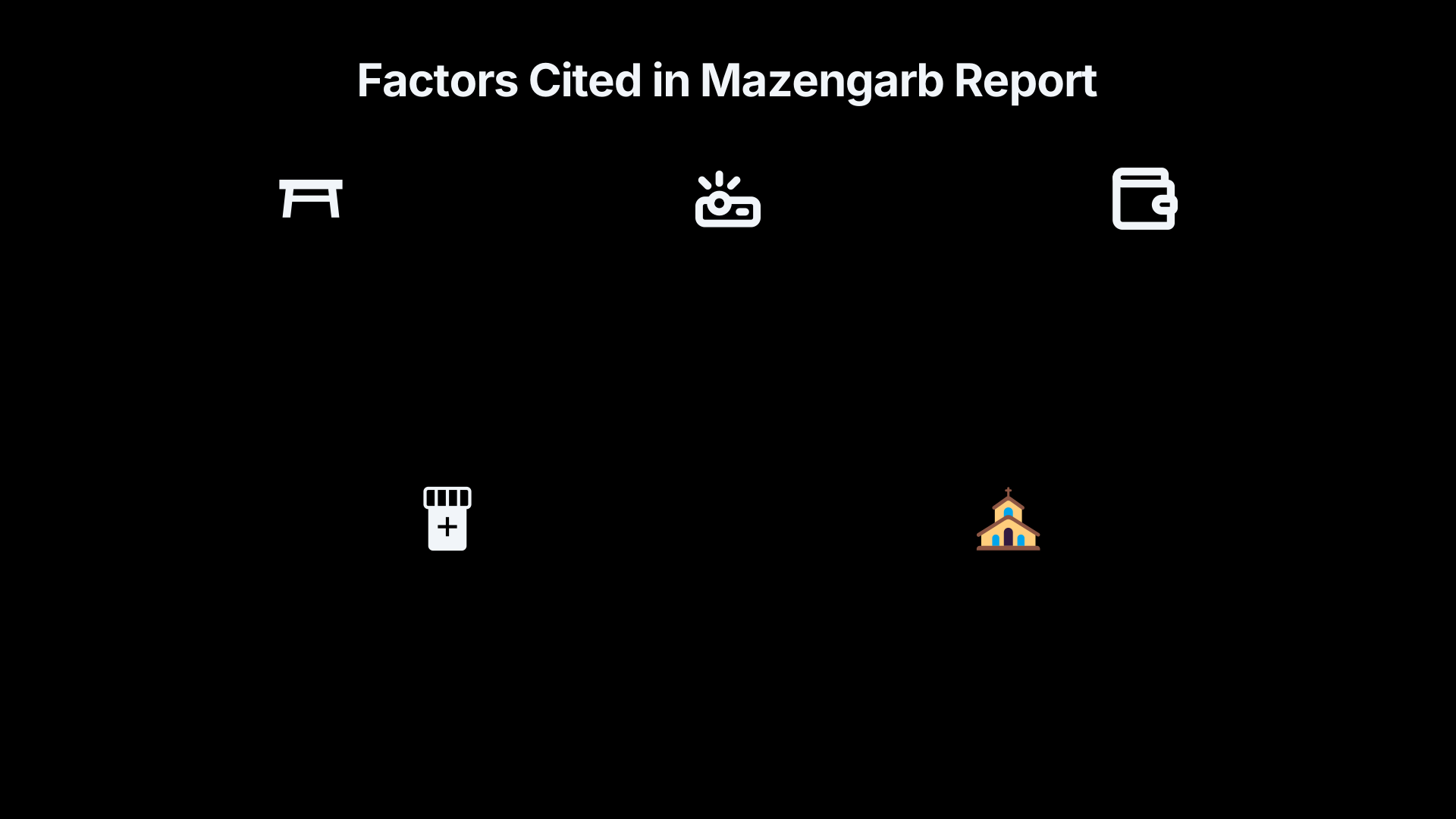
The committee argued that juvenile delinquency stemmed from a broad decline in parental authority and Christian values. Among the factors it identified were:
- inadequate parental supervision, especially because more mothers were working outside the home;
- easy access to contraceptives;
- high wages that gave teenagers too much spending money;
- American films, comics and popular culture;
- declining religious influence and weaker family discipline;
- greater opportunities for unsupervised socialising.[NZHistory]nzhistory.govt.nzNZHistory Mazengarb report released | NZ HistoryMazengarb report released | NZ HistorySeptember 20, 1954…
The report placed particular emphasis on female sexuality, suggesting that young women were encouraging immoral behaviour. This reflected wider assumptions about gender roles in the 1950s, when women’s employment, changing courtship patterns and growing youth independence unsettled many social conservatives. Modern historians generally see these conclusions as revealing contemporary social attitudes more than objective evidence about teenage behaviour.[NZHistory]nzhistory.govt.nzNZHistory Mazengarb report released | NZ HistoryMazengarb report released | NZ HistorySeptember 20, 1954…
Why do historians describe it as a moral panic?
The Mazengarb inquiry has become a textbook example of moral panic because the official response appears disproportionate to the available evidence.
Several features stand out:
- Local incidents became national symbols. Events centred largely on Lower Hutt and a handful of sensational crimes were treated as proof of a nationwide crisis.
- Extraordinary publicity magnified concern. The government distributed copies of the report to households throughout New Zealand receiving the family benefit, giving the document unparalleled reach.
- Broad social changes became moral explanations. Working mothers, consumer culture, comics and films were blamed for problems that had many possible causes.
- Evidence was limited. The committee collected testimony and submissions but did not demonstrate that sexual behaviour among young people had suddenly deteriorated across the country.[govt.nz]natlib.govt.nzOpen source on govt.nz.
Later scholarship has therefore distinguished between genuine concerns about adolescent welfare and the much larger public narrative that portrayed an entire generation as morally endangered.
How did the media and government reinforce the panic?
Press coverage was central to the episode. Newspapers reported the Hutt Valley allegations in highly dramatic language, while politicians portrayed the inquiry as an urgent defence of family life. Rather than calming public fears, the official investigation gave them greater legitimacy.
The report itself became part of the publicity campaign. Hundreds of thousands of copies were distributed nationally, making it one of the most widely circulated government publications in New Zealand history. Its recommendations reinforced the message that the country faced a serious moral emergency requiring action by parents, churches and schools.[NZHistory]nzhistory.govt.nzNZHistory Mazengarb report released | NZ HistoryMazengarb report released | NZ HistorySeptember 20, 1954…
The inquiry also influenced public policy. It helped justify tighter censorship of books and publications considered sexually explicit and supported restrictions on providing contraceptive information to young people. These measures reflected the belief that controlling information and popular culture could restore traditional morality.[NZHistory]nzhistory.govt.nzNZHistory Mazengarb report released | NZ HistoryMazengarb report released | NZ HistorySeptember 20, 1954…

Did the report actually change young people’s behaviour?
The available evidence suggests that it did not.
Government inquiries conducted in later decades found no observable reduction in juvenile misconduct that could be attributed to the Mazengarb Report or the policies inspired by it. Youth culture continued to evolve during the 1960s despite attempts to reinforce traditional moral standards.[NZHistory]nzhistory.govt.nzNZHistory Mazengarb report released | NZ HistoryMazengarb report released | NZ HistorySeptember 20, 1954…
This gap between public alarm and measurable outcomes is one reason the episode remains important to historians. It illustrates how governments can respond energetically to perceived social threats even when evidence for a widespread crisis is weak.
Why does the Mazengarb Report still matter?
The report occupies an unusual place in New Zealand’s cultural memory. It was neither a fabricated event nor a wholly evidence-based assessment. The Hutt Valley incidents were real, and some adults had genuine concerns about adolescent welfare. What later scholars question is the leap from a cluster of troubling cases to the conclusion that an entire generation had become morally delinquent.
Its legacy extends beyond the 1950s. The episode has become a reference point in debates over youth crime, sex education, censorship and media influence. Whenever fears arise that new forms of entertainment or changing family structures are corrupting young people, commentators often draw comparisons with the Mazengarb panic as a reminder that public anxiety can greatly exceed the underlying evidence.
Within New Zealand’s history of collective fears, the Mazengarb Report stands as perhaps the clearest example of a modern moral panic: an episode in which rapid social change, sensational media coverage, political pressure and deeply held cultural values combined to create a powerful national narrative that outlasted the evidence on which it was built.[NZHistory]nzhistory.govt.nzNZHistory Mazengarb report released | NZ HistoryMazengarb report released | NZ HistorySeptember 20, 1954…
Amazon book picks
Further Reading
Books and field guides related to How Did a Youth Scare Grip New Zealand?. Use these as the next step if you want deeper reading beyond the article.
Folk Devils and Moral Panics the Creation of the Mods and Roc...
First published 1972. Subjects: Youth, great britain, Deviant behavior, Case studies, Subculture, Young adults.
Mistakes Were Made (but Not by Me) Third Edition
Renowned social psychologists Carol Tavris and Elliot Aronson take a compelling look into how the brain is wired for self-justification....
Endnotes
1.
Source: nzhistory.govt.nz
Title: NZHistory Mazengarb report released | NZ History
Link:https://nzhistory.govt.nz/the-mazengarb-report-on-juvenile-moral-delinquency-is-released
Source snippet
Mazengarb report released | NZ HistorySeptember 20, 1954...
Published: September 20, 1954
2.
Source: natlib.govt.nz
Link:https://natlib.govt.nz/records/22731574
3.
Source: nzhistory.govt.nz
Title: 1954 key events
Link:https://nzhistory.govt.nz/page/1954-key-events
Source snippet
1954 – key events | NZ HistorySeptember 10, 2025...
Published: September 10, 2025
4.
Source: nzhistory.govt.nz
Title: NZHistory Mazengarb Report | NZ History
Link:https://nzhistory.govt.nz/keyword/mazengarb
5.
Source: natlib.govt.nz
Link:https://natlib.govt.nz/records/22408671
6.
Source: collections.tepapa.govt.nz
Link:https://collections.tepapa.govt.nz/object/1524536
7.
Source: teara.govt.nz
Link:https://teara.govt.nz/en/photograph/26999/mazengarb-report
8.
Source: nzhistory.govt.nz
Link:https://nzhistory.govt.nz/page/1950s
Source snippet
The 1950s | NZ HistorySeptember 23, 2025 — THE 1950S PAGE 1 – INTRODUCTION 1950s refrigerator advert (detail) In 1959 a Sydney beauty que...
Published: September 23, 2025
9.
Source: teara.govt.nz
Link:https://teara.govt.nz/mi/photograph/28261/mazengarb-report
Source snippet
Mazengarb report | Gangs | Te Ara Encyclopedia of New ZealandApril 1, 2020 — MAZENGARB REPORT Whai muri Image: Mazengarb report A clerk a...
Published: April 1, 2020
10.
Source: nzhistory.govt.nz
Title: The post-war family | NZ History
Link:https://nzhistory.govt.nz/culture/children-and-adolescents-1940-60/post-war-family
11.
Source: teara.govt.nz
Title: Mazengarb report | Gangs | Te Ara Encyclopedia of New Zealand
Link:https://teara.govt.nz/en/photograph/28261/mazengarb-report
12.
Source: teara.govt.nz
Title: Gangs and society | Te Ara Encyclopedia of New Zealand
Link:https://teara.govt.nz/en/gangs/page-5
13.
Source: nzhistory.govt.nz
Link:https://nzhistory.govt.nz/keyword/children
14.
Source: nzhistory.govt.nz
Link:https://nzhistory.govt.nz/keyword/adolescents
15.
Source: natlib.govt.nz
Link:https://natlib.govt.nz/records/23177982?search%5Bi%5D%5Bname_authority_id%5D=-85942&search%5Bpath%5D=items
Additional References
16.
Source: youtube.com
Title: The Teenagers Whose Fantasy World Turned Deadly
Link:https://www.youtube.com/watch?v=khoJ8p_rB08
Source snippet
Case 101: The Heavenly Creatures Murder AKA The Parker-Hulme Murder...
17.
Source: youtube.com
Title: Case 101: The Heavenly Creatures Murder AKA The Parker-Hulme Murder
Link:https://www.youtube.com/watch?v=vLsnazU5moY
Source snippet
Heavenly Creatures: The Parker-Hulme Murder | Morbid | Podcast...
18.
Source: youtube.com
Title: Episode 479: The Parker-Hulme Murder Case
Link:https://www.youtube.com/watch?v=GqtWoMy931o
Source snippet
The Teenagers Whose Fantasy World Turned Deadly - The 'Heavenly Creatures' Murder Case...
19.
Source: ahnz.anarkiwi.co.nz
Title: 1954 mazengarb
Link:https://ahnz.anarkiwi.co.nz/1954-mazengarb/
Source snippet
History of New ZealandSeptember 20, 2019 — ANARCHIST HISTORY OF NEW ZEALAND January 11, 2026 - The History of New Zealand through a Liber...
Published: September 20, 2019
20.
Source: gutenberg.org
Link:https://www.gutenberg.org/ebooks/14760
21.
Source: youtube.com
Title: S3 E3: Teenagers | RNZ
Link:https://www.youtube.com/watch?v=SzJ5feT9Bsg
Source snippet
Episode 479: The Parker-Hulme Murder Case...
22.
Source: youtube.com
Title: Heavenly Creatures: The Parker-Hulme Murder | Morbid | Podcast
Link:https://www.youtube.com/watch?v=V7sfE0tA1CI
23.
Source: abuseincare.org.nz
Title: chapter 6
Link:https://www.abuseincare.org.nz/reports/whanaketia/part-2/chapter-6
Topic Tree