Within Finland's Strange Fears
How Did Finland's Witch Trials Escalate?
Finland's witch trials grew from local disputes but became deadly when courts accepted demonology and children's accusations.
On this page
- Everyday magic, healing and neighbourhood accusations
- The Åland and Ostrobothnia panic of the 1660 s and 1670 s
- How courts, appeals and scepticism stopped executions
Page outline Jump by section
Introduction
Finland’s witch trials did not unfold as one long, nationwide frenzy. For most of the period between the early sixteenth and mid-eighteenth centuries, accusations of harmful magic were handled as local legal disputes under Swedish rule. What made some episodes turn into genuine witch panics was a change in how courts understood witchcraft. As ideas about the Devil, witches’ gatherings and organised satanic conspiracies spread from continental Europe into the Swedish kingdom, some Finnish courts began treating neighbourhood quarrels as evidence of a far wider supernatural threat. The most dangerous phase came during the 1660s and 1670s, particularly in Åland and Ostrobothnia, when children’s testimony, judicial assumptions and imported demonology combined to create a self-reinforcing cycle of accusations. Although dozens of people were executed, Finland also offers an important example of how legal scepticism and appeals eventually slowed and stopped the panic.[tuni.fi]researchportal.tuni.fiTampere University Research PortalWhat did a witch-hunter in Finland know about demonology? - Tampere University Research Portal…
How did everyday disputes become witchcraft cases?
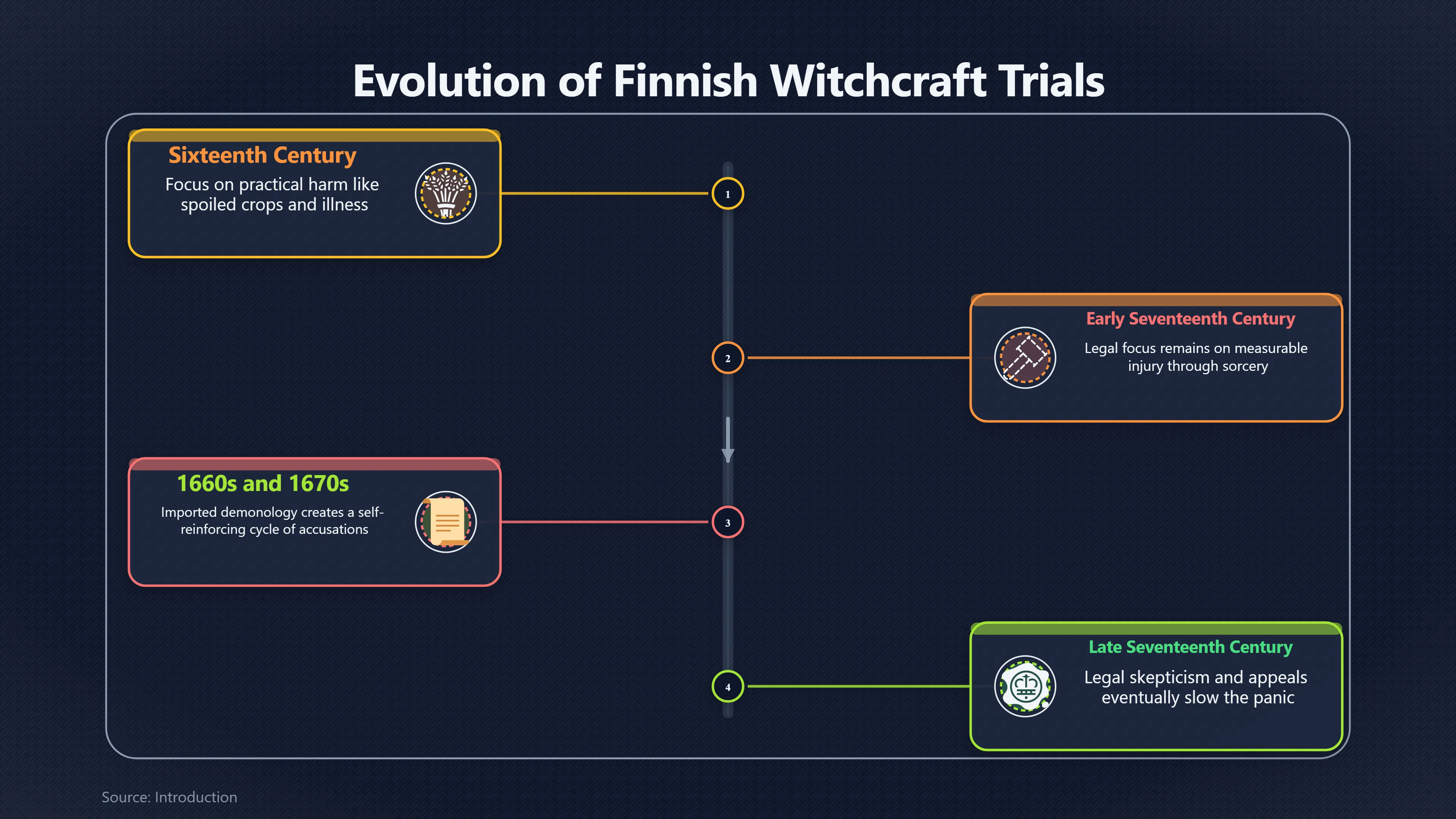
For much of the sixteenth and early seventeenth centuries, Finnish witchcraft prosecutions centred on practical harm rather than elaborate stories about Satan. A neighbour might accuse someone of causing illness, spoiling crops, killing livestock or using magical threats that later appeared to come true. These accusations reflected everyday anxieties in rural communities where illness, failed harvests and unexplained deaths demanded an explanation.
The legal distinction also mattered. Earlier Swedish law primarily punished harmful magic rather than membership of a demonic conspiracy. Courts therefore concentrated on whether a defendant had caused measurable injury through sorcery, not whether they had attended secret gatherings with the Devil. Benevolent healing, protective charms and folk remedies occupied a more ambiguous legal position and were not automatically prosecuted, although attitudes hardened during the seventeenth century.[webpages.tuni.fi]webpages.tuni.fiOpen source on tuni.fi.
This explains why many accusations remained local disputes instead of expanding into large hunts. A quarrel over livestock or illness could often be resolved through fines, compensation or acquittal rather than triggering dozens of new arrests.
Everyday magic, healing and neighbourhood accusations
Early modern Finnish villages accepted that certain people possessed unusual knowledge. Folk healers, charm-users and diviners were often consulted by the same neighbours who might later accuse them if a cure failed or misfortune followed.
An unusual feature of Finnish witch trials was the prominence of male defendants. Across much of western Europe, women formed the overwhelming majority of those accused. Finland differed because magical expertise and folk healing were frequently associated with men as well as women. Historians argue that older traditions surrounding male specialists in healing and ritual helped shape who became suspected when accusations first arose. Only later, during the major panic years, did the gender balance move closer to patterns seen elsewhere in Europe.[wikipedia.org]WikipediaWitch trials in FinlandWitch trials in Finland
This does not mean Finnish society was more tolerant. Rather, it shows that local beliefs about who possessed magical knowledge influenced who became vulnerable when fear intensified.
Why did the panic grow in the 1660s and 1670s?
The decisive change was not simply that people feared magic more. It was that judges, clergy and educated officials increasingly adopted the demonological ideas circulating across Europe.
Instead of asking whether someone had bewitched a neighbour, courts began asking whether witches had:
- made pacts with the Devil;
- attended secret nocturnal gatherings;
- flown through supernatural means;
- recruited others into organised witchcraft.
These concepts had developed in learned theological and legal writing long before they appeared widely in Finnish courtrooms. Research into the Åland trials shows that judges explicitly drew upon European demonological literature while conducting interrogations, demonstrating that learned ideas influenced courtroom practice rather than merely reflecting popular folklore.[Tampere University Research Portal]researchportal.tuni.fiTampere University Research PortalWhat did a witch-hunter in Finland know about demonology? - Tampere University Research Portal…
Once courts expected evidence of organised witchcraft, interrogations increasingly encouraged witnesses to describe conspiracies instead of isolated acts of harmful magic.
The Åland and Ostrobothnia panic
The most dangerous Finnish witch panic occurred during the later seventeenth century, particularly in Åland between 1666 and 1670 and later in Ostrobothnia.
These prosecutions increasingly resembled the wider Swedish witch panic known as Det stora oväsendet (“The Great Noise”), in which authorities believed witches carried children to meetings with the Devil.
Children became crucial witnesses. Some claimed they had been taken by accused adults to supernatural gatherings. Because these stories identified multiple participants, each testimony generated new suspects. Courts questioned those suspects, whose interrogations could produce additional names, creating a rapidly expanding chain of accusations.
This mechanism transformed isolated neighbourhood conflicts into collective persecution. The panic spread less because everyone independently reported similar experiences than because legal procedures encouraged increasingly connected narratives. Once judges accepted children’s testimony as credible evidence of organised witchcraft, accusations multiplied far faster than earlier local disputes ever had.[Tampere University Research Portal]researchportal.tuni.fiTampere University Research PortalWhat did a witch-hunter in Finland know about demonology? - Tampere University Research Portal…
In Ostrobothnia, the panic became especially deadly between 1674 and 1678. Contemporary records indicate that twenty women and two men were executed there, marking Finland’s most intense episode of witch persecution.[Wikipedia]WikipediaWitch trials in FinlandWitch trials in Finland

How courtroom procedures amplified fear
The Finnish witch panic demonstrates how institutions can unintentionally magnify rumours.
Several courtroom practices proved especially important:
- Leading expectations. Judges increasingly expected confessions involving Satan and organised witchcraft rather than isolated magical acts.
- Children’s evidence. Young witnesses were often treated as credible despite the extraordinary nature of their claims.
- Naming accomplices. Confessions or testimony naming additional witches encouraged ever larger investigations.
- Confirmation through repetition. Similar stories appearing in successive trials seemed to reinforce one another, even when witnesses had been exposed to earlier testimony.
Modern historians stress that trial records should not be read as straightforward accounts of popular belief. They are conversations shaped by interrogation, legal procedure and the expectations of both officials and witnesses. Recent narratological research argues that courtroom questioning actively influenced how experiences were described and remembered, making the records evidence not only of belief but also of judicial practice.[Tampere University Research Portal]researchportal.tuni.fiTampere University Research PortalA narratological approach to witchcraft trial records: Creating experience - Tampere University Researc…
Why Finland avoided even larger witch hunts
Despite thousands of accusations over more than two centuries, Finland experienced fewer executions than many parts of central Europe.
Several factors limited the scale of persecution.
First, many accusations never progressed beyond local courts. Rumours could circulate without producing formal prosecutions.
Second, higher courts frequently reviewed severe sentences. Death penalties imposed locally were not always confirmed on appeal, and acquittals or reduced punishments were common. Modern research suggests that only a minority of Finnish witchcraft cases resulted in execution, while more than half ended in acquittal or other outcomes.[Tampereen yliopisto ja TAMK]tuni.fiOpen source on tuni.fi.
Third, scepticism gradually strengthened. As Swedish authorities recognised the weaknesses of children’s testimony and the dangers of self-reinforcing accusations, confidence in large-scale witch prosecutions declined. The legal assumptions that had fuelled the panic lost credibility, helping to bring executions to an end.
Rather than ending because belief in magic suddenly disappeared, the panic faded because courts became less willing to accept extraordinary claims as sufficient evidence.

What the Finnish witch trials reveal about collective panic
The Finnish experience shows that witch panics were neither inevitable nor simply the product of widespread superstition. Most accusations remained small-scale neighbourhood conflicts rooted in everyday fears about illness, livestock and misfortune.
The deadliest episodes emerged when several forces aligned:
- existing local suspicions;
- imported demonological theories;
- judicial acceptance of children’s accusations;
- interrogation methods that generated new suspects;
- legal systems willing to treat rumours as evidence of organised conspiracy.
Equally significant is what happened afterwards. Appeals, judicial caution and growing scepticism interrupted the chain reaction before Finland experienced the sustained mass persecutions seen in some other European regions. For historians, Finland therefore illustrates both how a witch panic could develop and how legal institutions could eventually dismantle the mechanisms that had allowed it to spread.[tuni.fi]tuni.fiOpen source on tuni.fi.
Amazon book picks
Further Reading
Books and field guides related to How Did Finland's Witch Trials Escalate?. Use these as the next step if you want deeper reading beyond the article.
The witch-hunt in early modern Europe
Best single-volume context for Finnish witch trials.

Witchcraft in Europe,
Includes key legal and theological texts relevant to Scandinavian cases.
Endnotes
1.
Source: researchportal.tuni.fi
Link:https://researchportal.tuni.fi/en/publications/what-did-a-witch-hunter-in-finland-know-about-demonology/
Source snippet
Tampere University Research PortalWhat did a witch-hunter in Finland know about demonology? - Tampere University Research Portal...
2.
Source: webpages.tuni.fi
Link:https://webpages.tuni.fi/sochistoria/noitanetti/summary.html
3.
Source: tuni.fi
Link:https://www.tuni.fi/en/research/how-did-finland-manage-avoid-witch-hunts-action-and-experience-de-escalating-persecution
4.
Source: Wikipedia
Title: Witch trials in Finland
Link:https://en.wikipedia.org/wiki/Witch_trials_in_Finland
5.
Source: researchportal.tuni.fi
Link:https://researchportal.tuni.fi/en/publications/a-narratological-approach-to-witchcraft-trial-records-creating-ex/
Source snippet
Tampere University Research PortalA narratological approach to witchcraft trial records: Creating experience - Tampere University Researc...
6.
Source: webpages.tuni.fi
Title: fi Witchcraft
Link:https://webpages.tuni.fi/sochistoria/noitanetti/witchtrials.html
7.
Source: trepo.tuni.fi
Title: fi What did a witch-hunter in Finland know about demonology?
Link:https://trepo.tuni.fi/handle/10024/225640
8.
Source: researchportal.tuni.fi
Title: fi Male Witches and Masculinity in early modern Finnish witchcraft trials
Link:https://researchportal.tuni.fi/en/publications/male-witches-and-masculinity-in-early-modern-finnish-witchcraft-t/
9.
Source: webpages.tuni.fi
Title: fi Witchcraft
Link:https://webpages.tuni.fi/sochistoria/noitanetti/books.html
10.
Source: webpages.tuni.fi
Link:https://webpages.tuni.fi/sochistoria/noitanetti/index.en.html
11.
Source: youtube.com
Title: Witch Trials
Link:https://www.youtube.com/watch?v=EAn1QRJT6o4
Source snippet
Sweden's Witch Trials: Uncovering the Great Noise...
Additional References
12.
Source: researchgate.net
Title: (PDF) A narratological approach to witchcraft trial records: creating experience
Link:https://www.researchgate.net/publication/357998205_A_narratological_approach_to_witchcraft_trial_records_creating_experience
Source snippet
January 20, 2022 — A NARRATOLOGICAL APPROACH TO WITCHCRAFT TRIAL RECORDS: CREATING EXPERIENCE * January 2022 * Scandinavian Journal of Hi...
Published: January 20, 2022
13.
Source: diva-portal.org
Title: Vems ärenden går elden?
Link:https://www.diva-portal.org/smash/record.jsf?pid=diva2%3A1395117
Source snippet
En historiografisk jämförelse av Sveriges och Finlands häxprocesser ur ett genusperspektivJanuary 13, 2020 — Vems ärenden går elden?: En...
Published: January 13, 2020
14.
Source: youtube.com
Title: Swedish witch trials & traditions: Witches exhibition + witchy shop tour
Link:https://www.youtube.com/watch?v=vlouwOjWKDs
Source snippet
Scholastics and Inquisitors - Foundations of the Witch Trials...
15.
Source: youtube.com
Title: Sweden’s Witch Trials: Uncovering the Great Noise
Link:https://www.youtube.com/watch?v=JiqkHy2sDZw
Source snippet
Swedish witch trials & traditions: Witches exhibition + witchy shop tour...
16.
Source: journals.uchicago.edu
Link:https://www.journals.uchicago.edu/doi/pdf/10.1017/rqx.2023.563
Source snippet
Göran Malmstedt. Palgrave Historical Studies in Witchcraft and Magic. London: Palgrave Macmillan, 2021. xii pp. $139.99. | Renaissance Qu...
17.
Source: brill.com
Link:https://brill.com/display/title/537
Source snippet
'Wicked Arts' – Witchcraft and Magic Trials in Southern Sweden, 1635-1754 | BrillOctober 16, 2023 — 'WICKED ARTS' WITCHCRAFT AND MAGIC TR...
Published: October 16, 2023
18.
Source: everything.explained.today
Link:https://everything.explained.today/Witch_trials_in_Finland/
19.
Source: youtube.com
Title: Scholastics and Inquisitors
Link:https://www.youtube.com/watch?v=MI3Q2ShVKJY
Source snippet
The Philosophy of Witchcraft...
20.
Source: finna.fi
Title: shsdoria histut.10024 162471
Link:https://www.finna.fi/Record/shsdoria_histut.10024_162471
21.
Source: finna.fi
Title: shsdoria histut.10024 162471
Link:https://www.finna.fi/Record/shsdoria_histut.10024_162471?lng=sv
Topic Tree