Within Mali Beliefs
How Massa Turned Witch Fear Into Revolt
Massa promised protection from hidden harm while allowing younger followers to challenge elders, shrines and inherited authority.
On this page
- How the movement spread from San
- Witchcraft accusations and generational conflict
- Shrine destruction, collecting and contested memory
Page outline Jump by section
Introduction
Massa, often called Allah Koura (“New God”) in contemporary sources, was one of the most remarkable anti-witchcraft movements to emerge from what is now Mali. Beginning near San in the late 1940s, it spread rapidly across French Sudan (modern Mali), Upper Volta (Burkina Faso), northern Côte d’Ivoire and parts of neighbouring territories. To supporters, it promised protection from witches, illness and hidden spiritual attack. To critics, it threatened established religious authorities, encouraged the destruction of older shrines and unsettled village hierarchies. Rather than being a simple outbreak of irrational fear, historians now see Massa as a religious reform movement that channelled widespread anxieties about witchcraft into a broader social revolution during the final years of French colonial rule.[Cambridge University Press & Assessment]cambridge.orgCambridge University Press & AssessmentFETISHIZING RELIGION: ALLAH KOURA AND FRENCH ‘ISLAMIC POLICY’ IN LATE COLONIAL FRENCH SOUDAN (MALI…
How the movement spread from San
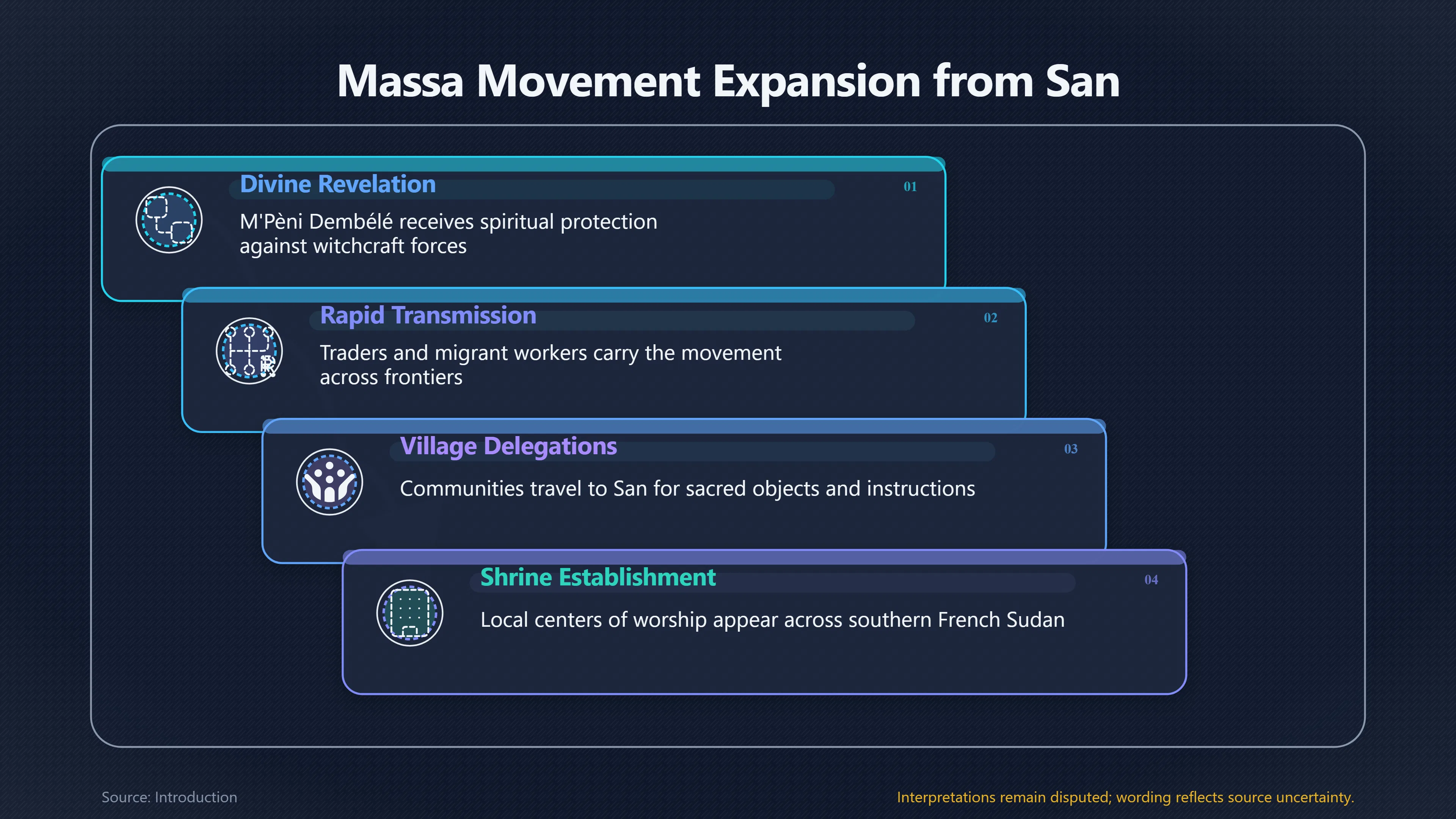
The movement is generally traced to M’Pèni (or Peni) Dembélé, a Minyanka farmer from the area around Wolo near San. According to followers, he received a divine revelation that offered a new source of spiritual protection capable of defeating witches and other hidden forces blamed for sickness, infertility, crop failure and sudden death. Instead of relying on older ritual specialists, believers could obtain a new protective power associated with Massa.[Cambridge University Press & Assessment]cambridge.orgCambridge University Press & AssessmentFETISHIZING RELIGION: ALLAH KOURA AND FRENCH ‘ISLAMIC POLICY’ IN LATE COLONIAL FRENCH SOUDAN (MALI…
Its expansion was remarkably rapid. Travellers, migrant workers, traders and self-described messengers carried the movement across colonial frontiers. Villages often sent delegations to San to obtain the sacred object associated with Massa and to receive instructions before establishing local centres of worship. By the early 1950s colonial administrators were reporting Massa shrines across large areas of southern French Sudan and neighbouring colonies.[Uplopen]uplopen.comUNSEENARTS OF POWER ASSOCIATIONS ON THE…
Several features made the movement unusually attractive:
- it promised immediate protection against witchcraft rather than long initiation into existing religious associations;
- it offered a clear moral code emphasising discipline and obedience;
- it presented itself as a newly revealed spiritual power suited to changing times;
- it spread through personal testimony, with successful harvests, recoveries from illness and apparent protection from misfortune reinforcing belief among neighbouring communities.[Uplopen]uplopen.comUNSEENARTS OF POWER ASSOCIATIONS ON THE…
Although colonial officials often described it as a “fetish” or “neo-fetishist” movement, later historians argue these labels reflected colonial categories more than the beliefs of participants. Massa combined elements of existing ritual practice with innovation and drew followers from both communities that maintained older religious traditions and communities with significant Muslim populations.[Cambridge University Press & Assessment]cambridge.orgCambridge University Press & AssessmentFETISHIZING RELIGION: ALLAH KOURA AND FRENCH ‘ISLAMIC POLICY’ IN LATE COLONIAL FRENCH SOUDAN (MALI…
Witchcraft accusations and generational conflict
Fear of witchcraft lay at the centre of Massa’s appeal, but the movement quickly became about much more than identifying hidden sorcerers.
Across rural Mali, accusations of witchcraft often reflected tensions over inheritance, authority, illness, unexplained deaths and unequal wealth. Massa promised to expose dangerous spiritual forces, but in doing so it also challenged the people who traditionally claimed authority over those forces—elders, shrine custodians and ritual experts. The movement therefore shifted power inside many villages rather than merely changing religious practice.[Cambridge University Press & Assessment]cambridge.orgCambridge University Press & AssessmentFETISHIZING RELIGION: ALLAH KOURA AND FRENCH ‘ISLAMIC POLICY’ IN LATE COLONIAL FRENCH SOUDAN (MALI…
Gregory Mann’s research shows an important contrast between the founder’s teachings and events on the ground. Dembélé himself appears to have urged obedience to recognised authorities. Yet many younger followers who claimed to act in his name became far more confrontational, publicly denouncing alleged witches, attacking older ritual leaders and undermining established systems of authority.[Cambridge University Press & Assessment]cambridge.orgCambridge University Press & AssessmentFETISHIZING RELIGION: ALLAH KOURA AND FRENCH ‘ISLAMIC POLICY’ IN LATE COLONIAL FRENCH SOUDAN (MALI…
This generational dimension helps explain why the movement spread so rapidly. Younger men who had little influence within inherited religious institutions suddenly possessed access to a powerful new source of legitimacy. Massa therefore became both an anti-witchcraft campaign and a vehicle for renegotiating social power.
Historians consequently caution against describing the episode as simple “mass hysteria”. The fears of witchcraft were genuine within local belief systems, while the conflicts that followed reflected real disputes over leadership, land, prestige and changing social relationships during the late colonial period.[Cambridge University Press & Assessment]cambridge.orgCambridge University Press & AssessmentFETISHIZING RELIGION: ALLAH KOURA AND FRENCH ‘ISLAMIC POLICY’ IN LATE COLONIAL FRENCH SOUDAN (MALI…

Shrine destruction, collecting and contested memory
One of the movement’s most visible consequences was the destruction or abandonment of older ritual objects.
Followers frequently dismantled existing shrines or surrendered sacred objects associated with earlier religious practices. In some places these items were deliberately destroyed because they were believed to harbour dangerous spiritual power or to support witchcraft. Elsewhere they were confiscated, abandoned or eventually entered museum and private collections after colonial officials, missionaries or collectors acquired them. As a result, surviving objects often tell a complicated story of religious change rather than simply preserving a vanished tradition.[Uplopen]uplopen.comUNSEENARTS OF POWER ASSOCIATIONS ON THE…
The movement also produced distinctive new ritual buildings, sometimes described by colonial observers as resembling miniature mosques while housing Massa’s protective objects. These structures reflected the movement’s hybrid character: neither simply an extension of existing local religions nor a straightforward form of Islam. Different communities adapted Massa in different ways, producing considerable local variation despite its shared anti-witchcraft message.[Uplopen]uplopen.comUNSEENARTS OF POWER ASSOCIATIONS ON THE…
Memory of Massa remains contested. Earlier colonial accounts often portrayed it as an irrational religious craze or “fetish cult”. More recent scholarship instead treats it as evidence of creative religious experimentation during a period of rapid political and economic change. Rather than dismissing participants as gullible, historians ask why so many communities found its promises convincing in a world marked by wartime disruption, migration, economic uncertainty and weakening confidence in older institutions.[Cambridge University Press & Assessment]cambridge.orgCambridge University Press & AssessmentFETISHIZING RELIGION: ALLAH KOURA AND FRENCH ‘ISLAMIC POLICY’ IN LATE COLONIAL FRENCH SOUDAN (MALI…
Why colonial authorities struggled to respond
French administrators found Massa difficult to classify.
For decades colonial policy had largely distinguished between Islam, which officials regarded as politically organised, and a broad category of “traditional” religions often dismissed as static or local. Massa blurred these categories. It was clearly innovative, spread over long distances and displayed strong organisation, yet it did not fit existing ideas about Islam or established African religious practice.[Cambridge University Press & Assessment]cambridge.orgCambridge University Press & AssessmentFETISHIZING RELIGION: ALLAH KOURA AND FRENCH ‘ISLAMIC POLICY’ IN LATE COLONIAL FRENCH SOUDAN (MALI…
Some administrators even viewed the movement as a possible counterweight to the continued spread of Islam in southern regions, while others became alarmed by reports of shrine destruction, attacks on alleged witches and the movement’s growing influence over village life. The result was an inconsistent colonial response that varied across districts and colonies.[Cambridge University Press & Assessment]cambridge.orgCambridge University Press & AssessmentFETISHIZING RELIGION: ALLAH KOURA AND FRENCH ‘ISLAMIC POLICY’ IN LATE COLONIAL FRENCH SOUDAN (MALI…

Why Massa matters in Mali’s history of collective belief
Massa occupies an important place in Mali’s history because it demonstrates how belief in witchcraft could become the foundation for rapid social change rather than merely private religious practice.
The movement transformed fears about hidden spiritual aggression into a programme of reform that questioned inherited authority, reshaped village religious life and crossed colonial boundaries with remarkable speed. It illustrates that anti-witchcraft movements were rarely only about identifying witches. They also addressed deeper concerns about justice, authority, prosperity and uncertainty during periods of profound political transition.
For historians of collective belief, Massa therefore stands as an example of how widely shared spiritual anxieties can generate organised religious innovation instead of indiscriminate panic. The movement’s lasting significance lies not only in its campaign against witchcraft but also in the way it reconfigured power, challenged established institutions and revealed the social pressures shaping rural Mali on the eve of independence.[cambridge.org]cambridge.orgCambridge University Press & AssessmentFETISHIZING RELIGION: ALLAH KOURA AND FRENCH ‘ISLAMIC POLICY’ IN LATE COLONIAL FRENCH SOUDAN (MALI…
Amazon book picks
Further Reading
Books and field guides related to How Massa Turned Witch Fear Into Revolt. Use these as the next step if you want deeper reading beyond the article.
African religions and philosophy
Explains religious ideas underpinning anti-witchcraft movements.

The witch-hunt in early modern Europe
Useful comparison for mass anti-witchcraft campaigns.
Magic, witchcraft, and religion
Provides comparative analysis of witchcraft movements.
Endnotes
1.
Source: cambridge.org
Link:https://www.cambridge.org/core/journals/journal-of-african-history/article/abs/div-classtitlefetishizing-religion-allah-koura-and-french-islamic-policy-in-late-colonial-french-soudan-malidiv/2C90A0F13E05B8E7046EDE957BACE16C
Source snippet
Cambridge University Press & AssessmentFETISHIZING RELIGION: ALLAH KOURA AND FRENCH ‘ISLAMIC POLICY’ IN LATE COLONIAL FRENCH SOUDAN (MALI...
2.
Source: dokumen.pub
Link:https://dokumen.pub/islamization-from-below-the-making-of-muslim-communities-in-rural-french-sudan-1880-1960-9780300152739.html
Source snippet
Islamization from Below: The Making of Muslim Communities in Rural French Sudan, 1880-1960 9780300152739 - DOKUMEN.PUB...
3.
Source: uplopen.com
Link:https://uplopen.com/books/328/files/17f9b481-2576-4cab-8bdd-81095a7b5f6a.pdf
Source snippet
UNSEENARTS OF POWER ASSOCIATIONS ON THE...
4.
Source: cambridge.org
Title: The Journal of African History: Volume 44
Link:https://www.cambridge.org/core/journals/journal-of-african-history/volume/883853571B62B60F11C16D7C463E323D
5.
Source: justapedia.org
Title: French Sudan
Link:https://justapedia.org/wiki/French_Sudan
Source snippet
September 9, 2024 — ^{[14]} The Office du Niger was founded in 1926 as the main organization facilitating planned, irrigated ag...
Published: September 9, 2024
Additional References
6.
Source: researchgate.net
Link:https://www.researchgate.net/publication/231933623Fetishizing_religion_Allah_Koura_and_French%27Islamic_policy%27_in_late_colonial_French_Soudan_Mali
Source snippet
July 1, 2003 — FETISHIZING RELIGION: ALLAH KOURA AND FRENCH 'ISLAMIC POLICY' IN LATE COLONIAL FRENCH SOUDAN (MALI) * July 2003 * The Jour...
Published: July 1, 2003
7.
Source: africabib.org
Link:https://www.africabib.org/rec.php?RID=263856364
Source snippet
AfricaBib | Fetishizing Religion: Allah Koura and French 'Islamic Policy' in Late Colonial French Soudan (Mali)...
8.
Source: youtube.com
Link:https://www.youtube.com/watch?v=XvjgnBNgK5w
Source snippet
Re-discovering the de Gironcourt collection of West African Arabic manuscripts...
9.
Source: lefaso1.rssing.com
Title: comle Faso.net
Link:https://lefaso1.rssing.com/chan-6397339/all_p3806.html
Source snippet
22, 2024 — 1950-1952: LE FÉTICHE DE SAN, L'HISTOIRE D'UN MOUVEMENT NÉO-FÉTICHISTE EN HAUTE VOLTA April 22, 2024, 6:51 am ≫ Next: Arrondi...
Published: April 22, 2024
10.
Source: youtube.com
Title: The Untold Wealth and Power of The Mali Empire
Link:https://www.youtube.com/watch?v=C1RIOWy8lsY
Source snippet
The Empire of Mali - Mansa Musa - Extra History - Part 3...
11.
Source: everything.explained.today
Link:https://everything.explained.today/French_Sudan/
12.
Source: youtube.com
Title: Re-discovering the de Gironcourt collection of West African Arabic manuscripts
Link:https://www.youtube.com/watch?v=hxHGT_1Ad00
Source snippet
Magic and Murder | People & Power...
13.
Source: youtube.com
Title: Magic and Murder | People & Power
Link:https://www.youtube.com/watch?v=Ya8PNxuhDS8
Source snippet
The Untold Wealth and Power of The Mali Empire...
14.
Source: lefaso.net
Link:https://lefaso.net/?id_article=129663&page=impression
Source snippet
1950-1952: Le fétiche de San, l’histoire d’un mouvement néo-fétichiste en Haute Volta...
15.
Source: youtube.com
Title: The Empire of Mali
Link:https://www.youtube.com/watch?v=4-Un2xx6Pzo
Topic Tree