Within Canada's Strange Beliefs
Was It Panic, Illness or Real Danger?
Rumour-driven accusations and stress-related symptom outbreaks may spread socially, but they require very different evidence and responses.
On this page
- How moral panics turn claims into presumed facts
- How mass psychogenic illness spreads
- Separating unconventional belief from documented harm
Page outline Jump by section
Introduction
When Canadians look back at episodes such as the Satanic Panic, false ritual-abuse allegations or clusters of unexplained illness in schools and workplaces, they are sometimes grouped together as examples of “mass hysteria”. That shortcut is misleading. A moral panic and mass psychogenic illness (also called mass sociogenic illness) are different phenomena that demand different kinds of evidence and different public responses.
The distinction matters because confusing the two can cause real harm. Moral panics can lead to false accusations, wrongful investigations and the stigmatisation of minority groups. Mass psychogenic illness involves genuine physical symptoms that spread through stress, expectation and social interaction, even though no infectious or toxic cause can be identified. Canadian experience illustrates why rumours, coercive groups, documented abuse and medically unexplained symptom outbreaks should never be treated as interchangeable.[PMC]pmc.ncbi.nlm.nih.govPMCMass sociogenic illnessJanuary 4, 2005…
Was it panic, illness or real danger?
The first question is not whether people were frightened, but what exactly spread.
A moral panic spreads beliefs and accusations. A community comes to see a person, practice or group as a major threat out of proportion to the available evidence. Media coverage, campaigners, officials and public discussion often reinforce one another until suspicion begins to substitute for proof. The consequences are social and legal rather than medical.[Annual Reviews]annualreviews.orgOpen source on annualreviews.org.
Mass psychogenic illness spreads physical symptoms. People may experience headaches, dizziness, nausea, weakness, fainting or breathing difficulties that are entirely real to them. Careful investigation, however, fails to find an infectious agent, poison or environmental exposure capable of explaining the pattern. The symptoms arise unconsciously through psychological and social processes rather than deliberate fabrication.[PMC]pmc.ncbi.nlm.nih.govPMCMass sociogenic illnessJanuary 4, 2005…
Neither phenomenon should be dismissed as people “making it up”. In one case, beliefs become socially contagious; in the other, bodily symptoms do.
How moral panics turn claims into presumed facts
Canadian history contains several episodes where allegations gained authority faster than reliable evidence.
The international Satanic Panic of the 1980s and early 1990s affected Canada through books, television, police training and child-protection investigations. Claims of organised satanic ritual abuse were often accepted despite a lack of corroborating physical evidence. In some cases, repeated interviewing techniques encouraged children to produce increasingly elaborate accounts, while investigators interpreted ordinary inconsistencies as confirmation of hidden conspiracies. Later reviews found no evidence for the vast secret networks that had been alleged, yet lives and reputations had already been damaged.
The mechanism followed a familiar pattern:
- a genuine concern, such as protecting children;
- dramatic claims that appear to explain many unrelated events;
- growing media attention;
- pressure on investigators to uncover hidden wrongdoing;
- scepticism becoming socially difficult because questioning allegations appears morally suspect.
Sociologists describe this as a process in which fear transforms uncertain claims into presumed facts before the evidence has caught up. Canadian scholarship continues to use the concept of moral panic while also debating how and when it should be applied, particularly in highly polarised public controversies.[annualreviews.org]annualreviews.orgOpen source on annualreviews.org.

How mass psychogenic illness spreads
Mass psychogenic illness operates through a very different mechanism.
Typically, a credible threat appears first. Someone notices an unusual smell, reports exposure to chemicals or becomes suddenly unwell. Others begin paying close attention to their own bodies. Anxiety increases, normal bodily sensations become alarming and symptoms spread through observation and expectation, particularly within close-knit groups such as schools, factories or workplaces.[PMC]pmc.ncbi.nlm.nih.govPMCMass sociogenic illnessJanuary 4, 2005…
The affected people are genuinely ill. Their symptoms are not consciously invented or faked.
A Canadian example often discussed in medical literature involved workers at a fish-processing plant in New Brunswick. Investigators examined whether workplace toxins or infectious disease could explain the outbreak. After extensive investigation, the pattern was judged most consistent with mass psychogenic illness, with social relationships and workplace stress helping to explain why symptoms spread through particular groups of workers rather than randomly across the workforce.[PMC]pmc.ncbi.nlm.nih.govPMCMass sociogenic illnessJanuary 4, 2005…
Medical authorities therefore focus on:
- ruling out genuine environmental hazards;
- communicating clearly about investigation results;
- reducing unnecessary alarm;
- treating affected individuals respectfully rather than dismissing them.
Simply telling people that “nothing is wrong” is rarely effective because the symptoms are experienced as real.
Why confusing the two causes harm
Although both involve social influence, they create different risks.
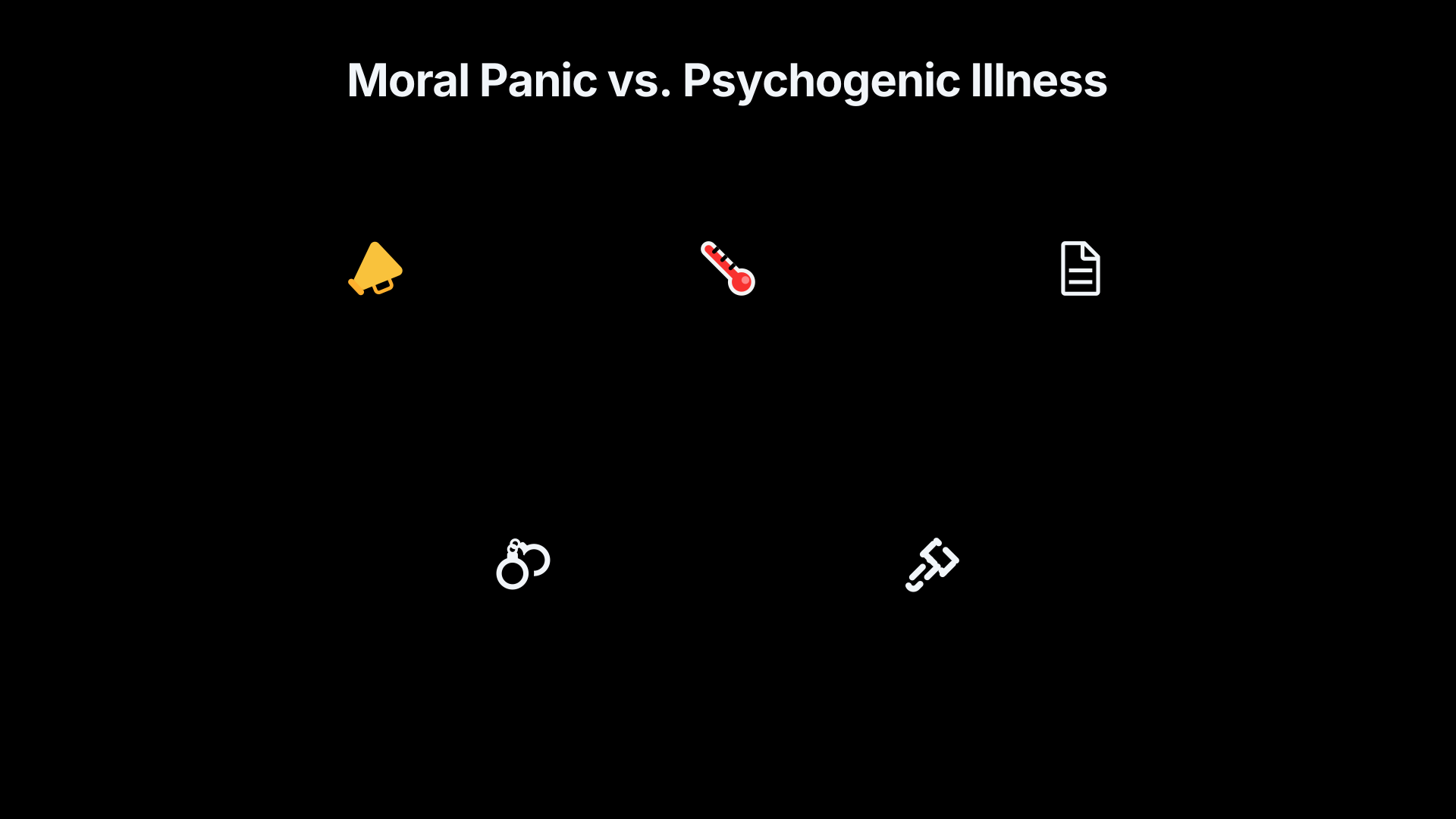
Moral panicMass psychogenic illnessSpreads accusations, rumours or fearsSpreads genuine physical symptomsMain evidence comes from social claimsMain evidence comes from medical investigationRisks wrongful accusation and persecutionRisks overlooking distress while searching for toxins or infectionsRequires careful evaluation of evidence and due processRequires medical assessment, reassurance and clear communication
Canada’s experience demonstrates that one type of event should never automatically be interpreted as the other.
A school experiencing unexplained dizziness may require environmental testing before concluding that stress played a role. Conversely, extraordinary criminal allegations require independent corroborating evidence rather than assuming that many similar stories automatically prove one another.
Separating unconventional belief from documented harm
Another common mistake is to treat unusual religious belief as evidence of either moral panic or mental illness.
Canada has long contained a wide variety of new religious movements. Most have never engaged in criminal behaviour. Calling an unfamiliar religion a “cult” does not establish coercion, abuse or exploitation. Scholars instead recommend examining observable behaviour: isolation from family, financial exploitation, coercive control, violence or documented abuse.
Likewise, discovering that allegations against a group were exaggerated does not mean that every concern was imaginary. Genuine abuse can occur within mainstream organisations, minority religions, families or secular institutions. The task is always to investigate specific evidence rather than relying on stereotypes.
This distinction became especially important after episodes in which public fear encouraged authorities to interpret unconventional beliefs themselves as signs of criminality rather than looking for independently verifiable evidence.[Annual Reviews]annualreviews.orgOpen source on annualreviews.org.

What Canadian experience teaches
Canadian examples reinforce several practical lessons that remain relevant.
First, fear alone is poor evidence. Large numbers of worried people do not necessarily indicate a genuine conspiracy or hidden danger.
Second, physical symptoms deserve medical attention even when investigators eventually conclude that they have a psychogenic origin. The absence of toxins or infection does not mean the suffering was imaginary.[PMC]pmc.ncbi.nlm.nih.govPMCMass sociogenic illnessJanuary 4, 2005…
Third, moral panics often begin with legitimate concerns. Protecting children, responding to disease or investigating abuse are essential responsibilities. Problems arise when assumptions replace corroboration and disagreement becomes interpreted as sympathy for wrongdoing.[Annual Reviews]annualreviews.orgOpen source on annualreviews.org.
Finally, careful investigation protects everyone. Independent evidence, transparent communication and willingness to revise conclusions are the best safeguards against both unnecessary panic and genuine danger. Canada’s history shows that rumours, stress-related illness, coercive organisations and documented crimes are distinct problems, each requiring its own evidence and its own response.
Amazon book picks
Further Reading
Books and field guides related to Was It Panic, Illness or Real Danger?. Use these as the next step if you want deeper reading beyond the article.
Extraordinary Popular Delusions and the Madness of Crowds
Rating: 4.0/5 from 5 Google Books ratings
Classic treatment of collective belief and social contagion.

Endnotes
1.
Source: pmc.ncbi.nlm.nih.gov
Title: PMCMass sociogenic illness
Link:https://pmc.ncbi.nlm.nih.gov/articles/PMC543940/
Source snippet
January 4, 2005...
Published: January 4, 2005
2.
Source: library-archives.canada.ca
Title: Item – Theses Canada
Link:https://library-archives.canada.ca/eng/services/services-libraries/theses/Pages/item.aspx?idNumber=1032994559
3.
Source: library-archives.canada.ca
Title: ca Item – Theses Canada
Link:https://library-archives.canada.ca/eng/services/services-libraries/theses/Pages/item.aspx?idNumber=858653075
4.
Source: annualreviews.org
Link:https://www.annualreviews.org/content/journals/10.1146/annurev.so.20.080194.001053
5.
Source: pubmed.ncbi.nlm.nih.gov
Title: Pub Med Mass sociogenic illness–real and imaginary
Link:https://pubmed.ncbi.nlm.nih.gov/15080215/
Source snippet
Mass sociogenic illness--real and imaginary - PubMed...
6.
Source: pmc.ncbi.nlm.nih.gov
Link:https://pmc.ncbi.nlm.nih.gov/articles/PMC12679345/
7.
Source: pmc.ncbi.nlm.nih.gov
Link:https://pmc.ncbi.nlm.nih.gov/articles/PMC8765660/
8.
Source: pubmed.ncbi.nlm.nih.gov
Link:https://pubmed.ncbi.nlm.nih.gov/19192234/
9.
Source: pubmed.ncbi.nlm.nih.gov
Link:https://pubmed.ncbi.nlm.nih.gov/15632400/
10.
Source: pubmed.ncbi.nlm.nih.gov
Link:https://pubmed.ncbi.nlm.nih.gov/12211323/
11.
Source: pubmed.ncbi.nlm.nih.gov
Link:https://pubmed.ncbi.nlm.nih.gov/9601200/
12.
Source: pubmed.ncbi.nlm.nih.gov
Link:https://pubmed.ncbi.nlm.nih.gov/11925351/
13.
Source: pubmed.ncbi.nlm.nih.gov
Link:https://pubmed.ncbi.nlm.nih.gov/7960296/
Additional References
14.
Source: doi.org
Link:https://doi.org/10.1177/17416590251407986
Source snippet
Hier, 2026January 4, 2026 — Crossref Web of Science Google Scholar Hier S (2018) Moral panic and digital media logic: Notes on a changing...
Published: January 4, 2026
15.
Source: journals.sagepub.com
Link:https://journals.sagepub.com/doi/10.1177/17416590251407986
Source snippet
Hier, 2026January 4, 2026 — First published online January 4, 2026 MORAL PANICS, CONSERVATIVE CONTRARIANISM, AND THE POLARIZING DEBATE AB...
Published: January 4, 2026
16.
Source: ojs.lib.uwo.ca
Link:https://ojs.lib.uwo.ca/index.php/si/article/view/24483
Source snippet
Fear to Policy: How Moral Panic Shapes the Lives of Black Immigrants in Canada | The Sociological Imagination: Undergraduate JournalApril...
17.
Source: youtube.com
Title: Episode 71. Frenzy – The Turmoil of Mass Psychogenic Illness
Link:https://www.youtube.com/watch?v=e2AdorYLDF8
Source snippet
East African Laughing Epidemic – History Documentary...
18.
Source: youtube.com
Title: Episode 72. Mass Psychogenic Illness with Robert Baloh
Link:https://www.youtube.com/watch?v=mnmv9erAqkM
Source snippet
Episode 71. Frenzy – The Turmoil of Mass Psychogenic Illness...
19.
Source: cambridge.org
Link:https://www.cambridge.org/core/journals/canadian-journal-of-philosophy/article/fear-within-the-frames-horror-comics-and-moral-danger/D52697232B590ADDA2A6B3AC7C0D195A
20.
Source: ijcst.journals.yorku.ca
Link:https://ijcst.journals.yorku.ca/index.php/ijcst/article/view/36405
21.
Source: cambridge.org
Link:https://www.cambridge.org/core/journals/the-british-journal-of-psychiatry/article/protean-nature-of-mass-sociogenic-illness/2BDC2262E104B8A33F3DD49773DA0D8B
22.
Source: fernwoodpublishing.ca
Link:https://fernwoodpublishing.ca/book/review/review-in-canadian-journal-of-sociology
23.
Source: youtube.com
Title: East African Laughing Epidemic – History Documentary
Link:https://www.youtube.com/watch?v=pGVvD7hlYzI
Source snippet
When the '80s Thought EVERYTHING Was Satanic...
Topic Tree