Within Romanian Belief
Who Were Romania's Phantom Terrorists?
Warnings about hidden loyalist terrorists helped turn post-regime confusion into chaotic gunfire, friendly fire and lasting political controversy.
On this page
- How the terrorist story spread
- Confused commands and post collapse deaths
- Competing explanations and unresolved responsibility
Page outline Jump by section
Introduction
After Nicolae Ceaușescu fled Bucharest on 22 December 1989, many Romanians became convinced that hidden loyalist “terrorists” were attacking the revolution from rooftops, apartment blocks and public buildings. Reports of snipers, poisoned water, disguised commandos and infiltrators spread rapidly through television broadcasts, military communications and word of mouth. The result was one of the most destructive rumour cascades in modern European history. Rather than bringing immediate peace, the collapse of the dictatorship was followed by days of confusion in which soldiers, police, civilian volunteers and armed revolutionaries frequently fired on one another while searching for an enemy that often could not be identified. Historians broadly agree that rumours and misinformation became central drivers of the post-22 December violence, although they continue to debate whether there were also isolated armed loyalists or sabotage operations alongside the far larger problem of panic and friendly fire.[usfca.edu]cs.usfca.eduBook: The Romanian Revolution of 1989June 17, 2014…
How the terrorist story spread
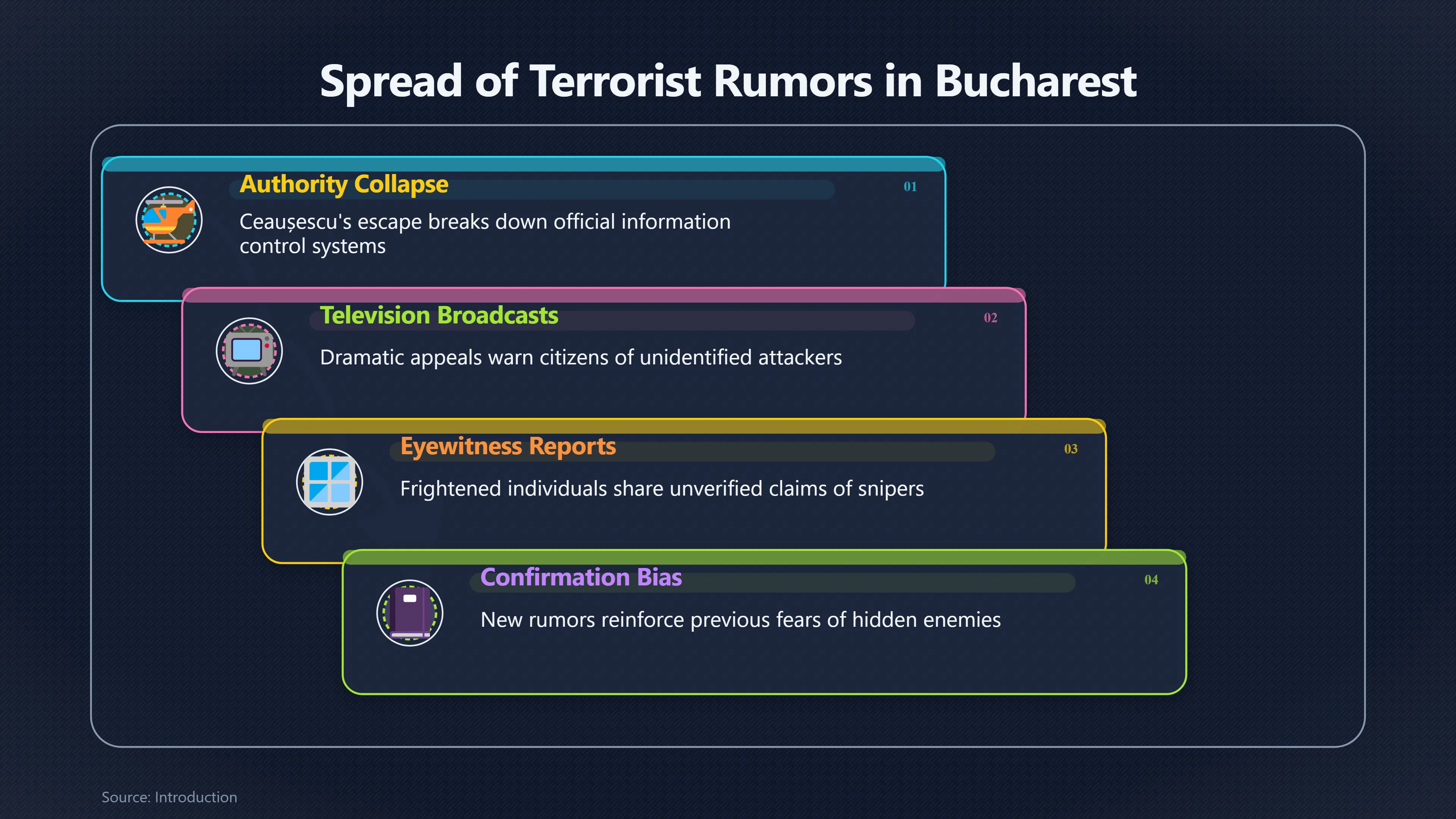
The belief in hidden terrorists emerged during an extraordinary collapse of authority. Once Ceaușescu had escaped by helicopter, the institutions that normally controlled information had broken down. Television became the country’s main source of news, broadcasting dramatic appeals for citizens to defend the revolution and repeatedly warning that unidentified attackers were operating across Bucharest and other cities.
Many reports came from frightened eyewitnesses, soldiers or television presenters working with fragmentary information. Claims spread that snipers were firing from rooftops, that elite security forces had disguised themselves as civilians, that helicopters were attacking the capital, or that foreign mercenaries were assisting loyalists. Most reports could not be independently verified before being broadcast or repeated.
Several factors made these stories believable:
- The Securitate, Romania’s feared secret police, had cultivated an image of secrecy and hidden power for decades.
- Ordinary people knew little about the organisation’s true structure or capabilities.
- Armed civilians, military units and police often lacked reliable communications and identification procedures.
- Continuous television coverage created the impression that attacks were occurring everywhere simultaneously.
The speed of transmission mattered as much as the content. Each new rumour appeared to confirm previous ones, encouraging soldiers and civilians alike to expect imminent attack. Historians have argued that participants increasingly interpreted ambiguous sights and sounds through the assumption that terrorists must already be present.[usfca.edu]cs.usfca.eduBook: The Romanian Revolution of 1989June 17, 2014…
Why rumours became deadly
The terrorist narrative did not simply frighten people. It changed behaviour in ways that produced genuine casualties.
Military units that had previously answered to different commands suddenly found themselves cooperating without clear leadership. Civilians seized weapons from army depots or received them from sympathetic soldiers. Checkpoints appeared throughout cities, often staffed by people with little training and no reliable way of identifying friend from foe.
In this atmosphere, ordinary events could trigger gunfire. A vehicle approaching too quickly, movement in a dark window, unexplained noises or tracer rounds fired elsewhere could all be interpreted as evidence of terrorist attack. Once shooting began, nearby units often assumed they too were under assault and opened fire.
Night-time proved especially dangerous. Poor visibility increased uncertainty, while repeated alarms kept soldiers and civilians under intense psychological stress. The expectation of hidden attackers became self-reinforcing: every burst of gunfire seemed to prove that terrorists existed, even when later investigation suggested opposing Romanian forces had been firing at each other.[usfca.edu]cs.usfca.eduBook: The Romanian Revolution of 1989June 17, 2014…
Confused commands and the deaths after 22 December
One of the most striking features of the Romanian Revolution is that most fatalities occurred after Ceaușescu had already lost power.
The period from 22 to 30 December saw widespread armed confrontations despite the absence of any organised counter-offensive capable of restoring the dictatorship. Subsequent investigations have found numerous incidents involving:
- Friendly fire between different army units.
- Soldiers exchanging fire with Interior Ministry or security personnel.
- Civilians shooting at military forces they mistook for terrorists.
- Military units reacting to false alarms transmitted over radio or television.
- Gunfire triggered by panic rather than confirmed enemy action.
The prolonged uncertainty prevented commanders from establishing a coherent operational picture. Instead, multiple institutions issued overlapping warnings while local commanders frequently acted independently.
The consequences were severe. Modern legal investigations into the revolution have linked the post-22 December misinformation campaign to hundreds of deaths and thousands of injuries, arguing that public fear of terrorists contributed directly to chaotic armed confrontations across the country.[HUDOC-EXEC]hudoc.exec.coe.intEXECASSOCIATION '21 DECEMBRE 1989' AND OTHERS v. Romania…
Did the phantom terrorists actually exist?
This remains one of the most disputed questions in Romanian history.
Most historians reject the simple idea that a large, centrally coordinated army of loyalist terrorists fought across Romania after 22 December. Extensive investigations have failed to identify evidence for the enormous clandestine force described in contemporary broadcasts. Peter Siani-Davies concludes that many reports reflected confusion, misidentification and competing revolutionary narratives rather than a coherent underground military campaign.[cs.usfca.edu]cs.usfca.eduBook: The Romanian Revolution of 1989June 17, 2014…
However, the debate does not end there.
Some researchers argue that isolated armed resistance probably did occur. Individual Securitate officers, military personnel or loyalist groups may have fired weapons or carried out limited actions in particular locations. Others point to electronic interference, false military communications or deliberate acts of disinformation that intensified confusion without requiring thousands of armed attackers. These possibilities are not necessarily incompatible with the broader conclusion that rumours became far more influential than any genuine terrorist activity.[cs.usfca.edu]cs.usfca.eduBook: The Romanian Revolution of 1989June 17, 2014…
The distinction is important. Modern scholarship increasingly separates three different questions:
- Were there isolated armed loyalists? Possibly, although their scale remains disputed.
- Was there a nationwide organised terrorist army? Strong evidence for such a force has not emerged.
- Did belief in terrorists shape the violence? On this point there is much broader agreement: fear itself became an operational force.[usfca.edu]cs.usfca.eduBook: The Romanian Revolution of 1989June 17, 2014…
Competing explanations and responsibility
The political consequences of the terrorist narrative remain controversial because they affect responsibility for the bloodshed.
Romania’s long-running Revolution Case has alleged that leading members of the newly installed National Salvation Front helped sustain public misinformation about terrorist attacks after taking power. According to prosecutors, this campaign created nationwide confusion that contributed to deaths, injuries and unlawful detentions while also strengthening the new leadership’s legitimacy during a moment of extreme uncertainty. Those allegations have formed part of prosecutions for crimes against humanity, although legal proceedings have been lengthy and contested.[HUDOC-EXEC]hudoc.exec.coe.intEXECASSOCIATION '21 DECEMBRE 1989' AND OTHERS v. Romania…
Not all historians accept every element of the prosecutorial interpretation. Some argue that genuine uncertainty, institutional collapse and fragmented decision-making explain much of the chaos without requiring a centrally directed deception. Others believe elements of both are likely to have been present: authentic confusion exploited or amplified by political actors seeking to consolidate authority.[cs.usfca.edu]cs.usfca.eduBook: The Romanian Revolution of 1989June 17, 2014…
The continuing disagreement reflects the difficulty of reconstructing events in which participants themselves often acted on incomplete or false information.
Why the episode matters
The phantom terrorists of December 1989 are a powerful example of collective fear transforming political reality.
Unlike classic moral panics centred on a social group, this episode unfolded over only a few days during the collapse of a dictatorship. Yet it demonstrates many of the same mechanisms found in studies of rumour and collective belief: trusted institutions repeating unverified claims, heightened emotional stress, fragmented information, confirmation bias and actions that unintentionally reinforced the original belief.
The consequences were unusually grave. Fear of unseen enemies contributed to lethal violence, shaped the public memory of Romania’s revolution and fuelled decades of political controversy over who was responsible for the post-revolution bloodshed. More than thirty years later, the identity, number and even existence of the alleged terrorists remain subjects of historical investigation, while there is far broader agreement that the rumours themselves became one of the revolution’s most consequential forces.[usfca.edu]cs.usfca.eduBook: The Romanian Revolution of 1989June 17, 2014…
Amazon book picks
Further Reading
Books and field guides related to Who Were Romania's Phantom Terrorists?. Use these as the next step if you want deeper reading beyond the article.
Extraordinary Popular Delusions and the Madness of Crowds
Rating: 4.0/5 from 5 Google Books ratings
Useful framework for understanding mass rumours.

The Romanian Revolution of December 1989
Directly analyzes the events surrounding the phantom terrorists.

Endnotes
1.
Source: cs.usfca.edu
Link:https://www.cs.usfca.edu/~cruse/RomaniaMinicourse/RomaniaBooks/Revolution1989/revolution1989.html
Source snippet
Book: The Romanian Revolution of 1989June 17, 2014...
Published: June 17, 2014
2.
Source: discovery.ucl.ac.uk
Link:https://discovery.ucl.ac.uk/id/eprint/10099991/
Source snippet
UCL DiscoveryThe Romanian revolution of 1989: myth and reality - myth or reality? - UCL Discovery...
3.
Source: hudoc.exec.coe.int
Link:https://hudoc.exec.coe.int/eng?i=004-13065
Source snippet
EXECASSOCIATION '21 DECEMBRE 1989' AND OTHERS v. Romania...
4.
Source: rri.ro
Title: the 1989 revolution case 2 id77255
Link:https://www.rri.ro/en/news-and-current-affairs/today-in-the-news/the-1989-revolution-case-2-id77255.html
Source snippet
Radio România InternaționalThe 1989 Revolution Case - Radio Romania International...
5.
Source: search.coe.int
Link:https://search.coe.int/cm?i=091259488025d0cb
Source snippet
coe.intCM/Notes/1483/H46-27December 7, 2023 — CM/Notes/1483/H46-27 [Button: ] 1483rd meeting (5-7 December 2023) (DH) - H46-27 Associatio...
Published: December 7, 2023
6.
Source: 1989.rrchnm.org
Link:https://www.1989.rrchnm.org/exhibits/unique-experience-of-romania/introduction.html
8.
Source: youtube.com
Title: War reporter reacts to his incredible unseen footage of Romanian revolution
Link:https://www.youtube.com/watch?v=Cbj4Vqs_Wf0
Source snippet
Romanian Revolution | Intense Footage of Bucharest Street Fighting (1989)...
9.
Source: youtube.com
Link:https://www.youtube.com/watch?v=p-Ei3o8MpRc
Source snippet
Maria Bucur: What is important about Ceausescu's last speech?...
Additional References
10.
Source: e-juridic.manager.ro
Title: dosarul revolutiei procurori nu au existat teroristi in decembrie 1989 29060
Link:https://e-juridic.manager.ro/articole/dosarul-revolutiei-procurori-nu-au-existat-teroristi-in-decembrie-1989-29060.html
Source snippet
manager.roDosarul "Revolutiei", procurori: Nu au existat teroristi in decembrie 1989August 16, 2022 — DOSARUL "REVOLUTIEI", PROCURORI...
Published: August 16, 2022
11.
Source: adevarul.ro
Title: Cine au fost teroriștii de la Revoluție
Link:https://adevarul.ro/stiri-interne/societate/cine-au-fost-teroristii-de-la-revolutie-de-unde-2410288.html
Source snippet
De unde s-a născut psihoza care a ucis cei mai mulți români în decembrie 1989 | adevarul.roDecember 22, 2024 — CINE AU FOST TERORIȘTII DE...
Published: December 22, 2024
12.
Source: youtube.com
Link:https://www.youtube.com/watch?v=5zrbToQ4KbU
Source snippet
War reporter reacts to his incredible unseen footage of Romanian revolution...
13.
Source: utpdistribution.com
Title: the romanian revolution of december 1989
Link:https://utpdistribution.com/9780801442452/the-romanian-revolution-of-december-1989/
Source snippet
University of Toronto Press DistributionThe Romanian Revolution of December 1989...
Published: december 1989
14.
Source: youtube.com
Title: Maria Bucur: What is important about Ceausescu’s last speech?
Link:https://www.youtube.com/watch?v=z2339ITCeDY
Source snippet
Videograms of a revolution / Ceausescu's last speech...
15.
Source: journals.sagepub.com
Link:https://journals.sagepub.com/doi/10.1177/17506980261447383
Source snippet
activism of the 1989 Romanian Revolution - Alina Satmari, Remus Creţan, Andreea Miruna Nicoară, Ioana Satmari, 2026May 14, 2026 — First p...
Published: May 14, 2026
16.
Source: researchgate.net
Link:https://www.researchgate.net/publication/391234266_Romanian_Revolution_or_Coup_d%27etat_A_Theoretical_View_of_the_Events_of_December_1989
Published: December 1989
17.
Source: tvrinfo.ro
Link:https://tvrinfo.ro/rechizitoriu-dosarul-revolutiei-nu-exista-probe-relevante-ale-existentei-teroristilor-in-decembrie-1989_912007/
18.
Source: blogs.fcdo.gov.uk
Link:https://blogs.fcdo.gov.uk/paulbrummell/2014/12/05/romania-revolution-through-british-eyesdennis-deletant-revisiting-the-1989-romanian-revolution-some-personal-reflections-chapter-ii/
19.
Source: romanianrevolutionofdecember1989.com
Link:https://romanianrevolutionofdecember1989.com/2009/07/17/the-securitate-roots-of-a-modern-romanian-fairy-tale-the-press-the-former-securitate-and-the-historiography-of-december-1989/
Published: december 1989
Topic Tree