Within Montenegro
Did Montenegro Really Have a Vampire Panic?
Montenegrin tales of revenants and spirit fighters reveal real fears, but the evidence does not support a nationwide vampire panic.
On this page
- Zduhaci, witches and harmful revenants
- Burial precautions and reported practices
- Where folklore ends and persecution begins
Page outline Jump by section
Introduction
Did Montenegro really have a vampire panic? The short answer is no. Montenegrin folklore contains rich traditions about harmful revenants, witches and supernatural protectors, but the available historical evidence does not support the idea of a nationwide vampire scare comparable to the documented eighteenth-century vampire panics recorded in parts of Habsburg Serbia or neighbouring regions. Instead, Montenegro’s traditions reveal how rural communities explained illness, storms, crop failures and unexplained deaths through shared beliefs, while religious and political authorities sometimes worked to restrain rather than encourage persecution. The result is a more complex picture: a society with vivid supernatural traditions, but relatively limited evidence for organised anti-vampire campaigns or large-scale collective panic.[Wikipedia]WikipediaOpen source on wikipedia.org.
Where folklore ends and panic begins
Modern popular culture often treats the Balkans as the birthplace of vampire belief, leading to the assumption that every Balkan society experienced dramatic vampire hunts. Montenegro’s historical record suggests otherwise.
Ethnographers, travellers and folklorists recorded beliefs in restless dead, magical combat and protective rituals throughout Montenegro, yet they found relatively few documented episodes in which entire communities descended into sustained fear or organised persecution. Most accounts describe accepted village traditions rather than crises that overwhelmed social order.[Wikipedia]WikipediaOpen source on wikipedia.org.
This distinction matters. Folklore represents a body of stories, customs and explanations that may exist for centuries without producing violence. A panic, by contrast, involves rapidly spreading fear that prompts exceptional actions against alleged threats. While Montenegrins certainly believed that some dead could become dangerous, surviving evidence rarely shows those beliefs escalating into prolonged community-wide campaigns.
Zduhaći, witches and harmful revenants
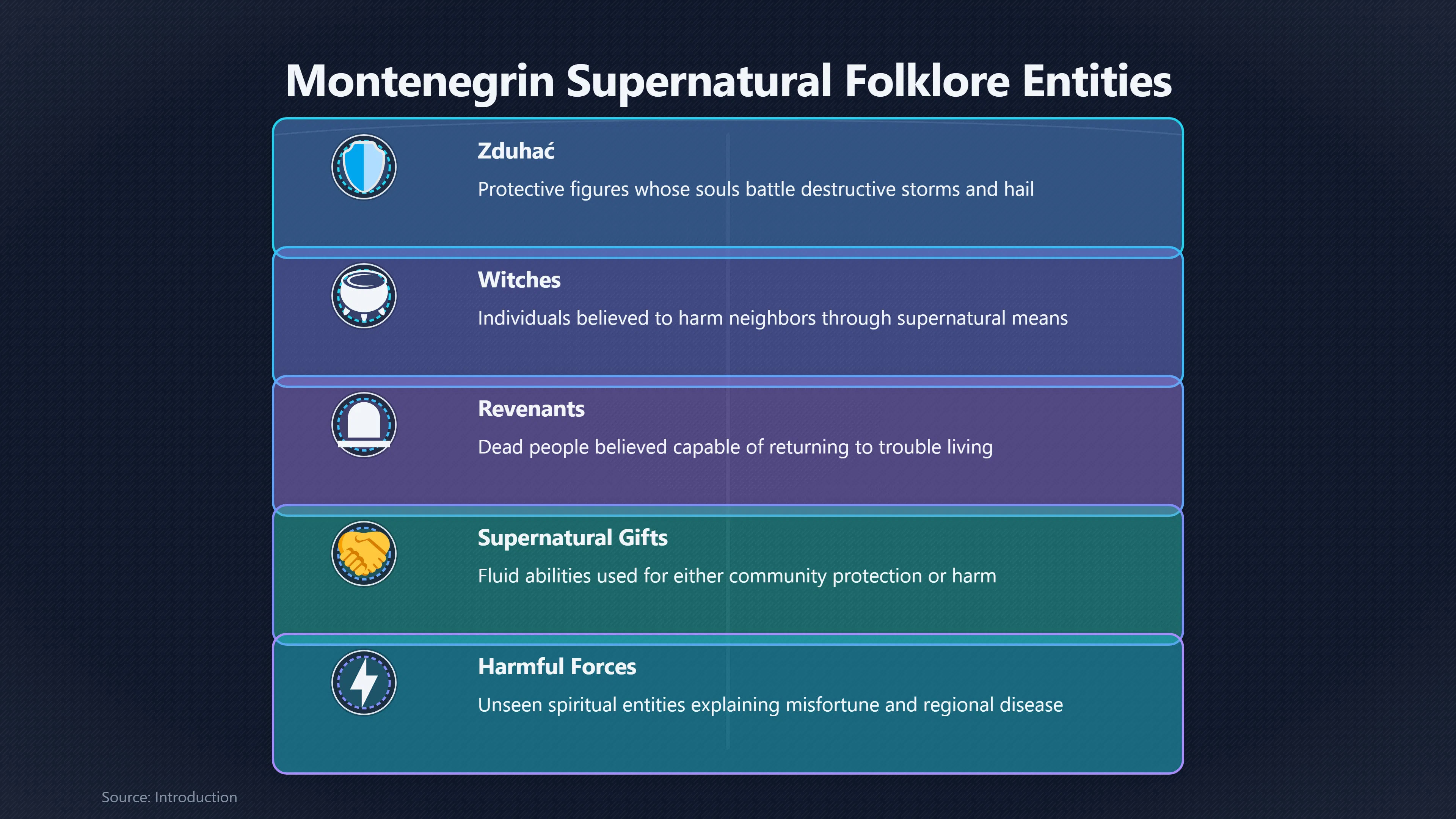
One of Montenegro’s most distinctive supernatural traditions concerns the zduhać. Unlike vampires, the zduhać was generally viewed as a protector rather than a monster.
According to traditional belief, certain people possessed an inborn ability for their soul to leave the sleeping body and battle hostile supernatural forces responsible for destructive storms or hail. Their victories supposedly protected crops, villages and entire regions. Such figures occupied an ambiguous position: they were extraordinary but usually beneficial members of the community.[Wikipedia]WikipediaOpen source on wikipedia.org.
The same folklore also included:
- beliefs in witches who harmed neighbours or relatives through supernatural means;
- revenants—dead people believed capable of returning to trouble the living;
- individuals whose supernatural gifts might be used for either protection or harm.
Rather than forming a single coherent “vampire religion”, these traditions reflected a broader worldview in which unseen spiritual forces explained misfortune, weather and disease. The boundaries between witches, revenants, magical protectors and other supernatural beings were often fluid in oral tradition.[Wikipedia]WikipediaOpen source on wikipedia.org.
An interesting feature of Montenegrin belief is that the same person who was celebrated as a supernatural defender could also be viewed with suspicion if thought to have allied with evil forces. Folklore therefore expressed both admiration and anxiety about unusual individuals without necessarily producing collective persecution.
Burial precautions and reported practices
Like many parts of the Balkans, Montenegro preserved stories about precautions intended to prevent dangerous dead from returning.
Ethnographic records describe practices that included:
- placing restrictions on how certain bodies were buried;
- using hawthorn, regarded as protective against revenants;
- physically disabling a corpse thought capable of returning from the grave;
- recounting tales of unusual funerary measures in exceptional circumstances.
One frequently cited nineteenth-century account describes tendons being cut and hawthorn driven beneath the nails of someone believed capable of returning after death. Such stories resemble anti-vampire customs known elsewhere in southeastern Europe, but they appear in ethnographic collections as descriptions of local belief rather than evidence of widespread official campaigns.[Wikipedia]WikipediaOpen source on wikipedia.org.
Recent scholarship on Montenegrin death customs likewise emphasises the richness of funeral traditions while placing them within broader religious and family practices. Modern historians generally interpret these customs as part of a comprehensive culture surrounding death rather than proof that fears of vampires dominated everyday life.[ojs.lib.unideb.hu]ojs.lib.unideb.huOpen source on unideb.hu.

Religious leaders often discouraged persecution
One of the strongest pieces of evidence against the idea of a major Montenegrin witch or vampire panic comes from the actions of senior Orthodox leaders.
Prince-Bishop Petar I Petrović-Njegoš is remembered not for organising witch hunts but for criticising belief in witches and related supernatural accusations. Contemporary accounts record him condemning the denunciation and persecution of women accused of witchcraft and explicitly rejecting popular claims about witches and supernatural fighters.[Wikipedia]WikipediaOpen source on wikipedia.org.
His intervention illustrates an important difference between folklore and official policy. Local communities could maintain supernatural beliefs while church authorities attempted to limit accusations that might otherwise lead to injustice.
This contrasts with some European witch panics, where courts and religious authorities actively prosecuted alleged witches. In Montenegro, surviving evidence points more often towards attempts at restraint than institutional encouragement.
Why later writers exaggerated the vampire connection
Montenegro became associated with vampires partly because it belonged to a wider Balkan cultural zone from which many famous vampire stories emerged.
Travellers such as Edith Durham recorded colourful tales of witches, ghosts and revenants during the late nineteenth and early twentieth centuries. These observations fascinated Western audiences already captivated by vampire literature. Over time, readers sometimes blurred the distinction between recording folklore and documenting genuine social panic.[Scribd]scribd.comBalkan Beliefs in Magic and Vampires | PDF | Vampires | WitchcraftBalkan Beliefs in Magic and Vampires | PDF | Vampires | Witchcraft…
Modern tourism, horror fiction and popular histories have reinforced this tendency by presenting “the Balkans” as a single landscape of vampire legends. In reality, different regions experienced different historical developments. The best-documented eighteenth-century vampire investigations occurred elsewhere, especially within territories administered by the Habsburg Monarchy, where military officials and physicians produced unusually detailed reports. Montenegro’s surviving record is much thinner and more heavily rooted in oral tradition.
What the evidence actually shows
Taken together, the evidence supports several cautious conclusions.
- Vampire and revenant beliefs unquestionably existed within Montenegrin folklore.
- Zduhaći formed an important part of local supernatural belief, usually acting as defenders rather than objects of fear.
- Protective burial customs were reported, but surviving evidence does not show they developed into sustained nationwide campaigns against supposed vampires.
- Religious authorities sometimes discouraged accusations, especially against alleged witches.
- Later popular culture has tended to magnify Montenegro’s vampire reputation, often treating folklore as if it documented historical panic.[wikipedia.org]WikipediaOpen source on wikipedia.org.
For the history of collective fear in Montenegro, these traditions are significant not because they demonstrate a forgotten vampire panic, but because they reveal how communities interpreted uncertainty. Stories of revenants, witches and zduhaći helped explain death, illness, storms and misfortune, while also showing the limits of supernatural belief: colourful oral traditions could persist for generations without producing the large-scale persecutions or mass scares seen elsewhere in European history.

Amazon book picks
Further Reading
Books and field guides related to Did Montenegro Really Have a Vampire Panic?. Use these as the next step if you want deeper reading beyond the article.

The Golden Bough
Explores magic, ritual and traditional belief systems relevant to revenant folklore.
Vampires, burial, and death
Examines how burial customs and misunderstandings created vampire traditions.


Montenegro
First published 2009. Subjects: Montenegro, history, Politics and government, History.
Endnotes
1.
Source: Wikipedia
Link:https://en.wikipedia.org/wiki/Zduha%C4%87
2.
Source: ojs.lib.unideb.hu
Link:https://ojs.lib.unideb.hu/ethnographica/article/view/12563
3.
Source: scribd.com
Title: Balkan Beliefs in Magic and Vampires | PDF | Vampires | Witchcraft
Link:https://www.scribd.com/document/390731067/2788569-pdf
Source snippet
Balkan Beliefs in Magic and Vampires | PDF | Vampires | Witchcraft...
4.
Source: ojs.lib.unideb.hu
Link:https://ojs.lib.unideb.hu/ethnographica/search?query=Montenegro
Additional References
5.
Source: nature.com
Link:https://www.nature.com/articles/s41599-023-02576-z
Source snippet
Humanities and Social Sciences CommunicationsFebruary 6, 2024 — Geo-political vampirism: how and why has Western literary scholarship a...
Published: February 6, 2024
6.
Source: researchgate.net
Link:https://www.researchgate.net/publication/374168698_Posthumous_Culture_of_Montenegrins_on_a_Timeline_between_Past_and_Present_The_Pattern_of_Behavior
Source snippet
September 26, 2023 — Article PDF Available POSTHUMOUS CULTURE OF MONTENEGRINS ON A TIMELINE BETWEEN PAST AND PRESENT: THE PATTERN OF BEH...
Published: September 26, 2023
7.
Source: ei.sanu.ac.rs
Link:https://www.ei.sanu.ac.rs/index.php/gei/en/article/view/33
Source snippet
and/or Transcultural Transformation of the Reality of the Village Community: the Zduhać, the Zmijar or the (Rural) Esoteric | Bulletin of...
8.
Source: guinnessworldrecords.com
Title: Are vampires real?
Link:https://www.guinnessworldrecords.com/news/2024/10/are-vampires-real-the-cursed-history-of-the-largest-vampire-epidemic
Source snippet
The cursed history of the largest vampire epidemic | Guinness World RecordsOctober 30, 2024 — ARE VAMPIRES REAL? THE CURSED HISTORY OF TH...
Published: October 30, 2024
9.
Source: youtube.com
Title: VAMPIRE Outbreak & The Real-Life Investigation That Followed | Arnold Paole
Link:https://www.youtube.com/watch?v=Owc0kE6FM6E
Source snippet
The First Vampire – The True Story of Petar Blagojević...
10.
Source: doiserbia.nb.rs
Title: rs DOI Serbia
Link:https://doiserbia.nb.rs/Article.aspx?id=0350-08612501035T
Source snippet
Transgenerational and/or transcultural transformation of the reality of the village community: The Zduhać, the Zmijar or the (rural) esot...
11.
Source: youtube.com
Link:https://www.youtube.com/watch?v=lbVATifYENg
Source snippet
The Terrifying Reality Behind the Vampire Mythos...
12.
Source: slavicworld.ru
Link:https://slavicworld.ru/index.php/jsw/en/article/view/372
13.
Source: researchgate.net
Link:https://www.researchgate.net/publication/229513307_The_Aetiology_of_Vampires_and_Revenants_Theological_Debate_and_Popular_Belief
14.
Source: eap-iea.org
Link:https://www.eap-iea.org/index.php/eap/article/view/1013
Topic Tree