Within North Macedonia
Why Poisoning Rumours Felt So Believable
Rumours gained force because Albanian families interpreted unexplained illness through memories of conflict, exclusion and earlier poisoning claims.
On this page
- Conflict memories and communal vulnerability
- The legacy of the Kosovo school illnesses
- How institutional distrust creates rival truths
Page outline Jump by section
Introduction
Poisoning rumours in North Macedonia did not become persuasive simply because pupils suddenly fell ill. They gained force because many ethnic Albanian families interpreted unexplained illnesses through a longer history of insecurity, disputed treatment by state institutions, and memories of earlier poisoning claims elsewhere in the former Yugoslavia. In this setting, the central question was not only whether a toxic substance existed, but also whether official explanations could be trusted. Competing interpretations of the same events reflected competing experiences of the state, making rumours unusually resilient even when medical investigations failed to identify a poison.[Institute for War & Peace Reporting]iwpr.netInstitute for War & Peace ReportingMacedonia: Albanian Students in Poisoning Scare | Institute for War and Peace ReportingSeptember 6, 2005…
Why poisoning rumours felt so believable
The school illness episodes in Kumanovo and later Gostivar unfolded in communities where ethnic relations remained fragile after the 2001 armed conflict in North Macedonia. Many Albanian citizens already believed that state institutions had historically failed to protect their community or treat it fairly. As a result, unexplained medical emergencies were interpreted through political memory as much as through clinical evidence.
This did not mean that families invented symptoms. Pupils experienced genuine distress, and hospitals treated them accordingly. The disagreement centred on the cause. Medical investigators generally reported that they could not confirm poisoning, while many affected families believed that the absence of proof reflected inadequate investigations rather than proof that nothing had happened.[Institute for War & Peace Reporting]iwpr.netInstitute for War & Peace ReportingMacedonia: Albanian Students in Poisoning Scare | Institute for War and Peace ReportingSeptember 6, 2005…
Rumours therefore answered an emotional question as much as a medical one. For communities shaped by previous conflict, an unexplained illness affecting mostly Albanian pupils appeared consistent with existing fears about vulnerability and unequal treatment.
Conflict memories and communal vulnerability
Collective memories of violence often shape how later ambiguous events are understood. In North Macedonia, memories of ethnic conflict made frightening explanations appear more plausible than they might have seemed in a society with higher institutional trust.
Several factors reinforced this pattern:
- Recent political violence. The 2001 conflict remained within living memory, especially in mixed towns such as Kumanovo.
- Separate social experiences. Schools, language rights and local government had long been politically sensitive issues, meaning that educational settings already carried symbolic importance.
- Different media narratives. Albanian- and Macedonian-language media sometimes framed the same incidents differently, encouraging parallel understandings of what had happened.
- Expectations of unequal treatment. Families who already doubted official investigations were more inclined to believe that evidence might be overlooked, hidden or dismissed.
Research on rumours and collective fear consistently shows that uncertainty becomes fertile ground for alarming explanations when trust in institutions is weak. In such circumstances, people rely more heavily on family networks, community leaders and previous experience than on official reassurance alone.[Institute for War & Peace Reporting]iwpr.netInstitute for War & Peace ReportingMacedonia: Albanian Students in Poisoning Scare | Institute for War and Peace ReportingSeptember 6, 2005…
The legacy of the Kosovo school illnesses
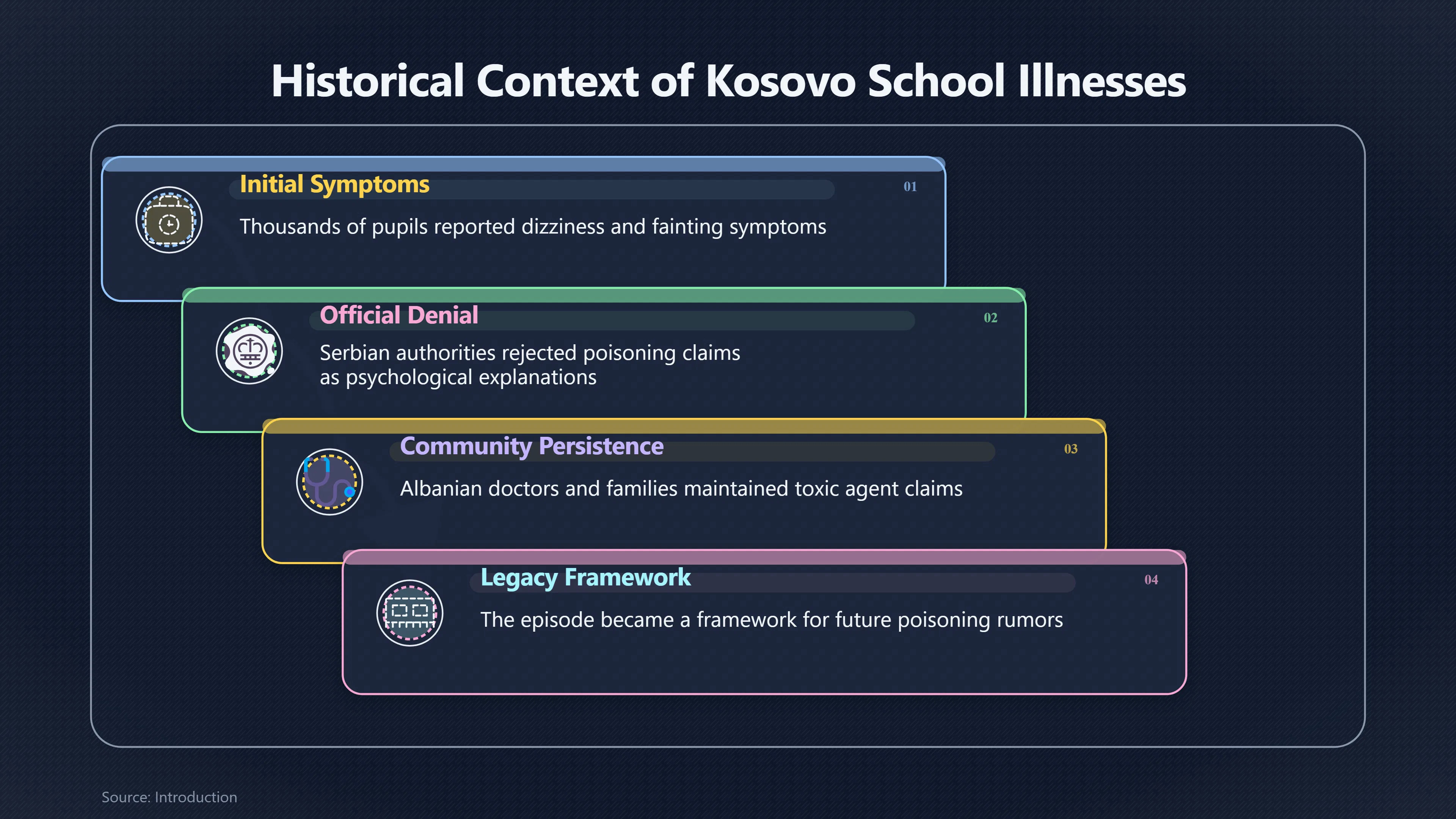
The strongest historical influence came from the disputed Kosovo school illness epidemic of 1990. Thousands of ethnic Albanian pupils reported symptoms including dizziness, breathing problems, fainting and convulsions. Serbian authorities generally rejected poisoning claims and promoted psychological explanations, while many Albanian doctors, families and political leaders maintained that a toxic agent had been deliberately used. The dispute has never achieved universal historical agreement.[PubMed]pubmed.ncbi.nlm.nih.govOn the origin of mass casualty incidents in Kosovo, Yugoslavia, in 1990 - PubMed…
This earlier episode became more than a medical controversy. It entered Albanian collective memory as evidence that official institutions could deny genuine suffering. Consequently, when pupils in North Macedonia later complained of similar symptoms, many families immediately recognised what they believed was a familiar pattern.
The influence operated through memory rather than direct evidence. Even though the circumstances differed, the Kosovo case provided an interpretive framework:
- unexplained illness among Albanian pupils;
- uncertainty over toxicological findings;
- competing official and community narratives;
- enduring disagreement over what really occurred.
Because the Kosovo controversy itself remained unresolved in public memory, it offered no shared lesson. Instead, it reinforced opposing expectations about future incidents. Some observers regarded later cases as examples of mass psychogenic illness, while others viewed them as further evidence that genuine poisoning might again be denied.[PubMed]pubmed.ncbi.nlm.nih.govOn the origin of mass casualty incidents in Kosovo, Yugoslavia, in 1990 - PubMed…
How institutional distrust creates rival truths
The poisoning rumours illustrate how low institutional trust can produce rival versions of reality without requiring either side to act in bad faith.
Medical authorities approached the incidents by asking whether laboratory evidence demonstrated exposure to a toxin. Families often approached the same events differently, asking whether institutions that they distrusted would reliably detect or admit such exposure in the first place.
This difference in starting assumptions meant that identical evidence could strengthen opposing conclusions. A negative toxicology report reassured some observers that poisoning had not occurred. Others interpreted the same result as evidence of inadequate testing or official unwillingness to acknowledge the truth. IWPR reporting on the Kumanovo incident captured this divide, noting that many parents refused to send children back to school despite repeated medical examinations that found no confirmed poisoning.[Institute for War & Peace Reporting]iwpr.netInstitute for War & Peace ReportingMacedonia: Albanian Students in Poisoning Scare | Institute for War and Peace ReportingSeptember 6, 2005…
This mechanism helps explain why rumours often survive official investigations. Once institutional credibility itself becomes disputed, new evidence is filtered through existing political and social loyalties instead of resolving them.
What historians and social scientists emphasise today
Most contemporary scholarship treats these episodes less as mysteries waiting for a single definitive medical answer than as examples of how collective fear develops within divided societies.
Researchers studying the earlier Kosovo illnesses have argued that severe ethnic tension could have contributed to mass sociogenic illness—a phenomenon in which genuine physical symptoms spread through groups without evidence of a shared toxic exposure. At the same time, many Albanian communities continue to reject that interpretation because they see it as repeating historical patterns of dismissing their experiences.[PubMed]pubmed.ncbi.nlm.nih.govOn the origin of mass casualty incidents in Kosovo, Yugoslavia, in 1990 - PubMed…
For North Macedonia, the broader lesson is that poisoning rumours cannot be understood solely through toxicology or psychology. They also belong to the country’s social history of ethnic mistrust. When communities carry memories of discrimination, conflict and disputed official narratives, ambiguous emergencies become contests over credibility as much as investigations into physical causes.
The continuing significance of these episodes therefore lies not only in whether poisoning occurred, but in what the rumours reveal about confidence in public institutions, the persistence of historical memory, and the difficulty of establishing shared facts in a deeply divided society.
Amazon book picks
Further Reading
Books and field guides related to Why Poisoning Rumours Felt So Believable. Use these as the next step if you want deeper reading beyond the article.
Imagined communities
Provides context for identity and competing historical narratives.

Black Lamb and Grey Falcon
Explores the historical and cultural background of the former Yugoslavia.

Mistakes Were Made (But Not by Me)
Explains belief persistence and resistance to contrary evidence.
Endnotes
1.
Source: iwpr.net
Link:https://iwpr.net/global-voices/macedonia-albanian-students-poisoning-scare
Source snippet
Institute for War & Peace ReportingMacedonia: Albanian Students in Poisoning Scare | Institute for War and Peace ReportingSeptember 6, 2005...
Published: September 6, 2005
2.
Source: pubmed.ncbi.nlm.nih.gov
Link:https://pubmed.ncbi.nlm.nih.gov/8817187/
Source snippet
On the origin of mass casualty incidents in Kosovo, Yugoslavia, in 1990 - PubMed...
Additional References
3.
Source: youtube.com
Title: Kumanovo bloodshed: Balkans tension or internal political intrigue?
Link:https://www.youtube.com/watch?v=hhxBt_HgWPA
Source snippet
The 2001 Insurgency In Macedonia | The Forgotten Final Yugoslav War...
4.
Source: youtube.com
Link:https://www.youtube.com/watch?v=fAIW44sclbI
Source snippet
Kumanovo bloodshed: Balkans tension or internal political intrigue? - reporter...
5.
Source: youtube.com
Title: Macedonian demonstrators want PM to stand down
Link:https://www.youtube.com/watch?v=tKp0boszMPY
Source snippet
Passing the Blame in Divided Macedonia (2001)...
6.
Source: youtube.com
Link:https://www.youtube.com/watch?v=gaeM_qYE32U
7.
Source: Wikipedia
Title: Kosovo student poisoning
Link:https://en.wikipedia.org/wiki/Kosovo_student_poisoning
Topic Tree