Within Lebanon Belief
How did heavy metal become a Satanic scare?
The campaign against Lebanon's metal scene shows how youth culture became framed as a dangerous religious threat.
On this page
- Origins of the crackdown
- Raids, arrests and censorship
- Why scholars call it a moral panic
Page outline Jump by section
Introduction
Lebanon’s heavy metal Satanism scare is the country’s best-known example of a modern moral panic. Beginning in the mid-1990s and recurring in several waves during the following decade, a small youth music scene was portrayed by sections of the media, religious figures and state authorities as evidence of organised devil worship. Metal music, black clothing, long hair, album artwork and unfamiliar symbols were interpreted as signs of Satanic activity rather than as elements of an international musical subculture. The result was police raids, arrests, interrogations, concert cancellations and public suspicion directed at musicians and fans, despite little publicly documented evidence of an organised Satanist movement. Historians and media scholars now treat the episode as a classic case of moral panic: a disproportionate response in which a marginal youth culture became a symbolic threat to wider society.[AUB ScholarWorks]scholarworks.aub.edu.lbOpen source on edu.lb.
How did heavy metal become a Satanic scare?
The panic did not emerge in isolation. Lebanon was rebuilding after the civil war, while political authority remained fragmented and heavily influenced by Syria. Religious identity carried unusual public importance, and anxieties about rapid social change, Western cultural influence and youth behaviour created fertile ground for suspicion of unfamiliar subcultures.
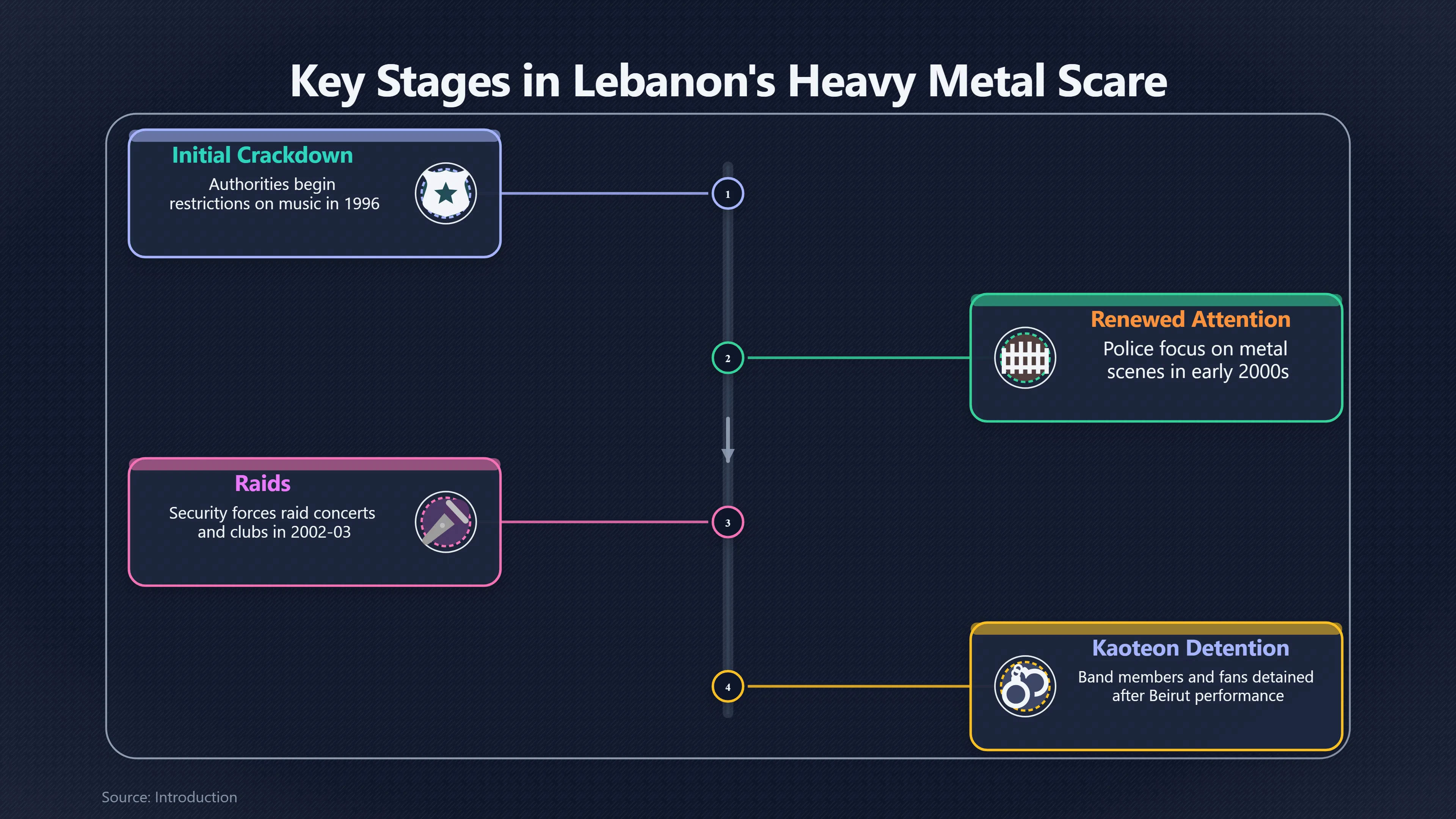
The first major crackdown is generally traced to 1996. Contemporary accounts and later research describe official concern following the suicide of the son of a senior military officer. Heavy metal and even grunge music were publicly associated with suicide and Satanism, leading to restrictions on music considered dangerous. Reports from musicians and journalists describe police questioning young people simply because they owned particular records, dressed in black or wore long hair.[PopMatters]popmatters.comPop Matters The Heavy Metal Witch Hunt Lives On » Pop MattersPop Matters The Heavy Metal Witch Hunt Lives On » Pop Matters
The allegations relied heavily on symbolic interpretation. Album covers featuring skulls, demons or inverted crosses, common theatrical devices within many forms of heavy metal, were treated as literal evidence of occult practice. Fans found themselves accused of participating in secret rituals, despite investigations producing little public evidence of organised Satanic groups operating within Lebanon’s metal scene.[AUB ScholarWorks]scholarworks.aub.edu.lbOpen source on edu.lb.
Origins of the crackdown
The panic unfolded in several waves rather than as a single event.
The initial campaign in 1996 was followed by renewed police attention in the early 2000s. Another widely reported wave came in 2002–03, when security forces raided concerts and clubs associated with heavy metal. In one of the best documented incidents, members of the Lebanese band Kaoteon and concert attendees were detained after a performance in Beirut. Journalistic accounts describe musicians being interrogated for days while authorities searched for evidence of Satanic organisations or anti-religious activity.[PopMatters]popmatters.comPop Matters The Heavy Metal Witch Hunt Lives On » Pop MattersPop Matters The Heavy Metal Witch Hunt Lives On » Pop Matters
Court officials publicly referred to organisations allegedly promoting insults to religion and practising rituals. Yet publicly reported evidence centred largely on music collections, clothing, appearance and alleged symbols rather than criminal acts. This gap between extraordinary claims and ordinary evidence is one of the main reasons scholars classify the episode as a moral panic rather than the exposure of an organised criminal conspiracy.[PopMatters]popmatters.comPop Matters The Heavy Metal Witch Hunt Lives On » Pop MattersPop Matters The Heavy Metal Witch Hunt Lives On » Pop Matters
Raids, arrests and censorship
The crackdown affected everyday cultural life more than it uncovered criminal activity.
Musicians and fans have described experiences including:
- Police raids on concerts and clubs.
- Temporary detention and lengthy interrogation.
- Questions about supposed devil worship, animal sacrifice or occult ceremonies.
- Confiscation of CDs, posters and other music-related material.
- Pressure on venues to cancel performances.
- Public association of metal culture with drugs, blasphemy and moral corruption.[PopMatters]popmatters.comPop Matters The Heavy Metal Witch Hunt Lives On » Pop MattersPop Matters The Heavy Metal Witch Hunt Lives On » Pop Matters
Some musicians recalled being asked whether they “practised Nirvana” or worshipped the Devil, illustrating how poorly understood alternative music genres were among some investigators. Others reported being treated with suspicion despite openly identifying as practising Christians or Muslims. Such accounts suggest that appearance and musical taste often became more significant to investigators than demonstrable criminal behaviour.[PopMatters]popmatters.comPop Matters The Heavy Metal Witch Hunt Lives On » Pop MattersPop Matters The Heavy Metal Witch Hunt Lives On » Pop Matters
Although the number of people directly arrested was relatively small, the wider effect was considerable. Concert organisers faced uncertainty, venues became cautious, and parts of the underground music scene moved further out of public view. Several musicians eventually left Lebanon, reducing the visibility of a scene that had previously been growing.[PopMatters]popmatters.comPop Matters The Heavy Metal Witch Hunt Lives On » Pop MattersPop Matters The Heavy Metal Witch Hunt Lives On » Pop Matters
Why scholars call it a moral panic
Researchers analysing the episode frequently draw on the sociological concept of a moral panic, first developed by sociologist Stanley Cohen. In this framework, a relatively small group becomes a “folk devil”—a symbolic enemy portrayed as threatening society’s moral order.
A media study completed at the American University of Beirut argues that Lebanese television repeatedly linked heavy metal with Satanism, drugs and social deviance. Rather than examining the music itself, broadcasts often relied on dramatic imagery, religious symbolism and sensational reporting that encouraged viewers to interpret metal fans as dangerous outsiders. The thesis concludes that media framing played an important role in constructing metal fans as folk devils and legitimising calls for state intervention.[AUB ScholarWorks]scholarworks.aub.edu.lbOpen source on edu.lb.
This interpretation does not deny that some individuals may have experimented with occult imagery or provocative symbolism. Heavy metal has long borrowed theatrical references to horror, mythology and religion. What scholars dispute is the leap from provocative aesthetics to claims of organised Satanic conspiracies. Available public evidence has not demonstrated that Lebanon’s metal community functioned as a coordinated Satanist movement.[AUB ScholarWorks]scholarworks.aub.edu.lbOpen source on edu.lb.
Why the panic spread
Several factors reinforced one another.
Media amplification. Sensational television coverage often blurred distinctions between music, fashion, rebellion and criminality, encouraging viewers to see ordinary youth behaviour as evidence of hidden religious danger.[AUB ScholarWorks]scholarworks.aub.edu.lbOpen source on edu.lb.
Religious sensitivity. Lebanon’s religiously diverse society places strong public importance on religious identity. Allegations of blasphemy or attacks on sacred values therefore carried particular emotional force across multiple communities.[AUB ScholarWorks]scholarworks.aub.edu.lbOpen source on edu.lb.
Post-war uncertainty. The country was emerging from years of conflict while remaining politically unstable. In periods of insecurity, symbolic threats can become attractive explanations for broader social anxieties. Several musicians later argued that crackdowns coincided with moments of political tension, although this interpretation remains debated rather than conclusively demonstrated.[PopMatters]popmatters.comPop Matters The Heavy Metal Witch Hunt Lives On » Pop MattersPop Matters The Heavy Metal Witch Hunt Lives On » Pop Matters
Limited familiarity with the subculture. Heavy metal remained a small scene. Many officials and commentators encountered its imagery without understanding its conventions, making theatrical symbolism easier to interpret literally.[AUB ScholarWorks]scholarworks.aub.edu.lbOpen source on edu.lb.
Lasting significance
The heavy metal scare remains an important episode in Lebanon’s cultural history because it illustrates how a marginal youth culture became the focus of wider fears about religion, morality and national identity.
The panic also left a lasting mark on Lebanon’s music community. Older musicians frequently recall the period as one in which artistic expression carried genuine legal and social risks, while younger generations remember it as a cautionary example of how rumours and sensational media narratives can stigmatise minority subcultures.
For scholars of collective fear, the Lebanese case stands alongside similar heavy metal scares in countries such as Egypt, although each developed within its own political and religious context. Rather than demonstrating the existence of organised Satanic networks, the Lebanese experience is generally understood as showing how cultural misunderstanding, media amplification and official intervention combined to transform a niche musical scene into a perceived national threat.[AUB ScholarWorks]scholarworks.aub.edu.lbOpen source on edu.lb.
Amazon book picks
Further Reading
Books and field guides related to How did heavy metal become a Satanic scare?. Use these as the next step if you want deeper reading beyond the article.

Imagined communities
Provides context for nationalism, colonialism and identity shaping religious movements.
Them
A wide variety of extremist groups -- Islamic fundamentalists, neo-Nazis -- share the oddly similar belief that a tiny shadowy elite rule...
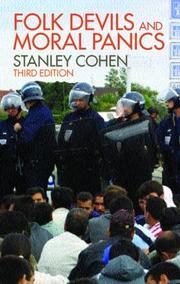
Folk devils and moral panics
Directly explains why youth cultures become symbolic threats.
Endnotes
1.
Source: scholarworks.aub.edu.lb
Link:https://scholarworks.aub.edu.lb/items/82c69b70-02d0-4eec-9295-b03000d7e882/full
2.
Source: popmatters.com
Title: Pop Matters The Heavy Metal Witch Hunt Lives On » Pop Matters
Link:https://www.popmatters.com/158667-the-heavy-metal-witch-hunt-lives-on-2495851143.html
3.
Source: scholarworks.aub.edu.lb
Link:https://scholarworks.aub.edu.lb/items/82c69b70-02d0-4eec-9295-b03000d7e882
4.
Source: ojp.gov
Link:https://www.ojp.gov/ncjrs/virtual-library/abstracts/satanism-scare
5.
Source: sciencedirect.com
Title: Moral Panic
Link:https://www.sciencedirect.com/topics/medicine-and-dentistry/moral-panic
Additional References
6.
Source: tandfonline.com
Link:https://www.tandfonline.com/doi/abs/10.1080/09592310208559197
Source snippet
08 — Image: Publication Cover Small Wars & Insurgencies Volume 13, 2002 - Issue 3 Submit an article Journal homepage 622 Views 2 CrossRef...
7.
Source: lbcgroup.tv
Title: REPOR T: Metal fans accused of Satanism
Link:https://www.lbcgroup.tv/news/news-bulletin-reports/59695/report-metal-fans-accused-of-satanism/en
Source snippet
REPORT: Metal fans accused of Satanism - Lebanon NewsNovember 10, 2012 — REPORT: METAL FANS ACCUSED OF "SATANISM" News Bulletin Reports 1...
Published: November 10, 2012
8.
Source: youtube.com
Link:https://www.youtube.com/watch?v=sooRzwlC3YA
Source snippet
Blaakyum - Metal Battle Middle East - Full Show - Live at Wacken Open Air 2015...
9.
Source: youtube.com
Title: Legends of Middle Eastern Metal: The Bands That Built a Scene
Link:https://www.youtube.com/watch?v=H7_0fZDjiB8
Source snippet
Lebanon's First All-Female Metal Band: The Untold Story of Slave to Sirens (Documentary, 2022)...
10.
Source: youtube.com
Link:https://www.youtube.com/watch?v=QEEdfIFvfn4
Source snippet
Legends of Middle Eastern Metal: The Bands That Built a Scene...
11.
Source: youtube.com
Link:https://www.youtube.com/watch?v=MMXmgUPPQ00
Source snippet
When the '80s Thought EVERYTHING Was Satanic...
12.
Source: pmc.ncbi.nlm.nih.gov
Link:https://pmc.ncbi.nlm.nih.gov/articles/PMC2030488/
13.
Source: stranger-aeons.com
Title: In some
Link:https://www.stranger-aeons.com/interview-blaakyum-lebanon/
Source snippet
Interview with Blaakyum from Lebanon - Stranger AeonsNovember 25, 2014 — * In Sam Dunn’s documentary ‘World Metal’ (if you haven’t seen i...
Published: November 25, 2014
14.
Source: academic.oup.com
Link:https://academic.oup.com/shm/article/25/2/271/1739124
Source snippet
Hypnosis: Sound and Selfhood from Mesmerism to Brainwashing | Social History of Medicine | Oxford AcademicOctober 5, 2011 — MUSIC AS SATA...
Published: October 5, 2011
15.
Source: sciencedirect.com
Link:https://www.sciencedirect.com/science/article/pii/S0140673606684274
Topic Tree