Within Czech Panics
How Czech Witchcraft Accusations Became Legally Lethal
The Velke Losiny and Sumperk trials show how torture, courts and local interests turned witchcraft claims into a lethal system.
On this page
- From a stolen wafer to a conspiracy
- How torture created new accusations
- Responsibility, profit and public memory
Page outline Jump by section
Introduction
The Moravian witch trials were not simply outbreaks of popular superstition. They became lethal because local suspicion was transformed into formal legal procedure. Between 1679 and 1696, the best-known prosecutions centred on the estates of Velké Losiny and the nearby town of Šumperk in northern Moravia, where inquisitorial methods, torture and expanding conspiracy theories combined to produce one of the deadliest witch persecutions in the history of the Czech lands. Modern historians increasingly argue that the trials are best understood as a judicial system that manufactured evidence rather than discovered it.[CU Digital Repository]dspace.cuni.czJanuary 27, 2014…
Rather than treating the episode as an unexplained burst of mass hysteria, it is more revealing to examine the mechanism that kept the prosecutions alive: how a minor accusation grew into an ever-expanding network of alleged witches, why confessions appeared so convincing despite being extracted under torture, and how legal authority made impossible claims appear credible.
From a stolen wafer to a conspiracy
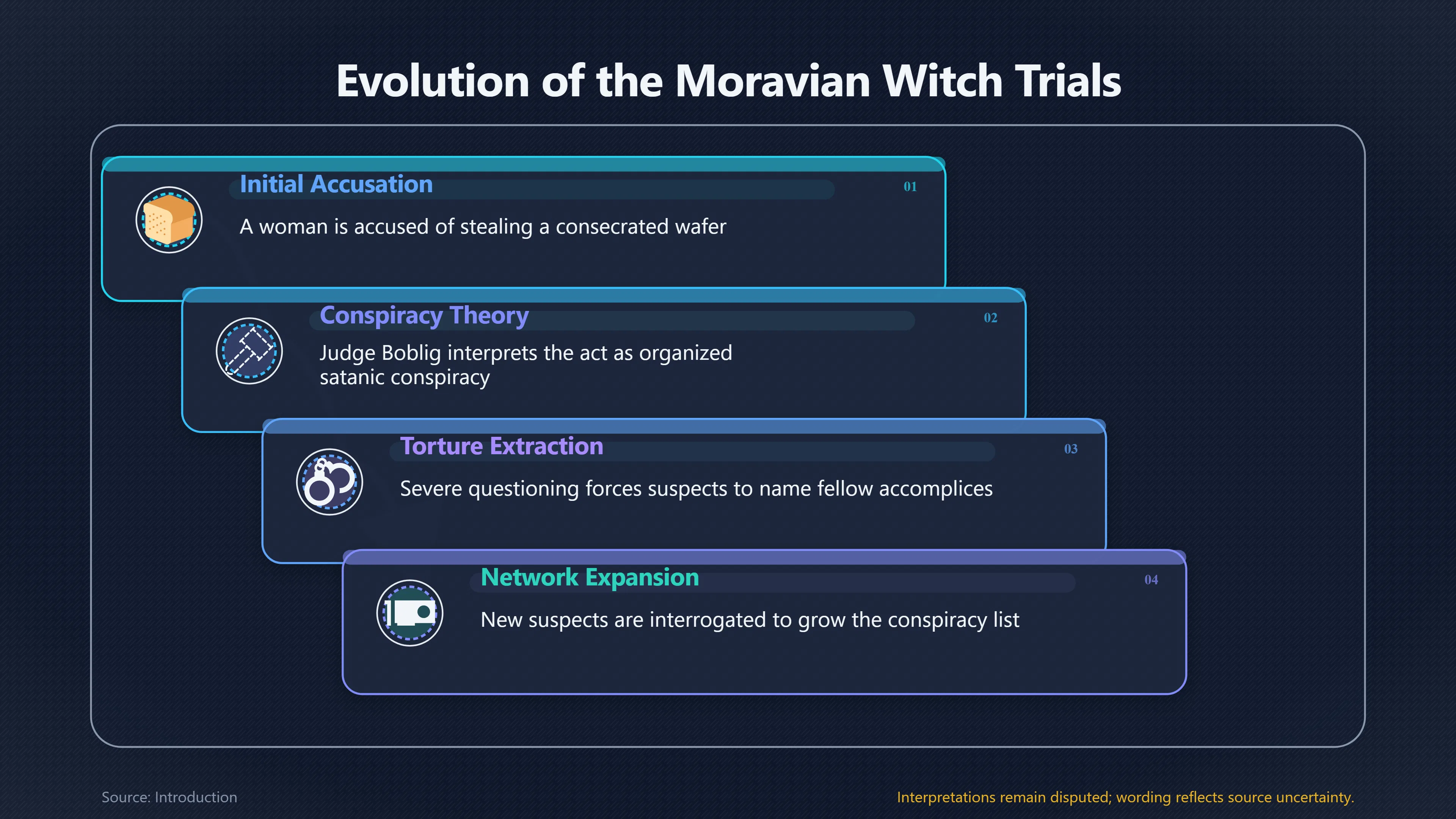
The immediate trigger was remarkably ordinary. During Easter 1678 or the following prosecution period, a poor woman was accused of removing a consecrated communion wafer from church. According to the allegations, it was intended for folk magic to improve a cow’s milk production. Such beliefs were not unique to Moravia; throughout early modern Europe, people sometimes attributed protective or healing powers to blessed objects. On its own, this incident could have remained a local religious offence. Instead, it was interpreted as evidence of organised witchcraft.[CU Digital Repository]dspace.cuni.czJanuary 27, 2014…
Estate authorities brought in the experienced inquisitorial judge Jindřich František Boblig of Edelstadt. Rather than investigating a single alleged act, Boblig developed the case into a theory of a hidden satanic conspiracy. Once investigators assumed that witches belonged to an organised network, every confession was expected to reveal further accomplices. Each new accusation appeared to confirm the previous one, creating a self-reinforcing chain.
This logic mattered more than the original allegation. The legal process no longer asked whether a particular person had committed a specific offence. Instead, it sought to expose an invisible organisation that investigators already believed existed.
How torture created new accusations
The defining feature of the Moravian trials was not popular belief alone but the way torture reshaped evidence.
Under inquisitorial procedure, suspects who initially denied the accusations were subjected to increasingly severe questioning. Confessions obtained under torture were then treated as reliable testimony. More importantly, prisoners were expected to identify fellow witches. Those new suspects were interrogated in the same way, producing additional names and expanding the supposed conspiracy.[CU Digital Repository]dspace.cuni.czJanuary 27, 2014…
The process created several powerful distortions:
- Confession became the expected outcome. Continued denial often resulted in further torture rather than acquittal.
- Every confession generated new suspects. The trials therefore expanded automatically unless outside authorities intervened.
- Contradictions were explained away. Differences between testimonies were interpreted as deception by witches rather than evidence that the accusations were false.
- Silence became suspicious. Refusing to accuse others could itself be presented as proof of loyalty to the Devil.
Modern historians regard this as a classic example of coercive evidence production. The confessions often appeared internally consistent because later prisoners had already heard the kinds of stories investigators expected them to repeat.[CU Digital Repository]dspace.cuni.czJanuary 27, 2014…
Why respected people also became victims
The prosecutions did not remain confined to poor or socially marginal villagers.
As the trials widened, prosperous townspeople, officials and members of respected local families were accused. One of the most famous victims was Kryštof Alois Lautner, the dean of Šumperk. Lautner criticised aspects of the prosecutions and eventually became a suspect himself. After years of imprisonment and repeated torture, he was executed in 1685 despite his social standing and clerical position. His fate demonstrated that no amount of reputation guaranteed safety once investigators decided someone belonged to the alleged conspiracy.[VisitCzechia]visitczechia.comVisit Czechia The Witches’ Cycle Route | Visit CzechiaVisit Czechia The Witches’ Cycle Route | Visit Czechia
Lautner’s case has become especially significant because it illustrates how judicial persecution could consume those who attempted to resist it. His execution also weakened the claim that the trials merely targeted isolated, unpopular individuals.
Responsibility, profit and judicial power
Earlier accounts often portrayed Boblig as the sole architect of the persecutions. Recent scholarship presents a more complicated picture.
Boblig undoubtedly directed the investigations and became the public face of the trials. However, historians increasingly emphasise that the prosecutions depended upon cooperation from estate authorities, local courts and members of the nobility who authorised the proceedings and allowed them to continue for many years. The judicial system itself made the expansion possible.[mujRozhlas]mujrozhlas.czOpen source on mujrozhlas.cz.
Economic incentives also played a role. Witch trials generated legal fees, while convictions could place the property of the condemned at risk. Financial benefit was not the sole cause of the persecutions, but it reduced incentives to question a process that appeared legally successful and economically rewarding.
The result was a system in which institutional interests and sincerely held religious beliefs reinforced one another. Fear alone did not sustain the trials; official procedure did.
How many people were killed?
Exact totals remain debated because historians use different geographical boundaries and surviving records.
The core Velké Losiny and Šumperk proceedings resulted in the execution of 81 people, according to research published through Charles University. Other historians, considering the wider northern Moravian and neighbouring Silesian persecutions, estimate that the broader campaign claimed close to 200 victims. These different figures are not contradictory so much as they describe different definitions of the same regional episode.[CU Digital Repository]dspace.cuni.czJanuary 27, 2014…
What is undisputed is that the Moravian prosecutions became the largest and most systematic witch trials in the Czech lands.
Why the trials eventually ended
The prosecutions did not collapse because belief in witchcraft suddenly disappeared.
Instead, growing doubts among higher authorities, legal scrutiny and changing attitudes towards evidence gradually weakened support for large-scale witch prosecutions. Across the Habsburg monarchy, central government became increasingly sceptical of spectacular witch cases. During the eighteenth century, reforms under Maria Theresa subjected such prosecutions to much closer central oversight, contributing to the eventual disappearance of witch trials from judicial practice.[CU Digital Repository]dspace.cuni.czOpen source on cuni.cz.
The end therefore reflected changing legal standards as much as changing beliefs.

Public memory in today’s Czech Republic
The Moravian witch trials remain one of the best-known examples of judicial persecution in Czech history.
Velké Losiny Castle preserves the courtroom associated with the trials, while memorials in Velké Losiny, Šumperk and nearby towns commemorate the victims rather than celebrate the mythology of witches. The region also maintains educational heritage routes linking sites connected with the persecutions, encouraging visitors to understand how ordinary legal institutions enabled extraordinary injustice.[VisitCzechia]visitczechia.comVisit Czechia Velké Losiny Chateau | Visit CzechiaVisit Czechia Velké Losiny Chateau | Visit Czechia
The story has also shaped Czech literature, film and public history, most famously through the 1970 film Witchhammer, which presents the trials as a warning about the abuse of judicial authority rather than a tale of supernatural forces.
Today, historians generally view the Moravian witch trials as a cautionary example of how fear becomes deadly when courts accept coerced testimony, assume hidden conspiracies and allow legal procedure to replace genuine evidence. That interpretation places the episode firmly within the wider history of judicial persecution, showing that the greatest danger came not from belief in magic itself but from institutions that transformed belief into legally sanctioned violence.
Amazon book picks
Further Reading
Books and field guides related to How Czech Witchcraft Accusations Became Legally Lethal. Use these as the next step if you want deeper reading beyond the article.
The witch-hunt in early modern Europe
Explains legal processes behind European witch persecutions.

Endnotes
1.
Source: mujrozhlas.cz
Link:https://www.mujrozhlas.cz/czechast-radio-prague-international/17th-century-witch-trials-northern-moravia-was-everything
2.
Source: visitczechia.com
Title: Visit Czechia Velké Losiny Chateau | Visit Czechia
Link:https://www.visitczechia.com/en-us/things-to-do/places/landmarks/chateaux/c-velke-losiny-chateau
3.
Source: visitczechia.com
Title: Visit Czechia The Witches’ Cycle Route | Visit Czechia
Link:https://www.visitczechia.com/en-us/things-to-do/places/summer-sports/cycling/s-jeseniky-witches-route
4.
Source: czechology.com
Link:https://www.czechology.com/witch-trials/
Source snippet
Witch Trials in Czech Lands - CzechologyJune 12, 2025 — WITCH TRIALS IN CZECH LANDS updated on May 15, 2025June 12, 2025Leave a Comment B...
Published: June 12, 2025
5.
Source: youtube.com
Link:https://www.youtube.com/watch?v=gvf6BXWPpVQ
Source snippet
Velké Losiny Castle - Where Renaissance Splendor Meets Fascinating Stories [EN]...
6.
Source: youtube.com
Title: Velké Losiny Castle
Link:https://www.youtube.com/watch?v=tZclZ_yt0uc
Source snippet
The Terror of History: The Witch Hunt in Early Modern Europe, UCLA...
7.
Source: dspace.cuni.cz
Link:https://dspace.cuni.cz/handle/20.500.11956/54257?locale-attribute=en
Source snippet
January 27, 2014...
Published: January 27, 2014
8.
Source: dspace.cuni.cz
Link:https://dspace.cuni.cz/bitstream/handle/20.500.11956/54257/DPBE_2009_2_11210_0_286815_0_87057.pdf?isAllowed=y&sequence=3
9.
Source: dspace.cuni.cz
Link:https://dspace.cuni.cz/handle/20.500.11956/54257?show=full
Source snippet
cuni.czČarodějnické procesy na severní Moravě | Digitální repozitář UKJanuary 27, 2014 — ČARODĚJNICKÉ PROCESY NA SEVERNÍ MORAVĚ WITCH TRI...
Published: January 27, 2014
10.
Source: dspace.cuni.cz
Link:https://dspace.cuni.cz/handle/20.500.11956/54257
Source snippet
cuni.czČarodějnické procesy na severní Moravě | Digitální repozitář UKJanuary 27, 2014 — ČARODĚJNICKÉ PROCESY NA SEVERNÍ MORAVĚ WITCH TRI...
Published: January 27, 2014
11.
Source: dspace.cuni.cz
Title: czČarodějnické procesy
Link:https://dspace.cuni.cz/handle/20.500.11956/58543
Source snippet
Digitální repozitář UKSeptember 11, 2013 — ČARODĚJNICKÉ PROCESY - ILUZE ČESKÝCH DĚJIN? WITCH TRIALS - AN ILLUSION OF CZECH HISTORY? DIP...
Published: September 11, 2013
Additional References
12.
Source: strednicechy.rozhlas.cz
Title: czČarodějnické procesy byly v českých zemích ojedinělé
Link:https://strednicechy.rozhlas.cz/carodejnicke-procesy-byly-v-ceskych-zemich-ojedinele-nejproslulejsi-propukl-ve-8930340
Source snippet
Nejproslulejší propukl ve Velkých Losinách | Střední ČechyFebruary 10, 2023 — ČARODĚJNICKÉ PROCESY BYLY V ČESKÝCH ZEMÍCH OJEDINĚLÉ. NEJPR...
Published: February 10, 2023
13.
Source: invenio.nusl.cz
Title: czČarodějnické procesy na severní Moravě
Link:https://invenio.nusl.cz/record/323551
Source snippet
nusl.czČarodějnické procesy na severní Moravě - Digitální repozitář(323551) Název: Čarodějnické procesy na severní Moravě Překlad názvu...
14.
Source: dobrahistorie.cz
Title: Toulky českou minulostí
Link:https://dobrahistorie.cz/dokument/6061-toulky-ceskou-minulosti-490-schuzka-hon-na-carodejnice
Source snippet
schůzka: Hon na čarodějnice – Dobrá historieTOULKY ČESKOU MINULOSTÍ - 490. SCHŮZKA: HON NA ČARODĚJNICE | 2021 | ČEŠTINA Image: Česko | ČE...
15.
Source: youtube.com
Title: The Witch-Hunt in Early Modern Europe: A Discussion with Brian Levack
Link:https://www.youtube.com/watch?v=eSvFMkcO2d4
Source snippet
The Brutal Witch Trials in Germany | Witches: Truth Behind the Trials | National Geographic UK...
16.
Source: youtube.com
Title: The Terror of History: The Witch Hunt in Early Modern Europe, UCLA
Link:https://www.youtube.com/watch?v=LOQND4fVF_w
Source snippet
The Witch-Hunt in Early Modern Europe: A Discussion with Brian Levack...
17.
Source: dvojka.rozhlas.cz
Link:https://dvojka.rozhlas.cz/491-schuzka-osud-statecneho-muze-cestneho-cloveka-a-neobycejneho-smolare-dekana-7938732
Source snippet
schůzka: Osud statečného muže, děkana Kryštofa Aloise Lautnera ze Šumperka | DvojkaNovember 13, 2025 — 491. SCHŮZKA: OSUD STATEČNÉHO MUŽE...
Published: November 13, 2025
18.
Source: youtube.com
Link:https://www.youtube.com/watch?v=RZ7OgjGhUB8
Topic Tree