Within Liechtenstein Panics
Why Higher Authority Finally Stopped the Trials
Imperial review halted the trials by exposing unlawful procedure, confiscation and abuse of criminal authority.
On this page
- Petitions and the imperial commission
- Legal review of the final convictions
- Loss of jurisdiction and collapse of Hohenems rule
Page outline Jump by section
Introduction
The witch executions in the territories that now form Liechtenstein did not end because belief in witchcraft suddenly disappeared. Instead, the final wave of prosecutions collapsed after victims, clergy and other opponents appealed beyond the local authorities to the Holy Roman Emperor. Imperial intervention exposed serious legal abuses, challenged the way the trials had been conducted, and stripped the ruling Counts of Hohenems of the criminal authority that had allowed the persecutions to continue. The result was not simply the end of a single series of trials, but a decisive assertion that even witchcraft prosecutions had to comply with imperial law.[Liechtenstein Lexicon]historisches-lexikon.liLiechtenstein Lexicon Hexenverfolgung – Historisches LexikonLiechtenstein LexiconHexenverfolgung – Historisches LexikonDecember 31, 2011…

Petitions and the imperial commission
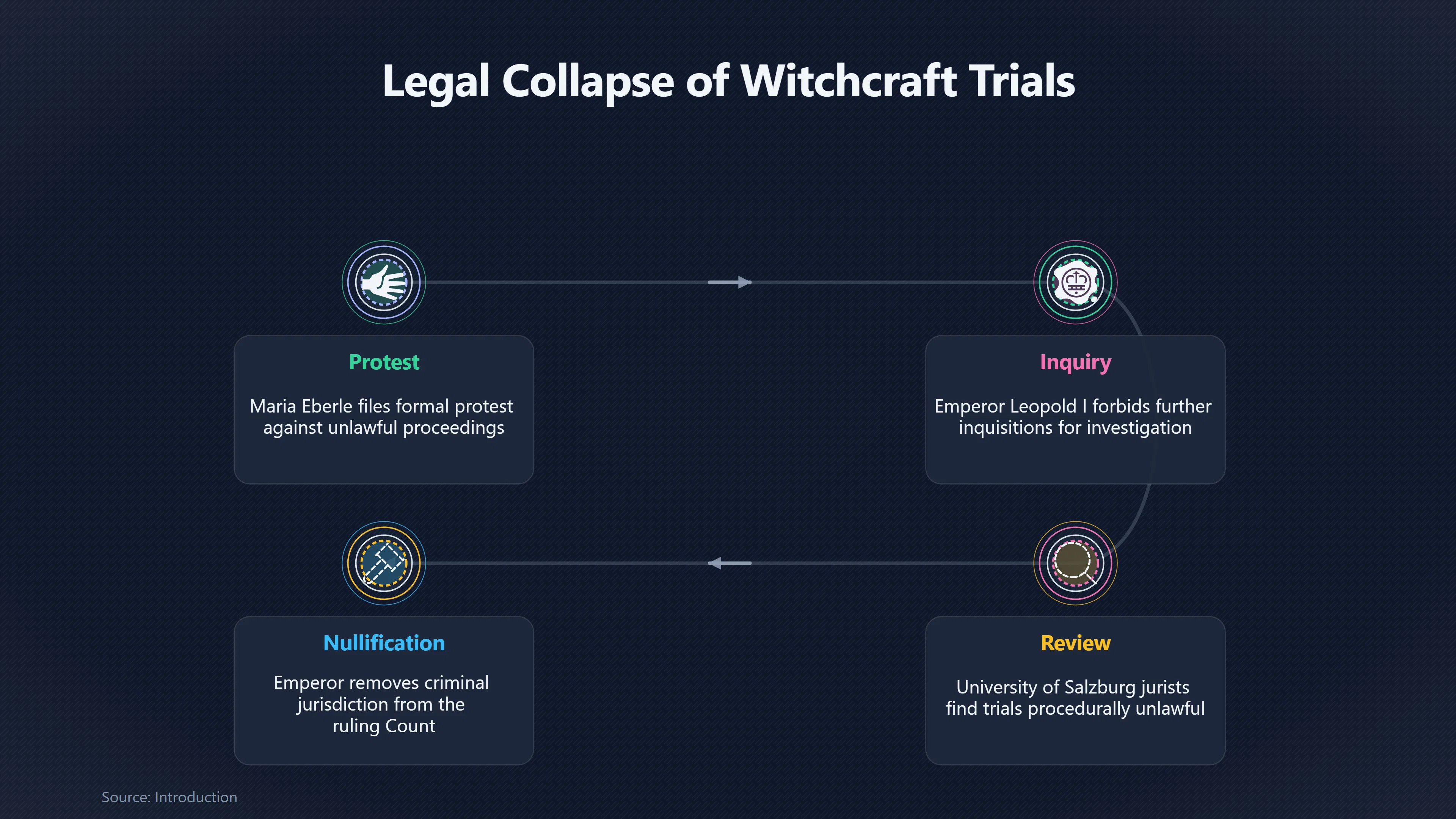
By 1680, resistance to the witch trials had become more organised than in earlier decades. The turning point came after Maria Eberle of Planken escaped from imprisonment in Vaduz Castle following her conviction for witchcraft. Rather than simply fleeing, she arranged for a formal protest through a notary in Feldkirch, arguing that the proceedings against her had been unlawful. Her case became the first documented challenge to the legitimacy of the prosecutions themselves rather than merely a plea for mercy.[news.historisches-lexikon.li]news.historisches-lexikon.limaria eberle und das ende der hexenverfolgungennews für eHFLApril 15, 2024…
Eberle was soon joined by other refugees from the county and by the parish priest Valentin von Kriss. Together they submitted complaints to Emperor Leopold I through imperial officials. Their petitions alleged that torture, procedure and confiscations had violated imperial law and that local authorities had abused their judicial powers.[news.historisches-lexikon.li]news.historisches-lexikon.limaria eberle und das ende der hexenverfolgungennews für eHFLApril 15, 2024…
The emperor responded in 1681 by forbidding the continuation of further inquisitions while an official investigation was undertaken. Rupert von Bodman, Prince-Abbot of Kempten, was appointed to oversee the inquiry into the conduct of the trials. This was significant because it shifted authority away from local officials whose decisions had previously gone largely unchecked.[Liechtenstein Lexicon]historisches-lexikon.liLiechtenstein Lexicon Hexenverfolgung – Historisches LexikonLiechtenstein LexiconHexenverfolgung – Historisches LexikonDecember 31, 2011…
Legal review of the final convictions
The imperial investigation did not attempt to settle whether witchcraft itself existed. Instead, it examined whether the courts had followed the legal standards required within the Holy Roman Empire.
A key stage was the referral of the trial records to the law faculty at the University of Salzburg. In 1682, the jurist Johann Baptist Moser reviewed the proceedings from 1679 and 1680. Applying unusually strict legal standards to each individual prosecution, he concluded that the cases had been conducted unlawfully. The review found that the convictions failed to satisfy proper legal requirements and criticised the handling of confessions and evidence.[Liechtenstein Lexicon]historisches-lexikon.liLiechtenstein Lexicon Hexenverfolgung – Historisches LexikonLiechtenstein LexiconHexenverfolgung – Historisches LexikonDecember 31, 2011…
This mattered because early modern criminal law, including the Carolina of 1532, still imposed procedural safeguards even in severe criminal cases. Although witchcraft prosecutions across Europe often stretched or ignored these protections, imperial authorities increasingly accepted challenges when courts exceeded their lawful powers. The Liechtenstein cases became one of the clearest examples of higher authorities overturning local judicial practice on procedural grounds rather than theological ones.[Liechtenstein Lexicon]historisches-lexikon.liLiechtenstein Lexicon Reichsgerichte – Historisches LexikonLiechtenstein Lexicon Reichsgerichte – Historisches Lexikon
In 1684 the emperor effectively nullified the recent convictions by removing criminal jurisdiction from the ruling count. The formal invalidation of the judgments followed in 1685, accompanied by a prohibition on renewed witch trials. These measures ended the legal machinery that had produced the executions.[Liechtenstein Lexicon]historisches-lexikon.liLiechtenstein Lexicon Hexenverfolgung – Historisches LexikonLiechtenstein LexiconHexenverfolgung – Historisches LexikonDecember 31, 2011…
Loss of jurisdiction and collapse of Hohenems rule
Imperial intervention extended well beyond the witch trials themselves. Investigators concluded that the prosecutions formed part of a broader pattern of arbitrary government under Count Ferdinand Karl von Hohenems, whose administration was already burdened by severe debt and accusations of misrule.[Liechtenstein Lexicon]historisches-lexikon.liLiechtenstein Lexicon Kaiserliche Administration – Historisches LexikonLiechtenstein Lexicon Kaiserliche Administration – Historisches Lexikon
The inquiry also examined the financial side of the prosecutions. Convicted people lost property through confiscation, creating incentives that further undermined confidence in the fairness of the courts. The imperial commission ordered the return of confiscated assets where possible, treating the seizures as part of the wider abuse of authority.[Liechtenstein Lexicon]historisches-lexikon.liLiechtenstein Lexicon Kaiserliche Administration – Historisches LexikonLiechtenstein Lexicon Kaiserliche Administration – Historisches Lexikon
The consequences for the ruling family were severe:
- Emperor Leopold I removed Ferdinand Karl’s criminal jurisdiction over Vaduz and Schellenberg.
- The territories came under imperial administration.
- Ferdinand Karl was arrested and imprisoned, dying in captivity in 1686.
- The weakening of Hohenems authority contributed to the financial and political crisis that eventually led to the sale of Schellenberg (1699) and Vaduz (1712) to the House of Liechtenstein.[Liechtenstein Lexicon]historisches-lexikon.liLiechtenstein Lexicon Kaiserliche Administration – Historisches LexikonLiechtenstein Lexicon Kaiserliche Administration – Historisches Lexikon
The end of the executions therefore became part of a much larger constitutional change. Imperial oversight demonstrated that local rulers could lose judicial authority if they violated the legal obligations of the Empire.
Why belief survived even after the trials ended
Imperial intervention halted executions, but it did not immediately eliminate belief in witchcraft. Contemporary accounts and later historical research indicate that supporters and opponents of the prosecutions remained deeply divided. Folklore and local traditions continued to preserve stories about witches long after the courts had ceased operating.[Liechtenstein Lexicon]historisches-lexikon.liLiechtenstein Lexicon Hexenverfolgung – Historisches LexikonLiechtenstein LexiconHexenverfolgung – Historisches LexikonDecember 31, 2011…
This distinction is important when interpreting the episode. The witch panic ended because legal and political institutions intervened against abusive judicial practice, not because communities suddenly abandoned supernatural explanations for misfortune. Changes in governance proved more decisive than changes in popular belief.
For historians, the final years of the Vaduz and Schellenberg prosecutions illustrate how witch panics could be stopped through external legal review. Appeals to imperial authority, independent examination of court records, and the withdrawal of criminal jurisdiction broke the cycle of accusations and executions that local institutions had been unable—or unwilling—to end.[Liechtenstein Lexicon]historisches-lexikon.liLiechtenstein Lexicon Hexenverfolgung – Historisches LexikonLiechtenstein LexiconHexenverfolgung – Historisches LexikonDecember 31, 2011…
Amazon book picks
Further Reading
Books and field guides related to Why Higher Authority Finally Stopped the Trials. Use these as the next step if you want deeper reading beyond the article.
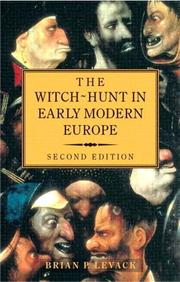
The witch-hunt in early modern Europe
Covers legal reform, appeals and the ending of witch prosecutions.

Endnotes
1.
Source: historisches-lexikon.li
Title: Liechtenstein Lexicon Hexenverfolgung – Historisches Lexikon
Link:https://historisches-lexikon.li/Hexenverfolgung
Source snippet
Liechtenstein LexiconHexenverfolgung – Historisches LexikonDecember 31, 2011...
Published: December 31, 2011
2.
Source: historisches-lexikon.li
Title: Liechtenstein Lexicon Reichsgerichte – Historisches Lexikon
Link:https://historisches-lexikon.li/Reichsgerichte
3.
Source: news.historisches-lexikon.li
Title: maria eberle und das ende der hexenverfolgungen
Link:https://news.historisches-lexikon.li/maria-eberle-und-das-ende-der-hexenverfolgungen
Source snippet
news für eHFLApril 15, 2024...
Published: April 15, 2024
4.
Source: historisches-lexikon.li
Title: Liechtenstein Lexicon Kaiserliche Administration – Historisches Lexikon
Link:https://historisches-lexikon.li/Kaiserliche_Administration
5.
Source: historisches-lexikon.li
Title: Liechtenstein Lexicon Hexenverfolgung
Link:https://historisches-lexikon.li/index.php?action=mpdf&title=Hexenverfolgung
6.
Source: historisches-lexikon.li
Title: Liechtenstein Lexicon Folter – Historisches Lexikon
Link:https://historisches-lexikon.li/Folter
7.
Source: historisches-lexikon.li
Title: Scharfrichter – Historisches Lexikon
Link:https://historisches-lexikon.li/Scharfrichter
8.
Source: historisches-lexikon.li
Title: Schaan – Historisches Lexikon
Link:https://historisches-lexikon.li/Schaan
9.
Source: historisches-lexikon.li
Title: Hohenems, Franz Wilhelm I. von – Historisches Lexikon
Link:https://historisches-lexikon.li/Hohenems%2C_Franz_Wilhelm_I._von
10.
Source: historisches-lexikon.li
Title: Carolina – Historisches Lexikon
Link:https://historisches-lexikon.li/Carolina
11.
Source: historisches-lexikon.li
Title: Eberle (Eberlin), Maria – Historisches Lexikon
Link:https://historisches-lexikon.li/Eberle_%28Eberlin%29%2C_Maria
Additional References
12.
Source: liechtenstein-institut.li
Link:https://liechtenstein-institut.li/publikationen/goop-cornelius-2024-maria-eberle-und-das-ende-der-hexenverfolgungen-gastbeitrag-liezeit-nr-124-13-april-2024
Source snippet
Gastbeitrag. Lie:Zeit Nr. 124, 13. April 2024.:: Liechtenstein-Institut. Forschung und Lehre.April 13, 2024 — GOOP, CORNELIUS (2024): MA...
Published: april 2024
13.
Source: blog.nationalmuseum.ch
Title: The spread of the plague claime
Link:https://blog.nationalmuseum.ch/en/2024/08/how-the-principality-of-liechtenstein-came-into-being/
Source snippet
the Principality of Liechtenstein came into being – Swiss National Museum - Swiss history blogAugust 20, 2024 — PURCHASE OF THE LORDSHIP...
Published: August 20, 2024
14.
Source: academic.oup.com
Link:https://academic.oup.com/book/44700/chapter/378812867
Source snippet
in Defence of Mediate Subjects: The Smallest Territories, c.1500–1780 | Intervention and State Sovereignty in Central Europe, 1500-1780 |...
15.
Source: liechtenstein-institut.li
Link:https://liechtenstein-institut.li/en/research-projects/vom-kaiserlichen-kommissar-zum-hohen-repraesentanten-zwangsadministrationen-im-historischen-vergleich-17-bis-21-jh
16.
Source: liechtenstein-institut.li
Link:https://liechtenstein-institut.li/en/research-projects/die-kaiserliche-administration-der-reichsgrafschaft-vaduz-und-der-reichsherrschaft-schellenberg-1684-16991712
17.
Source: liechtenstein-institut.li
Link:https://liechtenstein-institut.li/forschungsprojekte/die-kaiserliche-administration-der-reichsgrafschaft-vaduz-und-der-reichsherrschaft-schellenberg-1684-16991712
18.
Source: youtube.com
Title: Witch hunt history of Western Switzerland
Link:https://www.youtube.com/watch?v=otKUMO6nSps
Source snippet
The Age of Ash: A Gothic History of Europe's Witch Hunts...
19.
Source: youtube.com
Title: The Witchhunt that Founded Liechtenstein
Link:https://www.youtube.com/watch?v=1wC2iHX2dX4
Source snippet
Ugly History: Witch Hunts - Brian A. Pavlac...
20.
Source: historisches-lexikon-bayerns.de
Title: Historisches Lexikon Bayerns Hexenverfolgung – Historisches Lexikon Bayerns
Link:https://www.historisches-lexikon-bayerns.de/Lexikon/Hexenverfolgung
21.
Source: youtube.com
Title: The Brutal Witch Trials in Germany
Link:https://www.youtube.com/watch?v=RZ7OgjGhUB8
Source snippet
Witch hunt history of Western Switzerland...
Topic Tree