When Fear and Faith Shaped Lithuania
Lithuania’s history contains witchcraft prosecutions, disputed visions, miracle traditions, fears about “sects” and Satanism, and repeated attempts by governments or religious authorities to control collective belief.
Page outline Jump by section
Introduction
Lithuania’s history contains witchcraft prosecutions, disputed visions, miracle traditions, fears about “sects” and Satanism, and repeated attempts by governments or religious authorities to control collective belief. Yet it offers no well-documented equivalent of Europe’s largest witch crazes, a famous dance plague or a nationwide outbreak of mass psychogenic illness. Its most revealing episodes are usually smaller and more politically entangled.
Early modern accusations commonly grew from illness, failed healing, damaged property and quarrels between neighbours. Catholic apparition traditions flourished amid religious competition and later Soviet repression. After independence in 1990, unfamiliar spiritual movements and youth subcultures sometimes became objects of alarm, with “cult” or “Satanist” used more broadly than the evidence justified. Lithuania’s experience therefore shows why collective fear must be separated into different categories: persecution, rumour, devotional enthusiasm, state propaganda, moral panic and genuine misconduct are not the same phenomenon.
Witch trials without a national witch craze
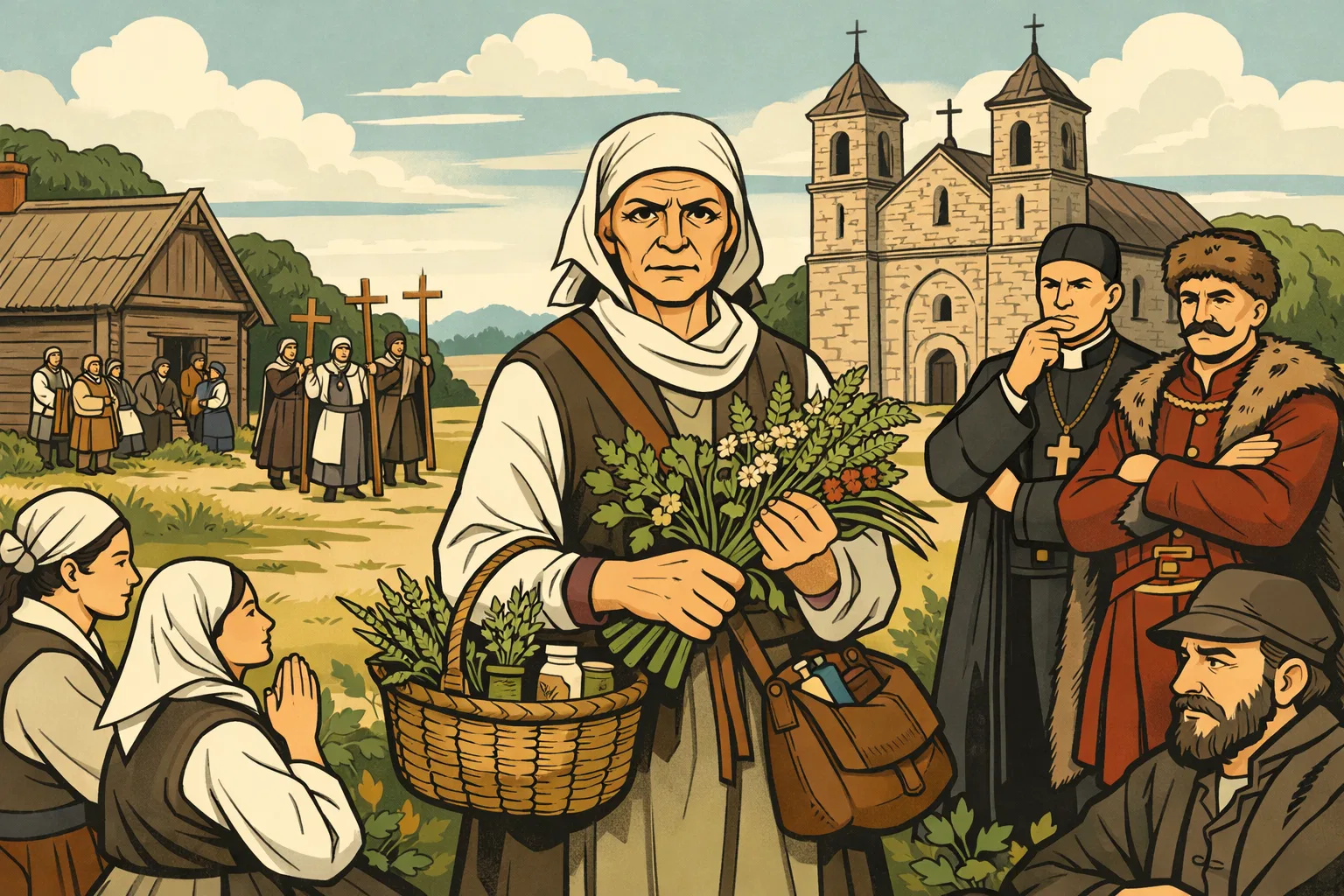
Witchcraft prosecutions appeared in the Grand Duchy of Lithuania from the sixteenth century and were most common in surviving records from the seventeenth and early eighteenth centuries. Several hundred cases are known, although the evidence is incomplete and covers a large, multilingual state extending far beyond the borders of modern Lithuania. Historians must therefore resist treating every trial in the Grand Duchy as an event involving ethnic Lithuanians or present-day Lithuanian territory.[ldkistorija.lt]ldkistorija.ltIn the second half of the 18th century, witch trials in GDL were…Read more…
The accusations were often practical rather than fantastical. Suspected witches were blamed for sickness, death, infertility, unsuccessful childbirth, damaged livestock or crops, and other misfortunes that seemed to demand a human cause. Healers, herbalists and midwives were particularly exposed: success could make their knowledge appear mysterious, while failure could be interpreted as deliberate harm. One recorded case from Kaunas in 1552 concerned a woman accused of using a spell to make a landowner ill.[ResearchGate]researchgate.netWitchcraft Court Cases in the Grand Duchy of Lithuania in…A study of the trial records reveals that approximately 400 indi…
This was not simply the survival of a pagan religion being systematically destroyed by Christianity. Belief in charms, harmful magic and supernatural healing crossed social and religious boundaries. The Grand Duchy contained Catholics, Orthodox Christians, Protestants, Jews, Muslims and others, and members of minority communities could appear as accusers, defendants or suspected practitioners. Their involvement was shaped by occupations, neighbourhood disputes and social position as much as by theology.[nec.ro]nec.roEthnic Minorities and Witchcraft Accusations in the GrandSummary: The paper discusses the features of witch‑hunts in the ethnically and religiously diverse society of the Grand Duchy of Lithuania…
Lithuania’s legal setting also differed from regions where large witch hunts became self-perpetuating. The Lithuanian Statutes did not establish a specific, comprehensive witchcraft offence, leaving courts to draw on customary practice, other legal traditions and local ideas about injury. Trials were generally conducted by secular courts rather than forming a centrally organised ecclesiastical campaign. The surviving record suggests roughly 400 accused people, with perhaps about one fifth receiving death sentences, though totals remain provisional because many documents have been lost.[ldkistorija.lt]ldkistorija.ltIn the second half of the 18th century, witch trials in GDL were…Read more…
Why accusations spread
A witchcraft case could convert ordinary uncertainty into a compelling story. A person became ill; a neighbour had recently made a threat; a healer’s remedy had failed; or cattle died after a quarrel. Once misfortune was linked to a suspect, every earlier disagreement could be reinterpreted as evidence of secret power.
Confessions and testimony then gave rumours legal authority. Some defendants were subjected to coercive interrogation, while ordeals and bodily searches appeared in parts of the record. Each admission could identify further suspects or confirm what a community already feared. Yet historians have not found evidence that Lithuanian judges generally imagined a vast underground organisation of Devil-worshipping witches comparable to the conspiratorial demonology seen in some western European prosecutions.[elaba.lt]gs.elaba.lt3. In Lithuanian witchcraft trials, witches would be accused of causing harm to life, health or…Read more…
Vilnius provides an especially important corrective to the language of “mass hysteria”. Historian David Frick’s study of witchcraft litigation there concluded that accusations were handled alongside other forms of neighbourhood conflict and that there was no sustained citywide witch scare. Complainants often used the courts to restore reputation, stop hostile behaviour or force a settlement rather than to uncover a hidden satanic network.[Cambridge University Press & Assessment]cambridge.orgCambridge University Press & AssessmentThe Witches of Wilno: Constant Litigation and Conflict…by D Frick · 2014 · Cited by 4 — My conc…
Lithuanian witch trials were therefore real and sometimes lethal, but they should not be inflated into an uninterrupted national frenzy. They were clusters of local prosecutions produced by fear, illness, interpersonal hostility and uncertain law.
Miracles, apparitions and competing authority
Lithuania has a deep tradition of pilgrimage to miraculous images, springs, crosses and places associated with visions. Such devotion cannot automatically be classified as panic or delusion. Pilgrimage is normally organised, socially accepted religious behaviour. It enters the history of collective belief when a reported miracle attracts crowds, divides communities or forces church and state authorities to decide whether it is authentic, fraudulent, politically dangerous or psychologically troubling.
The best-known example is the reported apparition at Šiluva. According to Catholic tradition, children tending animals in 1608 saw a weeping woman holding a child at the site of a former Catholic church. The story developed during conflict between Catholics and Protestants and became associated with the recovery of church property and the restoration of Catholic worship. Šiluva subsequently grew into one of Lithuania’s principal pilgrimage centres.[lcss.lt]vb.lcss.ltIn search of miracles: pilgrimage to the miraculous placesIn search of miracles: pilgrimage to the miraculous places
The evidential distinction is crucial. Sources can demonstrate that people reported the apparition, that church institutions accepted and promoted the tradition, and that pilgrims gathered there. They cannot independently establish that a supernatural appearance occurred. Devotional accounts often present the event as a direct intervention that reversed the Protestant Reformation in Lithuania, while historical analysis places it within a longer contest over land, confessional identity and sacred authority.[Wikipedia]WikipediaAnti-cult movementAnti-cult movement
Lithuania contains numerous other sites connected with visions or miraculous images. Research on Lithuanian pilgrimage describes around 20 major Catholic pilgrimage places and stresses that church authorities distinguish recognised traditions from the much larger number of reported visions, prophetic messages and private revelations. Institutional caution matters because an apparition claim can attract donations, travel, expectations of healing and intense emotional investment before its reliability has been assessed.[Academia]academia.eduIn search of miracles: pilgrimage to the miraculous placesIn search of miracles: pilgrimage to the miraculous places
During the Soviet period, reported apparitions acquired an added political meaning. A vision could be treated by believers as reassurance that divine power remained present despite official atheism. Authorities, by contrast, could see spontaneous pilgrimages and religious crowds as challenges to social control. The resulting confrontation was not simply “science versus superstition”: it also concerned who had the right to define reality, organise public gatherings and preserve Lithuanian identity.
When the Soviet state feared religious contagion
Under Soviet rule, the principal organised campaign surrounding supernatural belief came from the state rather than from frightened villagers. Authorities restricted religious education, monitored clergy, closed or repurposed religious buildings and used propaganda to present belief as backward or socially dangerous. Lithuania’s predominantly Catholic culture made the Church a particularly resilient alternative source of loyalty and organisation.[Lituanus]old.lituanus.orgReligious Persecution in LithuaniaReligious Persecution in Lithuania
The Hill of Crosses near Šiauliai became a striking example of belief spreading despite repression. People placed crosses there for the dead, for healing, as petitions and as expressions of national and religious identity. Soviet authorities repeatedly cleared the site, including a major destruction in April 1961, but new crosses returned. Roads were obstructed and visitors monitored, yet attempts to erase the shrine helped transform it into an even more powerful symbol.[nationalgeographic.com]nationalgeographic.comthings to do hill of crosses religious tourismthings to do hill of crosses religious tourism
This episode is sometimes told as a simple miracle narrative in which an indestructible sacred place defeated atheism. The social mechanism is more concrete. Destruction created visible evidence of persecution; replacing a cross became a manageable act of resistance; each new object encouraged others; and the accumulation of crosses demonstrated that private belief was shared by thousands. Suppression increased the symbolic value of the very practice it was intended to extinguish.
The underground Chronicle of the Catholic Church in Lithuania, published from 1972 to 1989, similarly recorded restrictions, interrogations and harassment. Copies circulated secretly and material was transmitted abroad for broadcast back into the Soviet Union. The state treated religious networks as politically threatening because they could gather information, preserve memory and coordinate action outside Communist institutions.[Le Monde.fr]lemonde.frThis worry echoes historical trauma from the Soviet occupation, when Kybartai was a hub of resistance, notably through the underground pu…
Calling this a Soviet “moral panic” requires care. The regime’s suspicion was ideological and strategic, not merely an emotional overreaction. Religious organisations genuinely could sustain dissent. But official claims that public faith represented ignorance, antisocial behaviour or hostile agitation also helped justify disproportionate surveillance and punishment. The panic-like element lay in the tendency to interpret pilgrimages, religious teaching and the distribution of devotional material as symptoms of a wider political infection.
The post-Soviet fear of “sects”
Independence brought religious freedom but also a sudden expansion of Lithuania’s visible religious marketplace. Catholic organisations revived, pre-Soviet traditions re-emerged, foreign missionaries arrived, and New Age, evangelical, Eastern-derived and esoteric movements became more noticeable. To many Lithuanians, this pluralism was unfamiliar after decades of tightly managed public life.
A Lithuanian survey of new religious movements at the turn of the millennium noted that local language commonly divided communities into “traditional” and “non-traditional” religions. The latter category could include groups with very different histories, beliefs and organisational practices. Public discussion often moved too quickly from “non-traditional” to “sect”, and from “sect” to an assumption of manipulation or danger.[cesnur.org]cesnur.orgOpen source on cesnur.org.
Some concerns were reasonable. Any religious or therapeutic organisation can be scrutinised for financial exploitation, coercive control, abuse, deceptive recruitment or interference with medical care. The problem arises when an alarming label substitutes for evidence. “Cult” has no single legal or scholarly definition and is frequently used as a judgement rather than a description. European discussions of minority religions have therefore often preferred the more neutral term “new religious movement”, while assessing harmful conduct separately.[European Parliament]europarl.europa.euEuropean Parliament Cults in EuropeEuropean Parliament Cults in Europe
Lithuanian debates were also influenced by international stories about brainwashing, ritual abuse and destructive sects. Imported media narratives supplied a ready-made script: a secretive organisation recruits vulnerable young people, isolates them from families and turns them against society. Such things can occur in controlling groups, but applying the script indiscriminately can stigmatise peaceful minorities and make ordinary religious conversion appear pathological.
The continuing tension between majority assumptions and religious pluralism can be seen in the treatment of Romuva, an association seeking to revive the pre-Christian Baltic religious tradition. In 2019 the Lithuanian Parliament refused it state-recognised status even though the Ministry of Justice had found that it met the legal requirements. In 2021 the European Court of Human Rights ruled that Lithuania had discriminated against the association and that parliamentarians had not remained neutral and impartial.[HUDOC]hudoc.echr.coe.intOpen source on coe.int.
The Romuva case was not a mass panic, but it reveals how the boundary between religion, folklore and supposed pseudo-religion can become politically charged. The Court emphasised that disagreement among historians or theologians about a movement’s ancient foundations is not sufficient reason for the state to deny its religious character.[ECHR-KS]ks.echr.coe.intOpen source on coe.int.
Satanism as belief, subculture and scare
Concern about Satanism became particularly visible in post-Soviet Lithuania, a strongly Catholic society encountering global youth culture, heavy metal imagery, occult publishing and new forms of religious choice. Lithuanian sociologist Milda Ališauskienė distinguished organised adult Satanism, where identifiable groups might possess doctrines and rituals, from loosely connected youth Satanism expressed through music, symbols, provocation or experimentation.[cesnur.org]cesnur.orgOpen source on cesnur.org.
That distinction matters because public scares often merge several different things:
- an organised religious or philosophical identity;
- adolescent rebellion using inverted crosses or demonic images;
- vandalism or cruelty committed without a coherent belief system;
- rumours about secret ritual groups;
- ordinary crime described as “Satanic” because of its appearance.
A cemetery desecration, animal killing or threatening piece of graffiti may be a genuine offence. It does not by itself prove the existence of a coordinated Satanist organisation. Conversely, the absence of a conspiracy does not mean that individual offenders or controlling groups should be ignored.
Lithuanian concern developed in the shadow of the wider international Satanic panic of the 1980s and 1990s, when claims of vast networks conducting ritual abuse circulated widely despite repeated failures to substantiate an organised conspiracy. In Lithuania, imported stories interacted with Catholic fears about secularisation and with anxiety over young people adopting western subcultures during a period of rapid social change.[cesnur.org]cesnur.orgOpen source on cesnur.org.
The useful question is therefore not “Were Satanists real?” People identifying with forms of Satanism certainly existed. The better questions are how many organised groups existed, what they actually practised, whether specific crimes were supported by evidence, and how much of the public image came from journalists, clergy, police speculation or rumour. Lithuanian research suggests that highly visible youth symbolism could be mistaken for the footprint of a larger, disciplined movement.[cesnur.org]cesnur.orgOpen source on cesnur.org.

What Lithuania’s record does not support
Several dramatic claims require restraint.
There is no strong evidence of a single, nationwide Lithuanian witch craze comparable to the most intensive persecutions in parts of Germany. Trials occurred over a long period, but their scale and purpose varied sharply by locality. In Vilnius, surviving litigation points towards neighbourhood conflict rather than a runaway conspiracy scare.[Cambridge University Press & Assessment]cambridge.orgCambridge University Press & AssessmentThe Witches of Wilno: Constant Litigation and Conflict…by D Frick · 2014 · Cited by 4 — My conc…
Nor is there a securely documented Lithuanian school epidemic or factory outbreak that has become a standard medical case of mass psychogenic illness. That term describes real physical symptoms spreading through a group without an identified toxic or infectious cause, often under conditions of stress. It should not be applied retrospectively to religious crowds, visions or political demonstrations merely because many people shared an emotion or belief.[nih.gov]pmc.ncbi.nlm.nih.govOpen source on nih.gov.
Apparition traditions should likewise be described according to the evidence available. A historian can establish reports, pilgrimages, institutional approval, suppression and cultural influence. Whether a vision had a supernatural source belongs to religious interpretation, while psychological explanations require information about the witnesses that surviving records often cannot provide.
Finally, allegations about minority religions must be tested against conduct rather than reputation. A small, unfamiliar or unpopular group is not inherently coercive. At the same time, calling criticism a “moral panic” should not become a way to dismiss credible reports of exploitation or abuse. The distinction depends on corroborated actions, proportionality and fair investigation.
Why these episodes still matter
Lithuania’s collective-belief history is shaped by its position between religious traditions, empires and political systems. In the Grand Duchy, cultural diversity and uncertain law influenced the form of witchcraft accusations. During confessional competition, miracle traditions helped establish sacred territory and Catholic identity. Under Soviet rule, practices condemned as irrational became vehicles of memory and peaceful resistance. After independence, the arrival or renewed visibility of minority movements produced arguments over where freedom ended and social danger began.
The same pattern repeatedly appears: uncertainty creates a struggle over interpretation. Illness becomes witchcraft; a vision becomes either revelation or fraud; a pilgrimage becomes either devotion or political defiance; a youth subculture becomes evidence of an imagined underground organisation. Courts, clergy, journalists and governments then decide which explanation will receive public authority.
Lithuania’s most important lesson is that contagious belief does not always look like a screaming crowd. It may unfold through repeated accusations, copied stories, accumulating crosses, devotional journeys, hostile labels or parliamentary debate. Its consequences depend less on how strange a belief appears than on what institutions do with it: tolerate it, investigate it carefully, exploit it, suppress it or turn it against a vulnerable minority.
Amazon book picks
Further Reading
Books and field guides related to When Fear and Faith Shaped Lithuania. Use these as the next step if you want deeper reading beyond the article.
The witch-hunt in early modern Europe
Places Lithuanian prosecutions in a European context.


Endnotes
1.
Source: link.springer.com
Link:https://link.springer.com/book/10.1007/978-3-032-00671-4
Source snippet
Witch Trials in the Grand Duchy of Lithuania in the Sixteenth to...This book explores witchcraft accusations as reflections of t...
2.
Source: gs.elaba.lt
Link:https://gs.elaba.lt/object/elaba%3A146592701/146592701.pdf
Source snippet
3. In Lithuanian witchcraft trials, witches would be accused of causing harm to life, health or...Read more...
3.
Source: researchgate.net
Link:https://www.researchgate.net/publication/339503878_Witchcraft_Court_Cases_in_the_Grand_Duchy_of_Lithuania_in_the_Sixteenth_to_Eighteenth_Centuries
Source snippet
Witchcraft Court Cases in the Grand Duchy of Lithuania in...A study of the trial records reveals that approximately 400 indi...
4.
Source: nec.ro
Title: Ethnic Minorities and Witchcraft Accusations in the Grand
Link:https://nec.ro/publication_library/the-other-witch-ethnic-minorities-and-witchcraft-accusations-in-the-grand-duchy-f-lithuania/
Source snippet
Summary: The paper discusses the features of witch‑hunts in the ethnically and religiously diverse society of the Grand Duchy of Lithuania...
5.
Source: cambridge.org
Link:https://www.cambridge.org/core/journals/slavic-review/article/witches-of-wilno-constant-litigation-and-conflict-resolution/7F56CE53D8984FE5DBD7CCA0593D4540
Source snippet
Cambridge University Press & AssessmentThe Witches of Wilno: Constant Litigation and Conflict...by D Frick · 2014 · Cited by 4 — My conc...
6.
Source: vb.lcss.lt
Title: In search of miracles: pilgrimage to the miraculous places
Link:https://vb.lcss.lt/object/elaba%3A22958711/22958711.pdf
7.
Source: Wikipedia
Link:https://en.wikipedia.org/wiki/Our_Lady_of_%C5%A0iluva
8.
Source: Wikipedia
Title: Anti-cult movement
Link:https://en.wikipedia.org/wiki/Anti-cult_movement
9.
Source: academia.edu
Title: In search of miracles: pilgrimage to the miraculous places
Link:https://www.academia.edu/35214307/In_search_of_miracles_pilgrimage_to_the_miraculous_places
10.
Source: old.lituanus.org
Title: Religious Persecution in Lithuania
Link:https://old.lituanus.org/1972/72_2_07.htm
11.
Source: Wikipedia
Title: Hill of Crosses
Link:https://en.wikipedia.org/wiki/Hill_of_Crosses
12.
Source: cesnur.org
Link:https://www.cesnur.org/conferences/riga2000/glodenis.htm
13.
Source: hudoc.echr.coe.int
Title: HUDOCAncient Baltic religious association “Romuva” v. Lithuania
Link:https://hudoc.echr.coe.int/fre?i=002-13292
14.
Source: ks.echr.coe.int
Link:https://ks.echr.coe.int/documents/d/echr-ks/guide_art_9_eng
15.
Source: cesnur.org
Link:https://www.cesnur.org/2003/vil2003_alisauskiene.htm
16.
Source: Wikipedia
Title: Satanic panic
Link:https://en.wikipedia.org/wiki/Satanic_panic
17.
Source: pmc.ncbi.nlm.nih.gov
Link:https://pmc.ncbi.nlm.nih.gov/articles/PMC7396040/
18.
Source: Wikipedia
Title: Witch hunt
Link:https://en.wikipedia.org/wiki/Witch_hunt
19.
Source: Wikipedia
Title: List of mass panic cases
Link:https://en.wikipedia.org/wiki/List_of_mass_panic_cases
20.
Source: Wikipedia
Title: New religious movement
Link:https://en.wikipedia.org/wiki/New_religious_movement
21.
Source: Wikipedia
Title: Grand Duchy of Lithuania
Link:https://en.wikipedia.org/wiki/Grand_Duchy_of_Lithuania
22.
Source: Wikipedia
Title: Marian apparition
Link:https://en.wikipedia.org/wiki/Marian_apparition
23.
Source: Wikipedia
Title: Witch trials in Poland
Link:https://en.wikipedia.org/wiki/Witch_trials_in_Poland
24.
Source: Wikipedia
Title: Doruchów witch trial
Link:https://en.wikipedia.org/wiki/Doruch%C3%B3w_witch_trial
25.
Source: Wikipedia
Link:https://en.wikipedia.org/wiki/Satanism
26.
Source: assets.cambridge.org
Title: 9781009586573 frontmatter
Link:https://assets.cambridge.org/97810095/86573/frontmatter/9781009586573_frontmatter.pdf
27.
Source: cambridge.org
Title: frightfully good reads from cambridge
Link:https://www.cambridge.org/gb/universitypress/about-us/news-and-blogs/frightfully-good-reads-from-cambridge
28.
Source: cambridge.org
Link:https://www.cambridge.org/core/services/aop-cambridge-core/content/view/846FECAD84B6C6ED44F978E48D51A6C8/9781009586573bib1_383-411.pdf/bibliography.pdf
29.
Source: resolve.cambridge.org
Link:https://resolve.cambridge.org/core/services/aop-cambridge-core/content/view/07A1B618C87F7C368F74EC3DFB5509CF/9781909821705c3_p26-38_CBO.pdf/images-of-the-jew-in-the-polish-commonwealth.pdf
30.
Source: cambridge.org
Link:https://www.cambridge.org/core/journals/studies-in-church-history/article/healthcare-and-catholic-enlightenment-in-the-polishlithuanian-commonwealth/340F08B6AFFD6E467FFF50E48B54B92A
31.
Source: cambridge.org
Title: Slavic Review: Volume 73
Link:https://www.cambridge.org/core/journals/slavic-review/issue/B16F17B82FE194C445470521B25398ED
32.
Source: assets.cambridge.org
Title: 9781009468596 index
Link:https://assets.cambridge.org/97810094/68596/index/9781009468596_index.pdf
33.
Source: cambridge.org
Title: Punishment (Part II)
Link:https://www.cambridge.org/core/books/crime-and-punishment-in-early-modern-russia/punishment/3605FE5D21E592117E5EECCA0C8E84B0
34.
Source: researchgate.net
Link:https://www.researchgate.net/publication/290199763_New_Religious_Movements_Countermovements_Moral_Panics_and_the_Media
35.
Source: researchgate.net
Link:https://www.researchgate.net/publication/398888416_The_Flight_to_Satrija_Hill_Lithuanian_Folk_Legends_of_the_Witches%27_Sabbath
36.
Source: researchgate.net
Link:https://www.researchgate.net/publication/399335600_Witchcraft_in_the_Courtroom_The_Toolkit_of_Lithuanian_Witch_Prosecution
37.
Source: academia.edu
Link:https://www.academia.edu/49798753/The_Other_Witch_Ethnic_minorities_and_witchcraft_accusations_in_the_Grand_Duchy_of_Lithuania
38.
Source: academia.edu
Link:https://www.academia.edu/30559904/New_Religious_Movements_Countermovements_Moral_Panics_and_the_Media
39.
Source: state.gov
Link:https://www.state.gov/report/custom/2fd3c32a6e
40.
Source: ldkistorija.lt
Link:https://www.ldkistorija.lt/sorcery-and-witchcraft-in-the-grand-duchy-of-lithuania/
Source snippet
In the second half of the 18th century, witch trials in GDL were...Read more...
41.
Source: epub.ub.uni-greifswald.de
Title: Dissertation Byl
Link:https://epub.ub.uni-greifswald.de/files/10399/Dissertation_Byl.pdf
Source snippet
Cambridge... Lithuanian witch-hunt history. At the territory of the Grand Duchy of...Read more...
42.
Source: lemonde.fr
Link:https://www.lemonde.fr/en/international/article/2025/05/18/in-lithuania-the-fear-of-war-with-russia-lurks-just-around-the-corner_6741400_4.html
Source snippet
This worry echoes historical trauma from the Soviet occupation, when Kybartai was a hub of resistance, notably through the underground pu...
43.
Source: nationalgeographic.com
Title: things to do hill of crosses religious tourism
Link:https://www.nationalgeographic.com/travel/article/things-to-do-hill-of-crosses-religious-tourism
44.
Source: europarl.europa.eu
Title: European Parliament Cults in Europe
Link:https://www.europarl.europa.eu/workingpapers/cito/w10/page1_en.htm
45.
Source: ouci.dntb.gov.ua
Title: l RPB81K7
Link:https://ouci.dntb.gov.ua/en/works/lRPB81K7/
46.
Source: hudoc.echr.coe.int
Link:https://hudoc.echr.coe.int/eng?i=001-210282
47.
Source: hudoc.echr.coe.int
Title: HUDOCancient baltic religious association “romuva”
Link:https://hudoc.echr.coe.int/eng?i=001-243342
48.
Source: sajp.org.za
Link:https://sajp.org.za/index.php/sajp/article/view/1671/2648
49.
Source: hudoc.echr.coe.int
Title: int Ancient Baltic religious association “Romuva” v
Link:https://hudoc.echr.coe.int/?i=001-237450
50.
Source: ks.echr.coe.int
Title: int Article 9
Link:https://ks.echr.coe.int/web/echr-ks/article-9-all-updates
51.
Source: hudoc.echr.coe.int
Title: int TELIATNIKO V v. LITHUANIA
Link:https://hudoc.echr.coe.int/eng?i=001-217607
52.
Source: hudoc.echr.coe.int
Title: intŠALTINYTĖ v. LITHUANIA
Link:https://hudoc.echr.coe.int/eng?i=001-212692
53.
Source: echr.coe.int
Title: int Lithuanian Parliament
Link:https://www.echr.coe.int/documents/d/echr/Speech_20220428_Spano_Lithuanian_Parliament_ENG
54.
Source: ks.echr.coe.int
Title: clin index 2021 eng
Link:https://ks.echr.coe.int/documents/d/echr-ks/clin_index_2021_eng
55.
Source: publicwitness.wordandway.org
Title: hill of crosses
Link:https://publicwitness.wordandway.org/p/hill-of-crosses
56.
Source: russiasperiphery.pages.wm.edu
Title: the hill of crosses
Link:https://russiasperiphery.pages.wm.edu/baltic-states/lithuania/general/the-hill-of-crosses/
57.
Source: ebsco.com
Link:https://www.ebsco.com/research-starters/social-sciences-and-humanities/mass-hysteria
Additional References
58.
Source: uscirf.gov
Title: us policy promote international religious freedom france and us commission 0
Link:https://www.uscirf.gov/resources/us-policy-promote-international-religious-freedom-france-and-us-commission-0
59.
Source: govilnius.lt
Link:https://www.govilnius.lt/api/files/6633412b6a5c660563fc73bd/EN%20Pilgrimage%20in%20Vilnius.pdf
60.
Source: govilnius.lt
Link:https://www.govilnius.lt/api/files/64fb1090de9ca7b209bf323b/unesco_EN.pdf
61.
Source: facebook.com
Link:https://www.facebook.com/groups/170790266633157/posts/2327708197608009/
62.
Source: facebook.com
Link:https://www.facebook.com/drewbinsky/posts/exploring-americas-bizarre-religion-cult-satanism/1515077583307789/
63.
Source: pilgrimmap.com
Link:https://www.pilgrimmap.com/site/keturnaujiena-divine-mercy-chapel-suodziai-383975f6
64.
Source: facebook.com
Link:https://www.facebook.com/JWEnglishJW/posts/lithuania-prejudice-against-jehovahs-witnesses-the-lithuanian-context-part-11510/1353545552804266/
65.
Source: rascee.net
Link:https://rascee.net/index.php/rascee/article/download/45/40/77
66.
Source: fieldepidemiology.org
Link:https://fieldepidemiology.org/index.php/ajfe/article/download/7807/6435/21437
67.
Source: apothecaries.org
Link:https://www.apothecaries.org/wp-content/uploads/2019/06/Mass-psychogenic-illness-and-how-to-respond.pdf
Topic Tree
Follow this branch
Related pages 192
- Antigua and Barbuda
- Argentina Belief Scares
- Azerbaijan Belief
- Bahrain Beliefs
- North Korea
- +187 more in sidebar