Within Vanuatu Beliefs
Why the Cargo Cult Story Misleads
The cargo cult label often turns political and religious movements into stereotypes while hiding land loss, labour inequality and resistance.
On this page
- Where the Label Came From
- What Followers Actually Wanted
- Colonial Control and Later Mythmaking
Page outline Jump by section
Introduction
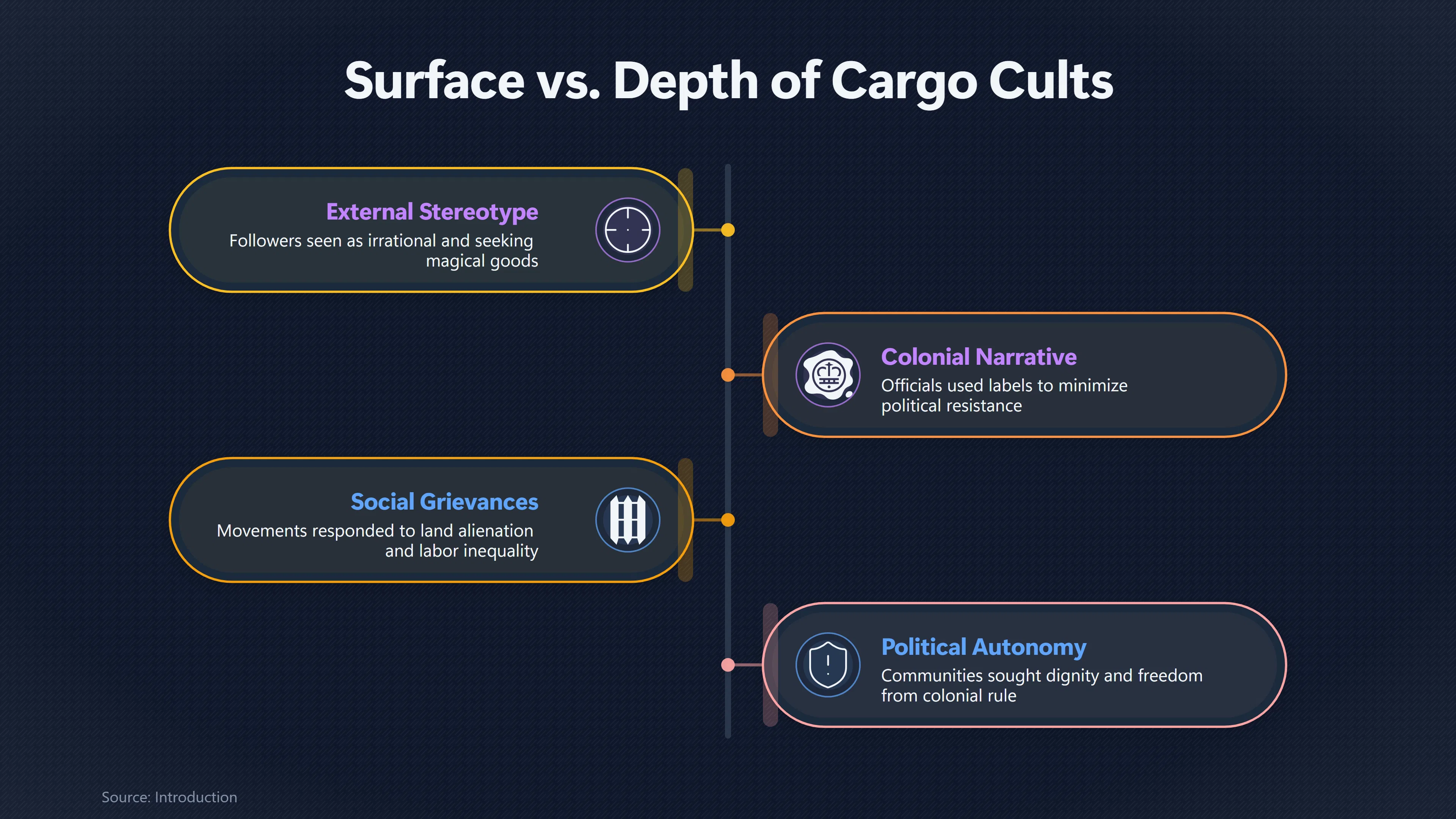
The phrase “cargo cult” is often treated as a simple description of unusual religious movements in Vanuatu. Many readers imagine islanders who believed that copying foreign behaviour would magically bring manufactured goods. Modern scholarship paints a much more complicated picture. Anthropologists now argue that the label itself often distorts what happened by reducing diverse religious, political and anti-colonial movements to a single exotic stereotype. In Vanuatu, movements commonly grouped as “cargo cults” were frequently concerned with land rights, cultural survival, political autonomy, moral renewal and unequal colonial power rather than a naïve desire for material goods alone. The result is that the label can obscure the very historical forces that made these movements meaningful.[Open Encyclopedia of Anthropology]anthroencyclopedia.comOpen Encyclopedia of AnthropologyCargo cults | Open Encyclopedia of AnthropologyMarch 29, 2018…
Where the Label Came From
The expression “cargo cult” entered colonial discussion during the final years of the Second World War before becoming a popular anthropological category. Colonial officials, missionaries and journalists used it to group together a wide range of Melanesian religious and social movements that appeared to predict dramatic change or the arrival of wealth. Although anthropologists later adopted the term, many have since questioned whether it ever described a coherent type of movement.[OpenEdition Books]books.openedition.orgOpen source on openedition.org.
The problem begins with the words themselves.
“Cargo” suggested that followers cared mainly about imported goods. Yet in many movements, imported wealth symbolised something much broader: justice, restored social balance, freedom from colonial domination or the end of racial inequality. Likewise, calling these movements “cults” implied irrational or fringe beliefs, even though many involved established community leaders, long-term religious traditions or organised political programmes.[Open Encyclopedia of Anthropology]anthroencyclopedia.comOpen Encyclopedia of AnthropologyCargo cults | Open Encyclopedia of AnthropologyMarch 29, 2018…
Anthropologist Lamont Lindstrom argues that “cargo cult” became less an accurate description than an outsider’s narrative. By the late twentieth century many anthropologists regarded the category as misleading because it bundled together movements with very different histories, aims and beliefs.[Open Encyclopedia of Anthropology]anthroencyclopedia.comOpen Encyclopedia of AnthropologyCargo cults | Open Encyclopedia of AnthropologyMarch 29, 2018…
What Followers Actually Wanted
Looking closely at movements in Vanuatu changes the picture considerably.
John Frum followers on Tanna were not simply waiting for miraculous deliveries of Western goods. Their movement also challenged missionary authority, defended customary practices, rejected aspects of colonial control and imagined a future in which local people regained dignity and independence. Expectations of prosperity existed alongside demands for social and political transformation rather than replacing them.[Open Encyclopedia of Anthropology]anthroencyclopedia.comOpen Encyclopedia of AnthropologyCargo cults | Open Encyclopedia of AnthropologyMarch 29, 2018…
More broadly, many Melanesian movements reflected experiences that were entirely understandable from the perspective of those living through colonial rule:
- Europeans controlled trade, government and most economic opportunities.
- Indigenous people supplied labour but saw little of the wealth generated.
- Missionaries often discouraged traditional ceremonies and religious practices.
- Land alienation threatened local authority and customary life.
- Wartime military activity demonstrated enormous foreign wealth arriving almost overnight.
Against this background, hopes for a transformed society were not simply fantasies about consumer goods. They were responses to visible inequalities and rapid historical change.[Open Encyclopedia of Anthropology]anthroencyclopedia.comOpen Encyclopedia of AnthropologyCargo cults | Open Encyclopedia of AnthropologyMarch 29, 2018…
Even references to “cargo” could express a moral argument: if outsiders possessed extraordinary abundance while relying heavily on Indigenous labour, why should local communities remain excluded from that prosperity? The symbolism of wealth therefore carried political as well as religious meaning.[Open Encyclopedia of Anthropology]anthroencyclopedia.comOpen Encyclopedia of AnthropologyCargo cults | Open Encyclopedia of AnthropologyMarch 29, 2018…

Colonial Control and Later Mythmaking
The popularity of the cargo cult story owes much to colonial storytelling.[encyclopedia.com]encyclopedia.comCargo Cult | Encyclopedia.comMay 14, 2018 — CARGO CULTS views 2,585,957 updated May 14 2018 CARGO CULTS Various forms of modern mythologies among the native peoples o…
Officials often found it easier to classify resistant communities as irrational religious enthusiasts than to acknowledge legitimate political grievances. Describing a movement as a “cargo cult” could make opposition appear harmless, childish or misguided rather than recognising demands over land, labour conditions or self-government.[OpenEdition Books]books.openedition.orgOpen source on openedition.org.
Later popular culture reinforced these images. Newspapers, documentaries and travel writing frequently highlighted colourful rituals while paying far less attention to colonial administration, economic inequality or local political debates. The resulting stereotype portrayed Melanesians as people who misunderstood modern technology rather than as people responding creatively to profound social disruption.[Open Encyclopedia of Anthropology]anthroencyclopedia.comOpen Encyclopedia of AnthropologyCargo cults | Open Encyclopedia of AnthropologyMarch 29, 2018…
This simplified version proved remarkably durable because it fit wider Western assumptions about “primitive” societies encountering modernity. It also produced memorable stories that travelled far beyond academic discussions, even as specialists increasingly abandoned the term or used it only with caution.[Open Encyclopedia of Anthropology]anthroencyclopedia.comOpen Encyclopedia of AnthropologyCargo cults | Open Encyclopedia of AnthropologyMarch 29, 2018…
Why Scholars Now Use More Careful Language
Many contemporary researchers prefer expressions such as millenarian movements, Indigenous religious movements, social movements, or simply use local names such as the John Frum movement instead of treating everything as a cargo cult. These alternatives recognise that different communities pursued different goals and that no single explanation fits every case.[Open Encyclopedia of Anthropology]anthroencyclopedia.comOpen Encyclopedia of AnthropologyCargo cults | Open Encyclopedia of AnthropologyMarch 29, 2018…
This shift is not merely about politeness. It reflects a broader change in historical interpretation. Earlier scholarship often asked why Indigenous people supposedly believed strange things. More recent work asks different questions:
- What colonial pressures shaped these movements?
- How did they defend land, identity and customary authority?
- What political messages did religious language express?
- Why did different communities respond differently to similar colonial experiences?
These questions produce a richer understanding of Vanuatu’s history than simply asking whether people expected miraculous deliveries of goods.[Open Encyclopedia of Anthropology]anthroencyclopedia.comOpen Encyclopedia of AnthropologyCargo cults | Open Encyclopedia of AnthropologyMarch 29, 2018…

Why the Cargo Cult Story Still Matters
The cargo cult stereotype continues to influence public understanding well beyond Melanesia. The phrase is now widely used as a metaphor for copying appearances without understanding underlying systems, particularly in computing, management and politics. While the metaphor has become common, it often carries forward simplified assumptions about the original movements and the people associated with them.[Open Encyclopedia of Anthropology]anthroencyclopedia.comOpen Encyclopedia of AnthropologyCargo cults | Open Encyclopedia of AnthropologyMarch 29, 2018…
For Vanuatu, the distortion has practical consequences. Focusing exclusively on supposedly irrational expectations of cargo can hide the realities of colonial government, unequal access to wealth, struggles over land, religious creativity and campaigns for greater autonomy. Seen in that light, the movements were not simply stories about belief. They were also attempts to make sense of dramatic historical change and to imagine a fairer future under conditions of profound inequality.[Open Encyclopedia of Anthropology]anthroencyclopedia.comOpen Encyclopedia of AnthropologyCargo cults | Open Encyclopedia of AnthropologyMarch 29, 2018…
Amazon book picks
Further Reading
Books and field guides related to Why the Cargo Cult Story Misleads. Use these as the next step if you want deeper reading beyond the article.

Guns, Germs, and Steel
Explores long-term causes of cultural inequality and colonial encounters.

Endnotes
1.
Source: books.openedition.org
Link:https://books.openedition.org/pacific/166?format=embed
2.
Source: books.openedition.org
Link:https://books.openedition.org/pacific/168?format=embed
3.
Source: books.openedition.org
Link:https://books.openedition.org/pacific/1935
Source snippet
OpenEdition BooksKago, Kastom and Kalja: The Study of Indigenous Movements in Melanesia Today - Chapter 1. What’s the Matter with Cargo C...
4.
Source: books.openedition.org
Link:https://books.openedition.org/pacific/164?format=embed
5.
Source: encyclopedia.com
Title: Cargo Cult | Encyclopedia.com
Link:https://www.encyclopedia.com/social-sciences-and-law/anthropology-and-archaeology/anthropology-terms-and-concepts/cargo-cult
Source snippet
May 14, 2018 — CARGO CULTS views 2,585,957 updated May 14 2018 CARGO CULTS Various forms of modern mythologies among the native peoples o...
Published: May 14, 2018
6.
Source: books.openedition.org
Link:https://books.openedition.org/pacific/1941
7.
Source: anthroencyclopedia.com
Link:https://www.anthroencyclopedia.com/entry/cargo-cults
Source snippet
Open Encyclopedia of AnthropologyCargo cults | Open Encyclopedia of AnthropologyMarch 29, 2018...
Published: March 29, 2018
8.
Source: manifold.uhpress.hawaii.edu
Title: cargo cult
Link:https://manifold.uhpress.hawaii.edu/projects/cargo-cult
9.
Source: newworldencyclopedia.org
Title: Cargo cult
Link:https://www.newworldencyclopedia.org/entry/Cargo_cult
Additional References
10.
Source: kailonmag.com
Link:https://www.kailonmag.com/p/cargo-colonies-and-cults-the-bizarre
Source snippet
December 29, 2024 — News & Culture CARGO, COLONIES, AND CULTS: THE BIZARRE WORSHIP OF WESTERN GOODS AND A BRITISH PRINCE HOW INDIGENOUS C...
Published: December 29, 2024
11.
Source: onlinelibrary.wiley.com
Title: Online Library Cargo Cult Horror
Link:https://onlinelibrary.wiley.com/doi/abs/10.1002/j.1834-4461.2000.tb03068.x
Source snippet
Wiley Online LibraryCargo Cult Horror - Lindstrom - 2000 - Oceania - Wiley Online Library...
12.
Source: onlinelibrary.wiley.com
Link:https://onlinelibrary.wiley.com/doi/10.1002/ocea.5329
Source snippet
93-106 ORIGINAL ARTICLE NOTES ON SOVEREIGNTY IN VANUATU Lamont Lindstrom, Lamont Lindstrom University of Tulsa Search for more papers by...
13.
Source: youtube.com
Title: Cargo Cults w/ Lamont Lindstrom
Link:https://www.youtube.com/watch?v=kcRK4RTUht4
Source snippet
Oceania Cargo Cult Post Mortem 10 25 2019...
14.
Source: degruyterbrill.com
Link:https://www.degruyterbrill.com/document/doi/10.1515/9780824840440/html
15.
Source: youtube.com
Title: The Man Who Convinced a Tribe to WORSHIP America
Link:https://www.youtube.com/watch?v=wnxguoXUKUs
Source snippet
Garry Trompf: Violence and Millenarian Cargo Cults...
16.
Source: youtube.com
Title: Cargo Cults: When WWII Supplies Became a Religion
Link:https://www.youtube.com/watch?v=2cPKc-lH4No
Source snippet
The Man Who Convinced a Tribe to WORSHIP America...
17.
Source: youtube.com
Link:https://www.youtube.com/watch?v=JuWVtKhnEQ8
Source snippet
Cargo Cults: When WWII Supplies Became a Religion...
18.
Source: degruyterbrill.com
Title: Chapter Six. Knowledge of Cargo, Knowledge of Cult: Truth
Link:https://www.degruyterbrill.com/document/doi/10.1515/9783110874419.239/html
19.
Source: degruyterbrill.com
Title: De Gruyter Brill Cargo, Cult, and Culture Critique
Link:https://www.degruyterbrill.com/document/doi/10.1515/9780824840440/html?lang=en
Topic Tree