Within Saint Kitts and Nevis
Why Did Obeah Frighten Colonial Authorities?
Obeah became feared not because it was one fixed religion, but because healers and diviners held influence beyond colonial control.
On this page
- What obeah meant in everyday life
- How spiritual authority became political
- Belief, fraud and hostile colonial labels
Page outline Jump by section
Introduction
In Saint Kitts and Nevis, the history of obeah is less about a single dramatic panic than about a long-running fear of hidden authority. Obeah was not one organised religion with a fixed doctrine. Instead, it described a wide range of African-derived practices involving healing, herbal knowledge, protection, divination and, in some cases, feared harmful magic. The same practitioner might be viewed by one neighbour as a respected healer and by another as someone capable of dangerous supernatural acts. Colonial governments found this ambiguity deeply unsettling because it created influence outside the plantation, the church and the courts.[Edinburgh Research]research.ed.ac.ukinburgh ResearchObeah and Other Powers: The Politics of Caribbean Religion and Healing - University of Edinburgh Research ExplorerJune…

For Saint Kitts and Nevis, the importance of obeah lies not in spectacular witch trials but in the way colonial officials transformed fears about invisible spiritual power into criminal law and social control. Understanding that process helps explain why obeah became associated with danger in official records, even though many ordinary people sought practitioners for practical help in everyday life.
Why did obeah matter in everyday life?
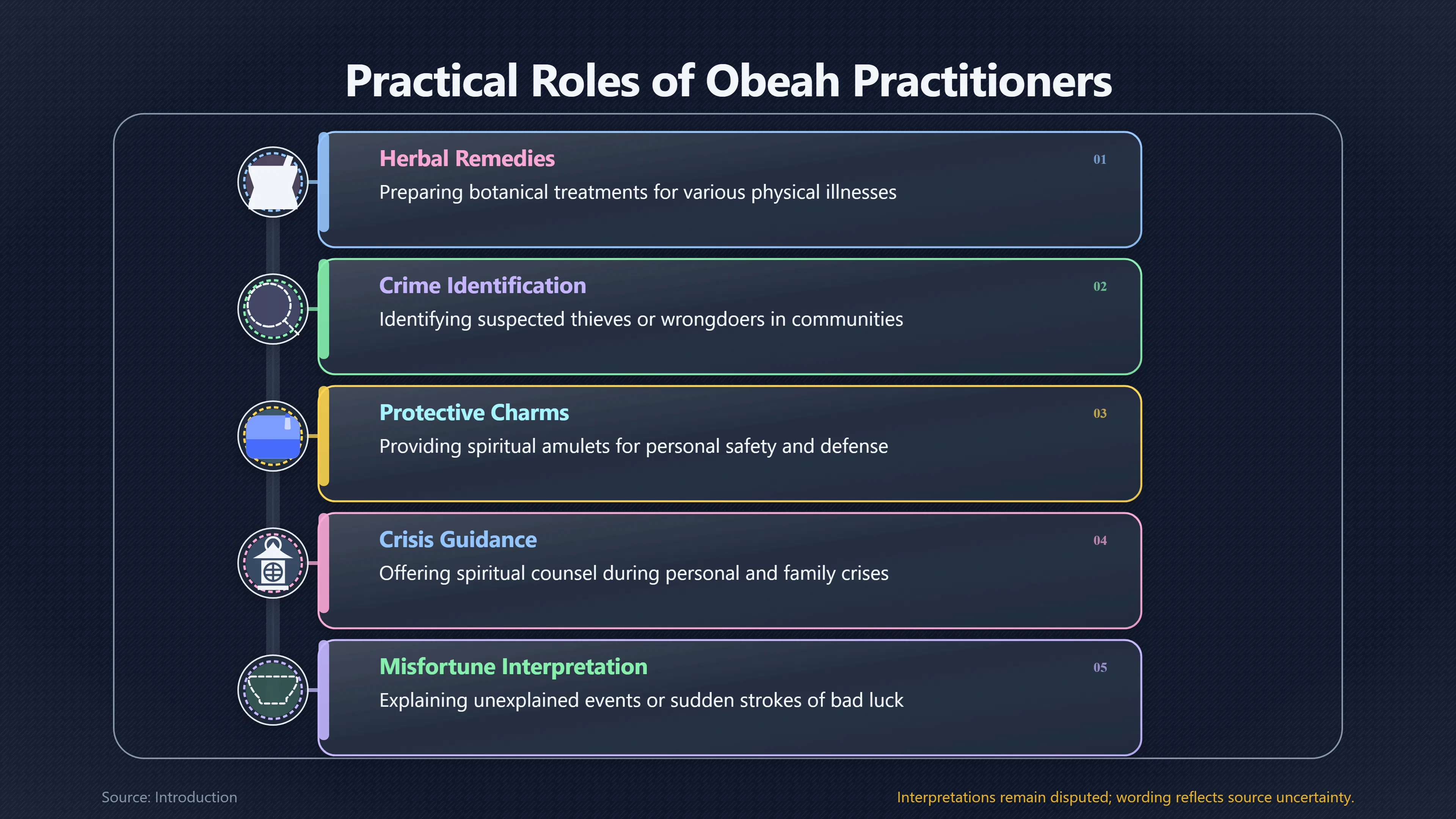
Historical sources suggest that people turned to obeah for reasons that official institutions often could not meet. Enslaved and later free Afro-Caribbean communities faced illness, uncertainty, family conflict, theft, violence and limited access to formal medical care. Within that world, practitioners might be consulted to:
- prepare herbal remedies for illness;
- identify suspected thieves or wrongdoers;
- provide protective charms;
- interpret misfortune or unexplained events;
- offer guidance during personal crises.
These activities did not fit neatly into modern distinctions between medicine, religion and magic. A healer might possess extensive botanical knowledge while also performing rituals that clients believed offered spiritual protection. Colonial observers often collapsed these varied activities into the single label “obeah”, obscuring important differences between healing, divination and alleged harmful practices.[ed.ac.uk]research.ed.ac.ukinburgh ResearchObeah and Other Powers: The Politics of Caribbean Religion and Healing - University of Edinburgh Research ExplorerJune…
For many clients, what mattered was not whether European officials regarded these practices as legitimate, but whether the practitioner had a reputation for helping people. Reputation spread through families and local communities rather than through recognised religious institutions.
How spiritual authority became political
The greatest colonial anxiety was not simply that people believed in supernatural power. It was that respected spiritual specialists possessed influence independent of colonial authority.
Plantation societies depended upon rigid hierarchies. Governors, magistrates, clergy and estate managers expected themselves to define legitimate authority. An individual whom hundreds of enslaved or working-class people trusted for healing, protection or advice represented an alternative source of confidence that officials could neither supervise nor easily understand.
Across the British Caribbean, colonial writers repeatedly linked obeah practitioners with resistance, conspiracy and rebellion, sometimes on substantial evidence and sometimes on speculation. After major slave uprisings elsewhere in the region, especially during the eighteenth century, legislators increasingly treated obeah as a potential threat to public order because practitioners could administer oaths, encourage solidarity or strengthen morale among enslaved people. Even where direct evidence of political organising was weak, authorities often assumed that hidden spiritual influence could foster collective resistance.[uchicago.edu]journals.uchicago.eduChicago JournalsPowers of Imagination and Legal Regimes against “Obeah” in the Late Eighteenth- and Early Nineteenth-Century British Cari…
Although Saint Kitts and Nevis did not produce one defining obeah conspiracy comparable to some neighbouring colonies, it belonged to this wider Leeward Islands legal and political environment. Regional fears shaped local legislation and policing, meaning that colonial officials viewed respected healers through a political as well as a religious lens.[Obeah Histories]obeahhistories.orgObeah Histories Legislation | Obeah HistoriesObeah Histories Legislation | Obeah Histories
Why colonial laws targeted obeah
Anti-obeah laws were designed to control more than demonstrably harmful acts such as poisoning or fraud. They also attempted to define which forms of supernatural belief counted as acceptable religion and which could be criminalised.
Legal definitions frequently relied on vague concepts such as “pretending to possess supernatural powers” or using occult means to deceive others. Such wording gave officials considerable discretion. Someone could be prosecuted not because physical harm had been proved but because authorities believed they exercised illegitimate spiritual influence.[Cambridge University Press & Assessment]cambridge.orgCambridge University Press & AssessmentOBEAH, VAGRANCY, AND THE BOUNDARIES OF RELIGIOUS FREEDOM: ANALYZING THE PROSCRIPTION OF “PRETENDIN…
The Leeward Islands, including Saint Kitts and Nevis, eventually adopted legislation influenced by broader British Caribbean anti-obeah measures. These laws reflected a common imperial approach rather than evidence that one island faced uniquely severe problems. They reinforced the message that African-derived spiritual authority itself was inherently suspect.[Obeah Histories]obeahhistories.orgObeah Histories Legislation | Obeah HistoriesObeah Histories Legislation | Obeah Histories
Modern historians argue that these laws actively shaped public understanding of obeah. Instead of merely responding to an existing social danger, legislation helped create enduring stereotypes by repeatedly presenting obeah in official language as fraud, superstition or criminality.[Edinburgh Research]research.ed.ac.ukinburgh ResearchObeah acts: Producing and policing the boundaries of religion in the Caribbean - University of Edinburgh Research Explorer…
Belief, fraud and hostile colonial labels
One reason obeah remains difficult to interpret is that historical records mix together very different kinds of activity.
Some practitioners almost certainly possessed valuable knowledge of medicinal plants and traditional healing. Others probably exaggerated their abilities or exploited fearful clients for money. Still others were accused by rivals or neighbours without reliable evidence. Because prosecutions were usually recorded by police, magistrates or missionaries rather than by practitioners themselves, surviving documents overwhelmingly reflect hostile perspectives.
This creates several important distinctions:
- Belief: Many clients sincerely believed spiritual protection or healing could improve their lives.
- Healing: Herbal medicine and practical care often existed alongside ritual practices.
- Fraud: Some individuals undoubtedly exploited popular beliefs, as happens within many religious and medical traditions.
- Colonial labelling: Officials frequently used the word “obeah” as a catch-all category that merged all of these activities into a single criminal stereotype.
Modern scholarship therefore cautions against assuming that every historical accusation described the same practice. The category itself was partly constructed by colonial governments attempting to regulate African cultural traditions.[Edinburgh Research]research.ed.ac.ukinburgh ResearchObeah and Other Powers: The Politics of Caribbean Religion and Healing - University of Edinburgh Research ExplorerJune…
Why fear of hidden power endured
The fear surrounding obeah proved remarkably durable because it combined several different anxieties at once.
Colonial officials feared political organisation beyond their control. Christian missionaries often viewed African-derived spiritual practices as religious error or demonic influence. Members of local communities could simultaneously respect a healer’s abilities while fearing the possibility of curses or retaliation. These overlapping concerns reinforced one another across generations.
The result was that obeah acquired a reputation far broader than any single set of practices could explain. Stories about hidden knowledge, invisible attacks and supernatural justice circulated alongside genuine experiences of herbal medicine, community support and spiritual counselling. The secrecy that developed around many practitioners was itself partly a consequence of criminalisation, making the practices appear even more mysterious to outsiders.[ed.ac.uk]research.ed.ac.ukinburgh ResearchObeah acts: Producing and policing the boundaries of religion in the Caribbean - University of Edinburgh Research Explorer…
Why this history matters in Saint Kitts and Nevis
The history of obeah in Saint Kitts and Nevis illustrates how fear can become embedded in institutions rather than erupting as a single episode of mass hysteria. Instead of spectacular witch trials, the islands experienced a prolonged pattern in which colonial governments treated informal spiritual authority as a challenge to political order.
Today, historians increasingly view obeah not as one fixed religion or an organised “cult”, but as a flexible collection of African-derived healing and spiritual practices whose meaning changed according to who was describing them. Colonial officials emphasised danger and disorder; many local communities valued protection, healing and guidance. Understanding both perspectives helps explain why obeah occupies such a contested place in Caribbean history and why debates over its meaning continue long after the end of colonial rule.[ed.ac.uk]research.ed.ac.ukinburgh ResearchObeah and Other Powers: The Politics of Caribbean Religion and Healing - University of Edinburgh Research ExplorerJune…
Amazon book picks
Further Reading
Books and field guides related to Why Did Obeah Frighten Colonial Authorities?. Use these as the next step if you want deeper reading beyond the article.


Mama Lola. Voodoo in Brooklyn
First published 1991. Subjects: Religion, Voodooism, Mambos (Voodooism), Vodou, Mambos (Vodou).
Endnotes
1.
Source: books.google.com
Title: Books Enacting Power: The Criminalization of Obeah in the Anglophone Caribbean
Link:https://books.google.com/books/about/Enacting_Power.html?id=N6hh3y2lVG0C
Source snippet
Google BooksEnacting Power: The Criminalization of Obeah in the Anglophone Caribbean... - Jerome S. Handler, Kenneth M. Bilby - Google B...
2.
Source: cambridge.org
Link:https://www.cambridge.org/core/journals/journal-of-law-and-religion/article/abs/obeah-vagrancy-and-the-boundaries-of-religious-freedom-analyzing-the-proscription-of-pretending-to-possess-supernatural-powers-in-the-anglophone-caribbean/11EEE1AD5948F72F423FE174FFE61F87
Source snippet
Cambridge University Press & AssessmentOBEAH, VAGRANCY, AND THE BOUNDARIES OF RELIGIOUS FREEDOM: ANALYZING THE PROSCRIPTION OF “PRETENDIN...
3.
Source: cambridge.org
Title: The Cultural Politics of Obeah
Link:https://www.cambridge.org/core/books/cultural-politics-of-obeah/18560C16399F297C310529C686CD039A
4.
Source: research.ed.ac.uk
Link:https://www.research.ed.ac.uk/en/publications/obeah-and-other-powers-the-politics-of-caribbean-religion-and-hea/
Source snippet
inburgh ResearchObeah and Other Powers: The Politics of Caribbean Religion and Healing - University of Edinburgh Research ExplorerJune...
5.
Source: research.ed.ac.uk
Link:https://www.research.ed.ac.uk/en/publications/obeah-acts-producing-and-policing-the-boundaries-of-religion-in-t/
Source snippet
inburgh ResearchObeah acts: Producing and policing the boundaries of religion in the Caribbean - University of Edinburgh Research Explorer...
6.
Source: obeahhistories.org
Title: Obeah Histories Legislation | Obeah Histories
Link:https://obeahhistories.org/law/
7.
Source: journals.uchicago.edu
Link:https://www.journals.uchicago.edu/doi/abs/10.1086/713926
Source snippet
Chicago JournalsPowers of Imagination and Legal Regimes against “Obeah” in the Late Eighteenth- and Early Nineteenth-Century British Cari...
8.
Source: research.ed.ac.uk
Link:https://www.research.ed.ac.uk/en/publications/the-cultural-politics-of-obeah-religion-colonialism-and-modernity/
9.
Source: obeahhistories.org
Title: Publications | Obeah Histories
Link:https://obeahhistories.org/publications/
10.
Source: obeahhistories.org
Title: Timeline | Obeah Histories
Link:https://obeahhistories.org/about/
11.
Source: doczz.net
Link:https://doczz.net/doc/4253134/obeah—jerome-s.-handler
Additional References
12.
Source: youtube.com
Title: History of St. Kitts and Nevis: The Islands That Survived Everything
Link:https://www.youtube.com/watch?v=WpLE0aUFBP0
Source snippet
"If Obeah Is Not Real, Why Did The British Outlaw Obeah In Jamaica During Slavery?[https://www.youtube.com/watch?v=3eQEaDO5eEk..."](https://www.youtube.com/watch?v=3eQEaDO5eEk...")...
13.
Source: scholarship.miami.edu
Title: Powers of Imagination and Legal Regimes
Link:https://scholarship.miami.edu/esploro/outputs/journalArticle/Powers-of-Imagination-and-Legal-Regimes/991031660538402976
Source snippet
of Imagination and Legal Regimes against “Obeah” in the Late Eighteenth- and Early Nineteenth-Century British Caribbean - University of M...
14.
Source: historyworkshop.org.uk
Title: Thanks to publishers who
Link:https://www.historyworkshop.org.uk/empire-decolonisation/the-racist-history-of-jamaicas-obeah-laws/
Source snippet
The Racist History of Jamaica's Obeah Laws | History WorkshopJuly 4, 2019 — #OBEAHSYLLABUS > For those following the obeah debate in Jama...
Published: July 4, 2019
15.
Source: youtube.com
Title: The Untold History of St. Kitts & Nevis: Colonial Resistance & Bermuda Ties
Link:https://www.youtube.com/watch?v=NtuXRlxT-fI
Source snippet
History of St. Kitts and Nevis: The Islands That Survived Everything...
16.
Source: youtube.com
Title: Guard Ring & Obeah: Beliefs That Still Shape Jamaica Today
Link:https://www.youtube.com/watch?v=tkyJ0o_-b9Q
Source snippet
The Untold History of St. Kitts & Nevis: Colonial Resistance & Bermuda Ties...
17.
Source: academic.oup.com
Link:https://academic.oup.com/ahr/article-pdf/121/5/1714/10298787/zah1714.pdf
Source snippet
The Cultural Politics of Obeah: Religion, Colonialism, and Modernity in the Caribbean World. | The American Historical Review | Oxford Ac...
18.
Source: researchgate.net
Link:https://www.researchgate.net/publication/236747892_Obeah_Acts_Producing_and_Policing_the_Boundaries_of_Religion_in_the_Caribbean
19.
Source: religionandslavery.org
Link:https://religionandslavery.org/resources
20.
Source: youtube.com
Title: The Demonisation of African Spirituality
Link:https://www.youtube.com/watch?v=aLP2jAqZ2K8
Source snippet
Obeah vs Healer: My Jamaican Mom Explains the Truth...
21.
Source: researchportal.helsinki.fi
Title: fi Obeah and Other Powers: The Politics of Caribbean Religion and Healing
Link:https://researchportal.helsinki.fi/en/publications/obeah-and-other-powers-the-politics-of-caribbean-religion-and-hea/
Topic Tree