Within India Panics
Why Did India's Miracle Claims Spread So Fast?
India's milk-drinking statues and sweet seawater episodes show how visible effects, devotion and rapid reporting can reinforce extraordinary claims.
On this page
- The milk drinking Ganesha statues
- Mumbai's sweet seawater crowds
- Natural explanations, faith and public safety
Page outline Jump by section
Introduction
India has experienced several high-profile waves of public miracle claims in which large numbers of people reported witnessing extraordinary events within a matter of hours. The best-known examples are the 1995 reports that statues of the Hindu deity Ganesha were drinking milk and the 2006 crowds who gathered at Mumbai’s Mahim Bay after rumours that seawater had turned sweet. These episodes matter not because they prove or disprove religious belief, but because they show how sincere observation, rapid communication and delayed verification can combine to create nationwide collective behaviour. They also illustrate the public risks that arise when crowds gather around unverified claims, particularly where health or safety concerns are involved.
For historians and social scientists, these events are not simply stories of gullibility. They are case studies in how expectations, trusted social networks, television coverage and visible demonstrations can reinforce one another. At the same time, they show why authorities face a delicate task: respecting religious devotion while providing timely scientific explanations and protecting public safety.
Why did the milk-drinking Ganesha statues spread so quickly?
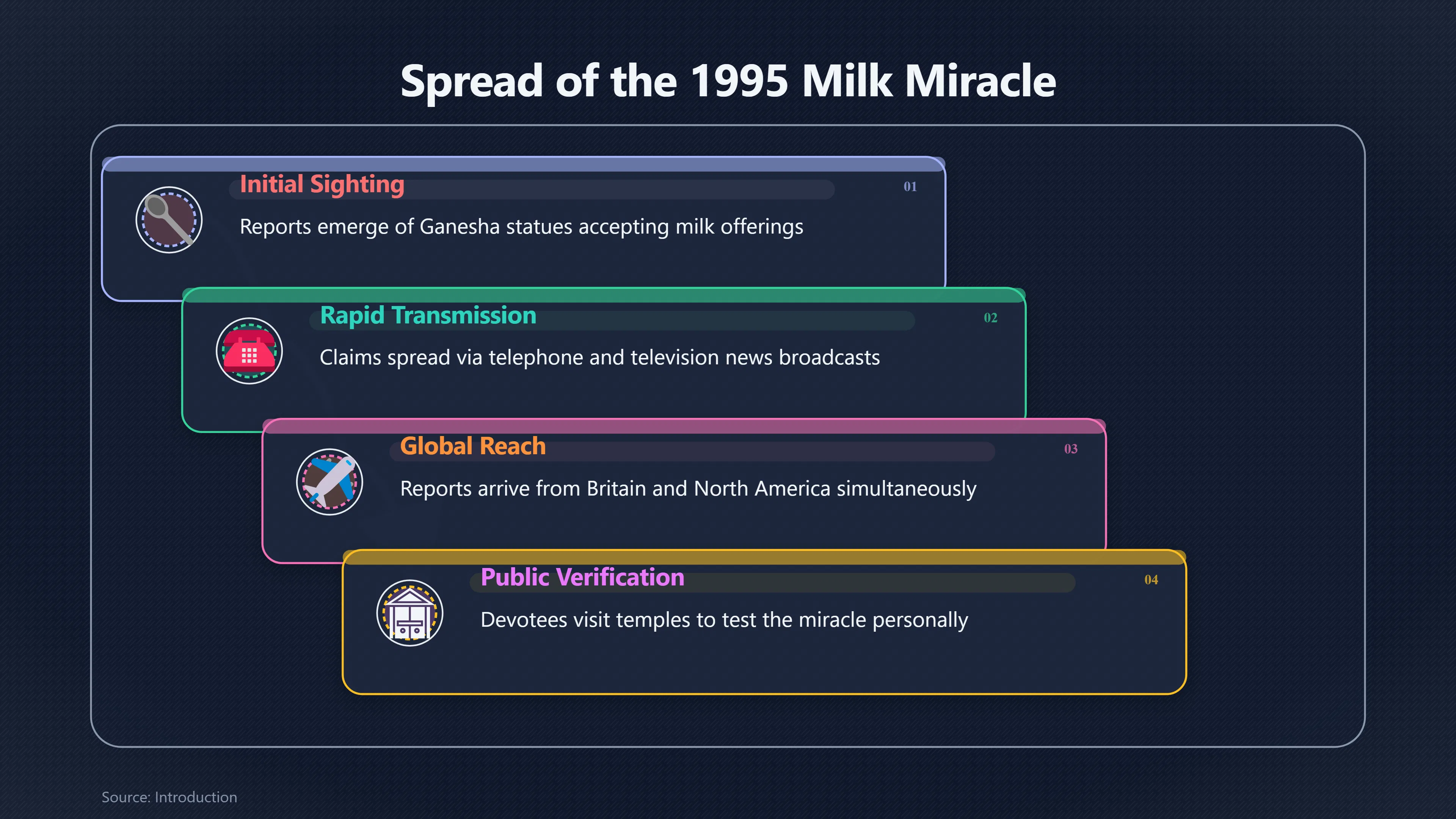
On 21 September 1995, reports emerged that statues of Ganesha in Delhi were accepting spoonfuls of milk offered by devotees. Within hours the claim spread across India and then to Hindu communities around the world through telephone calls, television news and word of mouth. Temples experienced exceptionally large crowds, milk supplies sold out in some places, and many people believed they had personally witnessed a miracle.[Wikipedia]WikipediaGanesha drinking milk miracleGanesha drinking milk miracle
The speed of the event was remarkable because it occurred before smartphones or social media. Newspapers later described it as one of the first examples of a religious phenomenon spreading globally through modern telecommunications rather than traditional pilgrimage or gradual storytelling. Reports arrived from Britain, North America, Malaysia, East Africa and elsewhere within the same day, reinforcing the impression that something unprecedented was happening.[Wikipedia]WikipediaGanesha drinking milk miracleGanesha drinking milk miracle
Several factors helped the reports spread:
- Direct participation. People did not merely hear about the event; they could test it themselves by offering milk to a statue.
- Trusted witnesses. Family members, neighbours and temple officials often reported seeing the same effect.
- Continuous media coverage. Television crews broadcast long queues and emotional reactions, making the event itself news regardless of whether the miracle was genuine.
- Religious familiarity. Offering milk was already a recognised devotional practice, so the reported behaviour fit existing expectations rather than introducing an entirely new belief.[Wikipedia]WikipediaGanesha drinking milk miracleGanesha drinking milk miracle
Importantly, many participants described genuine amazement rather than fear. Unlike a moral panic or rumour about hidden enemies, this was primarily a positive miracle claim rooted in established religious practice.
How did scientists explain what people saw?
Scientists investigated the phenomenon on the same day. Demonstrations showed that small amounts of milk placed against smooth or porous statues could appear to disappear because of surface tension and capillary action. Instead of remaining in the spoon, the liquid formed a thin film that travelled over the statue’s surface before draining away, sometimes leaving only a faint residue that was difficult to notice immediately.[Wikipedia]WikipediaGanesha drinking milk miracleGanesha drinking milk miracle
Capillary action is a well-understood physical process in which adhesion between a liquid and a surface, combined with surface tension, causes liquid to move through very narrow spaces or across thin films. Depending on the material and shape of the statue, the effect can make a spoon appear to empty without obvious dripping.[Scientific American]scientificamerican.comScientific American The Miracle of Capillary Action | Scientific AmericanScientific American The Miracle of Capillary Action | Scientific American
Not everyone accepted this explanation. Some devotees argued that metal or polished stone statues behaved in ways they believed capillary action could not explain and continued to interpret the event as miraculous. Others regarded the scientific demonstrations as convincing. The differing interpretations reflected different assumptions about what counted as sufficient evidence rather than a simple division between informed and uninformed observers.[Hinduism Today]hinduismtoday.comHinduism Today The Milk MiracleHinduism TodayThe Milk Miracle - Hinduism TodayDecember 1, 1995…
Why did Mumbai’s sweet seawater attract such large crowds?
In August 2006, another widely reported miracle claim emerged in Mumbai. People gathered near Mahim Bay after reports that seawater had become unusually sweet rather than salty. Many visitors tasted the water for themselves, collected it in bottles and interpreted the change as a divine sign, particularly because the reports centred on an important local shrine.[Wikipedia]Wikipedia2006 Mumbai sweet seawater incident2006 Mumbai sweet seawater incident
The crowds developed rapidly despite warnings from officials that the water might be polluted. Public health authorities feared outbreaks of water-borne disease because Mahim Bay receives urban runoff and sewage. Even after warnings were issued, many visitors continued to drink or collect the water, illustrating how first-hand experience and trusted testimony can outweigh official advice during unusual events.[Wikipedia]Wikipedia2006 Mumbai sweet seawater incident2006 Mumbai sweet seawater incident
Geologists from the Indian Institute of Technology Bombay proposed a natural explanation linked to the monsoon. Heavy rainfall can create underground stores of fresh water that emerge through coastal rock formations and temporarily float above denser seawater before gradually mixing back into the sea. This would produce patches of less salty water for a limited period without requiring any supernatural cause.[Hindustan Times]hindustantimes.comHindustan Times Sweet seawater is no miracle: IIT | India NewsHindustan Times Sweet seawater is no miracle: IIT | India News
Why visible demonstrations are especially persuasive
Both the milk miracle and the sweet seawater episode shared an important psychological feature: they invited ordinary people to become witnesses.
Unlike rumours that depend entirely on second-hand stories, these events appeared to offer direct personal confirmation. Someone could hold the spoon, watch the milk level fall or taste the water themselves. Once individuals believed they had observed something extraordinary, they became powerful messengers within their own families and communities.
Researchers who study collective belief note that people rarely assess unusual events in isolation. Instead, they combine:
- their own sensory impressions;
- explanations offered by trusted social contacts;
- religious or cultural expectations;
- media images showing many others reacting similarly; and
- uncertainty about whether an ordinary explanation has been ruled out.
When these influences reinforce one another, extraordinary claims can spread extremely quickly without requiring deliberate deception or coercion.
Faith, verification and public safety
These episodes also demonstrate why public authorities face difficult communication challenges.
Immediately dismissing a widely reported religious experience as foolish may alienate communities and reduce trust. At the same time, delaying investigation can allow unnecessary health risks or dangerous crowding to develop.
The Mumbai seawater episode illustrates this tension particularly clearly. Officials did not simply debate whether the water was miraculous; they also had to discourage people from consuming potentially contaminated seawater while scientific testing was under way. The immediate concern was disease prevention rather than settling questions of religious meaning.[Wikipedia]Wikipedia2006 Mumbai sweet seawater incident2006 Mumbai sweet seawater incident
Similarly, the milk miracle prompted practical concerns about crowd management, traffic congestion and food waste alongside debates over science and faith. None of these risks required assuming that participants were irrational. Large gatherings around sincerely held beliefs create logistical challenges regardless of whether the underlying claim is ultimately confirmed or explained naturally.

What these miracle waves reveal about collective belief
India’s miracle waves differ from episodes of mass psychogenic illness or moral panic because they centred primarily on hope, devotion and shared wonder rather than fear or physical symptoms. They also differ from persecution panics because they did not depend on identifying enemies or blaming vulnerable groups.
Their lasting significance lies elsewhere. They demonstrate how rapidly extraordinary claims can travel when people believe they have personally witnessed unusual events, how mass media can amplify those experiences, and how scientific investigation often unfolds alongside—not instead of—religious interpretation.
For historians, psychologists and scholars of religion, the milk-drinking statues and Mumbai’s sweet seawater remain valuable examples of the interaction between perception, cultural expectation and communication. They show that collective belief can spread through ordinary social processes, while also reminding public authorities that respectful verification and clear risk communication are essential whenever extraordinary public claims attract large crowds.
Amazon book picks
Further Reading
Books and field guides related to Why Did India's Miracle Claims Spread So Fast?. Use these as the next step if you want deeper reading beyond the article.
Extraordinary Popular Delusions and the Madness of Crowds
Rating: 4.0/5 from 5 Google Books ratings
Frames many Indian examples of collective fear.
Endnotes
1.
Source: Wikipedia
Title: Ganesha drinking milk miracle
Link:https://en.wikipedia.org/wiki/Ganesha_drinking_milk_miracle
2.
Source: Wikipedia
Title: 2006 Mumbai sweet seawater incident
Link:https://en.wikipedia.org/wiki/2006_Mumbai_sweet_seawater_incident
3.
Source: hinduismtoday.com
Link:https://www.hinduismtoday.com/magazine/september-1999/1999-09-what-miracles-are-made-of/
Source snippet
Hinduism TodayWhat Miracles Are Made of - Hinduism Today...
4.
Source: scientificamerican.com
Title: Scientific American The Miracle of Capillary Action | Scientific American
Link:https://www.scientificamerican.com/blog/observations/the-miracle-of-capillary-action/
5.
Source: hinduismtoday.com
Title: Hinduism Today The Milk Miracle
Link:https://www.hinduismtoday.com/magazine/december-1995/1995-12-the-milk-miracle/
Source snippet
Hinduism TodayThe Milk Miracle - Hinduism TodayDecember 1, 1995...
Published: December 1, 1995
6.
Source: hindustantimes.com
Title: Hindustan Times Sweet seawater is no miracle: IIT | India News
Link:https://www.hindustantimes.com/india/sweet-seawater-is-no-miracle-iit/story-igTBSsrvIbL2XDEbeBYEvL_amp.html
7.
Source: scientificamerican.com
Title: From the Archives: Frost Flowers and Hot Capillary Action | Scientific American
Link:https://www.scientificamerican.com/blog/cocktail-party-physics/from-the-archives-frost-flowers-and-hot-capillary-action/
8.
Source: hindustantimes.com
Title: Misled by belief | India News
Link:https://www.hindustantimes.com/india/misled-by-belief/story-YHvahuAQkABZ6zjCm96KDN_amp.html
9.
Source: hindustantimes.com
Title: Mahim seawater not potable: Govt | India News
Link:https://www.hindustantimes.com/india/mahim-seawater-not-potable-govt/story-2Cfzd5BltlVmhx909pNyWI.html
10.
Source: hindustantimes.com
Title: Milk?miracle? draws devotees | India News
Link:https://www.hindustantimes.com/india/milk-miracle-draws-devotees/story-KctY04WtoE2wnhHsc54JhP_amp.html
11.
Source: hinduismtoday.com
Title: My Friend, Lord Ganesha
Link:https://www.hinduismtoday.com/magazine/october-november-december-2005/2005-10-my-friend-lord-ganesha/
Additional References
12.
Source: denofgeek.com
Title: Science explained the Hindu milk miracle by
Link:https://www.denofgeek.com/culture/shiva-temple-claims-miracle-as-statue-bleeds/
Source snippet
Shiva Temple Claims Miracle as Statue Bleeds | Den of GeekJuly 26, 2018 — When the statue of Ganesha drank a spoonful of milk held to its...
Published: July 26, 2018
13.
Source: m.thewire.in
Title: ganesh milk miracle 1995 sangh parivar
Link:https://m.thewire.in/article/society/ganesh-milk-miracle-1995-sangh-parivar
Source snippet
the Sangh Parivar Organised the 1995 Ganesh Milk Miracle and Why the Plan Flopped - The WireSeptember 21, 2020 — HOW THE SANGH PARIVAR OR...
Published: September 21, 2020
14.
Source: scroll.in
Title: Manash Firaq Bhatta
Link:https://scroll.in/article/1028138/what-would-nehru-have-made-of-ganesh-statues-drinking-milk-asks-a-new-book-on-indias-first-pm
Source snippet
What would Nehru have made of Ganesh statues ‘drinking’ milk, asks a new book on India’s first PMJuly 14, 2022 — WHAT WOULD NEHRU HAVE MA...
Published: July 14, 2022
15.
Source: youtube.com
Title: HONG KONG: HINDU MIRACLE: MILK OFFERING TO STATUES IN TEMPLE
Link:https://www.youtube.com/watch?v=MCxZBPt9rxA
Source snippet
Mass Hysteria in Govt School, Students Seen Crying, Shouting & Banging Heads...
16.
Source: youtube.com
Link:https://www.youtube.com/watch?v=VfmLXgYp-h4
Source snippet
How the news of milk-drinking idols STUNNED an entire religion...
17.
Source: nature.com
Title: External Capillary Action | Nature
Link:https://www.nature.com/articles/118300b0
Source snippet
External Capillary Action | Nature...
18.
Source: sciencedirect.com
Link:https://www.sciencedirect.com/science/article/abs/pii/S016041200500190X
19.
Source: sciencedirect.com
Link:https://www.sciencedirect.com/science/article/abs/pii/S0160412005001947
20.
Source: himalayanacademy.com
Link:https://www.himalayanacademy.com/media/books/ten-tales-about-religious-life/web/ch04.html
21.
Source: indianexpress.com
Link:https://indianexpress.com/article/india/india-others/you-start-questioning-things-the-most-blatant-harmful-things-that-are-evil/
Topic Tree