Within Iraq
What Really Happened at the Najaf Battle?
The 2007 battle near Najaf mixed genuine armed millenarianism with disputed official claims about a planned apocalyptic massacre.
On this page
- The armed community at Zarqa
- Conflicting accounts of the alleged plot
- Why war made prophecy politically powerful
Page outline Jump by section
Introduction
The 2007 Najaf battle was one of the strangest and most controversial episodes of the Iraq War. Iraqi and US forces fought a heavily armed religious community based near the village of Zarqa, north-east of Najaf, leaving hundreds dead. Iraqi officials said they had stopped an apocalyptic conspiracy by a messianic movement known as the Soldiers of Heaven, which allegedly planned to assassinate leading Shi’a clerics during the Ashura pilgrimage. Almost immediately, however, journalists, researchers and some local witnesses challenged important parts of that account. Questions arose about who the fighters really were, whether the government had exaggerated the threat, and how an obscure religious movement had become capable of resisting regular military forces. Nearly two decades later, the battle remains important because it illustrates both the reality of violent millenarian movements and the difficulty of separating documented evidence from wartime propaganda.
What really happened at the Najaf battle?
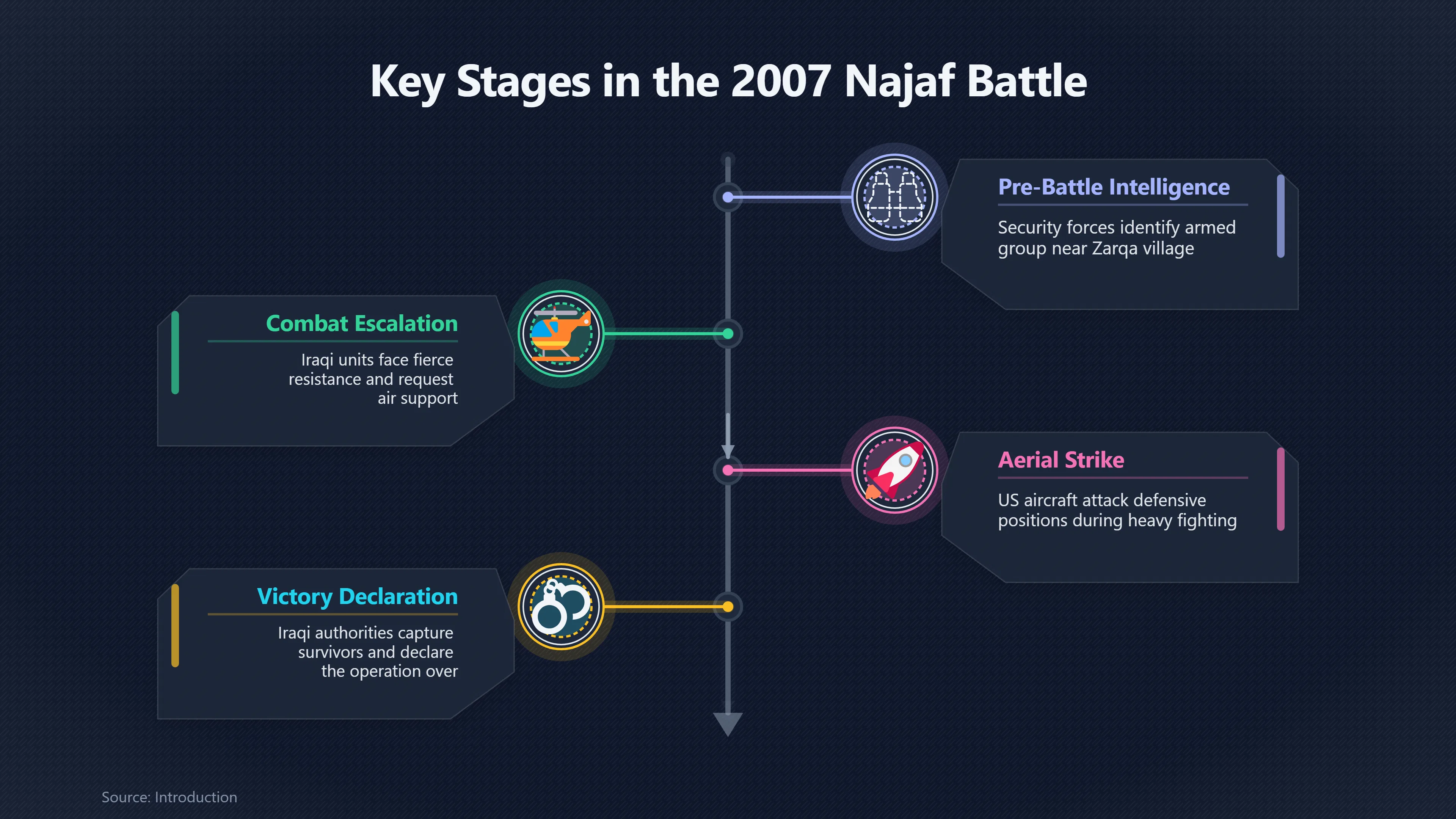
The fighting began on 28 January 2007, during the period leading into Ashura, when hundreds of thousands of Shi’a pilgrims travel to Najaf. Iraqi security forces moved against a fortified settlement near Zarqa after receiving intelligence that an armed group was preparing attacks. Instead of a straightforward arrest operation, they encountered fierce resistance.
The battle rapidly escalated. Iraqi units suffered significant casualties and requested American air support. US helicopters and fixed-wing aircraft attacked defensive positions while Iraqi ground forces surrounded the compound. An American AH-64 Apache helicopter was shot down during the fighting, demonstrating that the defenders possessed heavier weapons and greater organisation than many observers had expected. Iraqi authorities eventually declared victory after killing the group’s leader and capturing hundreds of survivors.[U.S. Department of War]media.defense.govU.S. Department of WarThe U.S. Army in the Iraq War: Volume 2, Surge and Withdrawal, 2007-2011January 23, 2019…
Official casualty figures varied during the following days, but Iraqi authorities generally reported more than 250 fighters killed and roughly 400–500 detainees, alongside losses among Iraqi security forces and two American servicemen killed in the helicopter crash.[RadioFreeEurope/RadioLiberty]rferl.orgRadio Free Europe/Radio Liberty Iraq ReportRadioFreeEurope/RadioLibertyIraq Report: February 2, 2007…
The armed community at Zarqa
The movement was commonly labelled the “Soldiers of Heaven” by Iraqi authorities, although contemporary reporting also referred to it as the “Army of Heaven”. It was presented as an extremist Shi’a splinter movement led by Dia Abdul Zahra Kadhim, who reportedly claimed extraordinary religious status. Iraqi officials alleged that he portrayed himself as the awaited Mahdi or as a divinely appointed figure connected to the expected end-times.
Most evidence suggests the group did hold unusual millenarian beliefs centred on the imminent transformation of the world. It had established a sizeable rural compound where followers lived with their families, and investigators found substantial stores of weapons after the battle. The US Army’s official history describes the community as a militant commune with distinctive religious teachings and notes that many women and children were living inside the settlement alongside armed members.[U.S. Department of War]media.defense.govU.S. Department of WarThe U.S. Army in the Iraq War: Volume 2, Surge and Withdrawal, 2007-2011January 23, 2019…
However, even basic facts about the movement proved difficult to establish. Iraqi officials offered inconsistent descriptions of its origins and leadership. At different times they suggested that it had links with al-Qaeda, foreign fighters, Iranian agents or Sunni extremists masquerading as Shi’a believers. These claims often contradicted one another and were never convincingly reconciled. Subsequent scholarship has generally treated these allegations cautiously.[U.S. Department of War]media.defense.govU.S. Department of WarThe U.S. Army in the Iraq War: Volume 2, Surge and Withdrawal, 2007-2011January 23, 2019…
Conflicting accounts of the alleged plot
The central dispute concerns why the battle occurred.
According to the Iraqi government’s account:
- the movement intended to infiltrate Ashura pilgrims;
- senior Shi’a clerics, including Grand Ayatollah Ali al-Sistani, were to be assassinated;
- the group hoped that mass bloodshed would trigger the appearance of the Mahdi;
- security forces launched a preventive operation after receiving intelligence about the conspiracy.[RadioFreeEurope/RadioLiberty]rferl.orgRadio Free Europe/Radio Liberty Iraq ReportRadioFreeEurope/RadioLibertyIraq Report: February 2, 2007…
Alternative accounts questioned several parts of this narrative.
Some Iraqi tribal representatives argued that the fighting began after security forces confronted pilgrims or local residents, causing an escalating armed clash rather than foiling a carefully prepared assassination plot. Independent journalists also reported that access to surviving witnesses was tightly controlled after the battle, making independent verification difficult. Several observers suggested that official statements changed repeatedly as new contradictions appeared.[Global Policy Forum]archive.globalpolicy.orgGlobal Policy Forum Official Lies Over Najaf Battle ExposedGlobal Policy ForumOfficial Lies Over Najaf Battle ExposedJanuary 31, 2007…
The available evidence does not support the strongest versions of either interpretation. There is substantial evidence that the community was armed, organised and committed to unusual messianic beliefs. There is much weaker publicly available evidence proving the detailed assassination conspiracy described in early government statements. The US Army’s later official history acknowledged that “no definitive explanation” for how the battle began has ever emerged and noted that controversy surrounded both the group’s intentions and the government’s version of events.[U.S. Department of War]media.defense.govU.S. Department of WarThe U.S. Army in the Iraq War: Volume 2, Surge and Withdrawal, 2007-2011January 23, 2019…

Why war made prophecy politically powerful
The Najaf battle cannot be understood simply as an isolated religious episode. It unfolded during one of the bloodiest phases of post-2003 Iraq, when sectarian violence, insurgency and state weakness created conditions in which radical religious claims could attract followers.
Several factors mattered:
- Political collapse: The fall of Saddam Hussein destroyed existing institutions and left many communities searching for new sources of authority.
- Religious expectation: Shi’a traditions include expectations surrounding the eventual return of the Hidden Imam. Mainstream religious scholars generally treat these beliefs cautiously and reject self-proclaimed messiahs, but periods of instability have repeatedly produced individuals claiming special divine authority.
- Violence and insecurity: Constant conflict made extraordinary explanations for suffering more persuasive to some people while encouraging heavily armed self-defence communities.
- Competition within Shi’a politics: The emergence of unconventional religious movements also threatened established clerical authority centred in Najaf, giving political leaders strong incentives to portray challengers as dangerous extremists.[U.S. Department of War]media.defense.govU.S. Department of WarThe U.S. Army in the Iraq War: Volume 2, Surge and Withdrawal, 2007-2011January 23, 2019…
These conditions help explain why a relatively obscure movement could become both a genuine security concern and the subject of competing political narratives.
Separating documented facts from later myths
The Najaf battle has accumulated numerous myths that go beyond the available evidence.[youtube.com]youtube.comBATTLE OF NAJAFVideo: Iraq's Najaf, the holy rebel city…
One common misconception is that the Soldiers of Heaven were simply another branch of al-Qaeda. Contemporary Iraqi officials occasionally suggested such links, but these claims were difficult to reconcile with the group’s Shi’a religious identity and were viewed sceptically by many analysts. No persuasive public evidence established an operational relationship.[U.S. Department of War]media.defense.govU.S. Department of WarThe U.S. Army in the Iraq War: Volume 2, Surge and Withdrawal, 2007-2011January 23, 2019…
Another misconception is that the entire event was fabricated. This is also inconsistent with the evidence. A major armed confrontation unquestionably occurred, hundreds of people died, and Iraqi and American forces recovered significant quantities of weapons. The principal uncertainty concerns the movement’s intentions before the battle and whether the official description of a planned apocalyptic massacre accurately reflected the available intelligence.[U.S. Department of War]media.defense.govU.S. Department of WarThe U.S. Army in the Iraq War: Volume 2, Surge and Withdrawal, 2007-2011January 23, 2019…
Finally, some later retellings portray the group as merely peaceful pilgrims caught in a military assault. Contemporary reporting and official investigations indicate that the defenders fought with heavy weapons for many hours, inflicted substantial casualties and even brought down an American helicopter. Whatever disputes remain about how the confrontation began, the fighting itself demonstrated organised armed resistance.[U.S. Department of War]media.defense.govU.S. Department of WarThe U.S. Army in the Iraq War: Volume 2, Surge and Withdrawal, 2007-2011January 23, 2019…

Why the Najaf battle still matters
The battle remains one of Iraq’s clearest examples of the overlap between millenarian belief, political conflict and information uncertainty. It demonstrates that unusual religious movements should not automatically be dismissed as harmless, but it also shows why official claims made during wartime require careful scrutiny.
For historians of collective belief, the episode illustrates how genuine apocalyptic expectations can coexist with competing political narratives. The armed movement was real, yet the most dramatic claims about its alleged plans remain disputed. As a result, the Najaf battle is remembered not simply as a military engagement but as a case in which evidence, propaganda, sectarian rivalry and religious expectation became tightly intertwined.
Amazon book picks
Further Reading
Books and field guides related to What Really Happened at the Najaf Battle?. Use these as the next step if you want deeper reading beyond the article.
The Looming Tower
First published 2006. Subjects: Current Events, September 11 Terrorist Attacks, 2001, Qaida (Organization), Intelligence service, Nonfict...

The Shia Revival
First published 2006. Subjects: Islam and politics, Sunnites, Middle east, politics and government, Shiites.
Republic of fear
First published 1989. Subjects: Politics and government, Iraq, politics and government, HISTORY, General, Baʹthpartij.

Black flags
First published 2015. Subjects: Politics and government, POLITICAL SCIENCE / Political Freedom & Security / Terrorism, Islamic fundamenta...
Endnotes
1.
Source: media.defense.gov
Link:https://media.defense.gov/2023/May/05/2003216674/-1/-1/0/3668.PDF
Source snippet
U.S. Department of WarThe U.S. Army in the Iraq War: Volume 2, Surge and Withdrawal, 2007-2011January 23, 2019...
Published: January 23, 2019
2.
Source: rferl.org
Title: Radio Free Europe/Radio Liberty Iraq Report
Link:https://www.rferl.org/a/1347487.html
Source snippet
RadioFreeEurope/RadioLibertyIraq Report: February 2, 2007...
Published: February 2, 2007
3.
Source: archive.globalpolicy.org
Title: Global Policy Forum Official Lies Over Najaf Battle Exposed
Link:https://archive.globalpolicy.org/security/issues/iraq/atrocities/2007/0131najaf.htm
Source snippet
Global Policy ForumOfficial Lies Over Najaf Battle ExposedJanuary 31, 2007...
Published: January 31, 2007
Additional References
4.
Source: brookings.edu
Link:https://www.brookings.edu/articles/al-qaeda-strikes-back/
Source snippet
Al Qaeda Strikes Back | BrookingsMay 1, 2007 — Thousands of Arab volunteers, many of them inspired by bin Laden’s words, went to Iraq in...
Published: May 1, 2007
5.
Source: theguardian.com
Link:https://www.theguardian.com/uk/2007/sep/17/iraq.humanrights
Source snippet
September 17, 2007 — This article is more than 18 years old BRITON JAILED IN IRAQ FOR TERRORISM CLAIMS HE WAS TORTURED This article is mo...
Published: September 17, 2007
6.
Source: brookings.edu
Title: Questioning Iran’s Role in Iraq Insurgency | Brookings
Link:https://www.brookings.edu/articles/questioning-irans-role-in-iraq-insurgency/
Source snippet
February 13, 2007 — QUESTIONING IRAN’S ROLE IN IRAQ INSURGENCY * Share * Share Search Sections Sections * Share * Share Commentary QUESTI...
Published: February 13, 2007
7.
Source: wsws.org
Title: Iraq: Who did the US military massacre near Najaf?
Link:https://www.wsws.org/en/articles/2007/02/mass-f02.html
Source snippet
World Socialist Web SiteFebruary 2, 2007 — IRAQ: WHO DID THE US MILITARY MASSACRE NEAR NAJAF? James Cogan 2 February 2007 * * * * * * * M...
Published: February 2, 2007
8.
Source: brookings.edu
Title: Fighting A Ruthless Foe in Iraq | Brookings
Link:https://www.brookings.edu/articles/fighting-a-ruthless-foe-in-iraq/
Source snippet
O’Hanlon Michael E. O’Hanlon Director of Research - Foreign Policy, Director - Strobe Talbott Center for Security, Strategy, and Technolo...
9.
Source: brookings.edu
Title: Al-Qaeda Five Years After the Fall of Kandahar | Brookings
Link:https://www.brookings.edu/articles/al-qaeda-five-years-after-the-fall-of-kandahar/
Source snippet
On 11 February 2003 bin Ladin sent a letter to the Iraqi people, broadcast via al-Jazirah...
Published: February 2003
10.
Source: youtube.com
Title: Video: Iraq’s Najaf, the holy rebel city
Link:https://www.youtube.com/watch?v=aMPnyT_NRIw
Source snippet
WRAP Thousands of anti-US demonstrators in Najaf, al-Sadr statement...
11.
Source: en-academic.com
Link:https://en-academic.com/dic.nsf/enwiki/4863908/
12.
Source: youtube.com
Title: BATTLE OF NAJAF
Link:https://www.youtube.com/watch?v=_vuXdHtormE
Source snippet
Video: Iraq's Najaf, the holy rebel city...
13.
Source: theguardian.com
Title: Iraqi shrine blast linked to UN attack | World news | The Guardian
Link:https://www.theguardian.com/world/2003/aug/31/iraq1
Topic Tree