Within Mozambique Panics
Night Witches, Cannibals and Hidden Enemies
Stories of spirit attacks on children and hidden cannibals gave form to fears about illness, trust, wealth and violence after social upheaval.
On this page
- The night war of Nampula
- Cannibal accusations after civil war
- How crisis reshaped supernatural fear
Page outline Jump by section
Introduction
Stories about night-time spirit attacks and hidden cannibals occupy a distinctive place in Mozambique’s history of collective fear. Unlike a single, dramatic panic, these beliefs developed over many years in the aftermath of war, displacement and rapid social change. In northern Mozambique, especially around Nampula, many families came to speak of a “night war” in which invisible forces abducted or attacked infants and young children. Elsewhere, particularly after the civil war ended in 1992, rumours that certain powerful people were secretly cannibals circulated alongside wider suspicions about unexplained wealth, political authority and memories of wartime brutality. These narratives were not simply supernatural folklore. They became ways of explaining illness, misfortune and broken trust in communities struggling to recover from decades of conflict.[Cambridge University Press & Assessment]cambridge.orgCambridge University Press & Assessment‘THE NIGHT WAR OF NAMPULA’: VULNERABLE CHILDREN, SOCIAL CHANGE AND SPIRITUAL INSECURITY IN NORTHER…

The night war of Nampula
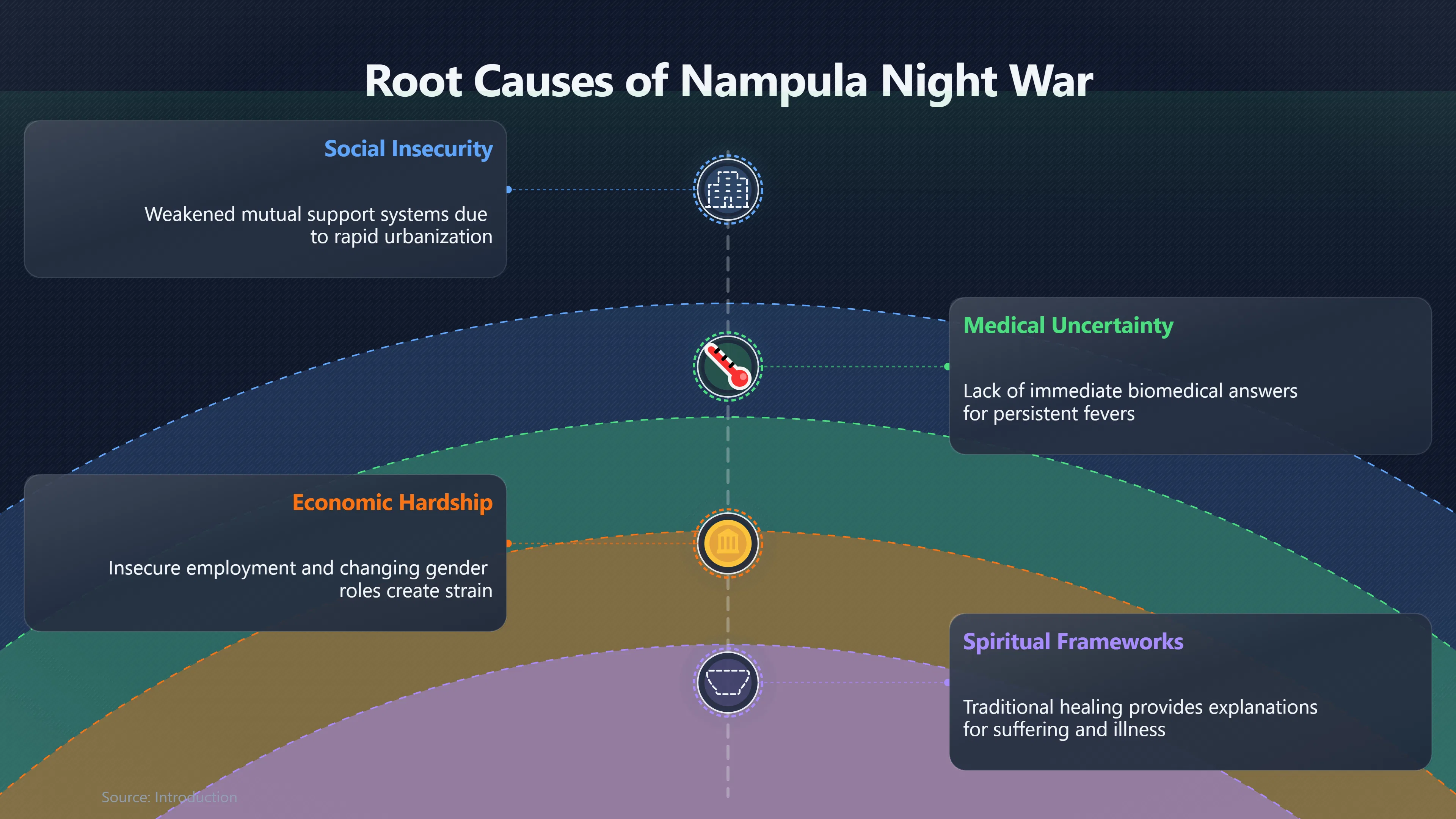
Anthropologist Daria Trentini describes the “night war” as a locally recognised struggle against unseen enemies rather than a conventional military conflict. Families in neighbourhoods around Nampula increasingly feared that sick babies and young children could be targeted by witches, malevolent ancestral forces or new spirits that arrived during the night to abduct or enslave them spiritually. These accounts were especially common when children developed illnesses that seemed difficult to diagnose or treat.[Cambridge University Press & Assessment]cambridge.orgCambridge University Press & Assessment‘THE NIGHT WAR OF NAMPULA’: VULNERABLE CHILDREN, SOCIAL CHANGE AND SPIRITUAL INSECURITY IN NORTHER…
The stories reflected genuine anxieties rather than a shared hallucination. Parents often interpreted persistent fever, weight loss or unusual behaviour through a spiritual framework because biomedical explanations did not always provide immediate answers, while traditional healing sometimes failed to produce the expected recovery. As uncertainty grew, mothers in particular described living with constant fear that their children were vulnerable to invisible attack.[Cambridge University Press & Assessment]cambridge.orgCambridge University Press & Assessment‘THE NIGHT WAR OF NAMPULA’: VULNERABLE CHILDREN, SOCIAL CHANGE AND SPIRITUAL INSECURITY IN NORTHER…
Trentini argues that these fears became more widespread as economic hardship and urbanisation altered household life. Migration, insecure employment and changing gender roles weakened older systems of mutual support. Grandparents, parents and children often lived under increasing strain, making accusations against hidden supernatural enemies more plausible than they might have seemed in more stable circumstances. The “night war” therefore expressed deep social insecurity as much as belief in literal nocturnal attacks.[Cambridge University Press & Assessment]cambridge.orgCambridge University Press & Assessment‘THE NIGHT WAR OF NAMPULA’: VULNERABLE CHILDREN, SOCIAL CHANGE AND SPIRITUAL INSECURITY IN NORTHER…
Children at the centre of fear
Infants and young children occupied a special place in these beliefs because they were widely understood to exist in a fragile state between life and the spiritual world. When a child became ill, families frequently sought help from both clinics and traditional healers.
Research found that healing rituals could sometimes reduce anxiety by providing an explanation for suffering. However, they could also intensify fear. If rituals failed or divination identified powerful hidden enemies, parents might become even more convinced that dangerous supernatural forces were operating within or around their own community. This reinforced the sense that ordinary illness could conceal deliberate spiritual aggression.[Cambridge University Press & Assessment]cambridge.orgCambridge University Press & Assessment‘THE NIGHT WAR OF NAMPULA’: VULNERABLE CHILDREN, SOCIAL CHANGE AND SPIRITUAL INSECURITY IN NORTHER…
Cannibal accusations after the civil war
Rumours about secret cannibals became particularly significant after Mozambique’s long civil war. Anthropologist Victor Igreja argues that these accusations cannot be understood simply as survival of ancient folklore. Instead, they were reshaped by memories of wartime violence and by struggles over political authority in the new post-conflict state.[Cambridge University Press & Assessment]cambridge.orgCambridge University Press & AssessmentMemories of Violence, Cultural Transformations of Cannibals, and Indigenous State-Building in Post…
Civil war had normalised extreme violence, disappearances and experiences that many survivors found difficult to explain or discuss openly. After peace returned, stories of hidden cannibals offered a language for expressing fears about individuals who seemed unusually wealthy, politically influential or socially detached from ordinary community life. The accusation suggested not merely that someone consumed human flesh but that they gained power through fundamentally inhuman acts.[Cambridge University Press & Assessment]cambridge.orgCambridge University Press & AssessmentMemories of Violence, Cultural Transformations of Cannibals, and Indigenous State-Building in Post…
Igreja’s research shows that cannibal rumours often appeared during local disputes over land, leadership and recognition rather than as isolated supernatural scares. Allegations became weapons in wider conflicts about legitimacy and trust. Local media sometimes amplified these stories, allowing rumours originating in one locality to become regional controversies.[Cambridge University Press & Assessment]cambridge.orgCambridge University Press & AssessmentMemories of Violence, Cultural Transformations of Cannibals, and Indigenous State-Building in Post…
Importantly, historians do not regard these accusations as evidence that organised cannibalism was occurring. Instead, they interpret them as culturally meaningful claims expressing moral judgement about exploitation, betrayal and abuses of power after years of conflict.[Cambridge University Press & Assessment]cambridge.orgCambridge University Press & AssessmentMemories of Violence, Cultural Transformations of Cannibals, and Indigenous State-Building in Post…
How crisis reshaped supernatural fear
The night-war narratives and cannibal rumours emerged from different regions and circumstances, yet they reveal several common patterns.
First, both developed during periods when everyday trust had been badly damaged. Civil war, forced displacement and poverty left many Mozambicans uncertain about neighbours, local authorities and even extended family members. Hidden enemies became believable because ordinary social relationships had become fragile.[Cambridge University Press & Assessment]cambridge.orgCambridge University Press & Assessment‘THE NIGHT WAR OF NAMPULA’: VULNERABLE CHILDREN, SOCIAL CHANGE AND SPIRITUAL INSECURITY IN NORTHER…
Second, both stories transformed invisible problems into understandable narratives. A child’s unexplained illness, unexplained wealth, political influence or sudden personal misfortune could be interpreted as evidence of concealed supernatural action. These explanations gave communities a framework for discussing suffering that otherwise appeared random or incomprehensible.[Cambridge University Press & Assessment]cambridge.orgCambridge University Press & Assessment‘THE NIGHT WAR OF NAMPULA’: VULNERABLE CHILDREN, SOCIAL CHANGE AND SPIRITUAL INSECURITY IN NORTHER…
Third, these beliefs were not isolated from modern institutions. Families frequently combined visits to hospitals with consultations with traditional healers. Likewise, rumours circulated through newspapers and radio as well as through neighbourhood conversation. Rather than representing a simple opposition between “traditional” and “modern” thinking, the episodes illustrate how multiple systems of explanation coexisted in postwar Mozambique.[Cambridge University Press & Assessment]cambridge.orgCambridge University Press & Assessment‘THE NIGHT WAR OF NAMPULA’: VULNERABLE CHILDREN, SOCIAL CHANGE AND SPIRITUAL INSECURITY IN NORTHER…

What researchers think these episodes reveal
Researchers generally reject explanations that dismiss these stories as mere irrational superstition. Instead, they emphasise that rumours spread because they helped communities interpret genuine experiences of insecurity.
Studies of postwar Mozambique have shown that spiritual affliction and spirit possession remained widespread after the conflict and were closely associated with traumatic experiences, health problems and disrupted social relationships. Local understandings of harmful spirits shaped how many people interpreted suffering and sought treatment, making supernatural explanations socially meaningful even when they differed from biomedical models.[ScienceDirect]sciencedirect.comThe epidemiology of spirit possession in the aftermath of mass political violence in Mozambique - ScienceDirect…
The “night war” likewise reflects anxieties about childhood vulnerability in rapidly changing urban communities rather than evidence of organised attacks by supernatural beings. Cannibal accusations reveal how memories of wartime brutality could become attached to contemporary political and economic conflicts, turning hidden enemies into symbols of exploitation and illegitimate power.[Cambridge University Press & Assessment]cambridge.orgCambridge University Press & Assessment‘THE NIGHT WAR OF NAMPULA’: VULNERABLE CHILDREN, SOCIAL CHANGE AND SPIRITUAL INSECURITY IN NORTHER…
Taken together, these episodes show how collective fears in Mozambique have often grown not from isolated rumours alone but from the interaction of trauma, uncertainty, changing family life and contested authority. They remain important because they demonstrate how societies emerging from prolonged violence can use supernatural narratives to explain very real experiences of illness, inequality and damaged trust.
Amazon book picks
Further Reading
Books and field guides related to Night Witches, Cannibals and Hidden Enemies. Use these as the next step if you want deeper reading beyond the article.
Purity and danger
Explains how societies construct ideas of danger, pollution and hidden threats that illuminate supernatural fears.
The witch-hunt in early modern Europe
Provides comparative insight into witchcraft accusations, fear and social crisis.
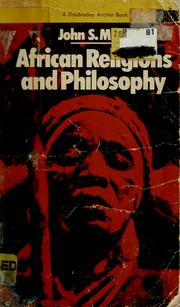
African religions and philosophy
Provides broad background on African religious worldviews relevant to interpreting spirit beliefs and accusations.

Magic, science, and religion, and other essays
Introduces foundational ideas about magic, uncertainty and belief in times of stress.
Endnotes
1.
Source: cambridge.org
Link:https://www.cambridge.org/core/journals/africa/article/abs/night-war-of-nampula-vulnerable-children-social-change-and-spiritual-insecurity-in-northern-mozambique/74DFD6A2F3ACB9F58C047BEAD507147A
Source snippet
Cambridge University Press & Assessment‘THE NIGHT WAR OF NAMPULA’: VULNERABLE CHILDREN, SOCIAL CHANGE AND SPIRITUAL INSECURITY IN NORTHER...
2.
Source: cambridge.org
Link:https://www.cambridge.org/core/journals/comparative-studies-in-society-and-history/article/memories-of-violence-cultural-transformations-of-cannibals-and-indigenous-statebuilding-in-postconflict-mozambique/49312841695212FA6C0565BEA051DE14
Source snippet
Cambridge University Press & AssessmentMemories of Violence, Cultural Transformations of Cannibals, and Indigenous State-Building in Post...
3.
Source: cambridge.org
Link:https://www.cambridge.org/core/journals/comparative-studies-in-society-and-history/article/abs/memories-of-violence-cultural-transformations-of-cannibals-and-indigenous-statebuilding-in-postconflict-mozambique/49312841695212FA6C0565BEA051DE14
Source snippet
Cambridge University Press & AssessmentMemories of Violence, Cultural Transformations of Cannibals, and Indigenous State-Building in Post...
4.
Source: sciencedirect.com
Link:https://www.sciencedirect.com/science/article/abs/pii/S0277953610003540
Source snippet
The epidemiology of spirit possession in the aftermath of mass political violence in Mozambique - ScienceDirect...
5.
Source: cambridge.org
Link:https://www.cambridge.org/core/journals/journal-of-african-history/article/abs/war-witches-and-traitors-cases-from-the-mplas-eastern-front-in-angola-19661975/C9EE5649AA2163F08145743940D34ADB
6.
Source: cambridge.org
Link:https://www.cambridge.org/core/journals/africa/health-sickness-and-medicine-in-africa-collection?aggs%5BproductTypes%5D%5Bfilters%5D=JOURNAL_ARTICLE
7.
Source: youtube.com
Title: Night War of Nampula
Link:https://www.youtube.com/watch?v=xi5bF2Kj8P0
Source snippet
Healers and The Night War of Nampula: Vulnerable Children, Social Change, and Spiritual Insecurity...
8.
Source: researchgate.net
Link:https://www.researchgate.net/profile/Daria-Trentini
Additional References
9.
Source: africabib.org
Link:https://www.africabib.org/rec.php?RID=407464336
Source snippet
AfricaBib | 'The night war of Nampula': vulnerable children, social change and spiritual insecurity in northern Mozambique...
10.
Source: pentecostaltheology.com
Title: Pentecostalism and Witchcraft: Spiritual Warfare | Pentecostal Theology
Link:https://www.pentecostaltheology.com/pentecostalism-and-witchcraft-spiritual-warfare/
Source snippet
May 13, 2020 — CHAPTER 2 German Pentecostal Witches and Communists: The Violence of Purity and Sameness Bjørn Enge Bertelsen introduction...
Published: May 13, 2020
11.
Source: periodicos.unb.br
Title: br O que os negacionismos negam?
Link:https://periodicos.unb.br/index.php/anuarioantropologico/article/view/51426
Source snippet
Gestão do oculto e produção da verdade a partir de uma etnografia da política no norte de Moçambique | Anuário AntropológicoAugust 28, 20...
12.
Source: youtube.com
Link:https://www.youtube.com/watch?v=st4uWIHc2YY
Source snippet
The Gamba Spirits of Gorongosa: Post-War Possession and Healing in Mozambique...
13.
Source: youtube.com
Title: The Gamba Spirits of Gorongosa: Post-War Possession and Healing in Mozambique
Link:https://www.youtube.com/watch?v=Obf_AVLUN9Q
Source snippet
Cleansing Rituals and Post-War Reintegration: Healers as Mental Health Agents in Mozambique...
14.
Source: youtube.com
Link:https://www.youtube.com/watch?v=BkInvzS38ok
Source snippet
How Healers Address the Invisible Wounds of Mozambique’s Civil War...
15.
Source: link.springer.com
Link:https://link.springer.com/chapter/10.1007/978-3-319-56068
Source snippet
Pentecostal Witches and Communists: The Violence of Purity and Sameness | Springer Nature LinkOctober 31, 2017 — GERMAN PENTECOSTAL WITCH...
Published: October 31, 2017
16.
Source: ascleiden.nl
Title: new titles
Link:https://www.ascleiden.nl/content/new-titles?page=179
Source snippet
Page 180 | African Studies Centre LeidenMay 8, 2017 — Kenya "Whoever leaves their traditions is a slave": contemporary notions of servit...
Published: May 8, 2017
17.
Source: researchgate.net
Link:https://www.researchgate.net/publication/305042385_%27THE_NIGHT_WAR_of_NAMPULA%27_VULNERABLE_CHILDREN_SOCIAL_CHANGE_and_SPIRITUAL_INSECURITY_in_NORTHERN_Mozambique
18.
Source: researchgate.net
Link:https://www.researchgate.net/publication/266080269_Memories_of_Violence_Cultural_Transformations_of_Cannibals_and_Indigenous_State-Building_in_Post-Conflict_Mozambique
Topic Tree