Within Timor Leste
Who Decides What Really Happened?
Autopsies, prosecutions and local mediation reveal who could define truth when supernatural accusations followed unexplained deaths.
On this page
- Forensic evidence and natural causes of death
- How courts treated belief and criminal responsibility
- The roles of police, priests and community leaders
Page outline Jump by section
Introduction
In Timor-Leste, disputes over alleged sorcery have often raised a practical question rather than a purely religious one: who has the authority to decide why somebody died? When an unexpected death was widely believed to have been caused by supernatural forces, several competing systems of authority could become involved. Families sought explanations through customary belief, traditional healers or religious leaders; police investigated possible crimes; doctors looked for medical causes; and courts had to decide whether there was evidence of criminal responsibility rather than supernatural guilt.
This tension has become one of the most revealing features of Timor-Leste’s experience with sorcery accusations. The country’s legal system has generally rejected supernatural claims as proof of criminal responsibility, while recognising that such beliefs remain socially important. Medical investigations, especially the rare use of forensic autopsies, have sometimes provided evidence that directly challenged accusations of sorcery and helped prevent further violence.[sciencedirect.com]sciencedirect.comScienceDirect Alleged lethal sorcery in East TimorAlleged lethal sorcery in East Timor - ScienceDirectJanuary 6, 2004…
Why unexplained deaths became legal disputes
Most serious accusations followed sudden illness or unexpected death. In many rural communities, limited access to healthcare and the rarity of post-mortem examinations meant that families often lacked a clear medical explanation for what had happened. Without an obvious cause, rumours could quickly fill the gap.
Belun’s Early Warning and Early Response programme observed that accusations commonly emerged after deaths that were medically unexplained or poorly understood. The organisation noted that autopsies were seldom performed and that limited confidence in medical diagnosis created space for speculation about supernatural intervention. Traditional healers, relatives or neighbours might identify an alleged sorcerer, turning grief into a conflict that could escalate into assault, displacement or homicide.[belun.tl]belun.tlALERT _______________…
Importantly, this was not simply a clash between “science” and “superstition”. For many families, accusations were also shaped by longstanding disputes over land, inheritance, kinship or personal rivalries. A belief in sorcery supplied an explanation that seemed morally satisfying even when no physical evidence existed.[belun.tl]belun.tlALERT _______________…
Forensic evidence and natural causes of death
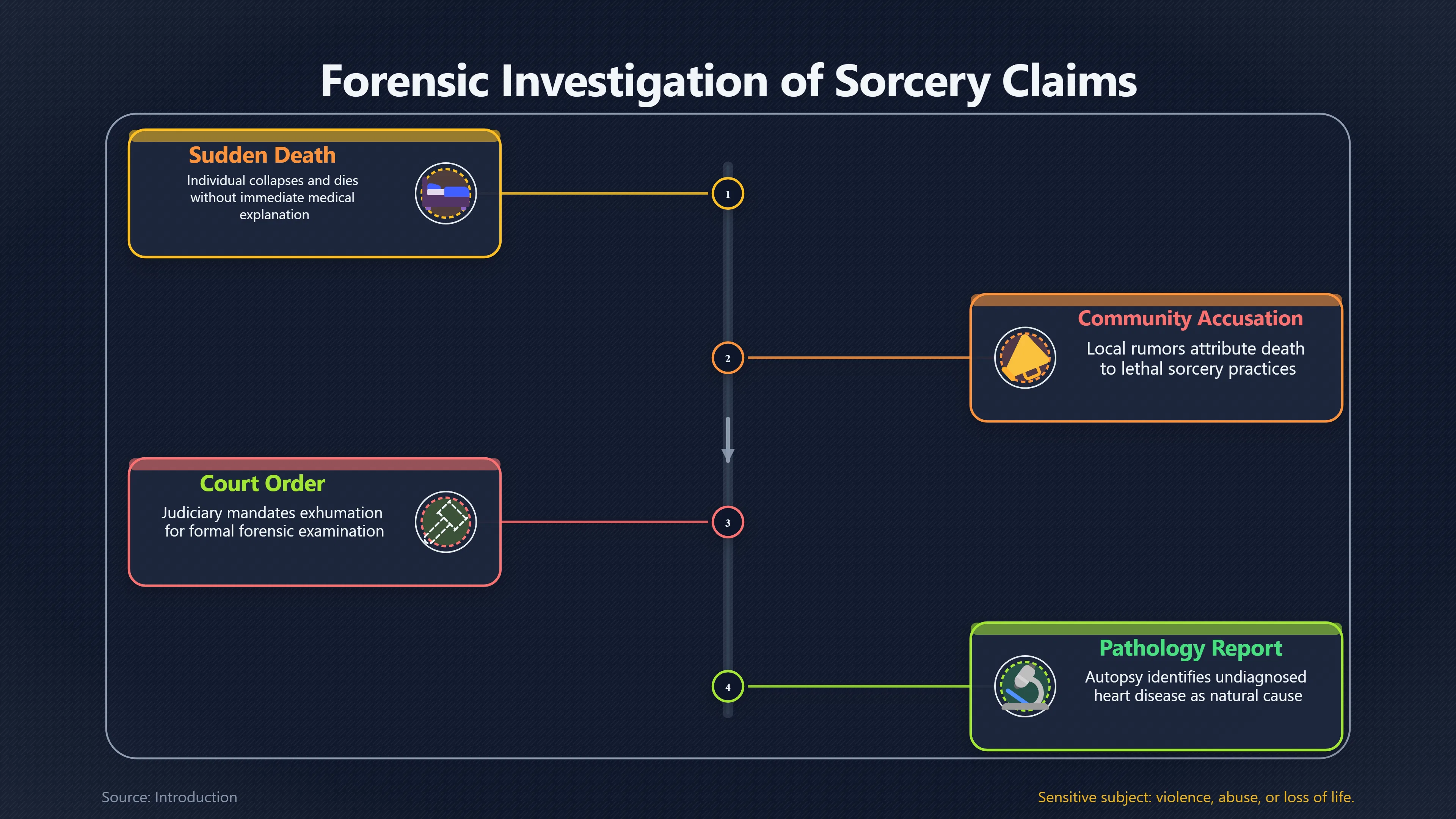
One of the clearest examples of medicine altering the course of a sorcery allegation comes from a forensic case reported in Forensic Science International.
A 53-year-old man collapsed suddenly and died after leaving the house of a local religious figure. He was buried, but weeks later local accusations claimed that he had been killed through a form of lethal sorcery known locally as ema halo. Rather than accepting the accusation, the local court ordered the body to be exhumed for forensic examination.
The autopsy found no evidence of supernatural killing or poisoning. Instead, pathologists discovered severe previously undiagnosed heart disease, including dilation associated with a bicuspid aortic valve and a sinus of Valsalva aneurysm. The medical findings established that the man had died from natural causes. The authors argued that many deaths attributed to sorcery in societies with limited death-investigation systems may in reality result from undiagnosed disease, although they also cautioned that proper forensic investigation is necessary because assumptions alone cannot determine the cause of death.[ScienceDirect]sciencedirect.comScienceDirect Alleged lethal sorcery in East TimorAlleged lethal sorcery in East Timor - ScienceDirectJanuary 6, 2004…
The case illustrates an important feature of Timor-Leste’s justice system after independence. Rather than treating belief as evidence, courts increasingly relied on physical investigation where possible. Even a single well-documented autopsy could fundamentally change how an entire community interpreted a suspicious death.[ScienceDirect]sciencedirect.comScienceDirect Alleged lethal sorcery in East TimorAlleged lethal sorcery in East Timor - ScienceDirectJanuary 6, 2004…
How courts separated belief from criminal responsibility
Timor-Leste’s courts have generally drawn a clear legal distinction between sincerely held belief and lawful justification.
Defendants may genuinely believe that another person caused illness through sorcery, but this belief does not excuse assault or homicide. Court proceedings involving killings of people accused of witchcraft have instead focused on ordinary criminal offences such as murder or assault, regardless of the alleged supernatural motive. Earlier prosecutions under the United Nations transitional administration and later convictions by Timorese courts demonstrate the state’s attempt to establish that violent retaliation remains criminal even where accusations are culturally meaningful.[SUB Hamburg Journals]journals.sub.uni-hamburg.deOpen source on uni-hamburg.de.
This approach reflects a broader constitutional commitment to the rule of law. Legal scholars Rebecca Strating and Beth Edmondson argue that extrajudicial punishment based on witchcraft accusations creates a direct challenge for a democratic state because it substitutes local supernatural judgement for equal legal protection. From the perspective of the courts, the question is not whether people sincerely believe in harmful magic but whether there is admissible evidence of a recognisable criminal act.[SUB Hamburg Journals]journals.sub.uni-hamburg.deOpen source on uni-hamburg.de.
The roles of police, priests and community leaders
In practice, determining “what really happened” rarely depended on a single institution.
Police were expected to investigate violence and preserve public order, yet officers often encountered communities whose first instinct was to seek customary explanations. Some local disputes therefore involved simultaneous processes: police investigations, mediation by village leaders, advice from Catholic clergy and discussions within customary authority structures.
Catholic priests sometimes played contradictory roles. In some reported incidents, a priest’s opinion was interpreted by relatives as confirming suspicions against an accused individual, helping to inflame conflict. In other situations, clergy attempted reconciliation or discouraged violence. Their influence reflected the Church’s considerable social authority rather than any formal legal power over criminal investigations.[belun.tl]belun.tlALERT _______________…
Customary leaders also remained influential because they were often trusted more than distant state institutions. Belun documented cases in which accused individuals themselves initiated customary or formal legal proceedings against their accusers. The organisation suggested that customary dispute-resolution mechanisms, when focused on mediation rather than punishment, could sometimes reduce tensions before violence occurred.[belun.tl]belun.tlALERT _______________…
Why medical proof alone was not always enough
Although forensic medicine can establish a biological cause of death, it does not necessarily settle every social question surrounding a tragedy.
Even where an autopsy identifies heart disease, stroke or infection, relatives may still ask why that particular person died at that particular moment. Within communities where supernatural explanations coexist with Catholic belief and customary traditions, medical findings answer one question while leaving others about fate, morality or spiritual responsibility unresolved.
Researchers therefore caution against viewing these disputes as simple contests between modern medicine and traditional belief. Medical evidence is most effective when accompanied by trusted communication, accessible healthcare and confidence that police and courts will respond fairly. Without that wider institutional trust, rumours may continue despite scientific findings.[sciencedirect.com]sciencedirect.comScienceDirect Alleged lethal sorcery in East TimorAlleged lethal sorcery in East Timor - ScienceDirectJanuary 6, 2004…
What the search for proof reveals about Timor-Leste
The history of sorcery accusations in Timor-Leste shows that arguments about unexplained death are also arguments about authority.
Forensic medicine asks what physical process caused death. Courts ask whether there is legally admissible evidence that a crime occurred. Police investigate facts, while customary leaders and religious figures may address the social and moral consequences for families and communities. These different approaches do not always compete directly, but they operate according to different standards of proof.
The gradual expansion of criminal investigations, forensic examination and formal prosecution has strengthened the state’s ability to reject violence based solely on supernatural accusation. At the same time, the persistence of customary beliefs reminds policymakers that evidence alone rarely resolves communal conflict unless it is accompanied by trusted institutions capable of convincing grieving families that justice has genuinely been done.[sciencedirect.com]sciencedirect.comScienceDirect Alleged lethal sorcery in East TimorAlleged lethal sorcery in East Timor - ScienceDirectJanuary 6, 2004…
Amazon book picks
Further Reading
Books and field guides related to Who Decides What Really Happened?. Use these as the next step if you want deeper reading beyond the article.
The poisoner's handbook
Demonstrates how scientific investigation can replace rumour and suspicion with evidence when causes of death are disputed.

East Timor
Helps explain the post-conflict state, competing authorities and fragile institutions within which sorcery-related disputes were adjudica...
A Not-So-Distant Horror
First published 2004. Subjects: Autonomy and independence movements, Violence, Political atrocities, History, Timor island.
The rule of law
Clarifies why courts require evidence, procedural fairness and legal standards rather than supernatural accusation or communal certainty.
Endnotes
1.
Source: sciencedirect.com
Title: ScienceDirect Alleged lethal sorcery in East Timor
Link:https://www.sciencedirect.com/science/article/abs/pii/S0379073803003803
Source snippet
Alleged lethal sorcery in East Timor - ScienceDirectJanuary 6, 2004...
Published: January 6, 2004
2.
Source: belun.tl
Link:https://belun.tl/wp-content/uploads/2014/03/EWER-Alert-Violence-Sorcery-Accusations-Eng-FINAL_11-March-2014.pdf
Source snippet
ALERT ___________________________________________...
3.
Source: belun.tl
Title: EWE R Alert: Motivations and social impacts of accusations of sorcery — Belun
Link:https://www.belun.tl/en/atres-alerta-motivu-no-impaktu-sosial-kona-ba-duun-malu-buan-2/
4.
Source: sciencedirect.com
Link:https://www.sciencedirect.com/journal/forensic-science-international/vol/139/issue/1
5.
Source: sciencedirect.com
Link:https://www.sciencedirect.com/science/article/pii/S1353113105000064
6.
Source: sciencedirect.com
Title: Forensic science capacity development: A case study of Timor-Leste
Link:https://www.sciencedirect.com/science/article/pii/S2589871X24001001
7.
Source: belun.tl
Link:https://www.belun.tl/en/early-warning-and-early-response-ewer/ewer-publications/
8.
Source: journals.sub.uni-hamburg.de
Link:https://journals.sub.uni-hamburg.de/giga/jsaa/article/view/905.html
Additional References
9.
Source: sljfmsl.sljol.info
Link:https://sljfmsl.sljol.info/articles/10.4038/sljfmsl.v13i2.7908
Source snippet
over the superstition of practising black magic: A case report | Sri Lanka Journal of Forensic Medicine, Science & LawDecember 16, 2022 —...
Published: December 16, 2022
10.
Source: abc.net.au
Link:https://www.abc.net.au/news/2018-01-19/png-official-public-autopsy-proposal-to-combat-sorcery/9336110
Source snippet
ABC NewsJanuary 19, 2018 — Senior PNG health official calls for public autopsies to stamp out sorcery attacks Share Share article SENIOR...
Published: January 19, 2018
11.
Source: journals.sagepub.com
Title: Sage Journals Beyond Democratic Tolerance: Witch Killings in Timor-Leste
Link:https://journals.sagepub.com/doi/10.1177/186810341503400302
Source snippet
Sage JournalsBeyond Democratic Tolerance: Witch Killings in Timor-Leste - Rebecca Strating, Beth Edmondson, 2015...
12.
Source: researchgate.net
Title: 308336669 Death and sorcery
Link:https://www.researchgate.net/publication/308336669_Death_and_sorcery
Source snippet
Death and sorcery | Request PDFSeptember 1, 2016 — Voodoo Death Article * Jan 2002 * AM J PUBLIC HEALTH * W B CANNON View Alleged lethal...
Published: September 1, 2016
13.
Source: pubmed.ncbi.nlm.nih.gov
Title: Pub Med Alleged lethal sorcery in East Timor
Link:https://pubmed.ncbi.nlm.nih.gov/14687768/
Source snippet
Alleged lethal sorcery in East Timor - PubMed...
14.
Source: youtube.com
Title: Forensic Pathology, From Crime Scene to Courtroom Evidence to Testimony
Link:https://www.youtube.com/watch?v=r9wtXAdcvsk
Source snippet
Forensic evidence and expertise in court | The Courtroom...
15.
Source: youtube.com
Title: (Audio Described) NLM Visible Proofs Exhibition
Link:https://www.youtube.com/watch?v=RUooveY3mZU
Source snippet
Forensic Pathology, From Crime Scene to Courtroom Evidence to Testimony...
16.
Source: youtube.com
Title: Forensic evidence and expertise in court | The Courtroom
Link:https://www.youtube.com/watch?v=GTz_ZoeH7_g
Source snippet
Papua New Guinea: A War on Witches | 101 East...
17.
Source: easttimorlawandjusticebulletin.com
Link:https://www.easttimorlawandjusticebulletin.com/2010/02/east-timors-assassination-trial.html
18.
Source: easttimorlawandjusticebulletin.com
Link:https://www.easttimorlawandjusticebulletin.com/2012/
Source snippet
East Timor Law and Justice Bulletin: 2012...
Topic Tree