When Fear and Belief Swept Through France
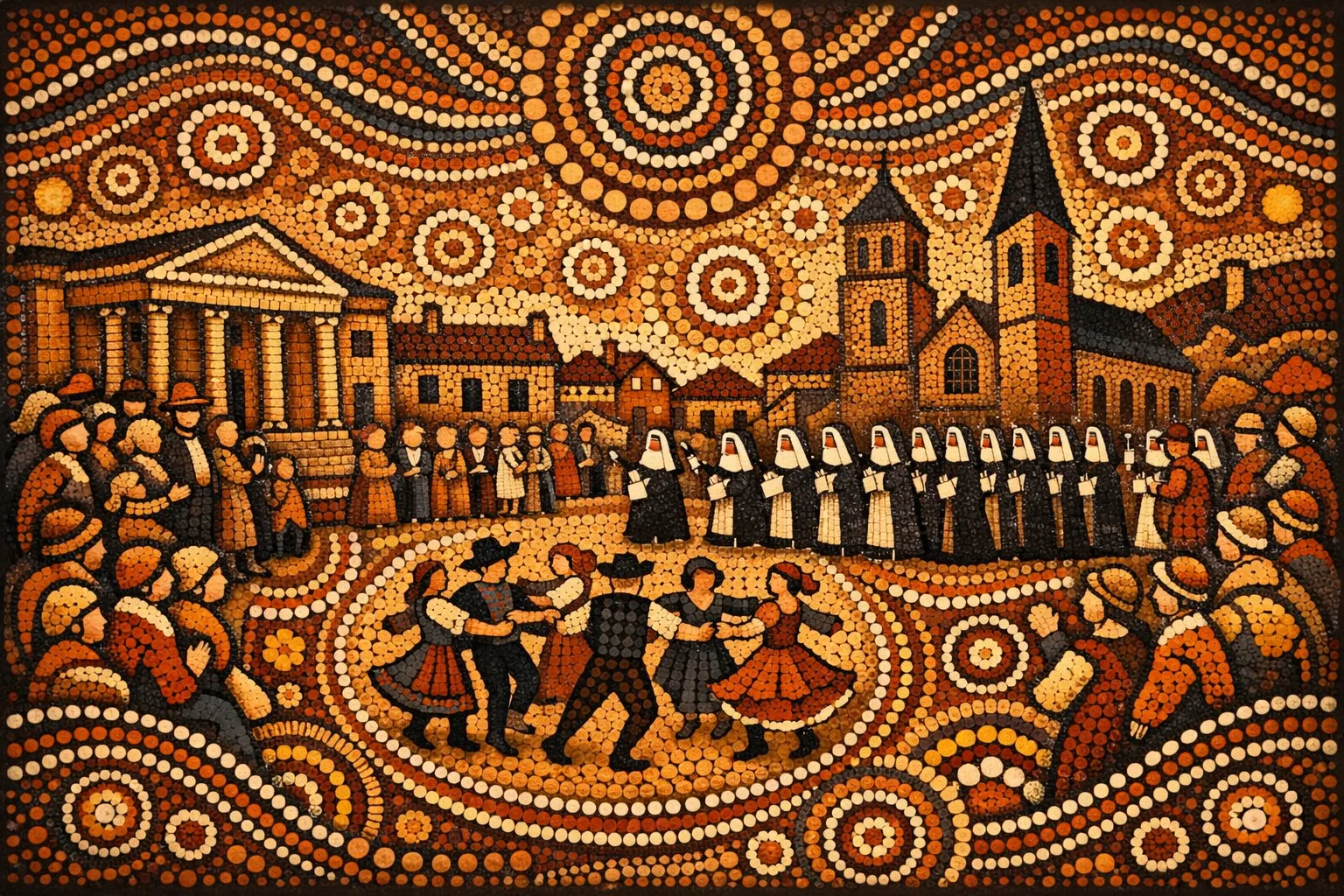
France’s history of collective belief and fear is not one continuous story of “mass hysteria”. It is a series of very different episodes: regional witch persecutions, staged public exorcisms, miracle movements, revolutionary rumour panics, apocalyptic religious violence and modern scares about manipulative groups. Some involved genuine crimes or coercion.
Page outline Jump by section
Introduction
The most revealing cases show that panics rarely arise from credulity alone. They spread when an alarming claim fits existing pressures: war, hunger, disease, religious conflict, political rivalry or distrust of institutions. Courts, clergy, newspapers and government agencies can restrain such fears, but they can also authenticate and amplify them. Modern France therefore presents a double lesson. Collective belief can cause serious harm, yet campaigns against supposed dangerous movements can themselves become indiscriminate when labels replace evidence.
Witchcraft was never one national French panic
Early modern France experienced substantial witch persecution, but there was no single nationwide witch hunt directed by a uniform French law. Prosecution depended heavily on local courts, regional politics and shifting borders. Trials were particularly intense in some eastern and north-eastern territories, including areas that lie in present-day France but then belonged wholly or partly to the Holy Roman Empire. Surviving records are incomplete, making confident national execution totals impossible.[uni-muenchen.de]mpra.ub.uni-muenchen.deThis paper explores the rise of the fiscal state in the early modern period and its impact on legal capacity.Read more…
Accusations commonly began with recognisable village conflicts: an illness, a failed harvest, the death of livestock, a quarrel followed by misfortune or a person already regarded as troublesome. Demonological teaching then supplied a larger explanation. The suspected neighbour was no longer merely malicious but an agent of Satan, supposedly operating through secret pacts, night meetings and harmful magic. Religious warfare between Catholics and Protestants made such interpretations more plausible, while plague and subsistence crises heightened the search for human causes of disaster.
Yet French institutions sometimes acted as brakes on persecution. The Parlement of Paris, a senior court with authority over much of northern France, regularly reviewed provincial decisions and overturned many death sentences. Research linking trial patterns to state development suggests that witch prosecutions flourished most readily where central legal oversight was weak. As royal administration and professional judicial review became stronger, local courts found it harder to condemn people on spectral claims, forced confessions or doubtful testimony.[Munich Personal RePEc Archive]mpra.ub.uni-muenchen.deThis paper explores the rise of the fiscal state in the early modern period and its impact on legal capacity.Read more…
This matters because the decline of witch trials was not simply a sudden triumph of science over superstition. It also reflected changes in legal procedure and political authority. Judges became more demanding about proof, appellate courts checked local zeal, and the monarchy increasingly treated alleged magic as fraud, poisoning or public disorder rather than as evidence of a supernatural conspiracy. Louis XIV’s edict of 1682 helped consolidate that change by reframing many magical practices as deception or sacrilege rather than prosecutable witchcraft in the older sense.[Geneafinder]geneafinder.comwitch trials in france tracing persecuted ancestorsThe Edict of July 1682 definitely decriminalizes witchcraft in France, attributing it solely to prejudices and superstitions. The text…
Loudun turned possession into political theatre
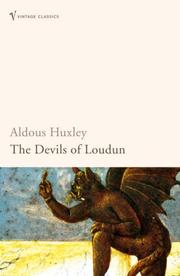
The possessions at Loudun in the 1630s are among the clearest French examples of religious fear becoming a public spectacle with lethal consequences. Ursuline nuns reported visions, convulsions and demonic possession. During exorcisms, the local priest Urbain Grandier was accused of bewitching them. He was tried for sorcery, tortured and burned in 1634. The possession performances and exorcisms continued after his death, weakening the claim that removing him had removed their supernatural cause.[bps.org.uk]bps.org.uklooking back possessions loudunLooking Back: The possessions at Loudun | BPS18 Feb 2014 — On 18 August 1634, the parish priest Urbain Grandier was found guilty of so…
Loudun was not merely an outbreak of unusual behaviour inside an isolated convent. The town had experienced fierce Catholic–Protestant tension, while Grandier had accumulated influential enemies. Cardinal Richelieu’s government had political interests in Loudun and entrusted the proceedings to Jean de Laubardemont, an official with extraordinary powers. Grandier’s supposed pact with demons, presented as evidence, has long been regarded with suspicion. The trial denied him normal avenues of appeal and converted disputed symptoms into proof of an organised satanic attack.
Modern accounts have proposed repression, suggestion, imitation, political manipulation, sincere religious experience and deliberate performance in varying combinations. Calling the episode “collective hysteria” may capture its contagious behaviour but can conceal the institutional machinery around it. The nuns did not create Grandier’s prosecution by themselves. Clerics interpreted their symptoms, exorcists displayed them before audiences, officials recorded accusations, and judges imposed a predetermined supernatural narrative.[BPS]bps.org.uklooking back possessions loudunLooking Back: The possessions at Loudun | BPS18 Feb 2014 — On 18 August 1634, the parish priest Urbain Grandier was found guilty of so…
Loudun remains culturally important because later writers and filmmakers transformed it into a story about sexual repression, authoritarian religion and political persecution. Those themes are grounded in real tensions, but dramatic retellings can make every participant appear either fraudulent or irrational. The historical evidence supports a more unsettling conclusion: sincere belief, performance, institutional self-interest and state power can operate at the same time.
Strasbourg’s dancers show the danger of a perfect explanation
The dancing epidemic of 1518 is frequently presented as a French case, although Strasbourg was then a free imperial city within the Holy Roman Empire, not part of the Kingdom of France. It belongs to the social history of the territory that later became French, but describing it simply as an event in “medieval France” erases an important political distinction.
Accounts describe people dancing compulsively in public over several weeks. Municipal authorities initially responded by allowing or encouraging continued dancing, apparently believing that sufferers needed to exhaust the condition. Musicians and spaces for dancing were reportedly provided before the policy was reversed and religious remedies were pursued. Estimates of the number affected vary substantially, while popular claims of large numbers dying each day are less secure than the basic evidence that a serious and disruptive outbreak occurred.[BPS]bps.org.ukdancing plagues and mass hysteriadancing plagues and mass hysteria
The best-known modern interpretation describes the epidemic as a culturally shaped stress response. Strasbourg and its surroundings had endured hunger, disease, cold weather and intense religious anxiety. Belief in divinely imposed dancing curses could have supplied a recognised form through which distress was expressed and imitated. In this view, people did not consciously choose to pretend: expectation and observation helped produce involuntary symptoms in susceptible individuals.[bps.org.uk]bps.org.ukdancing plagues and mass hysteriadancing plagues and mass hysteria
Ergot poisoning, caused by fungus-contaminated grain, is often offered as a rival explanation. It is an attractive theory because ergot can cause spasms and hallucinations, but it does not readily explain prolonged, coordinated dancing that spread through observation and local belief. Even so, “mass psychogenic illness” should remain an interpretation rather than a retrospective medical certainty. The surviving evidence is fragmentary, later narratives may have exaggerated the event, and no clinician examined the dancers using modern methods.
Miracles at Saint-Médard became a struggle over authority
In Paris during the 1720s and 1730s, the grave of the Jansenist deacon François de Pâris became associated with reported cures, trances and convulsions. Visitors gathered at the Saint-Médard cemetery, where some experienced violent bodily movements or claimed miraculous healing. The participants became known as the Convulsionaries. They emerged from Jansenism, a Catholic reform movement condemned by papal and royal authority, although only a minority of Jansenists embraced the convulsionary phenomenon.[wikipedia.org]WikipediaConvulsionnaires of Saint-MédardConvulsionnaires of Saint-Médard
The central question was not simply whether the convulsions were medically “real”. Bodies were being used as evidence in a political and religious dispute. Supporters argued that miracles at a Jansenist grave showed divine approval of a persecuted cause. Critics described the same behaviour as fanaticism, imposture, uncontrolled imagination or dangerous enthusiasm. Printed testimonies circulated accounts of cures and suffering, carrying the controversy beyond the cemetery.
The authorities closed Saint-Médard cemetery in 1732, but suppression did not end the movement. Convulsionary practices continued in private settings and some became more extreme, involving participants who sought blows, pressure or other painful ordeals while claiming supernatural protection. The state could disperse a crowd, but it could not easily settle what the participants believed their experiences meant.
This episode illustrates why hostile labels require care. The Convulsionaries were not simply members of a deceptive “cult”, nor were all reported miracles verified. They were part of a religious opposition movement whose bodily practices blurred devotion, protest, performance and altered states. Arguments about their sanity often doubled as arguments about whether marginal believers were entitled to challenge church and royal authority.[wikipedia.org]WikipediaConvulsionnaires of Saint-MédardConvulsionnaires of Saint-Médard
The Great Fear spread through believable rumours
In July and early August 1789, shortly after the fall of the Bastille, rumours of approaching brigands swept through large parts of rural France. Villagers armed themselves, rang alarm bells and formed defensive groups. In several regions, when the expected attackers failed to appear, crowds turned towards manor houses and destroyed documents recording feudal dues. The episode became known as the Great Fear.[jstor.org]jstor.orgOpen source on jstor.org.
The rumours were often false in their immediate details, but they were not detached from reality. Grain shortages, high prices, vagrancy, political breakdown and local unrest had made violence plausible. Many peasants believed that aristocrats were sponsoring brigands to destroy crops or punish communities for revolutionary activity. Different rumour streams appeared in different regions rather than spreading from a single national source.
Historian Georges Lefebvre’s influential interpretation treated the panic as socially structured, not as a meaningless loss of reason. More recent modelling has similarly suggested that rumour transmission followed geographical routes and was associated with economic pressures such as wheat prices. The people involved acted on bad information, but their fears reflected real insecurity and antagonism over land, food and power.[jstor.org]jstor.orgOpen source on jstor.org.
The political consequences were substantial. Fear travelled in both directions: villagers feared brigands and noble retaliation, while landowners and deputies feared peasant revolt. That atmosphere helped push the National Assembly towards the August Decrees attacking feudal privileges. The Great Fear therefore shows how a rumour panic can be factually mistaken yet historically effective. It changed behaviour, redistributed power and helped destroy the institutions that had made the rumour seem credible.
The Affair of the Poisons mixed real murder with imagined conspiracy
The Affair of the Poisons, investigated mainly between 1679 and 1682, cannot be reduced to either a witch panic or an entirely invented conspiracy. Poisoning was real. The earlier prosecution of the Marquise de Brinvilliers had demonstrated that aristocratic murder by poison was possible, and subsequent investigations uncovered networks dealing in poisons, fortune-telling, illicit remedies and purported magic. Members of elite society became implicated, bringing the scandal close to Louis XIV’s court.[loc.gov]guides.loc.govResearch Guides Witch Trials & WitchcraftThis was perhaps influenced…Read more…
At the same time, interrogation and rumour expanded the case beyond demonstrable poisoning. Claims about sacrilege, demonic rites and ritual murder entered proceedings in which suspects had strong incentives to accuse others. Because poison was difficult to detect and court life was secretive, almost any sudden illness could appear suspicious. A genuine criminal market became the foundation for a much broader fear that hidden practitioners could kill at will.
A special tribunal investigated hundreds of people, and dozens were executed, imprisoned or exiled. Yet some testimony was suppressed when allegations approached Madame de Montespan, a former royal favourite. The crown’s response was therefore both punitive and politically selective: it pursued lower-status poisoners while containing evidence that threatened the monarchy’s reputation.
The affair helped move French law away from prosecuting witchcraft as a supernatural offence. Authorities increasingly separated tangible crimes such as poisoning, fraud and sacrilege from claims that magic itself had caused physical harm. That shift did not eliminate belief in occult danger, but it changed what courts were prepared to recognise as proof.[Geneafinder]geneafinder.comwitch trials in france tracing persecuted ancestorsThe Edict of July 1682 definitely decriminalizes witchcraft in France, attributing it solely to prejudices and superstitions. The text…
Apocalyptic violence reshaped France’s idea of “sects”
The deaths associated with the Order of the Solar Temple in the 1990s transformed French public debate about minority religions. The movement combined esoteric Christianity, Templar imagery, ecological catastrophe and the belief that selected members would pass to a higher existence associated with the star Sirius. Its leaders, Joseph Di Mambro and Luc Jouret, exercised extensive authority while surrounding their teachings with staged rituals and deception.
Between 1994 and 1997, 74 members and related victims died in Switzerland, Canada and France. The deaths were sometimes described collectively as mass suicide, but investigations showed a mixture of suicide, coerced death and murder. Sixteen people, including three children, were found dead in the Vercors region of France in December 1995. Treating every victim as a voluntary believer obscures the violence and unequal power within the organisation.[wikipedia.org]WikipediaOrder of the Solar TempleOrder of the Solar Temple
The case encouraged French politicians and news organisations to view a wide range of unfamiliar religious groups through the lens of an impending collective catastrophe. A parliamentary commission published a controversial 1995 report identifying organisations it considered “sects”. Although intended to improve prevention, the use of lists risked treating association with an unpopular movement as evidence of harmful conduct. Scholars of new religious movements and religious-liberty advocates argued that the category was unstable and that very different groups were being placed together.[assemblee-nationale.fr]assemblee-nationale.frOpen source on assemblee-nationale.fr.
The Solar Temple posed a real public-safety problem. The wider scare arose when its exceptional violence became a template for judging unrelated organisations. Groups including the Raëlians faced speculation that they might also be preparing collective suicide, despite rejecting the allegation. This is a classic mechanism of moral panic: a documented atrocity lowers the threshold for believing similar claims about anyone who shares its most visible features.
UFO religion, publicity and the Raëlian controversy
The Raëlian movement began in France after Claude Vorilhon, later known as Raël, said he had encountered extraterrestrials in the Auvergne in 1973. He taught that advanced beings had created humanity through science and would eventually return if people built an embassy for them. The movement combined ancient-astronaut ideas, sexual liberalism, technological optimism and a hierarchical religious organisation.[Wikipedia]WikipediaOpen source on wikipedia.org.
Raëlism is regularly called a cult in journalism and by some scholars, but “UFO religion” or “new religious movement” is more descriptive when discussing its beliefs. Controversy should focus on specific conduct rather than the strangeness of extraterrestrial theology. Its public campaigns, provocative symbolism and later advocacy of human cloning were designed partly to attract attention, making it difficult to separate doctrine, publicity strategy and claims intended to shock.
That problem was evident in 2002 when Clonaid, an organisation linked to senior Raëlian figures, announced that it had produced a cloned baby. No verifiable evidence was supplied. The claim generated global coverage because it joined a dramatic religious movement to a genuine scientific and ethical anxiety. The episode demonstrates how modern miracle claims can be framed in technological rather than supernatural language: laboratory secrecy replaces the sacred shrine, while a press conference replaces public testimony of a cure.
The proper response is neither automatic belief nor dismissal based solely on the group’s reputation. Extraordinary biomedical claims require independently examinable evidence. No such evidence established the announced cloning. The broader fear that every unusual religious movement was potentially another Solar Temple also did not constitute proof of planned violence.
France built a distinctive anti-cult system
France’s modern response is unusual because the state has created permanent institutions specifically concerned with harmful conduct linked to sectarian influence. The current body, Miviludes, was established in 2002 after earlier interministerial organisations. It says its task is to observe and analyse “sectarian deviations”, coordinate public authorities, inform professionals and support the protection of victims. Crucially, French law does not provide a simple legal definition of a “sect”. The official emphasis is therefore supposed to fall on conduct that infringes rights, exploits vulnerability or threatens health and safety.[wikipedia.org]WikipediaOpen source on wikipedia.org.
The About–Picard law of 2001 strengthened measures against organisations whose activities create or exploit psychological or physical subjection and violate fundamental rights. It allowed, under defined conditions, the civil dissolution of legal entities repeatedly convicted of serious offences and expanded the legal tools available against abuse of weakness. A further law adopted in 2024 strengthened action against sectarian abuses and victim support.[Légifrance]legifrance.gouv.frOpen source on gouv.fr.
This policy grew from legitimate concerns: fraud, sexual abuse, medical neglect, coercive control, financial exploitation and the isolation of children. Yet it has remained controversial. Critics argue that official warnings, parliamentary lists and the language of psychological subjection can stigmatise unpopular religions before wrongdoing is proved. Defenders respond that apparently voluntary relationships can conceal manipulation and that ordinary criminal categories do not always capture sustained coercive environments.
The most defensible principle is conduct-based scrutiny. A group should not be considered dangerous merely because it is small, demanding, apocalyptic or socially unconventional. Conversely, religious freedom should not shield assault, financial abuse, unlawful medical claims or coercion. France’s gradual shift from a “fight against sects” towards action against harmful sectarian practices reflects an attempt—still disputed—to draw that line.
Today’s warnings increasingly concern health and the internet
The contemporary French picture is less dominated by large, highly organised religious communities than public memories of the Solar Temple might suggest. Miviludes reports increasing concern about small networks and individual influencers operating in health, nutrition, coaching, wellbeing, personal development and alternative therapy. Its 2022–2024 reporting stated that referrals and requests had risen from 2,160 in 2015 to 4,571 in 2024, with a marked increase since the Covid-19 crisis. Young people accounted for 19 per cent of reports. These figures measure contacts with the agency, not proven crimes or a count of “cult members”, so they should not be treated as direct prevalence statistics.[Miviludes]miviludes.interieur.gouv.frMiviludes Les rapports d'activité de la MiviludesMiviludes Les rapports d'activité de la Miviludes
Digital platforms have altered the shape of influence. A charismatic leader no longer needs a rural commune or formal church. Followers can be drawn into closed messaging groups, subscription programmes or online courses that merge medical misinformation, conspiracy narratives, financial demands and claims of exclusive knowledge. The boundaries between a manipulative community, an aggressive business, an alternative-health network and an online fandom may be difficult to establish.
Health claims are especially consequential because belief can delay effective treatment. Warning signs include demands to abandon conventional care, claims that one method cures almost everything, pressure to cut off sceptical relatives, escalating payments and the explanation of every setback as proof that the follower has not committed fully enough. None of those signs alone proves the existence of a coercive movement, but together they justify careful investigation.
Official referral totals can also contribute to a scare if repeated without context. More reports may reflect increased harm, greater public awareness, broader administrative definitions or easier reporting. A serious public response must distinguish allegations, assessed risks, prosecutions and convictions rather than collapsing them into a single count.
What these episodes reveal
France’s most important panics and contagious beliefs did not spread because entire populations suddenly became irrational. They spread through institutions and relationships that made particular fears credible.
Existing pressure gave the claim emotional force. Hunger and feudal conflict shaped the Great Fear; religious division shaped Loudun and Saint-Médard; catastrophe and spiritual elitism shaped the Solar Temple.
Authorities could amplify what they meant to control. Loudun’s exorcists turned private symptoms into public proof. Strasbourg’s council reportedly enabled more dancing before changing course. Parliamentary and media reactions to the Solar Temple made the language of “sects” central to the treatment of many unrelated groups.
Real danger and exaggerated danger often coexisted. The Affair of the Poisons involved actual poisoning but also expansive occult accusations. The Solar Temple committed genuine violence, yet fear of another mass death was projected onto movements without equivalent evidence.
Labels determined who was heard. “Witch”, “possessed”, “fanatic”, “hysterical” and “cult member” all compress complicated people into categories. Sometimes those labels identify patterns of harm. At other times they turn religious minorities, women displaying distress or political opponents into convenient threats.
Belief produced material consequences whether or not its central claim was true. Imaginary brigands helped destroy feudal records. Alleged demons helped send Grandier to the stake. Claims of miracle and possession mobilised political constituencies. Fear of sectarian influence created lasting French institutions and laws.
The enduring value of these histories lies in resisting two easy conclusions. One is that unusual belief itself proves stupidity or danger. The other is that respect for belief requires ignoring coercion and harm. France’s record shows why both errors matter: people can be persecuted through collective fear, and they can also be exploited inside communities whose claims outsiders are reluctant to examine. The task is to test conduct and evidence without turning difference into guilt.
Amazon book picks
Further Reading
Books and field guides related to When Fear and Belief Swept Through France. Use these as the next step if you want deeper reading beyond the article.

The witch-hunt in early modern Europe
Strong foundation for French witchcraft and persecution.

Endnotes
1.
Source: Wikipedia
Title: Witch trials in France
Link:https://en.wikipedia.org/wiki/Witch_trials_in_France
2.
Source: geneafinder.com
Title: witch trials in france tracing persecuted ancestors
Link:https://geneafinder.com/blog/en/13-396/witch-trials-in-france-tracing-persecuted-ancestors
Source snippet
The Edict of July 1682 definitely decriminalizes witchcraft in France, attributing it solely to prejudices and superstitions. The text...
Published: July 1682
3.
Source: bps.org.uk
Title: looking back possessions loudun
Link:https://www.bps.org.uk/psychologist/looking-back-possessions-loudun
Source snippet
Looking Back: The possessions at Loudun | BPS18 Feb 2014 — On 18 August 1634, the parish priest Urbain Grandier was found guilty of so...
Published: August 1634
4.
Source: archive.org
Link:https://archive.org/details/historyofdevilso00desn
Source snippet
Internet ArchiveThe history of the devils of Loudun; the alleged possession...10 Aug 2010 — The history of the devils of Loudun; the all...
5.
Source: jstor.org
Link:https://www.jstor.org/stable/j.ctt807vs
6.
Source: bps.org.uk
Title: [dancing plagues]({{ ‘dancing-plague/’ | relative_url }}) and mass hysteria
Link:https://www.bps.org.uk/psychologist/dancing-plagues-and-mass-hysteria
7.
Source: pmc.ncbi.nlm.nih.gov
Title: PMCMass psychogenic illness and the social network
Link:https://pmc.ncbi.nlm.nih.gov/articles/PMC3536509/
8.
Source: Wikipedia
Title: Convulsionnaires of Saint-Médard
Link:https://en.wikipedia.org/wiki/Convulsionnaires_of_Saint-M%C3%A9dard
9.
Source: ebsco.com
Link:https://www.ebsco.com/research-starters/history/jansenist-convulsionnaires-gather-saint-medard
10.
Source: academia.edu
Link:https://www.academia.edu/79098037/The_Rhetoric_of_Pain_Religious_Convulsions_and_Miraculous_Healings_in_the_Jansenist_Parish_of_Saint_M%C3%A9dard_Paris
11.
Source: jstor.org
Link:https://www.jstor.org/stable/j.ctt7zvdbh
12.
Source: Wikipedia
Title: Great Fear
Link:https://en.wikipedia.org/wiki/Great_Fear
13.
Source: Wikipedia
Title: Affair of the Poisons
Link:https://en.wikipedia.org/wiki/Affair_of_the_Poisons
14.
Source: Wikipedia
Title: Order of the Solar Temple
Link:https://en.wikipedia.org/wiki/Order_of_the_Solar_Temple
15.
Source: Wikipedia
Link:https://en.wikipedia.org/wiki/Ra%C3%ABlism
16.
Source: Wikipedia
Link:https://en.wikipedia.org/wiki/MIVILUDES
17.
Source: Wikipedia
Title: Loudun possessions
Link:https://en.wikipedia.org/wiki/Loudun_possessions
18.
Source: Wikipedia
Title: Dancing plague of 1518
Link:https://en.wikipedia.org/wiki/Dancing_plague_of_1518
19.
Source: Wikipedia
Link:https://en.wikipedia.org/wiki/Mass
20.
Source: Wikipedia
Title: Dancing mania
Link:https://en.wikipedia.org/wiki/Dancing_mania
21.
Source: Wikipedia
Title: Urbain Grandier
Link:https://en.wikipedia.org/wiki/Urbain_Grandier
22.
Source: Wikipedia
Title: Satanic panic
Link:https://en.wikipedia.org/wiki/Satanic_panic
23.
Source: Wikipedia
Title: Mass psychogenic illness
Link:https://en.wikipedia.org/wiki/Mass_psychogenic_illness
24.
Source: academia.edu
Link:https://www.academia.edu/34319669/The_Affair_of_the_Poisons_satanism_witchcraft_and_black_magic_in_the_Court_of_the_Sun_King
25.
Source: academia.edu
Link:https://www.academia.edu/28591173/Holy_Mountains_and_Anti_Cult_Ecology_The_Campaign_Against_the_Aumist_Religion_in_France
26.
Source: jstor.org
Link:https://www.jstor.org/stable/10.1525/nr.2008.11.3.104
27.
Source: daily.jstor.org
Title: moral panics a syllabus
Link:https://daily.jstor.org/moral-panics-a-syllabus/
28.
Source: ebsco.com
Link:https://www.ebsco.com/research-starters/religion-and-philosophy/raelism
29.
Source: archive.org
Link:https://archive.org/details/greatfearof17890000unse
30.
Source: mpra.ub.uni-muenchen.de
Link:https://mpra.ub.uni-muenchen.de/34266/1/MPRA_paper_34266.pdf
Source snippet
This paper explores the rise of the fiscal state in the early modern period and its impact on legal capacity.Read more...
31.
Source: guides.loc.gov
Title: Research Guides Witch Trials & Witchcraft
Link:https://guides.loc.gov/feminism-french-women-history/witch-trials-witchcraft
Source snippet
This was perhaps influenced...Read more...
32.
Source: college-de-france.fr
Title: UPL13205 LePillouerThe two great fears of 1789
Link:https://www.college-de-france.fr/media/jon-elster/UPL13205_LePillouerThe_two_great_fears_of_1789.pdf
33.
Source: atlasobscura.com
Title: affair of the poisons france witch hunt occult
Link:https://www.atlasobscura.com/articles/affair-of-the-poisons-france-witch-hunt-occult
34.
Source: sk.sagepub.com
Link:https://sk.sagepub.com/ency/edvol/the-sage-encyclopedia-of-sociology-of-religion/chpt/order-the-solar-temple
35.
Source: med.virginia.edu
Title: report apocalyptic millennialism c1998
Link:https://med.virginia.edu/ciag/wp-content/uploads/sites/313/2015/12/report_apocalyptic_millennialism_c1998.pdf
36.
Source: assemblee-nationale.fr
Link:https://www.assemblee-nationale.fr/rap-enq/r2468.asp
37.
Source: miviludes.interieur.gouv.fr
Link:https://www.miviludes.interieur.gouv.fr/
38.
Source: miviludes.interieur.gouv.fr
Link:https://www.miviludes.interieur.gouv.fr/comprendre-prevenir-et-lutter/comment-identifier-derive-sectaire
39.
Source: legifrance.gouv.fr
Link:https://www.legifrance.gouv.fr/jorf/id/JORFTEXT000000589924
40.
Source: legifrance.gouv.fr
Link:https://www.legifrance.gouv.fr/loda/id/JORFTEXT000000589924/?lang=en
41.
Source: miviludes.interieur.gouv.fr
Title: Miviludes Les rapports d’activité de la Miviludes
Link:https://www.miviludes.interieur.gouv.fr/nos-ressources/nos-publications/rapports-dactivite-de-miviludes
42.
Source: miviludes.interieur.gouv.fr
Title: dossier de presse du rapport dactivite 2022 2024
Link:https://www.miviludes.interieur.gouv.fr/presse/dossiers-de-presse/dossier-de-presse-du-rapport-dactivite
43.
Source: miviludes.interieur.gouv.fr
Title: dossiers de presse
Link:https://www.miviludes.interieur.gouv.fr/presse/dossiers-de-presse
44.
Source: assemblee-nationale.fr
Link:https://www.assemblee-nationale.fr/12/rapports/r3179.asp
45.
Source: assemblee-nationale.fr
Link:https://www.assemblee-nationale.fr/dyn/10/questions/QANR5L10QE20060
46.
Source: petitions.assemblee-nationale.fr
Title: i 1354
Link:https://petitions.assemblee-nationale.fr/initiatives/i-1354
47.
Source: archives.assemblee-nationale.fr
Link:https://archives.assemblee-nationale.fr/10/cri/1995-1996-ordinaire1/126.pdf
48.
Source: assemblee-nationale.fr
Link:https://www.assemblee-nationale.fr/dossiers/sectes/r1687.pdf
49.
Source: assemblee-nationale.fr
Link:https://www.assemblee-nationale.fr/dossiers/sectes/r1687p3.asp
50.
Source: assemblee-nationale.fr
Link:https://www.assemblee-nationale.fr/12/rap-enq/r3507.asp
51.
Source: assemblee-nationale.fr
Link:https://www.assemblee-nationale.fr/rapports/r2472.asp
52.
Source: assemblee-nationale.fr
Title: N° 518
Link:https://www.assemblee-nationale.fr/12/propositions/pion0518.asp
53.
Source: dictionary.cambridge.org
Link:https://dictionary.cambridge.org/dictionary/english-chinese-traditional/mass
54.
Source: miviludes.interieur.gouv.fr
Title: interieur.gouv.fr Actualités
Link:https://www.miviludes.interieur.gouv.fr/actualites
55.
Source: miviludes.interieur.gouv.fr
Link:https://www.miviludes.interieur.gouv.fr/taxonomy/term/37
56.
Source: miviludes.interieur.gouv.fr
Link:https://www.miviludes.interieur.gouv.fr/comprendre-prevenir-et-lutter/quelle-politique-de-prevention
57.
Source: miviludes.interieur.gouv.fr
Title: interieur.gouv.fr Questions parlementaires | Miviludes
Link:https://www.miviludes.interieur.gouv.fr/nos-ressources/documents/travail-avec-parlement/questions-parlementaires
58.
Source: miviludes.interieur.gouv.fr
Title: contacts associations specialisees
Link:https://www.miviludes.interieur.gouv.fr/agir-et-etre-aide/contacts-associations-specialisees
59.
Source: legifrance.gouv.fr
Link:https://www.legifrance.gouv.fr/loda/id/JORFTEXT000000589924/2001
60.
Source: legifrance.gouv.fr
Title: rapport application loi 2024 420
Link:https://www.legifrance.gouv.fr/contenu/Media/files/autour-de-la-loi/legislatif-et-reglementaire/application-des-lois/rapports-sur-la-mise-en-application-des-lois/2025/rapport_application_loi_2024-420.pdf
61.
Source: legifrance.gouv.fr
Link:https://www.legifrance.gouv.fr/contenu/Media/files/autour-de-la-loi/legislatif-et-reglementaire/etudes-d-impact-des-lois/ei_art_39_2023/ei_iomd2327297l_cm_15.11.2023_0.pdf
62.
Source: legifrance.gouv.fr
Link:https://www.legifrance.gouv.fr/jorf/id/JORFTEXT000027379612
63.
Source: legifrance.gouv.fr
Title: Article 19
Link:https://www.legifrance.gouv.fr/loda/article_lc/LEGIARTI000049531610
64.
Source: haenfler.sites.grinnell.edu
Title: moral panic
Link:https://haenfler.sites.grinnell.edu/moral-panic/
65.
Source: sajp.org.za
Link:https://sajp.org.za/index.php/sajp/article/view/1671/2648
66.
Source: aph.gov.au
Link:https://www.aph.gov.au/DocumentStore.ashx?id=9d7726b7-ae8c-4326-b556-feba185ec66f
67.
Source: books.google.com
Title: The Order of the Solar Temple
Link:https://books.google.com/books/about/The_Order_of_the_Solar_Temple.html?id=Rb9hjbzVKO0C
Additional References
68.
Source: markkoyama.github.io
Title: As such, witches were most likely to be.Read more
Link:https://markkoyama.github.io/Papers/witchcraft-trials-france.pdf
Source snippet
Taxes, Lawyers, and the Decline of Witch Trials in Franceby ND Johnson · 2014 · Cited by 86 — Witchcraft was a very difficult crime to pr...
69.
Source: youtube.com
Title: How Rumors Spread Faster Than Revolution and Destroyed the French Kingdom
Link:https://www.youtube.com/watch?v=lSA8dQmmJGY
Source snippet
Inside the Final Days of the Solar Temple Cult...
70.
Source: govinfo.gov
Link:https://www.govinfo.gov/content/pkg/CHRG-107shrg72558/html/CHRG-107shrg72558.htm
71.
Source: atusyd.dk
Link:https://atusyd.dk/sites/default/files/media/activity/voltmer_ew_witch_hunts.pdf
72.
Source: basildonheritage.org.uk
Link:https://www.basildonheritage.org.uk/media/other/4247/BOOKLET-SS-DANCINGPLAGUE.pdf
73.
Source: study.com
Link:https://study.com/academy/lesson/dancing-plague-cause-origin.html
74.
Source: researchgate.net
Link:https://www.researchgate.net/publication/240760314_France%27s_War_on_Sects_A_Post911_Update
75.
Source: merriam-webster.com
Link:https://www.merriam-webster.com/dictionary/mass
76.
Source: collinsdictionary.com
Link:https://www.collinsdictionary.com/dictionary/english/mass
77.
Source: apothecaries.org
Link:https://www.apothecaries.org/wp-content/uploads/2019/06/Mass-psychogenic-illness-and-how-to-respond.pdf
Topic Tree
Follow this branch
Related pages 192
- Antigua and Barbuda
- Argentina Belief Scares
- Azerbaijan Belief
- Bahrain Beliefs
- North Korea
- +187 more in sidebar