When Belief and Fear Reshaped Rwanda
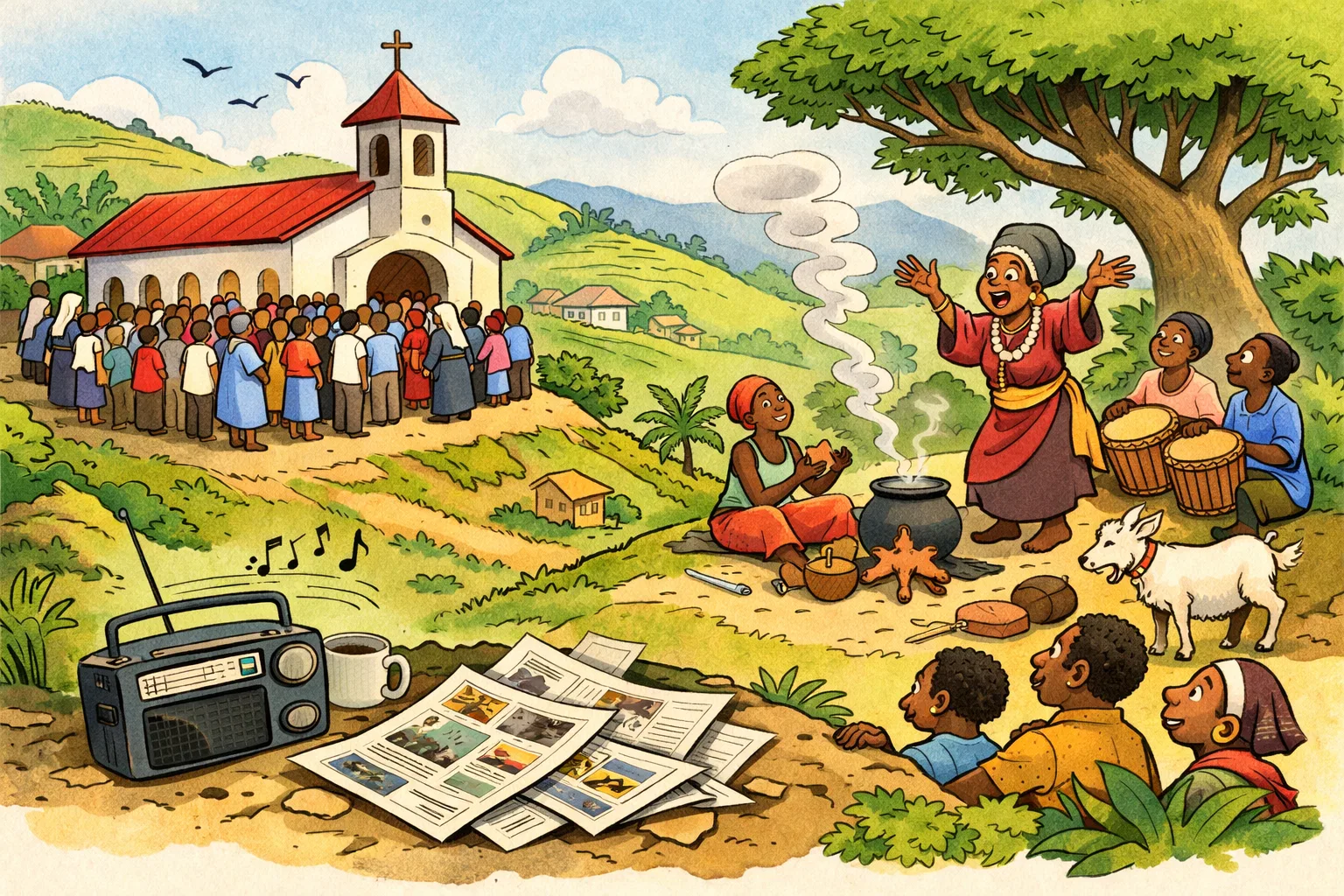
Rwanda’s history of contagious belief is not dominated by a single famous “cult” or classic witch panic.
Page outline Jump by section
Introduction
These episodes should not be collapsed into the loose label “mass hysteria”. They involve different mechanisms. Some were religious movements with political aims. Some concerned sincere visionary experiences. Some resembled mass psychogenic illness, in which real symptoms spread without an identified infectious or toxic cause. The genocide against the Tutsi, meanwhile, was organised political violence, not a spontaneous crowd delusion. Yet it also demonstrates how rumours, distorted history, dehumanising language and repeated warnings of imaginary danger can make extreme acts appear defensive or necessary.[Human Rights Watch]hrw.orgHuman Rights WatchHow It Was Prepared: Genocide: Ideology and OrganizationAmong the false ideas drawn on by political leaders and propag…
Why Rwanda does not fit a simple “mass hysteria” story
The phrase “mass hysteria” has often been used carelessly for almost any episode involving crowds, emotion or apparently irrational behaviour. It is particularly misleading in Rwanda, where social fears have frequently arisen amid real political conflict, colonial coercion, civil war and organised persecution.
Mass psychogenic illness has a narrower meaning. It describes the spread of physical symptoms within a connected group when investigation does not find an infectious, toxic or environmental agent capable of explaining the pattern. The symptoms are not necessarily pretended: stress, expectation and the sight or sound of other people becoming unwell can produce genuine fainting, tremors, breathing difficulty, pain or altered movement. School outbreaks are especially associated with close-knit groups, anxiety, strict institutional environments and rapid communication between pupils.[frontiersin.org]frontiersin.orgFrontiers Characteristics of Adolescents Affected by Mass Psychogenic IllnessFrontiersCharacteristics of Adolescents Affected by Mass Psychogenic Illness…November 16, 2020 — This paper presents the first systema…
A moral panic is different again. It develops when a person, minority or practice is portrayed as a grave threat to society, often through exaggerated or unverified claims. A religious vision need not be either illness or panic. Nor should an anti-colonial spiritual movement be dismissed as a “cult” simply because hostile authorities used supernatural language to discredit it.
These distinctions matter because calling everything hysteria can hide responsibility. The racist fear that preceded Rwanda’s 1994 genocide was cultivated by political leaders, newspapers, broadcasters, officials and militia organisers. Ordinary anxieties and historical memories helped the propaganda take hold, but the killing campaign was planned and directed rather than an inexplicable eruption of collective madness.[UN International Criminal Tribunal Rwanda]unictr.irmct.orgOpen source on irmct.org.
Nyabingi: spirit power and colonial resistance
One of Rwanda’s most important cases of contested religious labelling is the Nyabingi tradition of the northern Rwanda–southern Uganda borderlands. Nyabingi was understood as a powerful female spirit who communicated through mediums, many of them women. People approached these mediums for protection, healing, political guidance and help with misfortune.
European administrators commonly described Nyabingi practice as witchcraft, sorcery or a dangerous “cult”. Those labels reflected colonial assumptions as much as local reality. The movement did involve spirit possession and claims of supernatural power, but it also supplied a language of authority through which communities could resist taxation, imposed chiefs and foreign rule.[iiste.org]iiste.orgOpen source on iiste.org.
The best-known leader associated with the tradition was Muhumusa, whose life connected spiritual authority with a dispute over the Rwandan monarchy. Accounts differ over parts of her biography, including her exact relationship to King Kigeli IV Rwabugiri, but she presented her son as a legitimate claimant and challenged the authority of King Yuhi V Musinga. After moving through the border region, she became recognised as a medium of Nyabingi and attracted followers opposed to both royal and European demands.[murindwa-rutanga.com]murindwa-rutanga.comPEOPLE'S ANTI COLONIAL STRUGGLES IN KIGEZI UNDER THE NYABINGI MPEOPLE'S ANTI COLONIAL STRUGGLES IN KIGEZI UNDER THE NYABINGI M
German authorities arrested Muhumusa in 1908 and imprisoned her for what they characterised as witchcraft. She later escaped, and the movement continued to trouble colonial administrations. After armed resistance in the British-controlled Kigezi region, she was captured in 1911 and spent the remainder of her life in detention or restricted residence. Other mediums and leaders continued to invoke Nyabingi in later resistance.[iiste.org]iiste.orgOpen source on iiste.org.
It would therefore be inaccurate to present Nyabingi simply as a population gripped by supernatural panic. Belief in spirit power was sincere, but it also organised grievances that were plainly material: political displacement, taxation, forced obedience and the loss of local autonomy. Colonial officials’ emphasis on irrationality made resistance easier to portray as criminal manipulation rather than a response to foreign rule.
Nyabingi nevertheless belongs in the history of contagious belief because spiritual authority travelled through stories, ritual reputation and reports of possession. A medium’s influence depended partly on the shared expectation that the spirit could punish enemies or protect followers. Yet the movement’s spread cannot be understood without the political world that made such promises meaningful.
Kibeho: apparitions, crowds and retrospective prophecy
Rwanda’s most famous modern visionary episode began in November 1981 at a Catholic secondary school in Kibeho. Alphonsine Mumureke, a pupil at the school, reported seeing the Virgin Mary. Other pupils later claimed visions, and the events attracted growing attention from students, clergy, local residents and pilgrims.
The initial reaction was not uniform acceptance. Alphonsine faced ridicule and suspicion, while school authorities and church investigators tried to determine whether the experiences involved fraud, illness, religious devotion or something the Church could recognise as supernatural. Public apparitions and reported trances eventually drew large crowds, turning Kibeho into a national religious phenomenon.
In June 2001, Augustin Misago, the Catholic bishop of Gikongoro, formally approved the apparitions attributed to three visionaries: Alphonsine Mumureke, Nathalie Mukamazimpaka and Marie-Claire Mukangango. The declaration did not approve every person who later claimed visions at Kibeho, nor every message circulating under the site’s name. It stressed the need to separate the recognised cases from later additions, rumours and unresolved claims.[Vatican Press]press.vatican.vaOpen source on vatican.va.
Kibeho became internationally famous partly because of a disturbing vision reported in August 1982. Witness accounts described the visionaries reacting to scenes of slaughter, bodies and rivers of blood. After the 1994 genocide against the Tutsi, many believers interpreted this as a prophecy of the coming violence.
That interpretation has enormous emotional power, but it requires caution. The vision was reported years before the genocide, and Rwanda had already experienced ethnic discrimination, political killings, refugee crises and episodes of communal violence. Apocalyptic Christian imagery also commonly includes blood, destruction and calls to repentance. Reading the 1982 experience as an exact forecast of 1994 is therefore an act of retrospective interpretation, not a historically provable prediction. The Church’s recognition concerned the religious credibility of three visionaries; it did not establish that every later interpretation of their imagery was factually certain.[Vatican Press]press.vatican.vaOpen source on vatican.va.
Kibeho’s later history makes simple miracle storytelling even more difficult. During the genocide, large numbers of Tutsi sought refuge in and around Kibeho’s church and were killed. Religious space, which many expected to provide sanctuary, instead became a killing site. The town was again the scene of mass death in April 1995, when Rwandan government forces opened fire during the closure of a camp holding displaced people; the number killed remains disputed.
The apparitions are therefore remembered through several overlapping frames: Catholic pilgrimage, national tragedy, warnings ignored, contested prophecy and the human tendency to search the past for signs that catastrophe was coming. Kibeho is culturally important not because it can be reduced to either miracle or delusion, but because religious expectation and historical trauma became inseparable there.
When religious language was recruited into genocide
The most destructive collective fear in Rwanda was created through political propaganda before and during the 1994 genocide against the Tutsi. Extremist leaders promoted a distorted account of national history in which Tutsi were foreign intruders, permanent conspirators and a privileged minority plotting to restore domination over Hutu.
These claims mixed falsehood with selective memories of genuine conflict. The invasion by the predominantly Tutsi Rwandan Patriotic Front in 1990 created real wartime fear. Many Hutu also knew of massacres of Hutu in neighbouring Burundi, while Tutsi remembered earlier waves of persecution and killing inside Rwanda. Extremists converted these different histories of insecurity into a single conspiratorial message: every Tutsi civilian was potentially part of an enemy plan.[Human Rights Watch]hrw.orgHuman Rights WatchHow It Was Prepared: Genocide: Ideology and OrganizationAmong the false ideas drawn on by political leaders and propag…
Radio-Télévision Libre des Mille Collines, known as RTLM, helped make this worldview immediate and personal. Its broadcasters combined music, jokes, political commentary, rumours and warnings. They repeatedly described Tutsi and government opponents as hidden enemies, sometimes naming individuals or locations. Government-owned Radio Rwanda extended the reach of extremist messages, while the newspaper Kangura supplied an earlier print culture of racial conspiracy and exclusion.[irmct.org]unictr.irmct.orgOpen source on irmct.org.
The propaganda did more than express hatred. It created an atmosphere in which failure to attack could be presented as suicidal negligence. Rumours of infiltration, concealed weapons and impending Tutsi extermination of Hutu encouraged people to interpret neighbours, refugees and political critics as evidence of a vast plot. Dehumanising descriptions weakened ordinary moral restraints, while instructions and local authority structures directed violence towards identifiable victims.
Religious symbolism sometimes reinforced this process. Rwanda was overwhelmingly Christian, and political violence did not occur outside religious life. Researchers have documented both courageous resistance by clergy and lay believers and grave complicity by other church figures. Some killers continued to pray or attend religious observances, apparently seeing no contradiction between Christian identity and participation in murder.
An especially troubling example concerns an alleged apparition at Kibeho during the genocide. A woman not among the three visionaries later approved by the Church reportedly claimed that the Virgin Mary had appeared and offered reassurance. RTLM repeated the story in a way that extremists could hear as divine support. The episode demonstrates how an established site of devotion could be appropriated for propaganda, even though the claim had no recognised status within the Church’s eventual ruling on Kibeho.[Vatican Press]press.vatican.vaOpen source on vatican.va.
Describing the genocide as “mass hysteria” would remove the perpetrators’ political agency and blur the legal significance of incitement. The International Criminal Tribunal for Rwanda examined how media figures used public communication to encourage persecution and killing. Its cases helped establish that speech can be part of a criminal project when it directly and publicly calls for genocide.[irmct.org]unictr.irmct.orgOpen source on irmct.org.
At the same time, the history remains essential to the study of contagious fear. It shows how repetition, social authority and imagined self-defence can transform prejudice into a shared perception of emergency. Propaganda succeeds most dangerously when listeners do not experience it as an invitation to aggression, but as a warning that aggression is the only way to survive.
The Rambura Girls illness outbreak
In 2019, an episode at Rambura Girls School in Rwanda’s Nyabihu District provided a much closer fit with mass psychogenic illness. Reports said that pupils developed unusual symptoms including involuntary or disturbed movement, weakness and difficulties walking. By June, 35 students had reportedly been affected and were receiving hospital treatment, while others had recovered and returned to school.
The Rwanda Defence Force became involved through an outreach programme, providing medical support and physiotherapy. Contemporary reporting described the condition as a rare or mysterious illness and discussed “mass hysteria” as an explanation.[allAfrica.com]allafrica.comall Africa.com RD F Intervenes in Treating Rare Disease Among Female Studentsall Africa.com RD F Intervenes in Treating Rare Disease Among Female Students
The surviving public account is limited. It does not provide the kind of full epidemiological investigation needed to rule confidently between neurological disease, environmental exposure, individual functional neurological symptoms and a socially spreading psychogenic outbreak. The cautious description is therefore “reported or suspected mass psychogenic illness”, not a conclusively proven national epidemic.
Even with that qualification, the pattern resembles better-documented school outbreaks elsewhere. Such incidents often affect adolescents in boarding environments, with symptoms travelling through observation, conversation and shared anxiety. Girls are frequently overrepresented, although researchers warn against reviving the old sexist idea that female pupils are naturally “hysterical”. Institutional stress, limited privacy, examination pressure, separation from family and the response of adults can all shape an outbreak.[frontiersin.org]frontiersin.orgFrontiers Characteristics of Adolescents Affected by Mass Psychogenic IllnessFrontiersCharacteristics of Adolescents Affected by Mass Psychogenic Illness…November 16, 2020 — This paper presents the first systema…
A large emergency response can unintentionally intensify fear if pupils interpret ambulances, protective equipment or official secrecy as proof of an invisible threat. Conversely, dismissing symptoms as imagination can increase distress and distrust. Recommended responses usually combine ordinary medical investigation with calm communication, separation from frightening cues, psychological support and efforts to identify stresses within the institution.[South African Family Practice]safpj.co.zaSouth African Family PracticeMass hysteria among South African primary school…30 Aug 2010 — The discussion includes the rare outbreak…
The Rambura case is significant precisely because it is modest. It reminds readers that collective illness is not necessarily theatrical, supernatural or fraudulent. It may appear as a cluster of disabling physical symptoms among frightened young people, followed by uncertainty over whether the cause belongs to medicine, psychology or the school environment.
Witchcraft, healing and the limits of the evidence
Beliefs about harmful supernatural power, spirit attack and traditional healing have existed in Rwanda, as they have throughout the Great Lakes region. Missionaries and colonial officials frequently grouped many indigenous practices under hostile labels such as witchcraft, paganism or superstition.
However, reliable evidence for a distinct, large-scale Rwandan witch panic comparable with the European witch trials or documented modern witch-hunts elsewhere in Africa is limited. Regional reports about violence following witchcraft accusations should not automatically be treated as evidence about Rwanda. Doing so would reproduce the habit of presenting African societies as culturally interchangeable.
Nyabingi itself illustrates the problem. German authorities used a witchcraft accusation against Muhumusa, but historians now treat her movement as a complex combination of religious practice, dynastic politics and resistance. The accusation tells us at least as much about colonial methods of control as it does about the beliefs of her followers.[murindwa-rutanga.com]murindwa-rutanga.comPEOPLE'S ANTI COLONIAL STRUGGLES IN KIGEZI UNDER THE NYABINGI MPEOPLE'S ANTI COLONIAL STRUGGLES IN KIGEZI UNDER THE NYABINGI M
The responsible conclusion is not that witchcraft fears were absent, but that Rwanda’s best-supported history lies elsewhere: in colonial suppression of spirit mediums, visionary Catholicism, episodes of unexplained school illness and the political manufacture of ethnic danger. Claims of widespread witch-hunting require case-specific evidence rather than assumption.
What these episodes reveal
Rwanda’s cases show that contagious belief grows most powerfully where it connects with existing pressures. Nyabingi offered sacred authority in a landscape transformed by royal conflict and colonial rule. Kibeho’s visions emerged in a deeply Catholic society already marked by political violence and later became a language through which genocide was remembered. The Rambura illness spread within the enclosed social world of a girls’ school. Genocidal propaganda exploited war, insecurity and inherited narratives of victimhood.
They also show why labels matter. “Cult” can turn a political-religious movement into a curiosity. “Hysteria” can belittle real physical suffering. “Ancient tribal hatred” can conceal modern institutions, propaganda and deliberate organisation. “Prophecy” can make a complex warning appear more precise after the event than it was before it.
The clearest lesson is that collective fear is neither purely imaginary nor automatically spontaneous. It can be built from real anxieties, false explanations and repeated social cues. Authorities may suppress it, medicalise it, exploit it or amplify it. Understanding which of those processes is occurring is essential: in Rwanda, the difference between a misunderstood religious movement, a psychogenic illness and a state-supported campaign of exterminatory fear is not merely academic.

Amazon book picks
Further Reading
Books and field guides related to When Belief and Fear Reshaped Rwanda. Use these as the next step if you want deeper reading beyond the article.
We wish to inform you that tomorrow we will be killed with ou...
First published 1998. Subjects: Ethnic relations, Genocide, History, Human rights, Personal narratives.
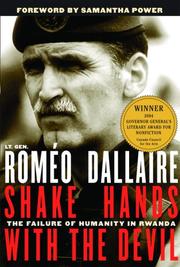
Shake hands with the devil
First published 2003. Subjects: Atrocities, Canadian Personal narratives, Genocide, History, Peacekeeping forces.
"Leave none to tell the story"
First published 1999. Subjects: Atrocities, Crimes against, Ethnic relations, Genocide, History.
Endnotes
1.
Source: scispace.com
Title: It.Read more
Link:https://scispace.com/pdf/view-point-episodes-of-mass-hysteria-in-african-schools-a-1dr2kr3qe4.pdf
Source snippet
View Point: Episodes of mass hysteria in African schoolsMass hysteria is a social phenomenon often occurring among otherwise heal...
2.
Source: iiste.org
Link:https://www.iiste.org/Journals/index.php/RHSS/article/download/61735/63717
3.
Source: murindwa-rutanga.com
Title: PEOPLE’S ANTI COLONIAL STRUGGLES IN KIGEZI UNDER THE NYABINGI M
Link:https://murindwa-rutanga.com/pub/PEOPLE%27S%20ANTI-COLONIAL%20STRUGGLES%20IN%20KIGEZI%20UNDER%20THE%20NYABINGI%20M.pdf
4.
Source: press.vatican.va
Link:https://press.vatican.va/content/salastampa/it/bollettino/pubblico/2001/06/29/0382/01118.html
5.
Source: allafrica.com
Title: all Africa.com RD F Intervenes in Treating Rare Disease Among Female Students
Link:https://allafrica.com/stories/201906190084.html
6.
Source: epiren.medium.com
Link:https://epiren.medium.com/when-bodies-tell-stories-the-mind-creates-understanding-mass-psychogenic-illness-759f663e9701
7.
Source: jeffmaysh.medium.com
Title: hysteria high how demons destroyed a florida school 5a31b4770f29
Link:https://jeffmaysh.medium.com/hysteria-high-how-demons-destroyed-a-florida-school-5a31b4770f29
8.
Source: 2021-2025.state.gov
Title: democratic republic of the congo
Link:https://2021-2025.state.gov/reports/2023-report-on-international-religious-freedom/democratic-republic-of-the-congo/
9.
Source: allafrica.com
Link:https://allafrica.com/view/group/main/main/id/00096722.html
10.
Source: allafrica.com
Link:https://allafrica.com/stories/200803031656.html
11.
Source: cdn.allafrica.com
Link:https://cdn.allafrica.com/download/resource/main/main/idatcs/00121841%3A60f08f6c61af17c55fc9764a60cdb17d.pdf
12.
Source: allafrica.com
Link:https://allafrica.com/stories/201208040309.html
13.
Source: allafrica.com
Link:https://allafrica.com/download/resource/main/main/idatcs/00010178%3Aaffb3b76075dd71c20d0b054b065bff9.pdf
14.
Source: hrw.org
Link:https://www.hrw.org/legacy/backgrounder/africa/rwanda0406/4.htm
Source snippet
Human Rights WatchHow It Was Prepared: Genocide: Ideology and OrganizationAmong the false ideas drawn on by political leaders and propag...
15.
Source: hrw.org
Link:https://www.hrw.org/reports/1999/rwanda/Geno1-3-10.htm
Source snippet
Tutsi recalled the reprisal killings at the time of invasions by refugee groups in the...Read more...
16.
Source: hrw.org
Link:https://www.hrw.org/reports/1999/rwanda/Geno1-3-09.htm
Source snippet
Human Rights WatchLeave None to Tell the Story: Genocide in Rwanda, March...Hutu who killed Tutsi did so for many reasons, but beneath t...
17.
Source: frontiersin.org
Title: Frontiers Characteristics of Adolescents Affected by Mass Psychogenic Illness
Link:https://www.frontiersin.org/journals/psychiatry/articles/10.3389/fpsyt.2020.493094/full
Source snippet
FrontiersCharacteristics of Adolescents Affected by Mass Psychogenic Illness...November 16, 2020 — This paper presents the first systema...
Published: November 16, 2020
18.
Source: safpj.co.za
Link:https://safpj.co.za/index.php/safpj/article/view/1411
Source snippet
South African Family PracticeMass hysteria among South African primary school...30 Aug 2010 — The discussion includes the rare outbreak...
19.
Source: unictr.irmct.org
Link:https://unictr.irmct.org/files/case-documents/ictr-96-4/trial-judgements/en/980902.pdf
20.
Source: unictr.irmct.org
Link:https://unictr.irmct.org/files/case-documents/ictr-99-52/trial-judgements/en/031203.pdf
21.
Source: unictr.irmct.org
Link:https://unictr.irmct.org/files/case-documents/ictr-98-41/trial-judgements/en/081218.pdf
22.
Source: Wikipedia
Link:https://en.wikipedia.org/wiki/Muhumusa
23.
Source: unictr.irmct.org
Link:https://unictr.irmct.org/sites/unictr.org/files/case-documents/ictr-99-52/appeals-chamber-judgements/en/071128.pdf
24.
Source: encyclopedia.ushmm.org
Link:https://encyclopedia.ushmm.org/content/en/article/incitement-to-genocide-in-international-law
25.
Source: sajp.org.za
Link:https://sajp.org.za/index.php/sajp/article/view/1671/2648
26.
Source: Wikipedia
Title: Mass psychogenic illness
Link:https://en.wikipedia.org/wiki/Mass_psychogenic_illness
27.
Source: youtube.com
Link:https://www.youtube.com/watch?v=mmUmK8G7NBk
28.
Source: hrw.org
Link:https://www.hrw.org/reports/pdfs/r/rwanda/rwanda993.pdf
29.
Source: hrw.org
Title: rwandas extraterritorial repression
Link:https://www.hrw.org/report/2023/10/10/join-us-or-die/rwandas-extraterritorial-repression
30.
Source: hrw.org
Link:https://www.hrw.org/reports/1996/Rwanda.htm
31.
Source: hrw.org
Link:https://www.hrw.org/reports/1999/rwanda/Geno15-8-03.htm
32.
Source: hrw.org
Link:https://www.hrw.org/sites/default/files/reports/RWANDA945.PDF
33.
Source: hrw.org
Link:https://www.hrw.org/legacy/reports/1999/rwanda/Geno4-7-02.htm
34.
Source: hrw.org
Link:https://www.hrw.org/reports/1999/rwanda/Geno15-8-02.htm
35.
Source: unictr.irmct.org
Link:https://unictr.irmct.org/files/case-documents/ictr-01-72/trial-judgements/en/081202.pdf
36.
Source: unictr.irmct.org
Link:https://unictr.irmct.org/files/case-documents/ictr-96-3/trial-judgements/en/991206.pdf
37.
Source: unictr.irmct.org
Link:https://unictr.irmct.org/files/case-documents/ictr-98-44/trial-judgements/en/120202.pdf
38.
Source: unictr.irmct.org
Link:https://unictr.irmct.org/files/case-documents/ictr-97-31/trial-judgements/en/090714.pdf
39.
Source: unictr.irmct.org
Link:https://unictr.irmct.org/files/case-documents/ictr-95-1/trial-judgements/en/990521.pdf
40.
Source: unictr.irmct.org
Link:https://unictr.irmct.org/files/case-documents/ictr-99-50/trial-judgements/en/110517.pdf
41.
Source: hts.org.za
Link:https://hts.org.za/index.php/hts/article/view/11036/29425
Additional References
42.
Source: youtube.com
Title: Kibeho: The Marian Apparitions That Warned the World (Full Documentary)
Link:https://www.youtube.com/watch?v=pZxaS3C5E60
Source snippet
Our Lady of Kibeho and the Rwandan Genocide - Jimmy Akin's Mysterious World...
43.
Source: youtube.com
Title: Not My Words: The Actor Who Carries the Voice of Genocide | United Nations
Link:https://www.youtube.com/watch?v=izDR4W68txE
Source snippet
NYABYINSHI - The warrior virgin princess...
44.
Source: govinfo.gov
Link:https://www.govinfo.gov/content/pkg/CPRT-108JPRT20429/html/CPRT-108JPRT20429.htm
45.
Source: researchgate.net
Link:https://www.researchgate.net/publication/338963265_28_Witchcraft_Accusations_A_Challenge_for_Families_Communities_and_Churches_in_Africa
46.
Source: ushmm.org
Link:https://www.ushmm.org/m/pdfs/20100423-atrauss-rtlm-radio-hate.pdf
47.
Source: researchgate.net
Link:https://www.researchgate.net/publication/271759288_Mass_hysteria_among_South_African_primary_school_learners_in_Kwa-Dukuza_KwaZulu-Natal
48.
Source: tandfonline.com
Link:https://www.tandfonline.com/doi/full/10.1080/15426432.2025.2559627
49.
Source: ushmm.org
Link:https://www.ushmm.org/m/pdfs/20140212-benesch-countering-dangerous-speech.pdf
50.
Source: ushmm.org
Link:https://www.ushmm.org/m/pdfs/Radio_Transcript_Nazi_Racism.pdf
51.
Source: opendoors.org
Link:https://www.opendoors.org/en-US/persecution/countries/drc/
Topic Tree
Follow this branch
Related pages 192
- Antigua and Barbuda
- Argentina Belief Scares
- Azerbaijan Belief
- Bahrain Beliefs
- North Korea
- +187 more in sidebar