Within Egyptian Panics
Why Did Egypt's Schoolgirls Suddenly Fall Ill?
More than a thousand reported cases of fainting and dizziness showed how real symptoms can spread through fear and social contact.
On this page
- Symptoms, school closures and public alarm
- How mass psychogenic illness spreads
- Stress, distrust and competing explanations
Page outline Jump by section
Introduction
In April 1993, thousands of Egyptian schoolgirls suddenly reported dizziness, nausea, fainting and, in some cases, brief periods of unconsciousness. The outbreak spread rapidly from one school to another, prompting school closures, emergency hospital admissions and intense public anxiety. At first, many people suspected poisoning, contaminated food, environmental pollution or even deliberate attacks on children. Yet extensive medical investigations failed to identify a toxic or infectious cause. Most researchers now regard the episode as one of the largest documented examples of mass psychogenic illness—sometimes called a collective stress response—rather than evidence of poisoning or an unknown disease. The symptoms were genuine, but they spread through social and psychological processes rather than an identifiable physical agent.[Los Angeles Times]latimes.comLos Angeles TimesWORLD IN BRIEF: EGYPT: Schoolgirls Suffer Mysterious Fainting - Los Angeles TimesApril 8, 1993…

How the outbreak unfolded
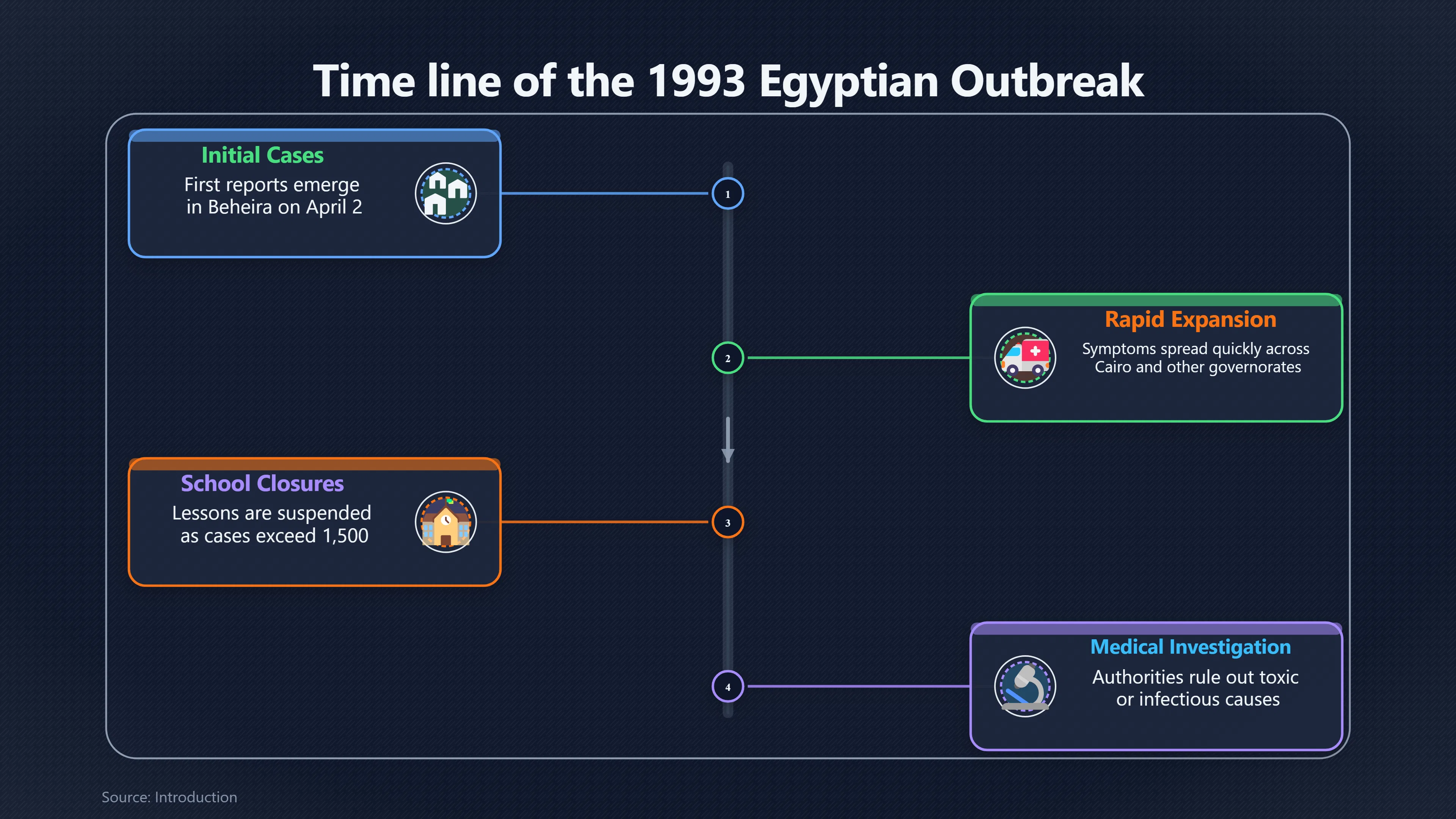
The first reported cases appeared on 2 April 1993 in the Nile Delta province of Beheira before spreading rapidly across Cairo and other governorates. Within days, hospitals were receiving hundreds of pupils, almost all girls between about 12 and 18 years old. Official figures soon exceeded 1,500 cases, while some newspapers claimed substantially higher numbers. Schools suspended lessons, ambulances waited outside school gates, and worried parents kept many children at home.[elpais.com]elpais.comOpen source on elpais.com.
Although reports often described girls “falling into comas”, most medical accounts referred to short-lived fainting episodes or temporary reductions in consciousness rather than prolonged neurological illness. Doctors consistently reported that patients recovered quickly and that there were no lasting physical injuries or deaths directly linked to the outbreak.[Los Angeles Times]latimes.comLos Angeles TimesWORLD IN BRIEF: EGYPT: Schoolgirls Suffer Mysterious Fainting - Los Angeles TimesApril 8, 1993…
Symptoms, school closures and public alarm
The reported symptoms were remarkably consistent:
- sudden dizziness
- fainting[latimes.com]latimes.comLos Angeles TimesWORLD IN BRIEF: EGYPT: Schoolgirls Suffer Mysterious Fainting - Los Angeles TimesApril 8, 1993…
- nausea
- headaches
- weakness
- brief loss of consciousness
- anxiety and rapid breathing in some patients
The concentration of cases in girls’ secondary schools became one of the defining features of the episode. Because pupils saw classmates collapse, rumours spread rapidly through classrooms and neighbourhoods. As more girls became frightened, additional cases appeared, sometimes shortly after witnesses observed another pupil becoming ill.[El Tiempo]eltiempo.comEl Tiempo MILES DE NIÑAS SE DESMAYAN Y ENTRAN EN COMA EN EGIPTOEl Tiempo MILES DE NIÑAS SE DESMAYAN Y ENTRAN EN COMA EN EGIPTO
The scale of the outbreak made reassurance difficult. Television, newspapers and political debate all amplified public concern. Competing explanations circulated faster than firm medical evidence could emerge, creating an atmosphere in which almost every new report appeared to confirm that an unknown danger was spreading.
Why doctors ruled out poisoning
Early speculation focused on contaminated food, polluted air, pesticides, industrial chemicals and other environmental hazards. Some politicians and commentators suggested more dramatic possibilities, including radioactive contamination or deliberate attempts to harm Egyptian children.[The Independent]independent.co.ukThe Independent Fainting riddle | The Independent | The IndependentThe IndependentFainting riddle | The Independent | The IndependentApril 8, 1993…
Health officials investigated these possibilities because they could not assume a psychological explanation from the outset. That distinction is important. Public-health practice requires investigators to exclude infectious, toxic and environmental causes before concluding that an illness is psychogenic.
After emergency investigations, Egyptian health authorities reported that they had found no convincing evidence of poisoning or infectious disease capable of explaining the nationwide pattern. Patients’ rapid recovery, the absence of lasting physical abnormalities, and the way cases clustered through social networks rather than environmental exposure all pointed away from a toxic event. The Health Minister publicly described the outbreak as psychological in origin.[El País]elpais.comOpen source on elpais.com.
How mass psychogenic illness spreads
The 1993 outbreak illustrates how mass psychogenic illness differs from people “pretending” to be ill. The symptoms are real. Stress and anxiety can trigger genuine changes in breathing, heart rate, balance and consciousness, producing dizziness, nausea and fainting without an infectious or toxic cause.
Research on similar school outbreaks around the world has identified several recurring features:
- an initial trigger, often an unexplained illness or alarming event;
- close social contact within schools or other tightly connected groups;
- observation of others becoming ill;
- widespread uncertainty about the cause;
- extensive discussion among peers, families and the media;
- rapid spread despite the absence of a common environmental exposure.
Studies of comparable outbreaks have shown that seeing classmates become ill, believing a dangerous exposure has occurred and repeated media attention can all increase the likelihood that symptoms spread through a group.[New England Journal of Medicine]nejm.orgNew England Journal of MedicineMass Psychogenic Illness Attributed to Toxic Exposure at a High School | New England Journal of MedicineJa…
The Egyptian outbreak closely matched this established pattern. Schools provided dense social networks in which pupils constantly observed one another. Every new fainting episode reinforced fears that an invisible threat was affecting everyone nearby.
Why teenage girls were affected most
Many large outbreaks of mass psychogenic illness have disproportionately involved adolescent girls in schools. Researchers do not regard this as evidence that girls are unusually “hysterical”—a term modern medicine generally avoids because of its misleading and sexist history.
Instead, psychologists point to a combination of factors:
- adolescence is a period of heightened emotional and physical stress;
- schools concentrate large numbers of similarly aged pupils in close contact;
- social observation makes symptoms highly visible;
- exam pressure, family expectations and uncertainty can increase vulnerability;
- once an outbreak begins, witnessing classmates collapse can become a powerful trigger.
These explanations emphasise social context rather than individual weakness. Most affected pupils had no evidence of chronic psychiatric illness, and the symptoms themselves were involuntary.[New England Journal of Medicine]nejm.orgNew England Journal of MedicineMass Psychogenic Illness Attributed to Toxic Exposure at a High School | New England Journal of MedicineJa…
Stress, distrust and competing explanations
The medical explanation competed with many alternative theories. Families naturally searched for tangible causes, while newspapers reported rumours alongside official statements. Suggestions ranged from contaminated food to industrial pollution and deliberate plots to make girls infertile. In a society where trust in official institutions was uneven, many people found hidden physical causes more convincing than a diagnosis based on collective stress.[The Independent]independent.co.ukThe Independent Fainting riddle | The Independent | The IndependentThe IndependentFainting riddle | The Independent | The IndependentApril 8, 1993…
This tension is common in mass psychogenic illness. People experiencing genuine symptoms often reject psychological explanations because they feel their suffering is being dismissed. Modern public-health communication therefore stresses that psychogenic illness involves real physical symptoms produced through brain-body responses to stress, expectation and social influence—not fabrication or malingering.
Why the 1993 outbreak still matters
The Egyptian school outbreak remains one of the best-known examples of mass psychogenic illness in the Middle East because of its extraordinary scale and the speed with which it spread through schools.
It also demonstrates several broader lessons that continue to shape public-health responses:
- unexplained illness outbreaks should always be investigated thoroughly before drawing conclusions;
- rumours can spread faster than medical evidence;
- schools are particularly susceptible to socially transmitted illness episodes;
- careful communication is essential to reduce fear without dismissing genuine suffering.
Within Egypt’s wider history of collective fears and public panics, the 1993 schoolgirl fainting outbreak stands apart because it was neither a religious vision nor a moral panic. Instead, it showed how uncertainty, stress and social communication can generate widespread, authentic physical illness even when no infectious or toxic agent can be found.[elpais.com]elpais.comOpen source on elpais.com.
Amazon book picks
Further Reading
Books and field guides related to Why Did Egypt's Schoolgirls Suddenly Fall Ill?. Use these as the next step if you want deeper reading beyond the article.
Extraordinary Popular Delusions and the Madness of Crowds
Rating: 4.0/5 from 5 Google Books ratings
Places school outbreaks within broader crowd psychology.

Mass Hysteria in Schools
Directly examines school outbreaks of mass psychogenic illness.
Endnotes
1.
Source: latimes.com
Link:https://www.latimes.com/archives/la-xpm-1993-04-08-mn-20465-story.html
Source snippet
Los Angeles TimesWORLD IN BRIEF: EGYPT: Schoolgirls Suffer Mysterious Fainting - Los Angeles TimesApril 8, 1993...
Published: April 8, 1993
2.
Source: elpais.com
Link:https://elpais.com/diario/1993/04/09/sociedad/734306402_850215.html
3.
Source: eltiempo.com
Title: El Tiempo MILES DE NIÑAS SE DESMAYAN Y ENTRAN EN COMA EN EGIPTO
Link:https://www.eltiempo.com/archivo/documento/MAM-98174
4.
Source: independent.co.uk
Title: The Independent Fainting riddle | The Independent | The Independent
Link:https://www.independent.co.uk/news/world/fainting-riddle-1454000.html
Source snippet
The IndependentFainting riddle | The Independent | The IndependentApril 8, 1993...
Published: April 8, 1993
5.
Source: nejm.org
Link:https://www.nejm.org/doi/full/10.1056/NEJM200001133420206
Source snippet
New England Journal of MedicineMass Psychogenic Illness Attributed to Toxic Exposure at a High School | New England Journal of MedicineJa...
6.
Source: nejm.org
Link:https://www.nejm.org/doi/abs/10.1056/NEJM200001133420206
7.
Source: the-independent.com
Link:https://www.the-independent.com/news/world/egyptians-suffer-as-government-ignores-a-nasty-little-conflict-robert-fisk-in-cairo-visited-a-young-victim-of-terrorism-and-wondered-what-it-will-take-to-stem-the-rising-tide-of-violence-1493119.html
8.
Source: eltiempo.com
Title: MAM 100806
Link:https://www.eltiempo.com/archivo/documento/MAM-100806
9.
Source: independent.co.uk
Link:https://www.independent.co.uk/news/world/egyptian-antagonists-square-up-robert-fisk-sees-fury-in-haekestap-as-extremists-go-on-trial-1499193.html
Additional References
10.
Source: cambridge.org
Title: Hysterical epidemic in a classroom | Psychological Medicine | Cambridge Core
Link:https://www.cambridge.org/core/journals/psychological-medicine/article/abs/hysterical-epidemic-in-a-classroom/195A8C3732D11188AE43C0AE7A82315E
Source snippet
July 9, 2009 — HYSTERICAL EPIDEMIC IN A CLASSROOM Published online by Cambridge University Press: 09 July 2009 Silvio Benaim, John Horde...
Published: July 9, 2009
11.
Source: pubmed.ncbi.nlm.nih.gov
Link:https://pubmed.ncbi.nlm.nih.gov/7952258/
Source snippet
A sudden outbreak of illness suggestive of mass hysteria in schoolchildren - PubMed...
12.
Source: royanews.com
Link:https://royanews.com/en/%D9%88%D9%81%D8%A7%D8%A9-%D9%88%D8%AD%D8%A7%D9%84%D8%A7%D8%AA-%D8%A5%D8%BA%D9%85%D8%A7%D8%A1-%D8%AC%D9%85%D8%A7%D8%B9%D9%8A-%D9%84%D8%B9%D9%86%D8%A9-%D8%A7%D9%84%D8%AB%D8%A7%D9%86%D9%88%D9%8A/
Source snippet
Two days ago Last updated: July 3, 2026 23 2 minutes Image BETWEEN MASS FAINTING SPELLS AND GIRLS C...
Published: July 3, 2026
13.
Source: pmc.ncbi.nlm.nih.gov
Link:https://pmc.ncbi.nlm.nih.gov/articles/PMC4884863/
Source snippet
Mass psychogenic illness has been a recurrent phenomenon in Bangladesh over recent times. Objectives. This study was aimed at investigati...
14.
Source: youtube.com
Title: The Razor-Thin Line Between Contagion and Connection | Dan Taberski | TED
Link:https://www.youtube.com/watch?v=u0fFIJapsRY
Source snippet
Episode 72. Mass Psychogenic Illness with Robert Baloh...
15.
Source: youtube.com
Title: 7 Incredible Mass Hysteria Events | Mental Floss
Link:https://www.youtube.com/watch?v=iSDdntubWls
Source snippet
The Razor-Thin Line Between Contagion and Connection | Dan Taberski | TED...
16.
Source: youtube.com
Title: Episode 72. Mass Psychogenic Illness with Robert Baloh
Link:https://www.youtube.com/watch?v=mnmv9erAqkM
Source snippet
Episode 71. Frenzy – The Turmoil of Mass Psychogenic Illness...
17.
Source: researchgate.net
Link:https://www.researchgate.net/publication/15060023_An_outbreak_of_illness_among_schoolchildren_in_London_Toxic_poisoning_not_mass_hysteria
18.
Source: sciencedirect.com
Title: Health reform for children: the Egyptian experience with school health insurance
Link:https://www.sciencedirect.com/science/article/abs/pii/S0168851099000731
19.
Source: youtube.com
Title: Mass Hysteria Throughout History
Link:https://www.youtube.com/watch?v=YXy3emGbxHg
Source snippet
7 Incredible Mass Hysteria Events | Mental Floss...
Topic Tree