When Fear Became Fact in Afghanistan
Afghanistan’s history contains no well-documented equivalent of the European witch craze or a single famous home-grown “cult panic”.
Page outline Jump by section
Introduction
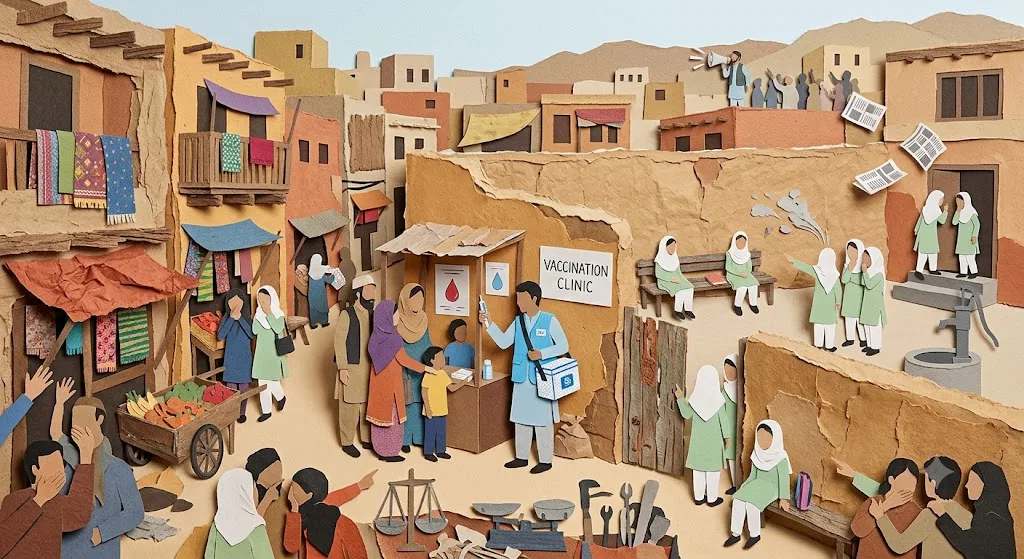
The most important lesson is therefore not that Afghans were irrational. It is that fear spread where war, weak institutions, restricted information and political rivalry made reliable explanations difficult to obtain. Doctors sometimes found no poison where officials announced an attack; rumours hardened into certainty before investigations began; and accusations could become fatal when police failed to restrain a crowd. Afghanistan’s record shows how collective scares flourish when real violence and imagined threats become almost impossible to separate.
Why the evidence is unusually difficult
More than four decades of conflict have shaped how rumours circulate in Afghanistan. Governments, insurgent organisations, foreign armies and intelligence services have all engaged in propaganda or covert activity. Civilians have therefore had sound historical reasons to suspect that apparently ordinary events might conceal political motives. An International Committee of the Red Cross consultation conducted around the end of the 1990s found widespread suspicion of foreign interference among civilians and combatants alike, reflecting both persistent rumours and genuine outside involvement in the country.[ICRC]icrc.orgPeople on War Reports - AfghanistanOctober 31, 2001 — And when the Cold War ended and the superpowers left Afghanistan to the Afghans…
This environment makes labels such as “mass hysteria” especially hazardous. A school evacuation may involve contagious fear, but girls’ education has also faced documented intimidation and violence. Suspicion of vaccination may be fuelled by false sterilisation stories, but health campaigns have also become entangled with security operations. A rumour can be untrue while the fear behind it remains entirely understandable.
For that reason, Afghanistan’s cases are best separated into several overlapping categories:
- Mass psychogenic illness: real symptoms spreading through social and psychological processes without a detected toxic or infectious cause.
- Rumour panic: an unverified story that rapidly changes behaviour, sometimes before officials can investigate it.
- Moral or religious panic: a perceived violation of sacred values treated as an immediate threat to the whole community.
- Deliberate disinformation: claims promoted for political, military or ideological advantage.
- Documented violence: actual attacks that cannot responsibly be dismissed as collective suggestion.
The same episode may move between these categories as evidence emerges.
The schoolgirl poisoning scares
What happened
Beginning in 2009, Afghan girls’ schools repeatedly reported suspected poisonings. Pupils described strange smells followed by dizziness, nausea, headaches, breathing difficulties, weakness, fainting or loss of consciousness. Ambulances carried groups of students to hospital, frightened parents gathered outside schools, and officials frequently announced that enemies of female education had released gas, sprayed classrooms or contaminated drinking water.
The incidents appeared during a period when attending school could carry a real political risk. Girls’ schools had been burned, threatened or attacked, and militant opposition to female education was widely known. A global survey of attacks on education recorded several alleged poisonings, including a May 2009 incident north of Kabul in which nearly 100 girls were reportedly admitted to hospital. It also noted that fear surrounding a suspected 2010 attack in Kunduz caused roughly 1,500 girls to miss classes.[Refworld]refworld.orgEducation under Attack 2014 - AfghanistanAn alleged poison attack in Kunduz city in 2010 caused 1,500 girls to miss classes at Kh…
The scare continued across several provinces. In August 2010, dozens of pupils at a Kabul school became ill amid reports of an unusual smell. Journalists at the scene described panic spreading rapidly through the building as students covered their faces, fled classrooms and jumped from ground-floor windows. Officials again suspected an attack, while doctors and international investigators questioned whether a poison had been used.[The Guardian]theguardian.comThe Guardian Taliban poison attack or mass hysteria?Chaos hits another…August 25, 2010 — 25 Aug 2010 — When the order came to evacuate the Totia high school, hundreds of girls ran from t…
What investigators found
The strongest contemporary assessment came from the World Health Organization. Its May 2012 epidemiological bulletin described that year as the fourth consecutive year in which suspected mass poisonings of Afghan schoolgirls had been reported. Reviewing the pattern of illness and the absence of a confirmed toxic agent, the organisation concluded that the episodes were consistent with mass psychogenic illness.[EMRO Dashboards]applications.emro.who.intEMRO Dashboards Weekly Epidemiological MonitorEMRO DashboardsWeeklyEpidemiological MonitorMay 30, 2012 — 23 May 2012 — This is the fourth year where episodes of suspected mass poisoni…
International investigators tested blood, urine, water and environmental samples from multiple incidents. Accounts of the investigations report that no common poison capable of explaining the outbreaks was found. In one widely publicised 2012 case in Takhar province, more than 170 students and staff became ill after drinking from a school well. Local authorities blamed opponents of girls’ education, but testing by a NATO laboratory reportedly detected no poison in the water.[Undark Magazine]undark.orgThe following month, 160 schoolgirls were allegedly poisoned by the TalibanUndark MagazineIn Afghanistan, a Quiet Epidemic of Mass Psychogenic IllnessJuly 13, 2022 — 13 Jul 2022 — A NATO laboratory in Kabul found…
Mass psychogenic illness does not mean that pupils invented their symptoms. It describes genuine physical distress produced or amplified through fear, expectation and social transmission. One person feels dizzy after noticing an odour; classmates see her collapse; others become hyper-alert to breathing, heartbeat or nausea; the alarm spreads through a tightly connected group. Symptoms can then multiply without conscious pretence.
Several features supported that explanation in Afghanistan:
- cases were concentrated among pupils sharing the same frightening environment;
- symptoms often appeared abruptly after someone reported an unusual smell;
- many patients recovered comparatively quickly;
- repeated laboratory investigations failed to identify a consistent toxin;
- news of earlier “poison attacks” created an expectation that the same thing could happen elsewhere.
War-related stress supplied a powerful background. Afghan girls attending school knew that armed groups had opposed female education. Their fear was therefore attached to a believable danger, even when a particular classroom illness did not result from poison.
Why officials kept announcing attacks
The psychogenic explanation never fully displaced the poisoning narrative. Afghan police, governors and education officials often attributed incidents to the Taliban or other enemies before medical tests had been completed. That interpretation fitted the political landscape and offered a clear villain. It also avoided the stigma surrounding psychological distress, which could be misunderstood as weakness, fabrication or mental illness.
Authorities may also have feared the consequences of appearing dismissive. Telling worried families that no toxin had been identified could sound like denying the girls’ suffering. Yet publicly asserting poisoning without evidence carried its own cost: it reinforced the expectation of attack, increased school absenteeism and made subsequent outbreaks more likely to spread.
The language used matters. “Mass hysteria” is now generally avoided by clinicians because it sounds contemptuous and has historically been applied disproportionately to women. “Mass psychogenic illness” is more precise, but it should still be used as a diagnosis reached after reasonable investigation, not as a convenient explanation for every unexplained event.
The scares did not simply end
Nearly 80 pupils and several teachers were taken ill at two primary schools in Sar-e-Pul province in June 2023. Taliban-era officials called the incidents poisonings and suggested that someone with a personal grievance had arranged them, but public reports supplied no toxicological evidence, no identified substance and no detailed account of how the alleged attack was carried out. All the pupils were reported to have recovered. International organisations called for a proper investigation.[reuters.com]reuters.comSixty Afghan girls hospitalised after school poisoningSixty Afghan girls hospitalised after school poisoningJune 5, 2023 — 5 Jun 2023 — Around 60 Afghan girls were hospitalised after b…
That case should not automatically be folded into the earlier psychogenic outbreaks. Deliberate contamination remains possible, and the available public evidence is incomplete. It does, however, show that the established poisoning narrative remains culturally available: when many schoolchildren become ill together, “attack” is often the first explanation rather than the last.
The false accusation that killed Farkhunda
The murder of Farkhunda Malikzada in Kabul on 19 March 2015 is Afghanistan’s most clearly documented modern rumour panic. Farkhunda, a 27-year-old student of religion, argued with a man associated with the sale of amulets near the Shah-e Du Shamshira shrine. During the confrontation she was accused of burning a copy of the Quran. The accusation was false, but it drew a crowd that beat her to death while police failed to protect her. Her body was then burned.[Human Rights Watch]hrw.orgOpen source on hrw.org.
This was not a slow-moving judicial persecution comparable to an organised witch trial. It was a rapid moral panic in miniature: an allegation involving a sacred object, immediate public outrage, the suspension of ordinary standards of evidence and the transformation of bystanders into participants or approving spectators.
Several forces accelerated the violence. The setting was a busy shrine district where religious commerce, begging, petty crime and policing overlapped. Afghanistan Analysts Network estimated that a crowd of several hundred gathered and argued that the surrounding social environment helped make prolonged mob action possible. As the confrontation expanded, additional rumours reportedly portrayed Farkhunda as connected to foreigners, giving a personal dispute the character of a wider religious threat.[Afghanistan Analysts Network - English]afghanistan-analysts.orgAfghanistan Analysts NetworkAfghanistan Analysts Network
Mobile phones played two contradictory roles. Some people filmed rather than intervened, and footage circulated on social media alongside messages that initially justified the killing. The same recordings later became evidence of both the mob’s actions and police inaction. They helped turn Farkhunda from a publicly condemned supposed offender into a national symbol of injustice.
Once officials confirmed that no Quran had been burned, protests spread through Kabul. Women carried Farkhunda’s coffin, breaking with customary funeral practice, and demonstrators demanded accountability from the killers, police and religious figures who had endorsed the attack.[Time]time.comOpen source on time.com.
The legal response was substantial but uneven. Numerous suspects and police officers were prosecuted, yet later proceedings reduced several sentences and drew criticism for failing to secure lasting accountability. Human Rights Watch argued that the handling of the case exposed continuing weaknesses in Afghanistan’s justice system.[Afghanistan Analysts Network - English]afghanistan-analysts.orgAfghanistan Analysts NetworkAfghanistan Analysts Network
Farkhunda’s murder remains culturally important because it reveals how a false accusation can acquire the force of proof when it touches a sacred boundary. It also shows that collective belief is not only a matter of private credulity. Police conduct, clerical authority, gender inequality, crowd dynamics and social media all helped determine whether a rumour would be questioned or acted upon.
Vaccination rumours and the price of broken trust
Afghanistan’s polio campaigns have repeatedly encountered claims that vaccination is a Western plot to sterilise Muslim children, spread disease, gather intelligence or identify militant positions. Such stories have circulated across Afghanistan and neighbouring Pakistan, sometimes promoted by armed movements and sometimes passed through families already suspicious of government and foreign agencies.
The sterilisation claim has no scientific basis. Yet it became persuasive because vaccination operated inside a wider war. Insurgent commanders suspected mobile health teams of collecting intelligence, while foreign intervention made claims about covert surveillance seem less implausible than they might elsewhere. Research on the global eradication campaign has identified espionage, disinformation and rumours about sterilisation as serious obstacles to public-health work in the region.[PMC]pmc.ncbi.nlm.nih.govOpen source on nih.gov.
The mistrust was worsened by the use of a sham vaccination operation by the United States Central Intelligence Agency during the search for Osama bin Laden in Pakistan. Although that operation was not an Afghan polio campaign, it appeared to confirm the broader suspicion that medical access could be exploited for intelligence purposes. The result was a dangerous fusion of false claims with a real breach of medical trust.
In parts of Afghanistan, Taliban representatives opposed door-to-door campaigns or insisted that vaccination teams conform to local security and religious requirements. Communities heard competing messages: some religious figures endorsed immunisation, while militants or local power-holders warned that teams could be spies. Negotiations consequently involved not only doctors and government officials but clerics, tribal leaders and armed organisations.[The Guardian]theguardian.comThe Guardian Afghan clerics in talks with Isis to break polio vaccine mythsThe Guardian Afghan clerics in talks with Isis to break polio vaccine myths
The effects were concrete. Campaigns were delayed, children were missed and vaccinators worked under threat. Even after Taliban leaders formally permitted some immunisation drives, suspicion remained embedded in the programme. UNICEF has consequently emphasised local engagement and trust-building alongside the medical work of delivering vaccine doses.[UNICEF]unicef.orgOpen source on unicef.org.
This episode is better understood as a rumour-driven public-health crisis than as a simple outbreak of irrational fear. The false story succeeded because it attached itself to genuine political grievances: foreign military intervention, covert surveillance, weak consent procedures and poor communication. Correcting the scientific falsehood could not by itself repair the institutional betrayal that made the rumour credible.

Spiritual explanations without a national “witch panic”
Belief in supernatural causes of illness and misfortune exists in Afghanistan, as it does in many societies, but the public record does not support describing the country as the site of a major, organised witch-hunting movement. Reports of possession, harmful magic, the evil eye, amulets and spiritual healing belong to a varied religious landscape rather than one unified panic.
Medical practitioners working with Afghan patients have documented cases in which hallucinations, seizures or severe emotional distress were understood by patients or relatives as spirit possession. One published psychiatric case concerned an Afghan woman whose family interpreted her experiences through possession, while clinicians diagnosed and successfully treated schizophrenia. The authors stressed the need to distinguish a culturally shared belief from symptoms that require medical care.[PubMed]pubmed.ncbi.nlm.nih.govOpen source on nih.gov.
That distinction is essential. A belief may be common within a religious or cultural framework without being evidence of collective delusion. Likewise, visiting a shrine, carrying an amulet or seeking prayer alongside medical treatment does not make someone a member of a “cult”. The term would obscure more than it explains.
Problems arise when supernatural attributions prevent treatment, justify coercive practices or become accusations against another person. In a country with limited mental-health provision, families may turn first to religious healers because they are accessible, trusted and able to give suffering a morally intelligible explanation. Decades of violence, displacement and bereavement have also created enormous psychological need while leaving specialist services scarce. Supernatural explanations can therefore function as both a source of comfort and a barrier to clinical care.
Farkhunda’s case illustrates the tension particularly sharply. Her reported criticism of amulet-selling was part of the dispute preceding the false Quran-burning allegation. The central issue was not that shrine visitors shared an unusual belief, but that a religious accusation was used to defend authority and commercial interests, after which a crowd treated the accusation as permission for violence.[Afghanistan Analysts Network - English]afghanistan-analysts.orgAfghanistan Analysts NetworkAfghanistan Analysts Network
What made these fears spread
Afghanistan’s best-documented collective scares have different immediate causes, but several mechanisms recur.
Real danger supplied the script. Poisoning stories spread in a country where schools had genuinely been attacked. Spy rumours circulated where intelligence agencies had genuinely operated. A false religious accusation became deadly in a society where claims of desecration could carry enormous moral weight.
Institutions announced conclusions too early. Police and political officials often named perpetrators before laboratory or criminal investigations were complete. Such declarations gave rumours official authority and made later corrections less persuasive.
Information travelled faster than verification. In schools, pupils could see classmates collapse within seconds. At Farkhunda’s killing, shouted accusations and phone recordings reached new audiences before anyone established the facts. Each observer received the emotional force of the event before its evidential basis.
Gender shaped vulnerability. School poisoning scares overwhelmingly affected girls, whose education had become a symbolic battlefield. Farkhunda was attacked in a public environment where a young woman challenging male religious commerce could be portrayed as transgressive. Women were therefore not merely more visible in these events; prevailing power relations influenced whose distress was medicalised, whose behaviour was suspected and whose word carried authority.
Weak accountability prolonged uncertainty. When investigations were incomplete, opaque or politically charged, no conclusion became fully trusted. An unresolved incident could then serve as precedent for the next one.
What historians and psychologists can responsibly conclude
The poisoning outbreaks provide the strongest Afghan evidence for mass psychogenic illness, especially where repeated testing found no toxin and symptoms followed a recognisable pattern of social transmission. Even so, the category should not be applied retrospectively to every reported school incident. Some attacks on education were real, evidence from remote provinces was often incomplete, and individual contamination events cannot be ruled out merely because earlier outbreaks were psychogenic.[EMRO Dashboards]applications.emro.who.intEMRO Dashboards Weekly Epidemiological MonitorEMRO DashboardsWeeklyEpidemiological MonitorMay 30, 2012 — 23 May 2012 — This is the fourth year where episodes of suspected mass poisoni…
Farkhunda’s murder is more securely described as a rumour-fuelled moral panic. The initiating allegation was false, the crowd acted before verification, religious and political meanings rapidly accumulated around the accusation, and institutional failure allowed belief to become lethal action. The episode also produced a counter-movement: public demonstrations, women’s activism and demands for legal reform transformed its cultural meaning.
The vaccination crisis sits between panic and rational mistrust. Sterilisation claims were false, but the belief that health operations might conceal political surveillance was reinforced by actual intelligence practices. Treating communities simply as ignorant therefore misses why the rumours endured.
Across all three cases, collective fear was not separate from Afghanistan’s modern history. It was one of the ways that war entered schools, clinics, shrines and ordinary conversations. The most effective response was rarely denunciation alone. Transparent testing, credible local messengers, accountable policing and respectful mental-health care were more capable of reducing fear than official certainty unsupported by evidence.
Why these episodes still matter
Afghanistan’s collective-belief history challenges the comforting idea that fact and rumour occupy separate worlds. In highly insecure societies, they can grow from the same experience. A real history of attacks makes an imagined poisoning believable. A false sterilisation story gains strength from a genuine intelligence scandal. A baseless accusation becomes deadly because existing inequalities determine who will be believed.
These episodes also show how harmful the language of “hysteria” can be when it erases context. The girls who fainted were not foolish; they were living under threat. Parents who feared vaccinators were responding to a political environment in which secrecy had damaged medical neutrality. Understanding those conditions does not make every claim true, but it explains why correction alone often failed.
The enduring question is therefore not simply why people believed something unsupported. It is why institutions, authorities and communities gave some fears the power to spread unchecked. Afghanistan’s record suggests that collective panics become most dangerous when evidence is slow, trust is already broken and powerful people find the rumour more useful than the truth.
Amazon book picks
Further Reading
Books and field guides related to When Fear Became Fact in Afghanistan. Use these as the next step if you want deeper reading beyond the article.

The Kite Runner
Provides accessible insight into Afghanistan's modern history and society.

No good men among the living
Explores how war shaped institutions, trust and civilian experience.


Ghost Wars 12-copy floor
First published 2004. Subjects: History, Nonfiction, Politics, United States, United States. Central Intelligence Agency.
Endnotes
1.
Source: icrc.org
Link:https://www.icrc.org/sites/default/files/external/doc/en/assets/files/other/afghanistan.pdf
Source snippet
People on War Reports - AfghanistanOctober 31, 2001 — And when the Cold War ended and the superpowers left Afghanistan to the Afghans...
Published: October 31, 2001
2.
Source: refworld.org
Link:https://www.refworld.org/reference/annualreport/gcpea/2014/104923
Source snippet
Education under Attack 2014 - AfghanistanAn alleged poison attack in Kunduz city in 2010 caused 1,500 girls to miss classes at Kh...
3.
Source: applications.emro.who.int
Title: EMRO Dashboards Weekly Epidemiological Monitor
Link:https://applications.emro.who.int/dsaf/epi/2012/epi_monitor_2012_5_22.pdf
Source snippet
EMRO DashboardsWeeklyEpidemiological MonitorMay 30, 2012 — 23 May 2012 — This is the fourth year where episodes of suspected mass poisoni...
Published: May 30, 2012
4.
Source: undark.org
Title: The following month, 160 schoolgirls were allegedly poisoned by the Taliban
Link:https://undark.org/2022/07/13/mass-psychogenic-illness-in-afghanistan/
Source snippet
Undark MagazineIn Afghanistan, a Quiet Epidemic of Mass Psychogenic IllnessJuly 13, 2022 — 13 Jul 2022 — A NATO laboratory in Kabul found...
Published: July 13, 2022
5.
Source: reuters.com
Title: Sixty Afghan girls hospitalised after school poisoning
Link:https://www.reuters.com/world/asia-pacific/sixty-afghan-girls-hospitalised-after-school-poisoning-police-2023-06-05/
Source snippet
Sixty Afghan girls hospitalised after school poisoningJune 5, 2023 — 5 Jun 2023 — Around 60 Afghan girls were hospitalised after b...
Published: June 5, 2023
6.
Source: kabulnow.com
Title: eu calls for investigation into poisoning of school girls
Link:https://kabulnow.com/2023/06/eu-calls-for-investigation-into-poisoning-of-school-girls/
7.
Source: afghanistan-analysts.org
Title: Afghanistan Analysts Network
Link:https://www.afghanistan-analysts.org/en/reports/rights-freedom/the-killing-of-farkhunda-1-the-physical-environment-and-the-social-types-party-to-her-murder/
8.
Source: time.com
Link:https://time.com/3757526/afghanistan-farkhunda-protest-islam-lynching/
9.
Source: afghanistan-analysts.org
Title: Afghanistan Analysts Network
Link:https://www.afghanistan-analysts.org/en/reports/rights-freedom/the-killing-of-farkhunda-2-mullahs-feminists-and-a-gap-in-the-debate/
10.
Source: afghanistan-analysts.org
Title: Afghanistan Analysts Network
Link:https://www.afghanistan-analysts.org/en/reports/rights-freedom/police-treated-with-kid-gloves-the-flaws-of-the-farkhunda-trial/
11.
Source: pmc.ncbi.nlm.nih.gov
Link:https://pmc.ncbi.nlm.nih.gov/articles/PMC4221744/
12.
Source: unicef.org
Link:https://www.unicef.org/afghanistan/polio-eradication
13.
Source: pmc.ncbi.nlm.nih.gov
Title: PMCProcess of determining the value of belief about jinn
Link:https://pmc.ncbi.nlm.nih.gov/articles/PMC4746541/
14.
Source: reuters.com
Title: afghan schoolgirls not intimidated by poisoning id USTRE53S1BZ
Link:https://www.reuters.com/article/world/afghan-schoolgirls-not-intimidated-by-poisoning-idUSTRE53S1BZ/
15.
Source: theguardian.com
Title: The Guardian Taliban poison attack or mass hysteria?
Link:https://www.theguardian.com/world/2010/aug/25/taliban-poison-attack-girls-school
Source snippet
Chaos hits another...August 25, 2010 — 25 Aug 2010 — When the order came to evacuate the Totia high school, hundreds of girls ran from t...
Published: August 25, 2010
16.
Source: hrw.org
Link:https://www.hrw.org/news/2019/03/19/justice4farkhunda-afghanistan-4-years
17.
Source: hrw.org
Title: dispatches 11th hour justiceforfarkhunda
Link:https://www.hrw.org/news/2015/07/07/dispatches-11th-hour-justiceforfarkhunda
18.
Source: hrw.org
Title: dispatches remembering murder afghanistan
Link:https://www.hrw.org/news/2015/03/26/dispatches-remembering-murder-afghanistan
19.
Source: theguardian.com
Title: The Guardian Afghan clerics in talks with Isis to break polio vaccine myths
Link:https://www.theguardian.com/global-development/2018/mar/27/afghan-clerics-in-talks-with-isis-to-break-polio-myths
20.
Source: pubmed.ncbi.nlm.nih.gov
Link:https://pubmed.ncbi.nlm.nih.gov/26838303/
21.
Source: Wikipedia
Title: Moral panic
Link:https://en.wikipedia.org/wiki/Moral_panic
22.
Source: Wikipedia
Title: Murder of Farkhunda Malikzada
Link:https://en.wikipedia.org/wiki/Murder_of_Farkhunda_Malikzada
23.
Source: hrw.org
Title: past atrocities kabul and afghanistans legacy impunity
Link:https://www.hrw.org/report/2005/07/06/blood-stained-hands/past-atrocities-kabul-and-afghanistans-legacy-impunity
24.
Source: hrw.org
Title: dispatches not much justiceforfarkhunda
Link:https://www.hrw.org/news/2015/05/06/dispatches-not-much-justiceforfarkhunda
25.
Source: facebook.com
Link:https://www.facebook.com/groups/837374916312742/posts/1715566685160223/
26.
Source: pmc.ncbi.nlm.nih.gov
Link:https://pmc.ncbi.nlm.nih.gov/articles/PMC4884863/
27.
Source: pmc.ncbi.nlm.nih.gov
Link:https://pmc.ncbi.nlm.nih.gov/articles/PMC7185826/
28.
Source: theguardian.com
Title: farkhunda afghan judge sentences four to death over mob killing
Link:https://www.theguardian.com/world/2015/may/06/farkhunda-afghan-judge-sentences-four-to-death-over-mob-killing
29.
Source: la.utexas.edu
Link:https://www.la.utexas.edu/users/bump/Afghan.pdf
Additional References
30.
Source: apnews.com
Link:https://apnews.com/article/4802c512f1a57b6963cc8e5fa1a487ae
Source snippet
This incident has added to the ongoing unrest in Iran, which began with the death of Mahsa Amini in September and has led to months of de...
31.
Source: academia.edu
Link:https://www.academia.edu/5368224/Apocalyptic_and_Millenarian_Movements
32.
Source: right-docs.org
Link:https://www.right-docs.org/doc/a-hrc-20-16/
33.
Source: cdamm.org
Link:https://www.cdamm.org/
34.
Source: gkstill.com
Link:https://www.gkstill.com/ExpertWitness/CrowdDisasters.html
35.
Source: x.com
Link:https://x.com/histories_arch/status/2075514639870292239
36.
Source: facebook.com
Link:https://www.facebook.com/aljazeera/videos/investigating-the-lynching-of-farkhunda-malikzada/10153309585703690/
37.
Source: unhcr.org
Link:https://www.unhcr.org/4d346eab9.pdf
38.
Source: facebook.com
Link:https://www.facebook.com/SimpleHistoryCartoons/posts/observation-point-rock-helmand-provinceobservation-point-rock-op-rock-southeast-/1317458517075161/
39.
Source: researchgate.net
Link:https://www.researchgate.net/publication/292945792_Process_of_determining_the_value_of_belief_about_jinn_possession_and_whether_or_not_they_are_a_result_of_mental_illness
Topic Tree
Follow this branch
Related pages 192
- Antigua and Barbuda
- Argentina Belief Scares
- Azerbaijan Belief
- Bahrain Beliefs
- North Korea
- +187 more in sidebar