Within Kyrgyzstan Panics
When Did Security Policy Become Religious Suspicion?
Real militant threats helped justify laws that increasingly treated peaceful worship, private teaching and unpopular texts as security risks.
On this page
- The militant incursions that shaped policy
- How extremism became a flexible legal label
- Registration, literature and minority faiths
Page outline Jump by section
Introduction
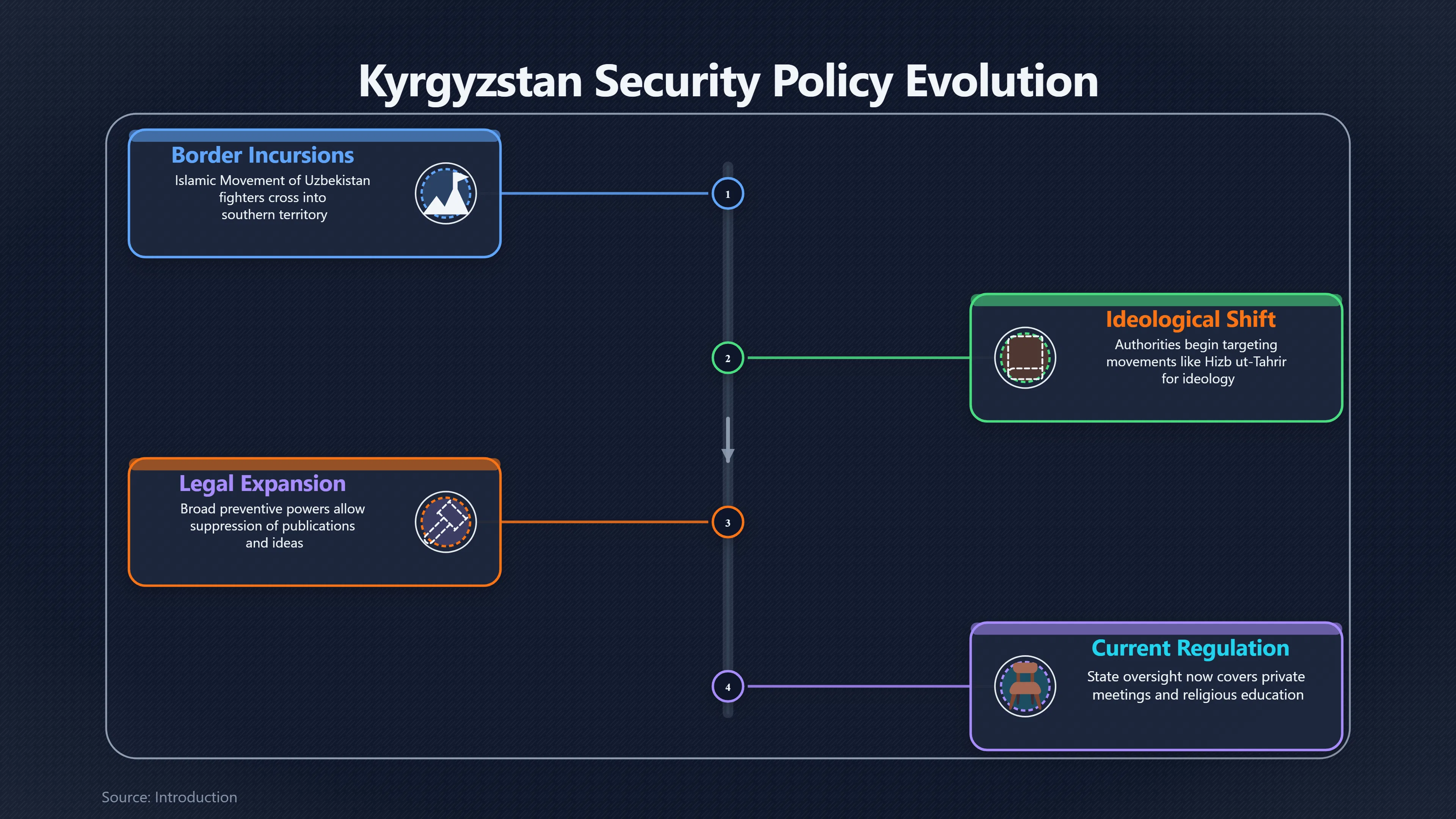
Kyrgyzstan’s modern security policy grew out of genuine fears. During the late 1990s and early 2000s, armed Islamist groups carried out cross-border incursions in southern Kyrgyzstan, while regional governments worried about militant recruitment and the spillover of violence from neighbouring Afghanistan and Tajikistan. Those threats prompted stronger counter-extremism laws and closer state supervision of religious life.
Over time, however, critics argued that the definition of “extremism” became much broader than violent militancy. Human rights organisations, legal experts and religious freedom monitors have repeatedly concluded that laws designed to combat terrorism increasingly affected peaceful religious activity, private study groups, possession of banned literature and minority faith communities. The result was not simply tighter security but an expanding climate of official suspicion in which unfamiliar religious practice could be treated as a potential security problem rather than an exercise of freedom of belief.[uscirf.gov]uscirf.govKyrgyzstan Country Update | USCIRFKyrgyzstan Country Update | USCIRF…
How militant violence reshaped security policy
Kyrgyzstan’s tougher approach cannot be understood without recognising the reality of militant violence in Central Asia. In 1999 and 2000, fighters from the Islamic Movement of Uzbekistan crossed mountainous border regions into southern Kyrgyzstan, taking hostages and fighting government forces. These incursions demonstrated that small militant groups could exploit weak borders and remote terrain.
Regional governments also became concerned about organisations promoting the replacement of existing states with an Islamic political order. Movements such as Hizb ut-Tahrir were viewed very differently across the world: while several Western countries long distinguished between its political programme and terrorist organisations, Russia and most Central Asian governments treated it as extremist or terrorist. Kyrgyz authorities argued that ideological movements could create conditions favourable to future violence even when individual members had committed no violent acts.[USCIRF]uscirf.govKyrgyzstan Country Update | USCIRFKyrgyzstan Country Update | USCIRF…
This security experience made broad preventive powers politically attractive. Rather than waiting for violent offences, officials increasingly sought to identify and suppress ideas, publications and organisations believed to pose future risks.
How “extremism” became a flexible legal label
The central controversy has been less about whether Kyrgyzstan should combat terrorism than about how widely “extremism” has been defined.
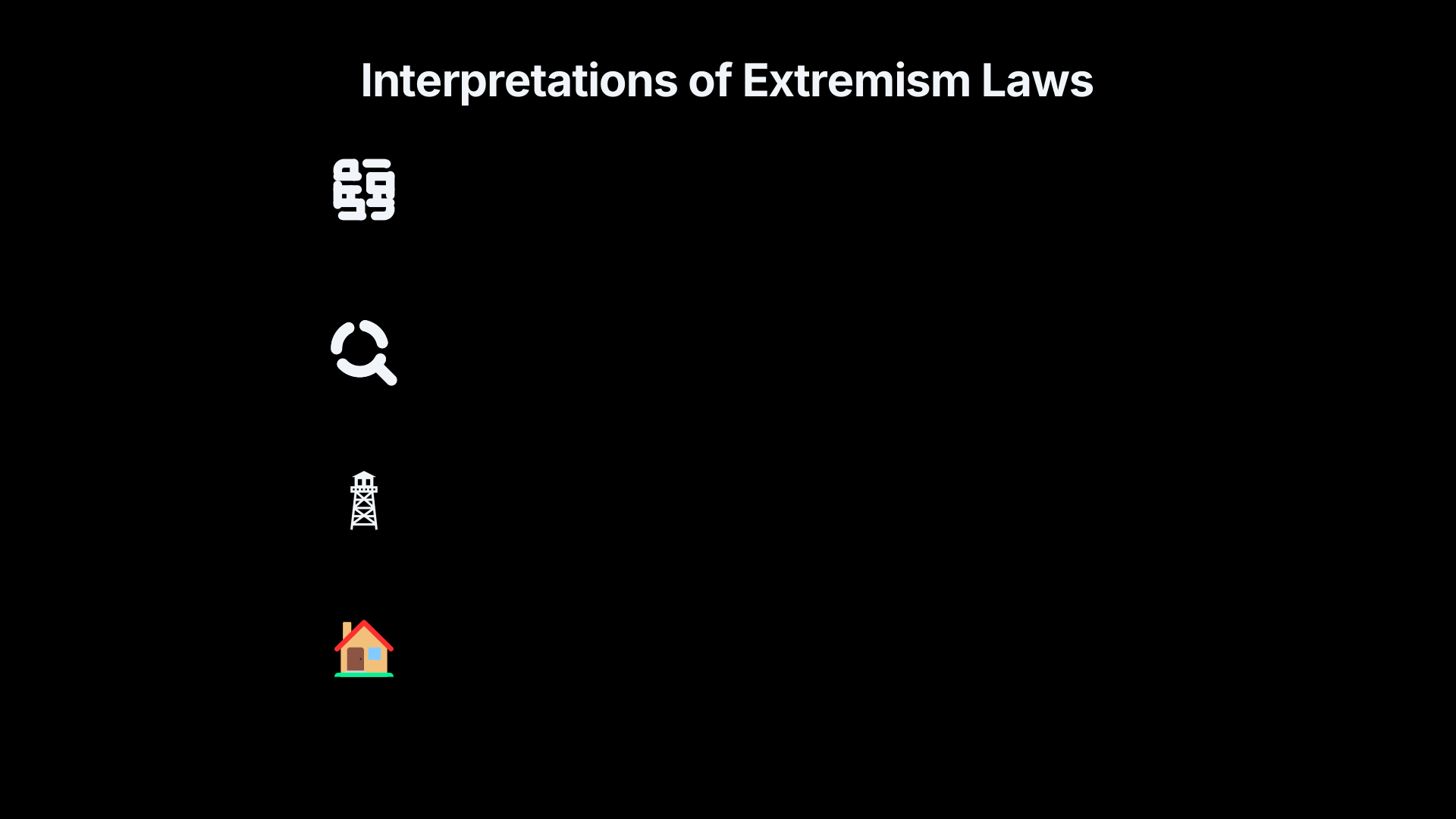
Successive legal frameworks allowed organisations, publications and online material to be prohibited as extremist. Human rights observers have argued that these definitions often lacked precise boundaries, making it possible for peaceful religious expression and political or theological literature to fall within security legislation rather than ordinary protections for freedom of religion or expression.[uscirf.gov]uscirf.govKyrgyzstan Country Update | USCIRFKyrgyzstan Country Update | USCIRF…
Several practical consequences followed:
- courts could prohibit religious publications as extremist;
- possession or distribution of banned literature could become a criminal matter;
- participation in prohibited organisations could attract prosecution even without evidence of planning violence;
- police surveillance increasingly extended into private religious meetings and study circles.
Critics have argued that such measures blurred the distinction between advocating violence and merely holding unpopular religious beliefs. Government officials, by contrast, maintained that extremist movements often begin through ideological indoctrination rather than overt attacks, making early intervention necessary.[USCIRF]uscirf.govKyrgyzstan Country Update | USCIRFKyrgyzstan Country Update | USCIRF…
Registration, literature and minority faiths
The expansion of suspicion did not affect only Islamist organisations.
Kyrgyzstan’s religion law requires religious organisations to register with the state, while unregistered activity has long faced legal restrictions. Religious freedom monitors have reported that registration can be especially difficult for smaller or non-traditional communities, leaving some groups vulnerable to police attention even when they operate peacefully.[ecoi.net]ecoi.netUSDOS – US Department of State (Author): “2020 Report on International Religious Freedom: Kyrgyzstan”, Document #2051642 - ecoi.net…
Minority communities have repeatedly argued that administrative controls became intertwined with security concerns. Jehovah’s Witnesses, for example, spent years challenging refusals to register congregations in southern Kyrgyzstan despite favourable constitutional and international human rights decisions. Their publications were also subjected to scrutiny under extremism legislation, illustrating how legal mechanisms developed for national security could extend into disputes involving peaceful religious practice.[ecoi.net]ecoi.netUSDOS – US Department of State (Author): “2020 Report on International Religious Freedom: Kyrgyzstan”, Document #2051642 - ecoi.net…
Independent Muslim groups likewise found themselves under increasing regulation. State authorities sought to channel Islamic education and organisation through officially recognised structures, arguing that consistent oversight reduced opportunities for radicalisation. Critics countered that this approach narrowed legitimate religious diversity and encouraged officials to treat independent religious activity as inherently suspicious.[USCIRF]uscirf.govKyrgyzstan Country Update | USCIRFKyrgyzstan Country Update | USCIRF…
Why suspicion spread beyond violent groups
One of the most significant changes was cultural rather than purely legal.
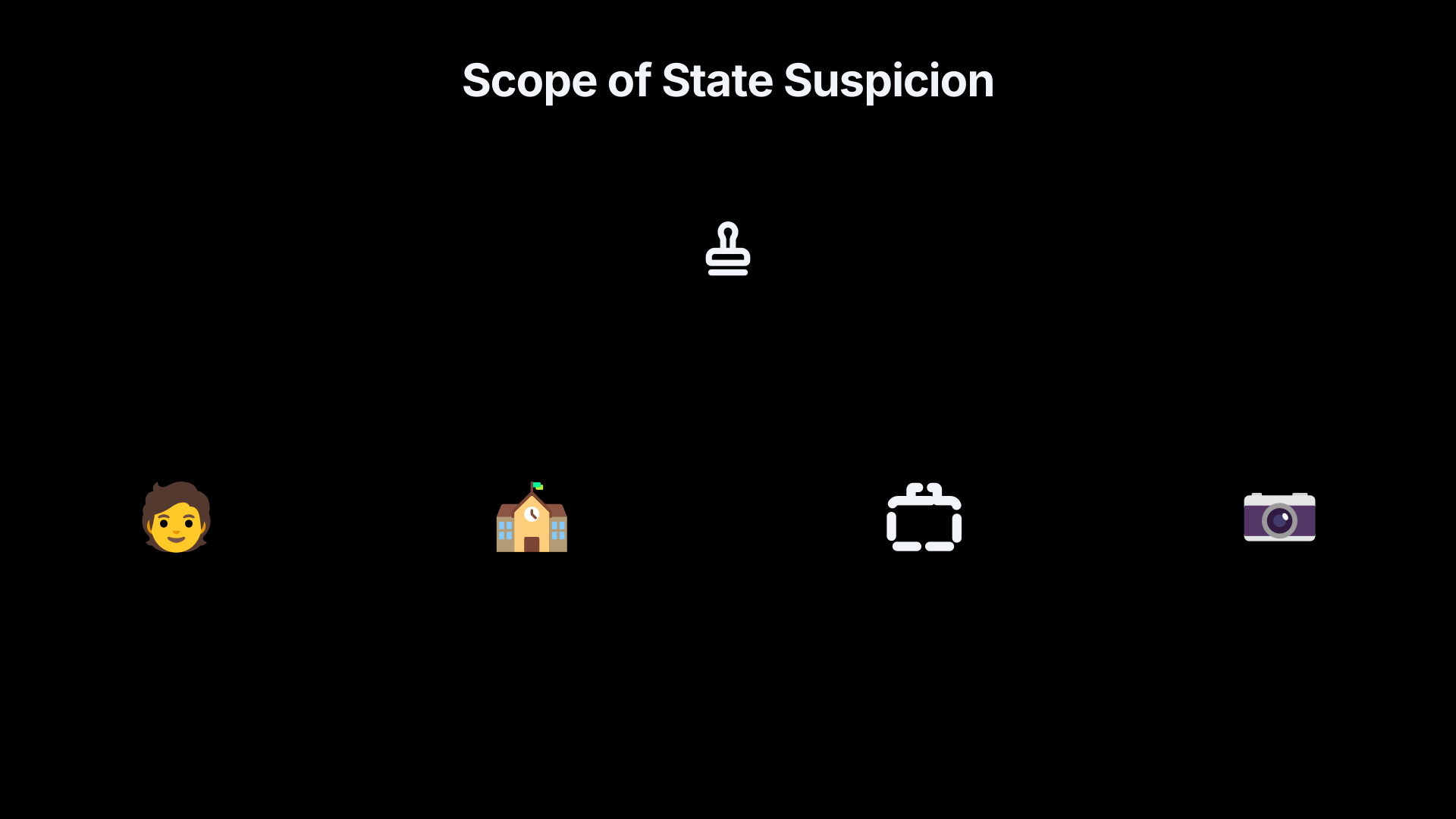
Public discussion increasingly linked several different ideas that are not necessarily the same:
- violent terrorism;
- religious conservatism;
- foreign missionary activity;
- independent religious education;
- possession of unfamiliar religious texts;
- membership of unpopular religious minorities.
For many officials these categories represented points along a single pathway towards radicalisation. Many scholars and religious freedom organisations reject that assumption, arguing that peaceful religious commitment should not automatically be interpreted as evidence of extremist intent.[uscirf.gov]uscirf.govKyrgyzstan Country Update | USCIRFKyrgyzstan Country Update | USCIRF…
This broader atmosphere also reinforced older post-Soviet fears about “sects” and foreign influence. Instead of focusing solely on demonstrably violent organisations, suspicion increasingly extended towards communities that simply fell outside the country’s preferred religious mainstream.
The continuing debate
The debate surrounding Kyrgyzstan’s extremism laws is therefore not whether genuine threats existed—they clearly did—but where legitimate security ends and unnecessary suspicion begins.
Supporters argue that the country’s location, porous borders and history of militant incursions justify broad preventive powers. Waiting until violence occurs, they contend, would expose citizens to unacceptable risks.
Critics respond that vague legal definitions encourage overreach. When peaceful meetings, theological discussion, possession of religious literature or minority religious identity become associated with extremism, they argue, public trust declines and ordinary believers may be pushed further to the margins rather than integrated into society. International observers have repeatedly recommended narrowing extremism legislation, improving judicial oversight and ensuring that restrictions target advocacy or preparation of violence rather than peaceful religious belief itself.[uscirf.gov]uscirf.govKyrgyzstan Country Update | USCIRFKyrgyzstan Country Update | USCIRF…
Within the broader history of collective fears in Kyrgyzstan, this represents a distinctive kind of moral panic. Instead of rumours spreading through villages or schools, the expansion of suspicion became embedded in legal categories. Real militant violence provided the original justification, but over time the language of extremism increasingly shaped how authorities and parts of society viewed peaceful religious difference.
Amazon book picks
Further Reading
Books and field guides related to When Did Security Policy Become Religious Suspicion?. Use these as the next step if you want deeper reading beyond the article.
Thinking, Fast and Slow
Useful for understanding threat perception and decision-making.
Endnotes
1.
Source: uscirf.gov
Title: Kyrgyzstan Country Update | USCIRF
Link:https://www.uscirf.gov/publications/kyrgyzstan-country-update
Source snippet
Kyrgyzstan Country Update | USCIRF...
2.
Source: ecoi.net
Link:https://www.ecoi.net/en/document/2051642.html
Source snippet
USDOS – US Department of State (Author): “2020 Report on International Religious Freedom: Kyrgyzstan”, Document #2051642 - ecoi.net...
3.
Source: uscirf.gov
Link:https://www.uscirf.gov/countries/kyrgyzstan
Source snippet
October 24, 2025 — KYRGYZSTAN IMAGE View the Kyrgyzstan chapters in our annual reports > Recent News Events Publications Advising G...
Published: October 24, 2025
4.
Source: uscirf.gov
Link:https://www.uscirf.gov/news-room/releases-statements/new-religion-law-kyrgyzstan-marks-deterioration-religious-freedom
Source snippet
New Religion Law in Kyrgyzstan Marks the Deterioration of Religious Freedom | USCIRFOctober 24, 2025 — NEW RELIGION LAW IN KYRGYZSTAN MAR...
Published: October 24, 2025
5.
Source: uscirf.gov
Title: alarmed regressive amendments kyrgyz laws
Link:https://www.uscirf.gov/news-room/releases-statements/uscirf-alarmed-regressive-amendments-kyrgyz-laws
Source snippet
USCIRF Alarmed by Regressive Amendments to Kyrgyz Laws | USCIRFJanuary 31, 2025 — USCIRF ALARMED BY REGRESSIVE AMENDMENTS TO KYRGYZ LAWS...
Published: January 31, 2025
6.
Source: ecoi.net
Link:https://www.ecoi.net/de/dokument/2111899.html
Source snippet
USDOS – US Department of State (Autor): „2023 Report on International Religious Freedom: Kyrgyzstan“, Dokument #2111899 - ecoi.netJune 26...
7.
Source: uscirf.gov
Title: releases report religious freedom kyrgyzstan
Link:https://www.uscirf.gov/news-room/releases-statements/uscirf-releases-report-religious-freedom-kyrgyzstan
8.
Source: ecoi.net
Link:https://www.ecoi.net/en/document/2091949.html
9.
Source: ecoi.net
Link:https://www.ecoi.net/en/document/2031347.html
10.
Source: uscirf.gov
Title: kyrgyzstan country update
Link:https://www.uscirf.gov/publication/kyrgyzstan-country-update
11.
Source: 2021-2025.state.gov
Link:https://2021-2025.state.gov/report/custom/5adfe4caeb/
12.
Source: freedomhouse.org
Title: freedom world
Link:https://freedomhouse.org/country/kyrgyzstan/freedom-world/2024
Source snippet
Freedom HouseKyrgyzstan: Freedom in the World 2024 Country Report | Freedom House...
13.
Source: freedomhouse.org
Title: freedom world
Link:https://freedomhouse.org/country/kyrgyzstan/freedom-world/2018
14.
Source: freedomhouse.org
Title: freedom world
Link:https://freedomhouse.org/country/kyrgyzstan/freedom-world/2021
15.
Source: hrw.org
Link:https://www.hrw.org/world-report/2025/country-chapters/kyrgyzstan
Additional References
16.
Source: hrw.org
Title: Kyrgyzstan: Reject Proposed Law on ‘Extremist’ Materials | Human Rights Watch
Link:https://www.hrw.org/news/2024/10/01/kyrgyzstan-reject-proposed-law-extremist-materials
Source snippet
October 1, 2024 — KYRGYZSTAN: REJECT PROPOSED LAW ON 'EXTREMIST' MATERIALS Print Donate Now October 1, 2024 9:00PM EDT | News Release KYR...
Published: October 1, 2024
17.
Source: youtube.com
Title: EU Efforts to Prevent Violent Extremism by Engaging Civil Society in Kyrgyzstan
Link:https://www.youtube.com/watch?v=GoNgE1pAg-U
Source snippet
Terrorist Recruitment in Central Asia Explained | Noah Tucker details how security grievances and state counter-extremism operations inte...
18.
Source: eurasiareview.com
Title: Kyrgyzstan: Repressive New Religion Law In Force
Link:https://www.eurasiareview.com/02022025-kyrgyzstan-repressive-new-religion-law-in-force-analysis/
Source snippet
Analysis - Eurasia ReviewFebruary 2, 2025 — KYRGYZSTAN: REPRESSIVE NEW RELIGION LAW IN FORCE – ANALYSIS February 2, 2025February 2, 2025...
Published: February 2, 2025
19.
Source: youtube.com
Link:https://www.youtube.com/watch?v=MeloWKJQcqs
Source snippet
EU Efforts to Prevent Violent Extremism by Engaging Civil Society in Kyrgyzstan...
20.
Source: youtube.com
Title: Terrorist Recruitment in Central Asia Explained | Noah Tucker
Link:https://www.youtube.com/watch?v=1SmkA0kWS2A
Source snippet
Nurbek Bekmurzaev, "Mediatization of Religion in Kyrgyzstan: Redistribution..."...
21.
Source: amnesty.org
Link:https://www.amnesty.org/en/location/europe-and-central-asia/eastern-europe-and-central-asia/kyrgyzstan/report-kyrgyzstan/
22.
Source: youtube.com
Title: New World Order
Link:https://www.youtube.com/watch?v=dTPcQd4ue2o
Source snippet
Terrorist Recruitment in Central Asia Explained | Noah Tucker...
23.
Source: article19.org
Title: Legal Analysis: Kyrgyzstan’s Law on Countering Extremist Activity
Link:https://www.article19.org/resources/legal-analysis-kyrgyzstans-law-on-countering-extremist-activity/
24.
Source: article19.org
Title: Kyrgyzstan: Report on freedom of expression and ‘extremism’
Link:https://www.article19.org/resources/kyrgyzstan-freedom-of-expression-and-extremism/
25.
Source: youtube.com
Title: Radical Islam in Kyrgyzstan. Broadcast
Link:https://www.youtube.com/watch?v=0fczAcB2yKE
Source snippet
New World Order - Kyrgyzstan...
Published: May 1, 2011
Topic Tree