Within Mauritania
Was Mauritania Really Facing a Shia Tide?
Warnings about a supposed Shia expansion recast a small religious minority as a threat shaped by domestic rivalry and regional politics.
On this page
- How the Shia threat narrative emerged
- Regional geopolitics and domestic religious rivalry
- Closure of the religious centre and minority consequences
Page outline Jump by section
Introduction
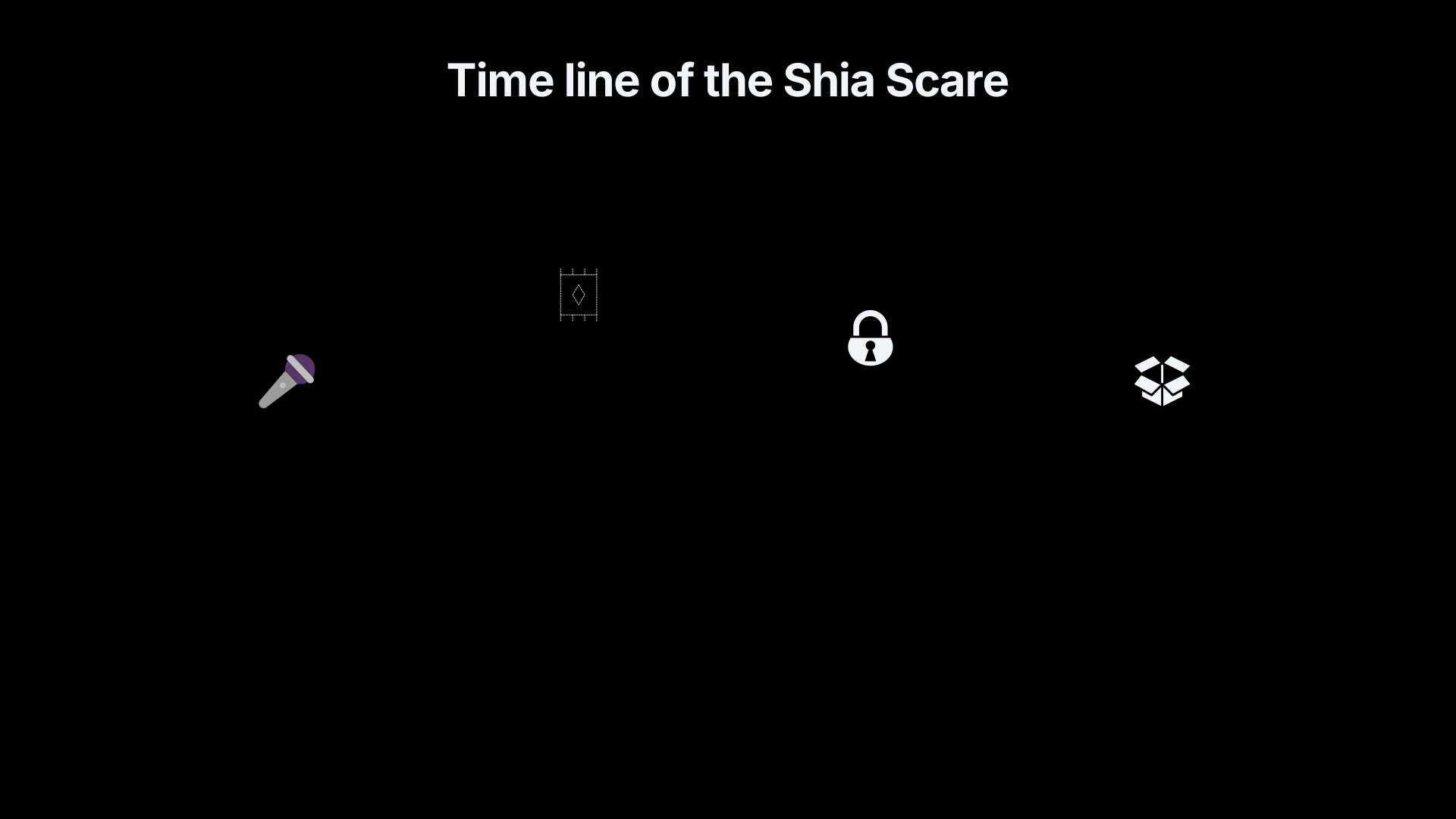
Warnings that Mauritania was facing a growing “Shia tide” became one of the country’s clearest examples of a modern religious scare centred on a very small minority rather than a demonstrable national security threat. During 2017 and 2018, religious leaders, officials and sections of the media increasingly portrayed the spread of Shia Islam as an urgent danger linked to foreign influence, especially Iran. The controversy culminated in the closure of the country’s best-known Shia religious centre and the confiscation of its property.
The episode is significant because it illustrates how geopolitical rivalry and domestic religious politics can transform a tiny minority community into the focus of a national moral alarm. Although Mauritania’s government presented its actions as protecting religious unity and regulating religious activity, independent observers found little public evidence that the country’s small Shia population posed the sweeping threat described in public debate. Instead, the affair is widely interpreted as an example of minority repression shaped by regional politics and anxieties over religious authority.[ecoi.net]ecoi.netUSDOS – US Department of State (Author): “2018 Report on International Religious Freedom: Mauritania”, Document #2011122 - ecoi.netJune 2…
Was Mauritania really facing a Shia tide?
Available evidence suggests that Mauritania’s Shia community has always been extremely small. Official estimates and outside observers generally place it at around 1% of the population or less, with Sunni Islam overwhelmingly dominant and recognised by the constitution as the religion of both the state and its citizens.[ecoi.net]ecoi.netUSDOS – US Department of State (Author): “2018 Report on International Religious Freedom: Mauritania”, Document #2011122 - ecoi.netJune 2…
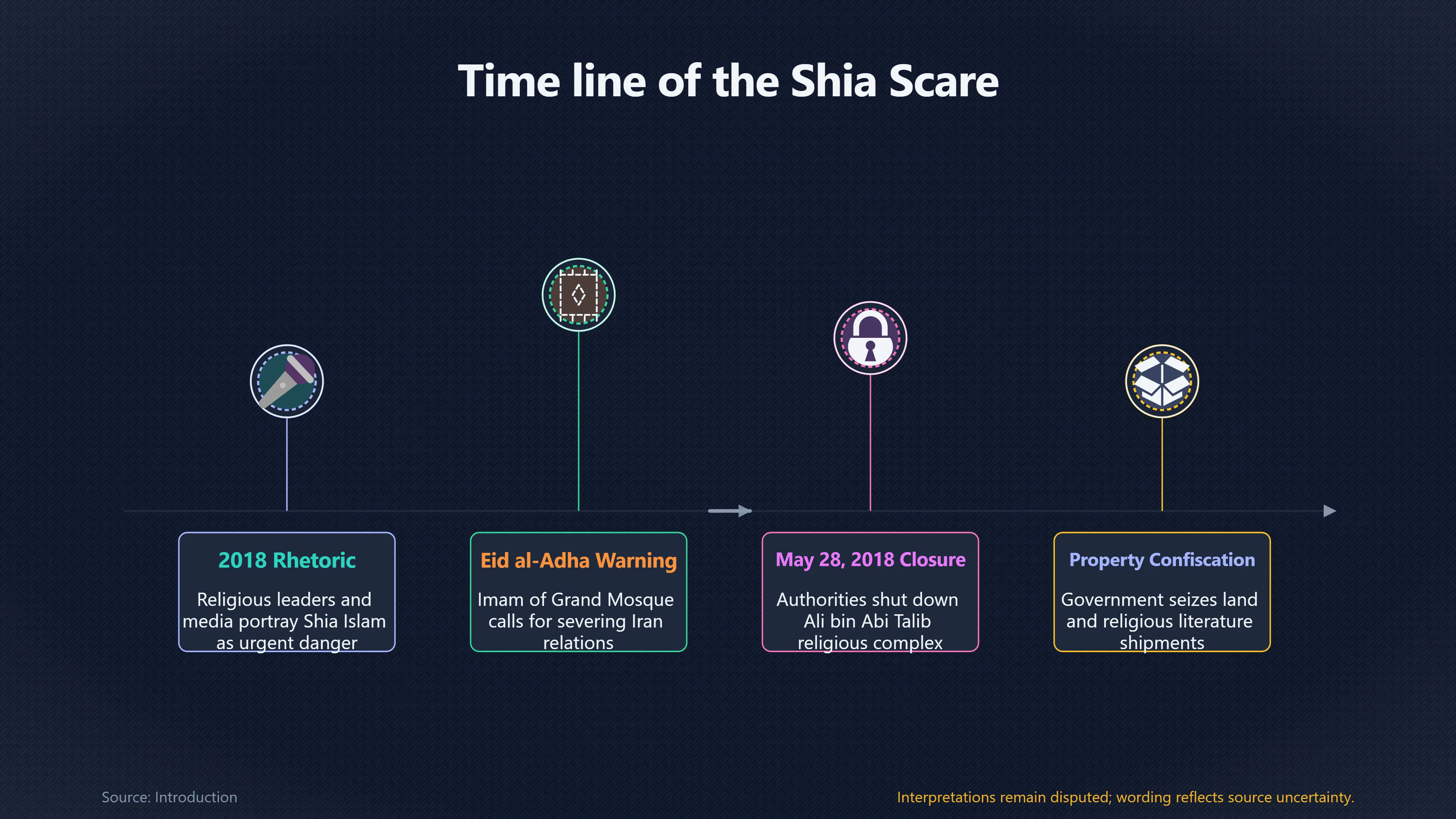
Despite this limited demographic presence, public rhetoric increasingly described Shia Islam not as a minor religious current but as an expanding movement capable of undermining Mauritania’s religious identity. Sermons, interviews and official statements warned of organised efforts to convert Sunnis and establish Iranian influence. During the 2018 Eid al-Adha celebrations, the imam of Nouakchott’s Grand Mosque publicly renewed warnings about alleged Shia expansion and called for Mauritania to sever relations with Iran in order to halt its spread.[ecoi.net]ecoi.netUSDOS – US Department of State (Author): “2018 Report on International Religious Freedom: Mauritania”, Document #2011122 - ecoi.netJune 2…
The language of an approaching “tide” was important. Rather than debating specific individuals or institutions, it suggested an unstoppable wave threatening the country’s religious foundations. That framing encouraged people to see isolated religious activity as evidence of a much larger campaign.
How the Shia threat narrative emerged
The scare developed through the interaction of several overlapping concerns rather than a single triggering incident.
First, Mauritania defines itself constitutionally as an Islamic republic whose religious institutions are closely connected to the state. Religious unity has long been presented as part of national stability, making theological differences politically sensitive.[ecoi.net]ecoi.netUSDOS – US Department of State (Author): “2018 Report on International Religious Freedom: Mauritania”, Document #2011122 - ecoi.netJune 2…
Second, regional politics strongly influenced domestic discussion. Across the Middle East and parts of North Africa, rivalry between Saudi Arabia and Iran intensified concern among many Sunni religious establishments about Iranian religious influence. Mauritania’s debate reflected this wider regional atmosphere more than any documented surge in local conversions.
Third, warnings often relied on claims about foreign funding, imported literature and missionary activity. Government officials stated that shipments of Shia religious literature intended for a religious centre had been seized because their dissemination lacked official authorisation. Critics argued that such claims did not demonstrate the existence of an organised national campaign capable of threatening Mauritania’s overwhelmingly Sunni society.[ecoi.net]ecoi.netUSDOS – US Department of State (Author): “2018 Report on International Religious Freedom: Mauritania”, Document #2011122 - ecoi.netJune 2…
This combination of constitutional identity, regional rivalry and concern over outside influence allowed a very small religious minority to be discussed in disproportionately existential terms.
Regional geopolitics and domestic religious rivalry
The controversy cannot be understood solely as a dispute over theology.
Mauritania’s religious establishment is rooted largely in the Maliki Sunni tradition, which has historically been promoted as a source of social cohesion. Officials simultaneously pursued policies aimed at countering violent extremism while also emphasising protection of accepted religious doctrine. Within that framework, minority Islamic traditions could be portrayed as potential sources of division even without evidence of violence or organised subversion.[ecoi.net]ecoi.netUSDOS – US Department of State (Author): “2018 Report on International Religious Freedom: Mauritania”, Document #2011122 - ecoi.netJune 2…
Regional developments reinforced these concerns. During the late 2010s, several Arab governments were reassessing their relationships with Iran amid conflicts in Yemen, Syria and elsewhere. In that atmosphere, local Shia communities in countries with only tiny Shia populations were sometimes viewed through the lens of international geopolitics rather than local religious practice.
This helps explain why rhetoric about the “Shia tide” often focused less on Mauritanian believers themselves than on alleged external sponsorship. The perceived danger lay in the idea of foreign ideological penetration rather than in the documented activities of a sizeable domestic movement.

Closure of the religious centre and consequences for the minority
The most visible outcome came on 28 May 2018, when authorities closed the Ali bin Abi Talib religious complex in Nouakchott’s Dar al-Na’im district. According to government accounts, officials also confiscated the property after alleging that unauthorised Shia religious literature had been imported for distribution. Media reports described the move as an effort to restrict public expressions of Shia Islam.[ecoi.net]ecoi.netUSDOS – US Department of State (Author): “2018 Report on International Religious Freedom: Mauritania”, Document #2011122 - ecoi.netJune 2…
For Mauritania’s already small Shia community, the closure had effects extending beyond a single building.
These included:
- loss of an important place for religious gathering and teaching;
- increased public suspicion towards Shia religious identity;
- stronger incentives for believers to practise privately rather than openly;
- reinforcement of the idea that Shia Islam represented an external political project rather than a legitimate minority religious tradition.
The closure also occurred during a broader period in which authorities took restrictive measures affecting other religious and political institutions, including Islamic organisations associated with opposition figures. This wider context suggests that concerns about religious authority, political competition and state control intersected rather than operating independently.[ecoi.net]ecoi.netUSDOS – US Department of State (Author): “2018 Report on International Religious Freedom: Mauritania”, Document #2011122 - ecoi.netJune 2…
Was the threat supported by evidence?
One of the striking features of the episode is the gap between the scale of the rhetoric and the publicly available evidence.
Government statements referred to imported literature and the need to prevent unauthorised religious activity. Religious leaders warned of growing influence. However, publicly available reports from international observers do not describe evidence of a large-scale conversion campaign or an organised movement capable of transforming Mauritania’s religious landscape. Instead, they consistently describe Shia Muslims as a very small minority.[ecoi.net]ecoi.netUSDOS – US Department of State (Author): “2018 Report on International Religious Freedom: Mauritania”, Document #2011122 - ecoi.netJune 2…
This does not mean that every concern expressed by officials was fabricated. States routinely regulate religious organisations and foreign-funded institutions. The question is one of proportionality. Independent reporting has generally found that the official response greatly exceeded the demonstrated scale of the community involved.
For historians and scholars of moral panics, this distinction is important. A moral panic does not require that every underlying concern be false. Rather, it involves presenting a limited or uncertain problem as an overwhelming social danger requiring exceptional measures.
Why the episode matters
The “Shia tide” controversy occupies an important place in Mauritania’s recent history because it demonstrates how minority religious identities can become symbols in larger political struggles.
Rather than reflecting a dramatic expansion of Shia Islam, the episode shows how:
- regional geopolitical conflicts can reshape domestic perceptions of tiny religious minorities;
- religious competition may become intertwined with state policy;
- fear of foreign influence can magnify limited evidence into a narrative of national emergency;
- restrictive measures against minority communities may gain public support when framed as protecting religious unity.
Within Mauritania’s broader history of religious controversies, the Shia scare belongs alongside other episodes in which disputes over belief became questions of national identity and public order. Unlike classic cases of mass psychogenic illness or witch panics, this was a moral panic rooted in perceptions of ideological infiltration, where the principal consequence fell upon a small religious minority whose visibility became interpreted as evidence of a much larger threat.[ecoi.net]ecoi.netUSDOS – US Department of State (Author): “2018 Report on International Religious Freedom: Mauritania”, Document #2011122 - ecoi.netJune 2…
Amazon book picks
Further Reading
Books and field guides related to Was Mauritania Really Facing a Shia Tide?. Use these as the next step if you want deeper reading beyond the article.
Folk Devils and Moral Panics the Creation of the Mods and Roc...
First published 1972. Subjects: Youth, great britain, Deviant behavior, Case studies, Subculture, Young adults.
Endnotes
1.
Source: ecoi.net
Link:https://www.ecoi.net/en/document/2011122.html
Source snippet
USDOS – US Department of State (Author): “2018 Report on International Religious Freedom: Mauritania”, Document #2011122 - ecoi.netJune 2...
2.
Source: state.gov
Title: Department Human Rights Reports: Custom Report Excerpts
Link:https://www.state.gov/report/custom/ecf871b3d2/
Source snippet
State DepartmentHuman Rights Reports: Custom Report Excerpts - United States Department of State...
3.
Source: ecoi.net
Link:https://www.ecoi.net/de/dokument/2031311.html
Source snippet
USDOS – US Department of State (Autor): „2019 Report on International Religious Freedom: Mauritania“, Dokument #2031311 - ecoi.netJune 10...
4.
Source: ecoi.net
Link:https://www.ecoi.net/en/document/1436836.html
5.
Source: state.gov
Link:https://www.state.gov/reports/2019-report-on-international-religious-freedom/burma
6.
Source: 2021-2025.state.gov
Title: bab1b5532c 3
Link:https://2021-2025.state.gov/report/custom/bab1b5532c-3/
7.
Source: hrw.org
Link:https://www.hrw.org/report/2018/02/12/ethnicity-discrimination-and-other-red-lines/repression-human-rights-defenders
8.
Source: thefederalnewswire.com
Title: Mauritania | Federal Newswire
Link:https://thefederalnewswire.com/stories/626699833-mauritania
Source snippet
June 21, 2019 — On May 28, government authorities closed a Shia religious center, the Ali bin Abi Talib complex in Nouakchott’s Dar al-Na...
Published: June 21, 2019
9.
Source: hrw.org
Link:https://www.hrw.org/world-report/2019/country-chapters/mauritania
10.
Source: hrw.org
Link:https://www.hrw.org/world-report/2020/country-chapters/mauritania
Additional References
11.
Source: hrw.org
Title: Mauritania: Repressive Laws Restrict Peaceful Speech | Human Rights Watch
Link:https://www.hrw.org/news/2019/01/17/mauritania-repressive-laws-restrict-peaceful-speech
Source snippet
January 17, 2019 — MAURITANIA: REPRESSIVE LAWS RESTRICT PEACEFUL SPEECH Print Donate Now January 17, 2019 4:25AM EST | News Release Avail...
Published: January 17, 2019
12.
Source: legistorm.com
Title: 2018 report on international religious freedom mauritania
Link:https://www.legistorm.com/stormfeed/view_rss/2666986/organization/95126/title/2018-report-on-international-religious-freedom-mauritania.html
Source snippet
Department of State Bureau of African Affairs Press release | LegiStormJune 21, 2019 — 2018 REPORT ON INTERNATIONAL RELIGIOUS FREEDOM: MA...
Published: June 21, 2019
13.
Source: aljazeera.net
Title: نذر أزمة بين النظام والإسلاميين في
Link:https://www.aljazeera.net/news/2018/9/26/%D9%86%D8%B0%D8%B1-%D8%A3%D8%B2%D9%85%D8%A9-%D8%A8%D9%8A%D9%86-%D8%A7%D9%84%D9%86%D8%B8%D8%A7%D9%85-%D9%88%D8%A7%D9%84%D8%A5%D8%B3%D9%84%D8%A7%D9%85%D9%8A%D9%8A%D9%86-%D9%81%D9%8A
Source snippet
موريتانيا | أخبار | الجزيرة نتSeptember 26, 2018 — نذر أزمة بين النظام والإسلاميين في موريتانيا Image: مركز تكوين العلماء مركز تكوين العل...
Published: September 26, 2018
14.
Source: youtube.com
Title: Iran, Politics, and Power: A Conversation with Mansour Farhang and John Limbert
Link:https://www.youtube.com/watch?v=5LqQ6nMQMSY
Source snippet
A broad political spectrum in Mauritania condemns the targeting of Iran...
15.
Source: youtube.com
Title: Mauritania confiscates a Shia mosque in Nouakchott, isolates Imam
Link:https://www.youtube.com/watch?v=VKh1U98zVe0
Source snippet
Iran, Politics, and Power: A Conversation with Mansour Farhang and John Limbert...
16.
Source: youtube.com
Title: A broad political spectrum in Mauritania condemns the targeting of Iran
Link:https://www.youtube.com/watch?v=ih4eQs16mR4
Source snippet
City Talk: Fmr. Amb. Richard Murphy Discusses the Middle East...
17.
Source: youtube.com
Title: City Talk: Fmr. Amb. Richard Murphy Discusses the Middle East
Link:https://www.youtube.com/watch?v=wLuKuPJPzmk
Source snippet
Islam in Africa - History Of Africa with Zeinab Badawi [Episode 9]...
18.
Source: amnesty.org
Link:https://www.amnesty.org/en/documents/afr38/7812/2018/en/
Source snippet
Amnesty International...
19.
Source: amnestyusa.org
Link:https://www.amnestyusa.org/reports/mauritania-a-sword-hanging-over-our-heads-the-repression-of-activists-speaking-out-against-discrimination-and-slavery-in-mauritania/
20.
Source: amnesty.org
Link:https://www.amnesty.org/en/latest/news/2018/03/mauritania-slavery-and-discrimination-human-rights-defenders-repressed/
Topic Tree