How Malta Turned Fear Into Social Control
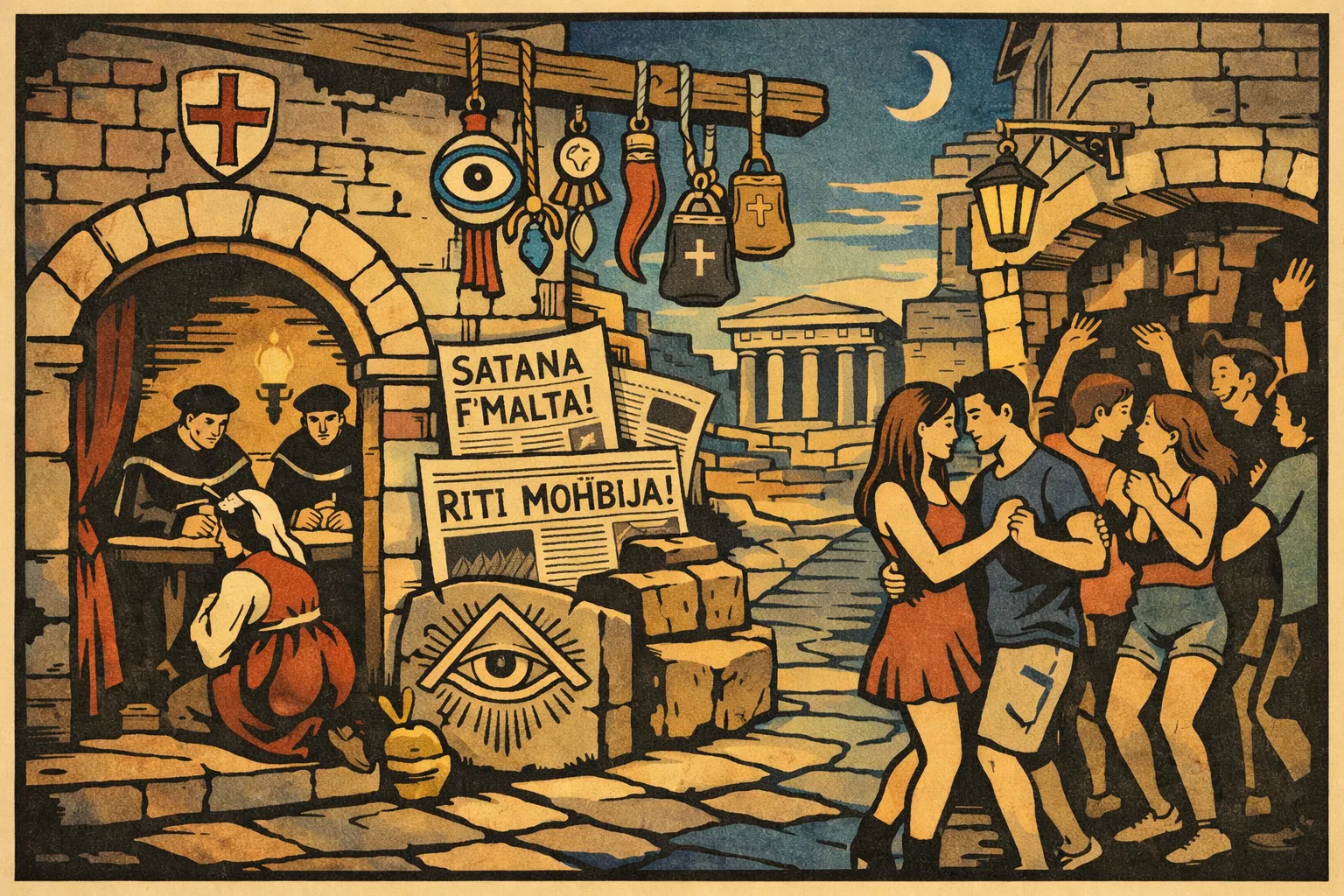
Malta’s history of collective fear is not dominated by one spectacular outbreak of “mass hysteria”. Instead, it reveals a recurring contest over who may define the supernatural, identify moral danger and police acceptable behaviour.
Page outline Jump by section
Introduction
The same pattern reappears in modern form. Reports of Satanism, dangerous youth parties and unauthorised religious apparitions have periodically attracted alarm, publicity and demands for intervention. Yet these episodes need separating carefully. Some involved real illegal conduct or risky behaviour; others magnified scattered incidents into a broader threat; still others concerned sincere religious experiences rejected by Church investigators. Malta’s small size, strong Catholic inheritance and tightly connected media environment have repeatedly helped rumours and moral judgements travel quickly.
Witchcraft without a mass witch hunt
What Maltese people were accused of doing
The Roman Inquisition operated in Malta from the sixteenth century until the French occupation of 1798. Its surviving case files are among the most valuable sources for understanding everyday supernatural belief on the islands. Witchcraft became a significant concern after the apostolic visitation of Pietro Dusina in 1574, but the records describe something more ordinary and socially embedded than an organised underground religion.[L-Università ta' Malta]um.edu.mtL-Università ta' MaltaOAR@UM: Malta [Encyclopedia of witchcraft]by C Cassar · 2006 — Information on witchcraft practices in Malta comes f…
People sought magical assistance for recognisable human problems: attracting or retaining a lover, identifying a thief, treating illness, protecting a household, finding missing property or influencing an absent partner. Practitioners might use prayers, herbs, written formulas, blessed objects or rituals that mixed approved Catholic devotion with prohibited magic. Historian Carmel Cassar argues that Maltese practices combined beliefs found elsewhere in Europe with circumstances particular to a Mediterranean island whose men were frequently absent at sea.[L-Università ta' Malta]um.edu.mtCarmel Cassar's carefully researched study makes innovative use of the great wealth that lies…
This mixture complicates the label “witch”. Many defendants did not belong to a separate faith and may not have considered themselves enemies of Christianity. Some apparently saw their practices as extensions of prayer, healing or folk religion. Inquisitors, however, could interpret invocations, divination and attempts to command supernatural powers as superstition, heresy or dealings with the Devil. The tribunal therefore helped turn ambiguous popular customs into officially recognised offences.[L-Università ta' Malta]um.edu.mt1993 (b) Witchcraft Beleifs and Social Control in Seventeenth century Maltawitch trials held by the Malta Inquisition in…Read more…
Women appear prominently in the records, especially in cases involving love, marriage and domestic insecurity. That does not prove that magical belief was exclusively female. It does show how women with limited legal, economic or personal power could be suspected when they offered remedies, advice or ritual solutions outside authorised male institutions. Accusations could regulate behaviour as well as belief, reinforcing expectations about sexuality, obedience and respectable womanhood.[L-Università ta' Malta]um.edu.mtOpen source on edu.mt.
Why Malta did not become another Salem
Malta certainly had witchcraft prosecutions, imprisonment and coercive interrogation. It should not be romanticised as tolerant. Nevertheless, the evidence does not support the popular image of villages consumed by a single escalating witch panic or of large numbers of accused people being burned.
Several features restrained escalation. Witchcraft cases were handled principally by a centralised inquisitorial tribunal rather than by numerous competing local courts. Roman inquisitorial procedure generally demanded investigation, confession and reconciliation with the Church. Many allegations concerned practical magic rather than claims that a vast Devil-worshipping conspiracy was destroying Christian society. Punishments could still be humiliating or severe, but they were more often penitential than fatal. Cassar’s research also suggests that relatively mild penalties failed to eradicate popular magic, which survived beyond the abolition of the tribunal.[L-Università ta' Malta]um.edu.mtOpen source on edu.mt.
The most accurate conclusion is therefore less dramatic than the folklore. Malta experienced persistent belief in harmful and helpful magic, repeated denunciations and institutional repression. It did not experience a classic mass witch hunt marked by contagious accusation and extensive execution.
When Satan became an explanation for modern disorder
Fear of Satanism resurfaced in Malta during the late twentieth century, particularly around youth culture, drugs, vandalism, heavy music and changing sexual behaviour. The available evidence is more fragmented than the Inquisition archive, so sweeping claims about a single national “Satanic panic” should be treated cautiously.
Anthropological work on contemporary Malta describes concern about Satanism alongside older beliefs in the Devil and the evil eye. In this setting, Satan could operate as both a religious being and an explanatory symbol for social changes that worried parents, clergy and commentators: drug use, rebellious youth, violence and declining religious observance.[De Gruyter Brill]degruyterbrill.comOpen source on degruyterbrill.com.
This did not mean that every disturbing incident was imaginary. Malta had drug misuse, destructive vandalism and people interested in occult imagery. The moral-panic question is narrower: did public discussion move from evidence of particular acts to claims that a coherent, hidden and expanding Satanic force was responsible?
The interpretation of damage to archaeological sites shows how easily that leap could occur. Commentary on an attack at the Mnajdra temples recalled earlier speculation that Satanists were responsible for vandalism marked by Satanic symbols, although those markings did not establish the existence of an organised ritual group. In April 2001, vandals toppled or damaged numerous stones at the World Heritage complex, prompting national and international concern about security and conservation. The documented fact was a serious heritage crime; the identity and ideology attributed to its perpetrators were a separate question.[com.mt]maltatoday.com.mtits doom alone that countsits doom alone that counts
A University of Malta dissertation on alleged “cult crime” later concluded, from expert interviews and newspaper coverage, that Satanism was Malta’s most destructive cult-related phenomenon. Its findings are useful evidence of how professionals and journalists understood the issue, but the study’s method cannot by itself establish the scale of clandestine groups or verify every incident described in the press. Newspaper reports about supposed cult activity may be part of the phenomenon being investigated rather than independent confirmation of it.[L-Università ta' Malta]um.edu.mtOpen source on edu.mt.
That distinction matters because the international Satanic panic of the 1980s and 1990s frequently converted ambiguous graffiti, adolescent experimentation and unrelated crimes into evidence of organised ritual networks. Malta’s version appears to have shared some of that language, filtered through a society where Catholic symbols remained culturally powerful and social distance between clergy, journalists, officials and families was comparatively small.
Youth parties and the making of “folk devils”
Modern Maltese moral panics have not always required a supernatural enemy. Young people themselves have repeatedly been represented as evidence that social order is deteriorating.
Research into the treatment of so-called SIN parties during the 1990s found that local newspapers associated the events with indecency and illicit drugs. The study concluded that the press did more than report public concern: it helped define the parties as a social threat and encouraged demands that something be done.[L-Università ta' Malta]um.edu.mtOpen source on edu.mt.
A similar cycle developed around teenage parties between 2011 and 2013. A University of Malta case study examined print and online reporting, television programmes and interviews with influential participants. It found that young partygoers were cast as what moral-panic scholars call “folk devils”: a recognisable group blamed for wider fears about alcohol, sexuality, parenting, commercial nightlife and declining discipline.[L-Università ta' Malta]um.edu.mtOpen source on edu.mt.
Calling this a moral panic does not mean that every concern was invented. Under-age drinking, unsafe venues, drug availability and sexual exploitation are legitimate safeguarding issues. The analytical test is whether reporting distinguishes demonstrable risks from assumptions about an entire generation. Panic develops when exceptional incidents are presented as typical, lurid anecdotes outweigh reliable prevalence data and young people are discussed primarily as either threats or helpless victims.
Malta’s scale can intensify this process. A small number of incidents may receive sustained national attention, while overlapping personal, political and institutional networks can make an issue feel socially omnipresent. Online circulation adds another layer: warnings, photographs and unverified claims can move between parents, broadcasters and social media before evidence has been checked. Research on digital moral panics more broadly suggests that social media does not replace traditional news institutions so much as accelerate exchanges among journalists, campaigners, officials and audiences.[PMC]pmc.ncbi.nlm.nih.govOpen source on nih.gov.
The youth-party scares also reveal a recurring cultural tension. Public arguments ostensibly about drugs or safety often become arguments about who controls young people’s leisure, sexuality and independence. The practical danger may be real, but the symbolic fear is larger: that Malta is becoming less governable, less religious or less recognisably Maltese.
Apparitions, miracles and religious authority
Collective belief is not necessarily a panic. Malta has a long and deeply rooted tradition of Marian devotion, pilgrimage, votive offerings and reported miracles. Such practices cannot reasonably be dismissed as mass hysteria merely because they involve supernatural claims.
The sanctuary at Ta’ Pinu in Gozo, for example, developed around Karmni Grima’s report that she heard a woman’s voice from the chapel in 1883. The devotion grew through local testimony, reports of answered prayers and institutional acceptance, eventually producing a major pilgrimage site. The episode is best understood as the formation of a religious tradition, not as evidence of contagious mental illness.[Our Sunday Visitor]oursundayvisitor.comOur Sunday Visitor Unveiling the miraculous shrines of the Virgin Mary in MaltaOur Sunday Visitor Unveiling the miraculous shrines of the Virgin Mary in Malta
A more revealing case for the study of disputed belief arose at Borġ in-Nadur near Birżebbuġa. Anġelik Caruana reported apparitions and messages attributed to the Virgin Mary, attracting followers to gatherings at the site. The events generated publicity, devotional practices and controversy over whether the claims were authentic.[MaltaToday.com.mt]maltatoday.com.mtangeliks apparitions not divine in origin says curiaangeliks apparitions not divine in origin says curia
In January 2016, the Maltese Church announced the result of an investigation ordered by Archbishop Pawlu Cremona. It concluded that the alleged apparitions, messages and associated phenomena were neither divine nor supernatural. The judgement was important because Catholic authorities do not automatically approve popular supernatural claims; they investigate credibility, conduct, doctrine and the effects of the claimed revelations.[Arċidjoċesi ta' Malta]church.mtArċidjoċesi ta' Malta The alleged mystical phenomena in Borġ in-NadurArċidjoċesi ta' Malta The alleged mystical phenomena in Borġ in-Nadur
Borġ in-Nadur should not be described casually as a “cult”. The evidence supports describing it as an unauthorised apparition movement centred on a claimed visionary. Some followers evidently regarded the experiences as sincere, while ecclesiastical authorities rejected their supernatural origin. Without evidence of systematic coercion, exploitation or criminal organisation, the more sensational label obscures more than it explains.
The case does, however, show how collective expectation can build. Repeated meetings, testimony from believers, emotionally charged objects and anticipation of further messages can reinforce commitment within a group. Public controversy may strengthen that identity by allowing followers to see scepticism as persecution or a test of faith. Institutional rejection does not necessarily dissolve belief; it can shift authority away from the official Church and towards the visionary and the community surrounding him.
What the Maltese record actually shows
Malta’s most important contribution to the history of panics and collective belief is the contrast between persistent supernatural culture and the relative absence of a single, catastrophic national hysteria.
The Inquisition files show that magical belief was woven into everyday life. People used ritual and divination to manage love, illness, insecurity and misfortune. Authorities prosecuted those practices, but the proceedings did not develop into mass executions. Modern Satanism scares similarly reveal genuine concern about crime and social change, yet the evidence for large, organised Devil-worshipping networks is much weaker than the public imagery surrounding them.
Youth-party controversies demonstrate how the structure of panic can survive after its supernatural language fades. The threatening witch or Satanist is replaced by the drug-taking teenager, irresponsible promoter or supposedly negligent parent. The underlying mechanism remains familiar: a visible incident becomes a symbol of wider decline, media repetition enlarges its apparent scale and authorities face pressure to make a moral statement as well as solve a practical problem.
Apparition movements present a different problem. They involve collective supernatural belief but are not automatically irrational crowds or dangerous sects. The crucial questions are whether claims are independently supported, how leaders exercise authority, whether followers are harmed and how religious institutions respond. At Borġ in-Nadur, the official response was investigation and rejection rather than prosecution.
Across these cases, several distinctions keep the history honest:
- Popular magic was not necessarily Devil worship. Many practices combined prayer, healing and divination without forming an anti-Christian religion.
- Prosecution was not the same as mass panic. Malta’s Inquisition harmed defendants, but its witchcraft cases did not become an execution-driven hunt on the scale seen elsewhere.
- Occult symbols were not proof of an organised Satanic movement. Graffiti, vandalism and adolescent experimentation could be interpreted through fears already circulating in society.
- Moral panic did not make every underlying risk unreal. Drug misuse, unsafe parties and heritage destruction required responses, even when reporting exaggerated their representativeness or causes.
- Religious enthusiasm was not automatically psychogenic illness. Apparitions and pilgrimages belong first to the study of religion unless there is evidence of contagious physical symptoms or clinically significant collective disorder.
- “Cult” is a claim, not a neutral diagnosis. It is most useful when tied to demonstrable practices such as coercive control, exploitation, isolation or abuse, rather than unfamiliar belief alone.
Malta’s history therefore warns against searching only for spectacular outbreaks. Collective fear often works through ordinary institutions: a confession before an inquisitor, a newspaper story about a party, a clerical warning about Satanism or a crowd waiting for another heavenly message. What changes over time is the alleged enemy. What endures is the struggle to decide which dangers are real, which beliefs are legitimate and who has the authority to tell the difference.
Amazon book picks
Further Reading
Books and field guides related to How Malta Turned Fear Into Social Control. Use these as the next step if you want deeper reading beyond the article.
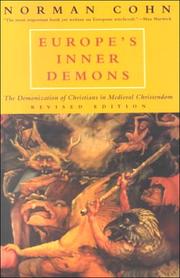
Europe's inner demons
Explains how supernatural fears became mechanisms of social control across Europe, providing strong context for Malta.


The Penguin book of witches
Provides primary-source perspectives on accusations and supernatural belief.

Witchcraft in Europe,
Documents how inquisitions and courts handled witchcraft across Europe.
Endnotes
1.
Source: maltatoday.com.mt
Title: its doom alone that counts
Link:https://www.maltatoday.com.mt/comment/opinions/57097/its_doom_alone_that_counts
2.
Source: whc.unesco.org
Link:https://whc.unesco.org/document/140353
3.
Source: pmc.ncbi.nlm.nih.gov
Link:https://pmc.ncbi.nlm.nih.gov/articles/PMC7201200/
4.
Source: maltatoday.com.mt
Title: angeliks apparitions not divine in origin says curia
Link:https://www.maltatoday.com.mt/news/national/60996/angeliks_apparitions_not_divine_in_origin_says_curia
5.
Source: church.mt
Title: Arċidjoċesi ta’ Malta The alleged mystical phenomena in Borġ in-Nadur
Link:https://church.mt/the-alleged-mystical-phenomena-in-borg-in-nadur/
6.
Source: maltatoday.com.mt
Title: pbss big solution to the impasse will ricochet back at them hard
Link:https://www.maltatoday.com.mt/comment/skinny/120359/pbss_big_solution_to_the_impasse_will_ricochet_back_at_them_hard
7.
Source: gozo.news
Title: alleged mystical phenomena in borg in nadur is not divine church
Link:https://gozo.news/60244/alleged-mystical-phenomena-in-borg-in-nadur-is-not-divine-church/
8.
Source: um.edu.mt
Title: Authors: Cassar, Carmel. Keywords: Malta – Church history Read more
Link:https://www.um.edu.mt/library/oar/handle/123456789/29176
Source snippet
L-Università ta' MaltaOAR@UM: Witchcraft, sorcery and the Inquisition: a study...by C Cassar · 1996 · Cited by 47 —...
9.
Source: um.edu.mt
Link:https://www.um.edu.mt/library/oar/handle/123456789/26130
Source snippet
L-Università ta' MaltaOAR@UM: Malta [Encyclopedia of witchcraft]by C Cassar · 2006 — Information on witchcraft practices in Malta comes f...
10.
Source: um.edu.mt
Link:https://www.um.edu.mt/library/oar/handle/123456789/22425
Source snippet
This paper analyses two and a half years of witchcraft accusations in mid-seventeenth century Malta before the Inquisition Tribunal.Read...
11.
Source: um.edu.mt
Link:https://www.um.edu.mt/library/oar/handle/123456789/106791
Source snippet
Carmel Cassar's carefully researched study makes innovative use of the great wealth that lies...
12.
Source: um.edu.mt
Title: 1993 (b) Witchcraft Beleifs and Social Control in Seventeenth century Malta
Link:https://www.um.edu.mt/library/oar/bitstream/123456789/22425/1/1993%20%28b%29%20Witchcraft%20Beleifs%20and%20Social%20Control%20in%20Seventeenth%20century%20Malta.pdf
Source snippet
witch trials held by the Malta Inquisition in...Read more...
13.
Source: um.edu.mt
Link:https://www.um.edu.mt/library/oar/handle/123456789/106281
Source snippet
L-Università ta' MaltaThe mixed traits of knowledgeable Renaissance magicby C Cassar · 2022 — An in-depth analysis of the Inquisition tri...
14.
Source: um.edu.mt
Link:https://www.um.edu.mt/library/oar/handle/123456789/42316
15.
Source: um.edu.mt
Link:https://www.um.edu.mt/library/oar/handle/123456789/42328
16.
Source: um.edu.mt
Link:https://www.um.edu.mt/library/oar/bitstream/123456789/26130/3/2006%20%28b%29.%20Encylopedia%20of%20Witchcraft%20-%20The%20Western%20Tradition%20Volume%203%20-%20Malta-2-4.pdf
17.
Source: um.edu.mt
Title: Magic, heresy and the broom riding midwife witch 2004
Link:https://www.um.edu.mt/library/oar/bitstream/123456789/22298/5/Magic%2C_heresy_and_the_broom_riding_midwife_witch_2004.pdf
18.
Source: degruyterbrill.com
Link:https://www.degruyterbrill.com/_language/en?srsltid=AfmBOopYCowk-2W0u4wqToLl-GHrrSJ0Hpzsa-mORsg9TQUz-ME8Omet&uri=%2Fdocument%2Fdoi%2F10.1515%2F9781782387565-006%2Fpdf%3FlicenseType%3Drestricted
19.
Source: um.edu.mt
Link:https://www.um.edu.mt/pressreleases/2001/mnajdra.html
20.
Source: um.edu.mt
Link:https://www.um.edu.mt/library/oar/handle/123456789/85116
21.
Source: um.edu.mt
Link:https://www.um.edu.mt/library/oar/handle/123456789/7591
22.
Source: um.edu.mt
Link:https://www.um.edu.mt/library/oar/handle/123456789/4944
23.
Source: oursundayvisitor.com
Title: Our Sunday Visitor Unveiling the miraculous shrines of the Virgin Mary in Malta
Link:https://www.oursundayvisitor.com/unveiling-the-miraculous-shrines-of-the-virgin-mary-in-malta/
24.
Source: Wikipedia
Title: Moral panic
Link:https://en.wikipedia.org/wiki/Moral_panic
25.
Source: Wikipedia
Title: Satanic panic
Link:https://en.wikipedia.org/wiki/Satanic_panic
26.
Source: um.edu.mt
Title: 2418EMAPPL500905065789 1
Link:https://www.um.edu.mt/library/oar/bitstream/123456789/119555/1/2418EMAPPL500905065789_1.PDF
27.
Source: um.edu.mt
Link:https://www.um.edu.mt/library/oar/handle/123456789/22298
28.
Source: um.edu.mt
Title: 19 PHDANT 001
Link:https://www.um.edu.mt/library/oar/bitstream/123456789/56786/1/19%20PHDANT%20001.pdf
29.
Source: um.edu.mt
Link:https://www.um.edu.mt/library/oar/bitstream/123456789/50114/1/A%20fresh%20look%20at%20Hagar%20Qim%20and.pdf
30.
Source: pmc.ncbi.nlm.nih.gov
Link:https://pmc.ncbi.nlm.nih.gov/articles/PMC3536509/
31.
Source: pmc.ncbi.nlm.nih.gov
Link:https://pmc.ncbi.nlm.nih.gov/articles/PMC12710187/
Additional References
32.
Source: heritagemalta.mt
Link:https://heritagemalta.mt/news/unique-exhibition-on-the-roman-inquisition-in-malta/
Source snippet
Heritage MaltaUnique exhibition on the Roman Inquisition in MaltaAmongst other artefacts, this exhibition includes authentic proceedings...
33.
Source: youtube.com
Title: Inside the Inquisitor’s Palace, Malta | Secrets of the Roman Inquisition
Link:https://www.youtube.com/watch?v=ELVJSSV3BaQ
Source snippet
The Inquisitor's Palace and Torture chamber, MALTA...
34.
Source: cia.gov
Link:https://www.cia.gov/library/abbottabad-compound/4A/4A92FD2FB4DAE3F773DB0B7742CF0F65_Coleman.-.CONSPIRATORS.HIERARCHY.-.THE.STORY.OF.THE.COMMITTEE.OF.300.R.pdf
35.
Source: academia.edu
Link:https://www.academia.edu/2153760/Moral_Panics_and_the_British_Media_A_look_at_some_contemporray_Folk_Devils_
36.
Source: academia.edu
Link:https://www.academia.edu/2073204/Sex_and_Drugs_before_Rock_n_Roll_Youth_Culture_and_Masculinity_during_Hollands_Golden_Age
37.
Source: facebook.com
Link:https://www.facebook.com/OrderofMalta/posts/when-the-plague-hit-malta-the-knights-made-a-promise-a-marian-miracle-followedth/10157185016351780/
38.
Source: heritagemalta.mt
Link:https://heritagemalta.mt/app/uploads/2022/01/annual-report-2018.pdf
39.
Source: heritagemalta.mt
Link:https://heritagemalta.mt/app/uploads/2022/01/annual-report-2011.pdf
40.
Source: heritagemalta.mt
Link:https://heritagemalta.mt/explore/borg-in-nadur/
41.
Source: researchgate.net
Link:https://www.researchgate.net/publication/259732121_Decline_of_a_Moral_Panic_A_Social_Psychological_and_Socio-Legal_Examination_of_the_Current_Status_of_Satanism
Topic Tree
Follow this branch
Related pages 192
- Antigua and Barbuda
- Argentina Belief Scares
- Azerbaijan Belief
- Bahrain Beliefs
- North Korea
- +187 more in sidebar