Within Saudi Arabia
Were Pilgrimage Disasters Really Caused by Panic?
Deadly pilgrimage crushes are better explained by density, bottlenecks and crowd flow than by claims of irrational mass hysteria.
On this page
- How dangerous crowd density develops
- Why stampede language can mislead
- Separating crowd physics from contagious belief
Page outline Jump by section
Introduction
Pilgrimage crowd disasters in Saudi Arabia are often described as “stampedes” caused by panic. That explanation is simple, memorable and frequently repeated, but it is often misleading. Research into major Hajj disasters shows that many deaths were not primarily caused by frightened crowds suddenly running out of control. Instead, they resulted from extreme crowd density, opposing flows of people, bottlenecks and the physical forces generated when thousands of bodies become packed together. Once those forces develop, individuals can lose the ability to choose where they move, regardless of how calm they remain. Modern crowd science has therefore shifted attention away from the myth of irrational mass panic and towards the mechanics of crowd movement, infrastructure and event management.[PubMed]pubmed.ncbi.nlm.nih.govPub Med Dynamics of crowd disasters: an empirical studyDynamics of crowd disasters: an empirical study - PubMedApril 18, 2007…
This distinction matters because Saudi Arabia’s Hajj has repeatedly shaped global thinking about crowd safety. Understanding these tragedies as failures of crowd dynamics rather than outbreaks of collective hysteria has influenced engineering, planning and emergency management for mass gatherings around the world.[ScienceDirect]sciencedirect.comThe impact of crowd control measures on the occurrence of stampedes during Mass Gatherings: The Hajj experience - ScienceDir…
How dangerous crowd density develops
The Hajj is one of the world’s largest annual gatherings, with millions of pilgrims carrying out rituals within limited spaces and time windows. Certain locations, particularly around Mina and the Jamarat Bridge where pilgrims perform the symbolic stoning ritual, naturally attract enormous concentrations of people.
Crowd scientists distinguish between a large crowd and a dangerously dense one. A crowd can appear orderly while density steadily increases. At very high densities, individuals no longer walk independently. Instead, they become physically connected to those around them through continuous body contact. Pressure passes through the crowd much like force travels through a compressed material. At this stage, people may be pushed several metres without intending to move at all.[nih.gov]pubmed.ncbi.nlm.nih.govPub Med Dynamics of crowd disasters: an empirical studyDynamics of crowd disasters: an empirical study - PubMedApril 18, 2007…
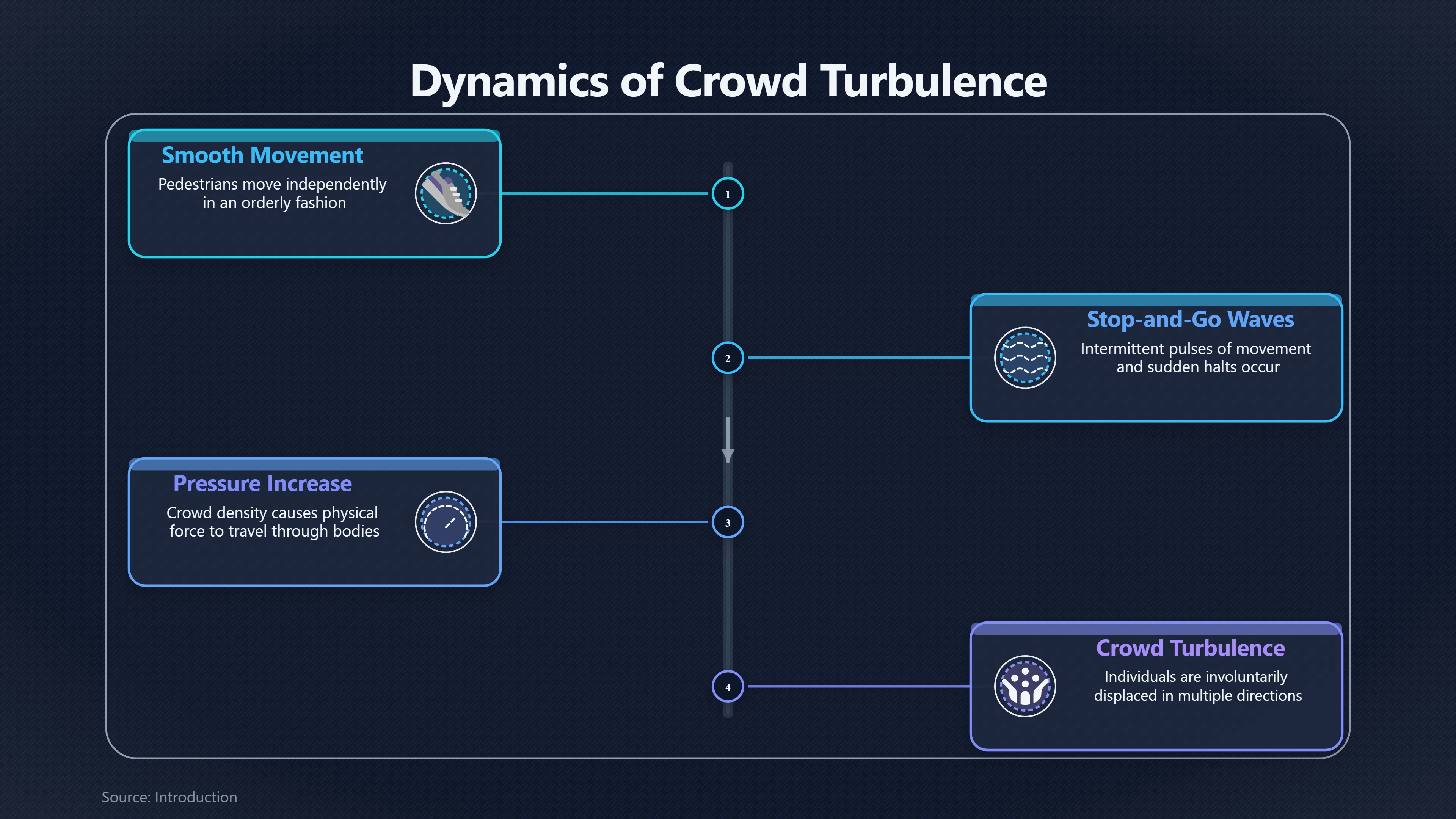
Researchers analysing video from the 2006 Hajj disaster identified a characteristic sequence:
- smooth pedestrian movement;
- intermittent “stop-and-go” waves;
- rapidly increasing crowd pressure;[tandfonline.com]tandfonline.comSource details in endnotes.
- unpredictable “crowd turbulence”, in which people are involuntarily displaced in multiple directions.
Once this turbulent state develops, falls become difficult to prevent. People who stumble can create pile-ups, while those behind may be physically unable to stop because they are themselves being compressed by the crowd. Many victims die from compression asphyxia—the inability to breathe because of intense pressure on the chest—rather than from being trampled by panicked runners.[nih.gov]pubmed.ncbi.nlm.nih.govPub Med Dynamics of crowd disasters: an empirical studyDynamics of crowd disasters: an empirical study - PubMedApril 18, 2007…
Why “stampede” language can mislead
The word “stampede” suggests a frightened herd suddenly rushing in one direction. In many Hajj disasters, however, investigators found little evidence that this accurately described what happened.
Crowd researchers argue that the language of panic can obscure the real mechanisms involved. In extremely dense crowds, people often cannot choose their speed or direction. Even those trying to remain calm become part of a system governed by physical pressure rather than individual decisions. Describing these events simply as panic risks implying that the victims themselves caused the disaster through irrational behaviour.[arXiv]arxiv.orgarXiv Crowd Disasters as Systemic Failures: Analysis of the Love Parade DisasterarXiv Crowd Disasters as Systemic Failures: Analysis of the Love Parade Disaster
This does not mean fear is absent. When people realise they cannot breathe or cannot move, anxiety naturally increases. But the crucial point is that fear usually follows the dangerous conditions instead of creating them. By the time panic becomes visible, the underlying crowd dynamics have often already become life-threatening.[arXiv]arxiv.orgarXiv Crowd Disasters as Systemic Failures: Analysis of the Love Parade DisasterarXiv Crowd Disasters as Systemic Failures: Analysis of the Love Parade Disaster
What Hajj research revealed
The 2006 disaster at Mina became especially important because researchers obtained unusually detailed video footage for scientific analysis. Their work challenged older assumptions that crowd disasters mainly resulted from irrational rushing.
Instead, they documented measurable transitions from normal pedestrian movement into stop-and-go waves and finally into “crowd turbulence”. These findings demonstrated that dangerous conditions could emerge even when the crowd’s overall objective remained orderly and shared. Pilgrims were not trying to flee from an imagined threat or reacting to contagious belief. They were attempting to complete a religious ritual within an environment that had become physically unstable.[nih.gov]pubmed.ncbi.nlm.nih.govPub Med Dynamics of crowd disasters: an empirical studyDynamics of crowd disasters: an empirical study - PubMedApril 18, 2007…
Subsequent studies have used these observations to improve computer simulations of pedestrian movement and to identify warning signs before catastrophic pressure develops. Rather than focusing solely on human psychology, engineers increasingly monitor density, flow rates, bottlenecks and opposing streams of movement.[arXiv]arxiv.orgarXiv How simple rules determine pedestrian behavior and crowd disastersHow simple rules determine pedestrian behavior and crowd disastersMay 11, 2011…

The 2015 Mina disaster and continuing debate
The 2015 Mina disaster, one of the deadliest incidents in the history of the Hajj, again prompted widespread use of the term “stampede” in news reporting. Yet many specialists cautioned that this label oversimplified events.
Independent analyses pointed towards a combination of extreme density, intersecting pedestrian flows, route management problems and delayed emergency access rather than a spontaneous outbreak of collective panic. Exact casualty figures remain disputed, with Saudi Arabia reporting lower totals than several independent compilations, but there is broad agreement among crowd scientists that the physical characteristics of crowd crush provide a better explanation than the traditional narrative of a panicked mob.[vanityfair.com]vanityfair.comVanity Fair The 10-Minute Mecca Stampede That Made HistoryMismanagement and high crowd density contributed to this catastrophe, making it the deadliest hajj disaster in history. The event was ini…
The continuing debate illustrates an important distinction. Disagreement may remain about operational decisions, infrastructure or official responses, but there is much less disagreement among specialists about the underlying mechanics of crowd disasters.

Separating crowd physics from contagious belief
Within the wider history of collective fear in Saudi Arabia, pilgrimage crowd disasters occupy a different category from episodes involving rumours, apocalyptic movements or witchcraft accusations.
A crowd crush is not an example of mass psychogenic illness, moral panic or contagious belief. No shared false idea needs to spread for a disaster to occur. Instead, the decisive factors are measurable physical conditions:
- crowd density exceeding safe limits;
- restricted movement through bottlenecks;[spa.gov.sa]spa.gov.saSource details in endnotes.
- intersecting streams of pedestrians;
- delayed release of pressure;
- insufficient opportunities for people to disperse.
This distinction is important because it changes both historical interpretation and practical prevention. Treating a crush as “mass panic” encourages explanations centred on supposedly irrational behaviour. Treating it as a crowd-physics problem directs attention towards engineering, scheduling, infrastructure, monitoring and real-time management.[arxiv.org]arxiv.orgarXiv Crowd Disasters as Systemic Failures: Analysis of the Love Parade DisasterarXiv Crowd Disasters as Systemic Failures: Analysis of the Love Parade Disaster
How the understanding changed Hajj safety
Scientific work following repeated Hajj disasters influenced significant changes in crowd management. Saudi authorities invested heavily in redesigning infrastructure, expanding the Jamarat complex, improving surveillance, using computer simulations of pedestrian flow, staggering movement schedules and strengthening monitoring of crowd density. Reviews of Hajj safety describe these engineering and organisational measures as central to reducing the risk of future crushes, although they also emphasise that gatherings of this scale can never become entirely risk-free.[ScienceDirect]sciencedirect.comThe impact of crowd control measures on the occurrence of stampedes during Mass Gatherings: The Hajj experience - ScienceDir…
Current official Hajj safety guidance likewise focuses on avoiding overcrowding, following designated routes, complying with crowd-control instructions and choosing appropriate times to perform rituals. These recommendations reflect an understanding that prevention depends on managing movement and density rather than simply urging pilgrims not to panic.[moh.gov.sa]moh.gov.saPilgrim’s HealthGuidelines for Security and Safety during HajjJune 21, 2023…
Amazon book picks
Further Reading
Books and field guides related to Were Pilgrimage Disasters Really Caused by Panic?. Use these as the next step if you want deeper reading beyond the article.
The Lucifer Effect
Provides accessible background on collective human behavior and challenges simplistic explanations of group actions.
The Hajj
Provides essential context on the Hajj, its rituals, and why crowd management is uniquely challenging.

Inside the Kingdom
First published 2009. Subjects: Politics and government, Social conditions, Travel, Description and travel, History.
Introduction to Crowd Science
Focuses on the mechanics of crowd behavior, density, movement, and safety engineering.
Endnotes
1.
Source: arxiv.org
Title: arXiv Crowd turbulence: the physics of crowd disasters
Link:https://arxiv.org/abs/0708.3339
2.
Source: sciencedirect.com
Link:https://www.sciencedirect.com/science/article/pii/S147789391630120X
Source snippet
The impact of crowd control measures on the occurrence of stampedes during Mass Gatherings: The Hajj experience - ScienceDir...
3.
Source: arxiv.org
Title: arXiv Crowd Disasters as Systemic Failures: Analysis of the Love Parade Disaster
Link:https://arxiv.org/abs/1206.5856
4.
Source: arxiv.org
Title: arXiv Modeling Crowd Turbulence by Many-Particle Simulations
Link:https://arxiv.org/abs/0708.3282
5.
Source: arxiv.org
Title: arXiv How simple rules determine pedestrian behavior and crowd disasters
Link:https://arxiv.org/abs/1105.2152
Source snippet
How simple rules determine pedestrian behavior and crowd disastersMay 11, 2011...
Published: May 11, 2011
6.
Source: moh.gov.sa
Title: Pilgrim’s Health
Link:https://www.moh.gov.sa/en/healthawareness/pilgrims-health/pages/guidelines-for-security-and-safety-during-hajj.aspx
Source snippet
Guidelines for Security and Safety during HajjJune 21, 2023...
Published: June 21, 2023
7.
Source: spa.gov.sa
Link:https://www.spa.gov.sa/en/N2602426
8.
Source: spa.gov.sa
Link:https://www.spa.gov.sa/en/N2599430
9.
Source: spa.gov.sa
Title: Interior Ministry Issues Comprehensive Safety and Security Guide for Hajj Season
Link:https://www.spa.gov.sa/en/N2586615
10.
Source: sciencedirect.com
Link:https://www.sciencedirect.com/science/article/pii/S0968090X19306527
11.
Source: sciencedirect.com
Link:https://www.sciencedirect.com/science/article/pii/S1477893918301315
12.
Source: pubmed.ncbi.nlm.nih.gov
Title: Pub Med Dynamics of crowd disasters: an empirical study
Link:https://pubmed.ncbi.nlm.nih.gov/17500963/
Source snippet
Dynamics of crowd disasters: an empirical study - PubMedApril 18, 2007...
Published: April 18, 2007
13.
Source: vanityfair.com
Title: Vanity Fair The 10-Minute Mecca Stampede That Made History
Link:https://www.vanityfair.com/news/2018/01/the-mecca-stampede-that-made-history-hajj
Source snippet
Mismanagement and high crowd density contributed to this catastrophe, making it the deadliest hajj disaster in history. The event was ini...
14.
Source: pmc.ncbi.nlm.nih.gov
Link:https://pmc.ncbi.nlm.nih.gov/articles/PMC7104005/
15.
Source: pubmed.ncbi.nlm.nih.gov
Link:https://pubmed.ncbi.nlm.nih.gov/27640116/
16.
Source: pmc.ncbi.nlm.nih.gov
Link:https://pmc.ncbi.nlm.nih.gov/articles/PMC5038153/
17.
Source: pmc.ncbi.nlm.nih.gov
Link:https://pmc.ncbi.nlm.nih.gov/articles/PMC4078860/
18.
Source: pmc.ncbi.nlm.nih.gov
Link:https://pmc.ncbi.nlm.nih.gov/articles/PMC7137144/
Additional References
19.
Source: ssph-journal.org
Link:https://www.ssph-journal.org/journals/public-health-reviews/articles/10.3389/phrs.2026.1609310/full
Source snippet
SSPH+ | Preventive Measures and Crowd Management Strategies to Mitigate the Risk of Stampedes in Public Gatherings: A Systematic ReviewJu...
20.
Source: youtube.com
Title: In a big crowd, as at the Hajj, danger can come on quickly
Link:https://www.youtube.com/watch?v=b_Lv5wTW1Ds
Source snippet
This video analyzes how extreme density during the Hajj pilgrimage makes crowd movement uncontrollable, demonstrating the physics behind...
21.
Source: youtube.com
Title: Crowd crush: Could fluid dynamics save lives?
Link:https://www.youtube.com/watch?v=SbVhHqBtHNg
Source snippet
In a big crowd, as at the Hajj, danger can come on quickly...
22.
Source: tandfonline.com
Link:https://www.tandfonline.com/doi/abs/10.1080/21680566.2024.2328774
23.
Source: coss.ethz.ch
Link:https://coss.ethz.ch/publications/supporting/crowd-turbulence.html
24.
Source: theguardian.com
Link:https://www.theguardian.com/world/2015/oct/03/hajj-crush-how-crowd-disasters-happen-and-how-they-can-be-avoided
25.
Source: nature.com
Title: Crowd researchers make pilgrimage safer: Nature News
Link:https://www.nature.com/news/2007/070115/full/news070115-13.html
26.
Source: english.ajel.sa
Title: sa Saudi Interior Ministry Issues Hajj Safety and Crowd Management Guidelines
Link:https://english.ajel.sa/business/saudi-interior-ministry-issues-hajj-safety-and-crowd-management-guidelines
27.
Source: safetylit.org
Link:https://www.safetylit.org/citations/index.php?citationIds%5B%5D=citjournalarticle_62812_4&fuseaction=citations.viewdetails
28.
Source: youtube.com
Title: How Crowds Can Kill You
Link:https://www.youtube.com/watch?v=ldOprmqSt7o
Source snippet
Crowd crush: Could fluid dynamics save lives?...
Topic Tree