Within Nicaragua Belief Panics
When Religion Becomes Nicaragua's Political Enemy
From revolutionary suspicion to modern attacks on clergy, religious opponents have repeatedly been cast as threats to justify exceptional political control.
On this page
- How sacred authority becomes political danger
- Priests, conspiracies and hostile state labels
- The consequences of turning opponents into evil
Page outline Jump by section
Introduction
In modern Nicaragua, religious figures have repeatedly been transformed from moral authorities into alleged political enemies. This has not primarily taken the form of panic about dangerous new religious movements. Instead, governments—particularly during periods of intense political conflict—have portrayed sections of the clergy as conspirators, foreign agents, terrorists or organisers of disorder. Such narratives have helped justify exceptional state powers, while encouraging supporters to see religious criticism not as legitimate dissent but as a threat to national survival. The result is a politics of fear in which faith becomes inseparable from questions of loyalty, security and state power, leaving lasting effects on public trust, religious freedom and civic life.[uscirf.gov]uscirf.govreleases new report religious freedom nicaraguaUSCIRF Releases New Report on Religious Freedom in Nicaragua | USCIRFJune 28, 2024…
How sacred authority becomes political danger
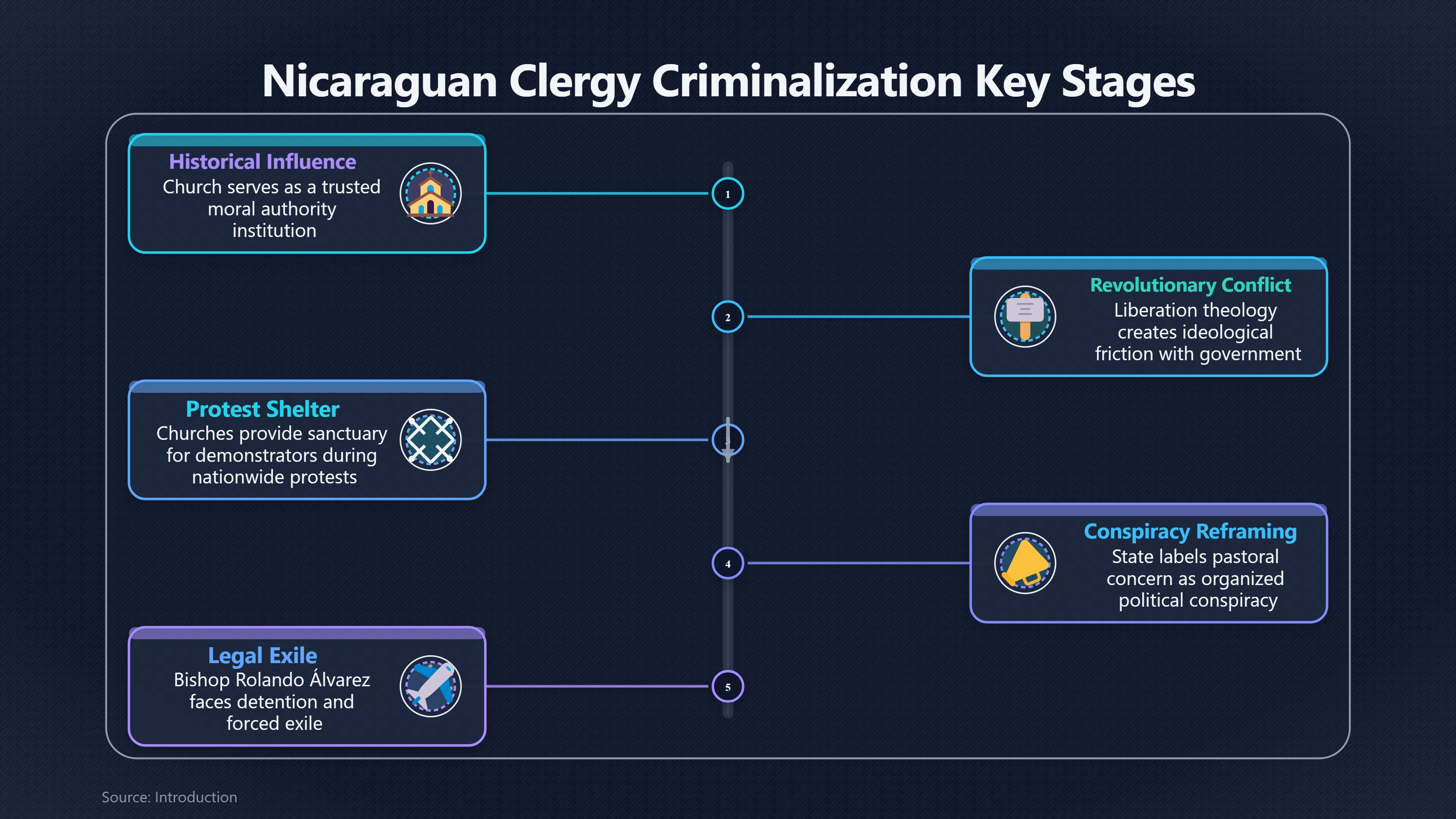
Nicaragua has long been shaped by a close relationship between religion and politics. The Catholic Church has historically been one of the country’s most trusted institutions, giving bishops and priests considerable moral influence beyond purely religious matters. That influence has repeatedly brought clergy into conflict with governments whenever they criticised corruption, defended human rights or acted as mediators during political crises.
This dynamic became especially visible during the Sandinista revolution of the 1980s. The revolutionary movement itself included committed Christians influenced by liberation theology, yet it also distrusted church leaders who questioned the government’s direction or aligned themselves with political opponents. Religious disagreements therefore became intertwined with ideological conflict rather than remaining purely theological.
The pattern intensified after the nationwide protests that erupted in 2018. When many Catholic churches sheltered demonstrators, documented injuries and attempted to mediate between the government and protesters, senior officials increasingly described parts of the Church as participants in an attempted coup rather than neutral religious actors. The shift was significant: criticism from clergy was reframed as evidence of organised political conspiracy rather than pastoral concern.[hrw.org]hrw.orgHuman Rights WatchWorld Report 2025: Nicaragua | Human Rights Watch…
Priests, conspiracies and hostile state labels
One striking feature of Nicaragua’s politics of fear is the language used against religious opponents. Rather than simply accusing individual priests of specific offences, official rhetoric has often portrayed sections of the clergy as members of wider conspiratorial networks supposedly working with foreign governments, hostile media or domestic opposition movements.
This framing serves several political purposes.
- It transforms political disagreement into a security threat.
- It portrays extraordinary legal measures as necessary acts of national defence.
- It encourages supporters to interpret criticism of the government as evidence of hidden plots rather than ordinary democratic disagreement.
- It weakens public confidence in independent religious institutions.
Human rights organisations have documented repeated accusations that clergy promoted terrorism, destabilisation or foreign interference, particularly after 2018. Although individual cases have involved specific legal charges, international observers have argued that many prosecutions formed part of a broader campaign against perceived opponents rather than responses to recognisable criminal conduct.[uscirf.gov]uscirf.govreleases new report religious freedom nicaraguaUSCIRF Releases New Report on Religious Freedom in Nicaragua | USCIRFJune 28, 2024…
The treatment of Bishop Rolando Álvarez illustrates this broader pattern. After openly criticising government actions, he was detained, sentenced on charges including actions considered damaging to the state, and later expelled into exile following negotiations involving the Vatican. International human rights organisations have treated his case as emblematic of the wider use of criminal law against religious critics.[Human Rights Watch]hrw.orgHuman Rights WatchWorld Report 2025: Nicaragua | Human Rights Watch…
Fear as a method of political control
The political value of portraying religious figures as dangerous lies less in convincing every citizen than in creating uncertainty. When priests, pastors or lay leaders can be investigated, detained or publicly denounced, other religious communities may become more cautious about discussing public affairs.
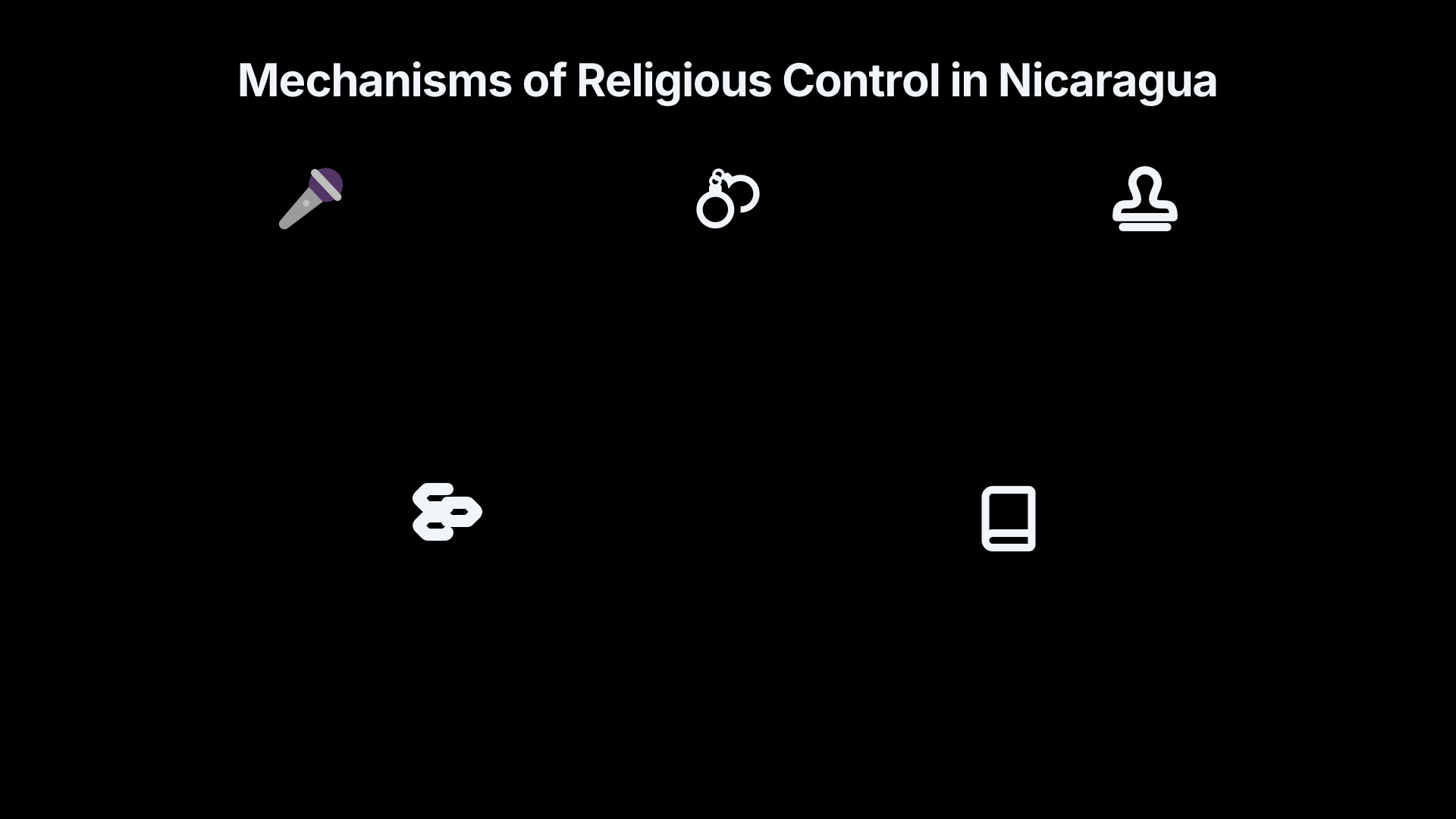
Reports from organisations monitoring religious freedom describe several mechanisms that contribute to this atmosphere:
- surveillance of religious services;
- restrictions on public processions and celebrations;
- cancellation of religious organisations’ legal status;
- confiscation of church-linked property;
- detention, deportation or forced exile of clergy;
- pressure for sermons to avoid subjects interpreted as political criticism.
Researchers note that these measures affect everyday behaviour even when arrests are relatively uncommon. Religious leaders may censor themselves because the boundaries of acceptable speech become unclear, encouraging caution through uncertainty rather than through explicit legal rules alone.[csw.org.uk]csw.org.ukHostile takeover: Tightening reins on freedom of religion or belief in NicaraguaHostile takeover: Tightening reins on freedom of religion or belief in Nicaragua

Beyond the Catholic Church
Although the Catholic Church has received the greatest international attention, recent documentation suggests that pressure has expanded beyond one denomination.
Human rights monitors report that Protestant and evangelical churches have also experienced investigations, arrests of pastors, closure of organisations and administrative restrictions, particularly where leaders have spoken publicly about human rights or maintained relationships with opposition groups. This broader pattern suggests that the defining issue is not theology itself but whether religious institutions are perceived as independent centres of influence outside state control.[hrw.org]hrw.orgHuman Rights WatchWorld Report 2025: Nicaragua | Human Rights Watch…
At the same time, observers note that not every religious organisation has been treated identically. Some groups regarded as politically supportive of the government have continued public activities with fewer restrictions. This uneven application reinforces the view that political loyalty, rather than religious identity alone, shapes official responses.[csw.org.uk]csw.org.ukNicaragua ReportNicaragua Report
Why this is different from a classic moral panic
Nicaragua’s experience differs from familiar episodes such as satanic panics or fears of destructive cults.
The central mechanism is not widespread public fear of an unfamiliar religious movement. Instead, political authorities portray established religious leaders as sources of danger. Fear flows downward through state institutions, official media and legal processes rather than emerging primarily through rumours circulating among the public.
This distinction matters because it changes the role of collective belief. The issue is less about ordinary citizens imagining hidden supernatural threats and more about governments encouraging the belief that respected religious authorities are secretly working against the nation. Historians and political scientists often describe this as a form of authoritarian threat construction: defining opponents as existential enemies whose normal civil rights can therefore be restricted.[csw.org.uk]csw.org.ukHostile takeover: Tightening reins on freedom of religion or belief in NicaraguaHostile takeover: Tightening reins on freedom of religion or belief in Nicaragua
The consequences of turning opponents into evil
Casting religious opponents as dangerous conspirators has consequences extending beyond church-state relations.
For religious communities, it creates fear of surveillance, arrest or exile, reducing the willingness of clergy to act as mediators during future political crises. For ordinary believers, it encourages suspicion of institutions that have traditionally provided social support, education and charitable work.
For society more broadly, it narrows the space between political disagreement and accusations of national betrayal. Once critics are portrayed not simply as mistaken but as morally corrupt or agents of hostile forces, compromise becomes more difficult and exceptional government powers become easier to justify.
International organisations, including United Nations experts, the United States Commission on International Religious Freedom, Human Rights Watch and independent religious freedom monitors, have concluded that the cumulative effect has been a significant deterioration in freedom of religion and civic space in Nicaragua. While the government has defended many of its actions as necessary to protect national sovereignty and public order, outside observers have consistently argued that these measures form part of a broader pattern of suppressing independent voices rather than responding to genuine security threats.[uscirf.gov]uscirf.govreleases new report religious freedom nicaraguaUSCIRF Releases New Report on Religious Freedom in Nicaragua | USCIRFJune 28, 2024…

Endnotes
1.
Source: uscirf.gov
Title: releases new report religious freedom nicaragua
Link:https://www.uscirf.gov/news-room/releases-statements/uscirf-releases-new-report-religious-freedom-nicaragua
Source snippet
USCIRF Releases New Report on Religious Freedom in Nicaragua | USCIRFJune 28, 2024...
Published: June 28, 2024
2.
Source: csw.org.uk
Title: Hostile takeover: Tightening reins on freedom of religion or belief in Nicaragua
Link:https://www.csw.org.uk/2024/02/13/report/6164/article.htm
3.
Source: csw.org.uk
Title: Nicaragua Report
Link:https://www.csw.org.uk/nicaraguareport
4.
Source: uscirf.gov
Link:https://www.uscirf.gov/news-room/releases-statements/nicaragua-continues-its-unrelenting-campaign-eliminate-religious
Source snippet
Nicaragua Continues its Unrelenting Campaign to Eliminate Religious Freedom | USCIRFMay 5, 2026 — NICARAGUA CONTINUES ITS UNRELENTING CAM...
Published: May 5, 2026
5.
Source: csw.org.uk
Title: New report finds increased restrictions on religious leaders
Link:https://www.csw.org.uk/2026/03/30/press/6770/article.htm
Source snippet
March 30, 2026 — NEW REPORT FINDS INCREASED RESTRICTIONS ON RELIGIOUS LEADERS 30 Mar 2026 Image CSW has today released a new report on...
Published: March 30, 2026
6.
Source: 2021-2025.state.gov
Link:https://2021-2025.state.gov/reports/2018-report-on-international-religious-freedom/nicaragua/
7.
Source: state.gov
Link:https://www.state.gov/reports/2023-country-reports-on-human-rights-practices/nicaragua
8.
Source: 2021-2025.state.gov
Link:https://2021-2025.state.gov/report/custom/8b977c7d04/
9.
Source: 2021-2025.state.gov
Link:https://2021-2025.state.gov/report/custom/3618fd785b/
10.
Source: hrw.org
Link:https://www.hrw.org/world-report/2025/country-chapters/nicaragua
Source snippet
Human Rights WatchWorld Report 2025: Nicaragua | Human Rights Watch...
11.
Source: hrw.org
Link:https://www.hrw.org/world-report/2026/country-chapters/nicaragua
Source snippet
Human Rights WatchWorld Report 2026: Nicaragua | Human Rights Watch...
12.
Source: hrw.org
Link:https://www.hrw.org/world-report/2023/country-chapters/nicaragua
13.
Source: hrw.org
Link:https://www.hrw.org/es/world-report/2025/country-chapters/nicaragua
14.
Source: hrw.org
Link:https://www.hrw.org/world-report/2024/country-chapters/nicaragua
15.
Source: countrystudies.us
Link:https://countrystudies.us/nicaragua/30.htm
Additional References
16.
Source: reuters.com
Link:https://www.reuters.com/world/americas/nicaraguan-officials-committed-systematic-repression-un-says-2025-04-03/
Source snippet
This includes military officers and ruling party members who are alleged to have committed crimes such as arbitrary detentions, torture...
17.
Source: youtube.com
Title: Nicaragua Ends the Year With More Than a Dozen Catholic Clergy in Jail
Link:https://www.youtube.com/watch?v=xMhzIJx9BO0
Source snippet
Nicaraguan government arrests Bishop of Matagalpa, Rolando Álvarez...
18.
Source: youtube.com
Title: Nicaragua’s Government Continues to Escalate Efforts to Silence Catholics
Link:https://www.youtube.com/watch?v=psdjXJTez3I
Source snippet
Pope 'Pained' by Nicaraguan Bishop's 26-Year Prison Sentence...
19.
Source: youtube.com
Title: Pope ‘Pained’ by Nicaraguan Bishop’s 26-Year Prison Sentence
Link:https://www.youtube.com/watch?v=xZloCvCABYQ
Source snippet
Nicaragua Ends the Year With More Than a Dozen Catholic Clergy in Jail...
20.
Source: youtube.com
Title: Nicaragua Cracks Down On Catholic Church
Link:https://www.youtube.com/watch?v=xBqaZ6iVlFE
Source snippet
Nicaragua's Government Continues to Escalate Efforts to Silence Catholics...
21.
Source: researchgate.net
Link:https://www.researchgate.net/publication/282648211_When_and_Why_Religious_groups_Become_Political_Players_The_Pro-Life_Movement_in_Nicaragua
22.
Source: ecoi.net
Link:https://www.ecoi.net/en/document/2100640.html
23.
Source: iberoamericana.se
Link:https://iberoamericana.se/en/articles/ibero.38
24.
Source: periodicos.ufsm.br
Link:https://periodicos.ufsm.br/seculoxxi/article/view/25348
25.
Source: platform.openjournals.nl
Link:https://platform.openjournals.nl/ERLACS/article/view/24038
Topic Tree