When Fear Took Hold Across Germany
Germany’s history of collective fear and contagious belief is not one continuous story of irrational crowds.
Page outline Jump by section
Introduction
The strongest pattern is institutional amplification. Belief became most dangerous when authorities treated accusation as proof, when torture generated further names, when newspapers converted local events into national spectacles, or when political conflict made a religious minority seem like an enemy within. Germany’s fragmented political history also mattered: before national unification in 1871, the German lands consisted of many jurisdictions, so an extreme panic could flourish in one territory while a neighbouring state remained comparatively restrained.[cambridge.org]resolve.cambridge.orgCambridge University Press & AssessmentThe Persecution of WitchcraftSmall and fragmented jurisdictions such as Cologne, Würzburg, Luxem…
What counts as collective hysteria?
The phrase “mass hysteria” is often used too loosely. It can refer to several processes that should be kept separate.
Mass psychogenic illness means that real physical symptoms spread through a group without an identified toxic or infectious cause. Symptoms may include fainting, dizziness, pain, spasms or breathing difficulties. Researchers emphasise that sufferers are not pretending: expectation, stress, observation and social communication can produce genuine bodily effects.[PMC]pmc.ncbi.nlm.nih.govPMCMass psychogenic illness and the social networkNIHby RE Bartholomew · 2012 · Cited by 108 — There is increasing recognition that mass psychogenic illness (MPI) is underappreciate…
Moral panic occurs when a person, practice or minority is presented as a grave threat to society, often out of proportion to the available evidence. Public anxiety may then drive surveillance, legislation or punishment.
Persecution is different again. Germany’s witch hunts were not merely frightened villagers behaving contagiously. They were legal and political campaigns involving interrogation, torture, confiscation, imprisonment and execution.
Finally, an unconventional religion is not automatically a “cult”. The label may describe coercion or abusive leadership in some cases, but it has also been used polemically to stigmatise unfamiliar beliefs. Germany’s official inquiry into “so-called sects and psychogroups” reflected that difficulty: public concern could be legitimate, yet broad labels risked treating very different organisations as a single menace.[jstor.org]jstor.orgFreedom and Control in the Unified Germanyby H Seiwert · 2003 · Cited by 25 — This article describes Geran governmental reactions to…
When whole communities seemed compelled to dance
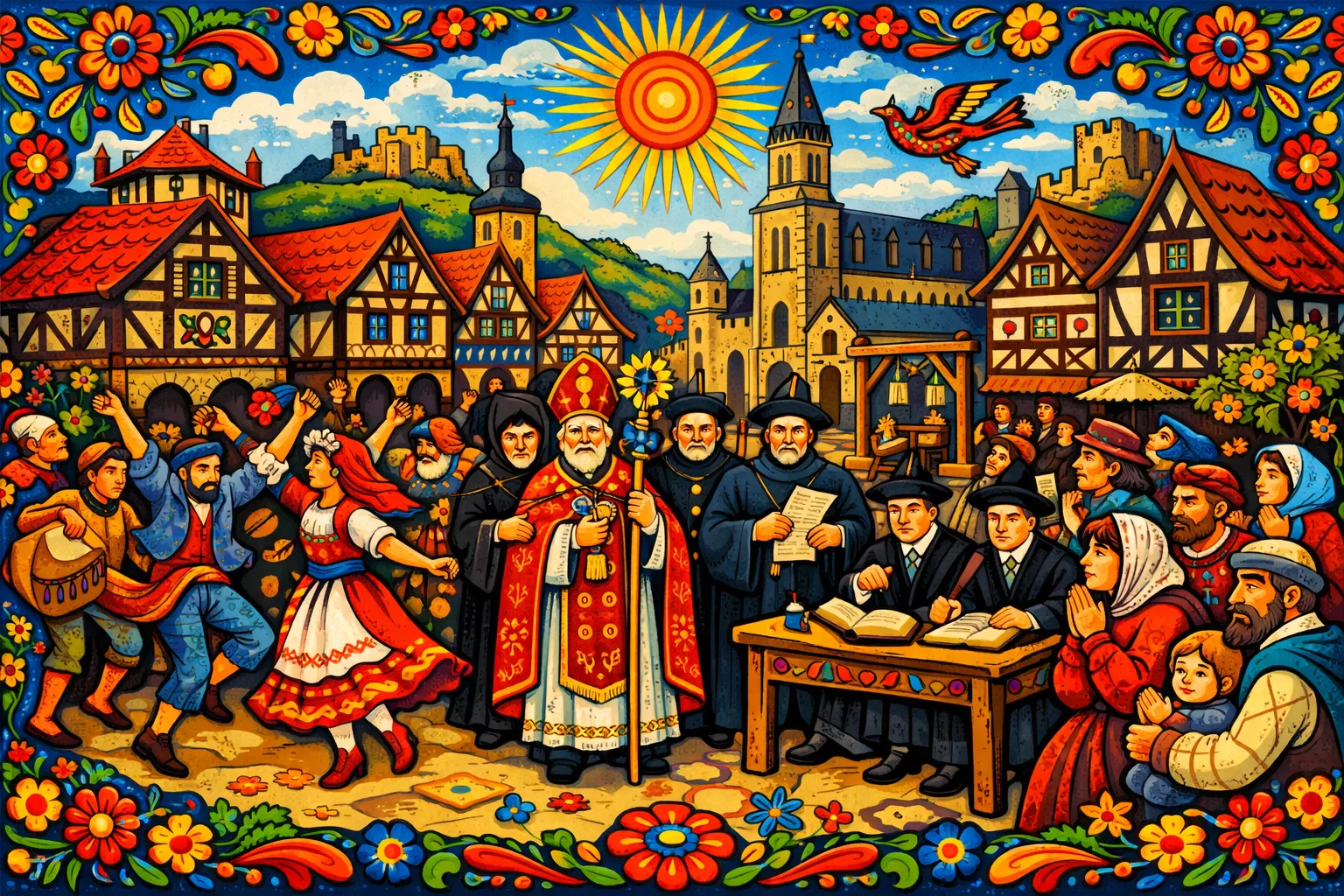
One of the earliest famous outbreaks associated with the German lands occurred in 1374, when groups of people around Aachen and the Rhine were reported to dance, leap and convulse for prolonged periods. The phenomenon spread into neighbouring parts of the Low Countries and France. Contemporary observers interpreted the behaviour through religion: sufferers might be cursed, possessed or punished by a saint. Chapels, prayers and ritual treatment therefore formed part of the response.[wikipedia.org]WikipediaDancing maniaDancing mania
Popular retellings often describe hundreds dancing until they died. The basic evidence for widespread dancing episodes is real, but exact numbers, fatalities and dramatic details are harder to establish. Medieval chronicles were not clinical reports, and later writers sometimes merged separate outbreaks or embellished them.
Historian John Waller has argued that the dancing was a culturally shaped stress response. Communities around the Rhine had endured plague, food insecurity, religious fear and social instability. People also possessed a shared model for what supernatural affliction looked like. Under extreme pressure, involuntary trance and movement could therefore spread through expectation and observation.[smithsonianmag.com]smithsonianmag.comSmithsonian Magazine A Strange Case of Dancing Mania Struck Germany SixSmithsonian Magazine A Strange Case of Dancing Mania Struck Germany Six
That interpretation is plausible rather than conclusively proved. Neurological disease, poisoning and deliberate religious performance have also been proposed, but no single medical explanation fits every reported outbreak. What makes the events important is that bodily distress followed the language available to sufferers. In a society that feared saintly curses and demonic attack, distress could be expressed as compulsive sacred dancing rather than as a modern panic attack.
The often-confused Strasbourg dancing outbreak of 1518 belongs to the same Rhine tradition, although Strasbourg is now in France. Its frequent inclusion in “German” accounts reflects the political geography of the Holy Roman Empire, not the borders of modern Germany.[ScienceDirect]sciencedirect.comOpen source on sciencedirect.com.
Why the German witch hunts became so destructive
The German-speaking territories were among the principal centres of European witch persecution. Most trials occurred in the early modern period, especially from the late sixteenth century to the first decades of the seventeenth, rather than in the Middle Ages. The idea at their centre was not simply that harmful magic existed. Authorities increasingly imagined a hidden conspiracy of people who had made pacts with the Devil, attended nocturnal gatherings and plotted collective harm.[Historisches Lexikon Bayerns]historisches-lexikon-bayerns.deEN:Persecution of witchesHistorisches Lexikon BayernsEN:Persecution of witches25 Feb 2025 — The majority of trials against alleged witches and sorcerers occurred…
The persecutions were highly uneven. Political fragmentation allowed local rulers, judges and clergy considerable freedom. Small ecclesiastical territories including Bamberg, Würzburg and Eichstätt produced some of the most severe campaigns, while other German jurisdictions conducted few trials. This unevenness is one reason historians reject simple explanations based only on “German superstition” or one religious confession. Catholic and Protestant territories both prosecuted witches, although particular waves were concentrated in certain south-western prince-bishoprics.[cambridge.org]resolve.cambridge.orgCambridge University Press & AssessmentThe Persecution of WitchcraftSmall and fragmented jurisdictions such as Cologne, Würzburg, Luxem…
Several forces could combine:
- crop failure, disease and war encouraged suspicions of supernatural sabotage;
- local quarrels supplied initial accusations;
- demonological books gave educated authorities a theory of organised conspiracy;
- torture produced confessions that confirmed the theory;
- accused prisoners were required to name accomplices, allowing cases to multiply;
- judges who doubted the proceedings could themselves appear sympathetic to witches.
The resulting process was circular. Torture extracted descriptions of impossible crimes; those confessions were then treated as independent evidence that the conspiracy was real.
Bamberg and the machinery of accusation
The Bamberg persecutions reached their peak between 1626 and 1631, during the Thirty Years’ War. Hundreds were executed across the prince-bishopric. Victims included poor women, prosperous townspeople, officials and members of prominent families, demonstrating that the panic had escaped its usual social boundaries.[wikipedia.org]WikipediaBamberg witch trialsBamberg witch trials
Prince-Bishop Johann Georg Fuchs von Dornheim authorised a special prison known as the Drudenhaus. It was designed for people accused of witchcraft and was used for detention and interrogation. Its existence shows how far the hunt had become institutionalised: this was not an improvised village response but a dedicated apparatus of prosecution.[Wikipedia]WikipediaDrudenhaus (prisonDrudenhaus (prison
One of the best-known surviving documents is the 1628 case of Johannes Junius, a former mayor of Bamberg. The trial record and a letter secretly sent to his daughter describe how torture forced him to confess and implicate others. His case offers unusually direct evidence of how an educated official who denied witchcraft could be broken by the judicial process.[Hanover College History Department]history.hanover.eduOpen source on hanover.edu.
Würzburg and the widening circle of victims
The parallel Würzburg trials of 1625–31 likewise consumed people from many social groups, including children, clergy and members of the political elite. Exact totals remain debated because records are incomplete, but the surviving evidence establishes one of Europe’s largest concentrated witch persecutions.[Wikipedia]WikipediaWürzburg witch trialsWürzburg witch trials
The expansion of accusations into elite households is significant. Witch panics sometimes began with marginal figures, but an unchecked prosecution could eventually attack the people responsible for governing the community. Once confessions were produced by torture and each prisoner supplied further names, status offered diminishing protection.
The persecutions declined not because one decisive scientific discovery disproved witchcraft, but because scepticism, legal intervention, military disruption and concern about procedural abuses gradually weakened the system. In Bamberg, the advance of Swedish forces in 1632 helped bring the most intense phase to an end. More broadly, higher courts and cautious rulers could restrain local hunts by demanding stronger evidence or limiting torture.[radar.brookes.ac.uk]radar.brookes.ac.ukGermany mother of the witchesGermany mother of the witches
Münster’s attempt to build the New Jerusalem
The Anabaptist regime in Münster in 1534–35 was not a spontaneous crowd delusion, nor was it representative of Anabaptism as a whole. It was a revolutionary, apocalyptic movement that seized power in a city during the upheaval of the Reformation.
Radical preachers taught that Münster would become a new Jerusalem in preparation for divine judgement. Adult baptism, prophetic revelation and imminent end-times expectation drew converts, including migrants from the Netherlands. In February 1534, Anabaptist leaders gained control of the city while opponents and many residents fled or were expelled.[wikipedia.org]WikipediaMünster rebellionMünster rebellion
Jan Matthys, one of the movement’s prophets, predicted divine intervention against the besieging forces. At Easter he rode out with a small band and was killed. Leadership then passed to Jan van Leiden, who proclaimed a sacred kingship and reshaped civic life around his claimed revelations. Property was reorganised, dissent was harshly punished and plural marriage was introduced in a city where the siege had left substantially more women than men.[Wikipedia]WikipediaMünster rebellionMünster rebellion
The city fell in June 1535 after prolonged siege, hunger and betrayal. Its leaders were later tortured and executed; their bodies were displayed in iron cages on the tower of St Lambert’s Church.
Münster became a propaganda weapon. Catholic and Protestant opponents used it to portray Anabaptists generally as violent fanatics, even though many later Anabaptist communities embraced strict pacifism. The episode therefore belongs both to the history of apocalyptic rule and to the history of moral panic: a real, coercive regime was subsequently used to stigmatise a much broader religious movement.[Brill]brill.comB9789004475809 s004B9789004475809 s004
Marpingen and the politics of miracles
In July 1876, three young girls in the Saarland village of Marpingen reported seeing the Virgin Mary. News travelled quickly. Pilgrims arrived, stories of further visions circulated and claims of miraculous healing followed. The village was soon discussed as a possible “German Lourdes”.[proquest.com]search.proquest.comOpen source on proquest.com.
The timing transformed a local religious event into a national controversy. Chancellor Otto von Bismarck’s government was engaged in the Kulturkampf, a political and legal struggle intended to reduce the power of the Catholic Church. Many Catholics felt besieged by a Protestant-dominated state. In that climate, belief in the apparitions could express both religious hope and communal resistance.[Cambridge University Press & Assessment]cambridge.orgOpen source on cambridge.org.
Officials treated the gatherings as a threat to order. Troops and police intervened, an undercover investigator was sent to the area, and the affair reached parliament and the courts. Church leaders remained cautious and did not formally validate the visions.[wku.edu]digitalcommons.wku.eduOpen source on wku.edu.
Historian David Blackbourn’s influential study does not reduce the event to gullibility or ask only whether the Virgin “really” appeared. It examines how children’s testimony, rural Catholic culture, healing hopes, newspaper publicity and state repression interacted. The crucial lesson is that miracle movements can grow through conflict with sceptical authority. Attempts to suppress Marpingen helped convince some believers that the state feared what had happened there.[Google Books]books.google.comOpen source on google.com.
Comparable apparition waves occurred in West Germany after the Second World War. Reports of visions, prophecies and miraculous signs spoke to fears of communism, nuclear war, moral decline and a third world war. Church authorities often rejected or contained particular claims, even while large Catholic gatherings drew on similar Cold War imagery.[Zeithistorische Forschungen]zeithistorische-forschungen.deOpen source on zeithistorische-forschungen.de.
UFO prophecy in the Black Forest
Germany’s best-known UFO religion was Fiat Lux, founded in 1980 by the Swiss-born spiritual leader Erika Bertschinger-Eicke, known as Uriella. The movement later established its main centre at Ibach in the Black Forest. Members regarded Uriella as a channel for messages from Jesus, Mary and spiritually advanced extraterrestrial beings.[wikipedia.org]WikipediaFiat Lux (UFO religionFiat Lux (UFO religion
Fiat Lux combined familiar Christian ideas with modern technological mythology. It taught that the Earth faced catastrophic transformation and that selected believers might be rescued by extraterrestrial spacecraft before a renewed paradise emerged. Uriella’s failed prediction of an apocalypse in 1998 became the movement’s most widely publicised claim. The failure was explained not as disproof but as a catastrophe postponed through prayer, a classic mechanism by which prophetic groups can preserve belief after an expected event does not occur.[Wikipedia]WikipediaFiat Lux (UFO religionFiat Lux (UFO religion
The movement was small, but German-language media treated Uriella as a striking television personality, emphasising white robes, prophecy and alien rescue. That visibility created a mismatch between social scale and cultural fame.
Fiat Lux illustrates why careful language matters. Its unusual beliefs do not by themselves establish abuse. More serious concerns arose from allegations about financial pressure, healing claims and authority over members. A Swiss court ordered Uriella to repay a large sum to a former follower who said that apocalyptic warnings had influenced her decision to surrender money.[SWI swissinfo.ch]swissinfo.chfiat lux controversial sect leader uriella diesfiat lux controversial sect leader uriella dies
How fear of “sects” became a national issue
From the 1970s onwards, West German public debate increasingly focused on unfamiliar religious movements, sometimes called youth religions, sects or psychogroups. Concern centred on groups such as the Unification Church, the Children of God, Hare Krishna and, above all, Scientology. Church-based advisers, parents’ organisations, journalists and political campaigners warned about manipulation, financial exploitation and the loss of young people to authoritarian communities.[Wikipedia]WikipediaScientology in GermanyScientology in Germany
Some concerns were supported by testimony from former members and by documented disputes over money, labour or coercive leadership. The panic element lay in treating a highly varied field as a coordinated invasion. After German reunification, commentators sometimes predicted that new religious movements would sweep into the former East Germany and exploit a supposed spiritual vacuum. Sociologist Hubert Seiwert describes the resulting 1990s atmosphere as a public anti-cult wave that prompted political action.[JSTOR]jstor.orgFreedom and Control in the Unified Germanyby H Seiwert · 2003 · Cited by 25 — This article describes Geran governmental reactions to…
In 1996, the Bundestag established an inquiry into “so-called sects and psychogroups”. Its eventual work helped cool public emotion by replacing some broad fears with differentiated investigation, although negative attitudes towards new religious movements persisted. The choice of “so-called” in the commission’s title acknowledged that “sect” was a disputed and potentially prejudicial category.[springer.com]link.springer.comThe German Enquete Commission on SectsFinal Report of the Enquête Commission on “So-called Sects and Psychogroups”: New Religious and Ideological Communities and…Read more…
Scientology became the central case because German officials often viewed it not simply as a religion but as a commercial and political organisation with authoritarian aims. Authorities issued warnings, certain public bodies used declarations intended to exclude Scientology-linked contractors, and intelligence offices began surveillance. Scientology, in turn, described these actions as religious discrimination. Courts produced a mixed record, sometimes permitting observation while restricting particular investigative methods or administrative practices.[washingtonpost.com]washingtonpost.comOpen source on washingtonpost.com.
This dispute cannot be resolved by calling either side irrational. Scientology has faced substantial criticism over its internal practices, while the German response raised genuine questions about proportionality, religious liberty and the danger of government adopting an elastic “cult” category. The broader European human-rights approach has generally favoured prosecuting specific illegal acts rather than attempting to define a “sect” in law.[PACE]pace.coe.intPACEIllegal activities of sectsPACEIllegal activities of sects

What these episodes have in common
Germany’s witch trials, Münster regime, apparition movements and anti-sect controversies did not arise from one national tendency. They occurred under different states, political systems and religious conditions. Yet several recurring mechanisms connect them.
Shared threats made unusual claims credible. Plague, war, failed harvests, confessional conflict, rapid modernisation and Cold War fears created environments in which supernatural explanations or apocalyptic warnings felt relevant.
Institutions determined the scale of harm. A rumour became lethal when courts accepted torture. An apparition became a national crisis when police, parliament and newspapers intervened. Concern about minority religions became a civil-liberties issue when administrative exclusion and intelligence surveillance followed.
Suppression could strengthen belief. The siege of Münster intensified its apocalyptic outlook. State intervention at Marpingen allowed pilgrims to see themselves as persecuted witnesses. Hostile treatment of new religions could reinforce a group’s claim that outsiders were conspiring against it.
Media visibility distorted size. Dramatic movements such as Fiat Lux received attention far beyond their membership. The unfamiliar, theatrical and apocalyptic was more newsworthy than ordinary religious life.
Later retellings simplified complicated events. Dancing outbreaks became stories of people joyfully dancing themselves to death. Witch trials became evidence of an undifferentiated medieval superstition. Münster became shorthand for all Anabaptism. Such versions are memorable, but they erase political institutions, local differences and contested evidence.
Why Germany’s history still matters
The most important lesson is not that people in the past were uniquely credulous. It is that fear becomes socially powerful when a community possesses a convincing story, institutions reward that story, and contrary evidence becomes difficult or dangerous to express.
The witch hunts show the extreme case: accusation, confession and corroboration were produced by the same coercive system. Münster shows how genuine authoritarian violence can lead to the lasting demonisation of a wider minority. Marpingen shows that visions may function as political and communal events regardless of whether an apparition can be verified. The modern sect debates show the continuing tension between protecting people from exploitation and protecting unpopular belief from collective suspicion.
Germany’s cases therefore resist a single label. Some were outbreaks of contagious behaviour; some were apocalyptic movements; some were moral panics; and some were state persecutions. Understanding the difference is not a matter of polite terminology. It determines who is treated as ill, who is treated as dangerous, whose testimony is believed and whether fear produces care, inquiry or punishment.


Endnotes
1.
Source: resolve.cambridge.org
Link:https://resolve.cambridge.org/core/services/aop-cambridge-core/content/view/B44C4191D69726FB3C025197DF257756/9781108348102c11_p203-228_CBO.pdf/the-persecution-of-witchcraft.pdf
Source snippet
Cambridge University Press & AssessmentThe Persecution of WitchcraftSmall and fragmented jurisdictions such as Cologne, Würzburg, Luxem...
2.
Source: historisches-lexikon-bayerns.de
Title: EN:Persecution of witches
Link:https://www.historisches-lexikon-bayerns.de/Lexikon/EN%3APersecution_of_witches
Source snippet
Historisches Lexikon BayernsEN:Persecution of witches25 Feb 2025 — The majority of trials against alleged witches and sorcerers occurred...
3.
Source: books.openedition.org
Title: Open Edition Books Witchcraft in the City
Link:https://books.openedition.org/pus/3051?lang=en
Source snippet
Patterns of Persecution in the Holy...During the same period, in the territory of Osnabrück, “only” 53 women and men were executed as wi...
4.
Source: pmc.ncbi.nlm.nih.gov
Title: PMCMass psychogenic illness and the social network
Link:https://pmc.ncbi.nlm.nih.gov/articles/PMC3536509/
Source snippet
NIHby RE Bartholomew · 2012 · Cited by 108 — There is increasing recognition that mass psychogenic illness (MPI) is underappreciate...
5.
Source: cambridge.org
Link:https://www.cambridge.org/core/journals/the-british-journal-of-psychiatry/article/protean-nature-of-mass-sociogenic-illness/2BDC2262E104B8A33F3DD49773DA0D8B
Source snippet
Cambridge University Press & AssessmentProtean nature of mass sociogenic illnessby RE Bartholomew · 2002 · Cited by 322 — Mass sociogenic...
6.
Source: jstor.org
Link:https://www.jstor.org/stable/3712490
Source snippet
Freedom and Control in the Unified Germanyby H Seiwert · 2003 · Cited by 25 — This article describes Geran governmental reactions to...
7.
Source: link.springer.com
Title: The German Enquete Commission on Sects
Link:https://link.springer.com/chapter/10.1007/978
Source snippet
Final Report of the Enquête Commission on “So-called Sects and Psychogroups”: New Religious and Ideological Communities and...Read more...
8.
Source: researchgate.net
Link:https://www.researchgate.net/publication/249291757_Freedom_and_Control_in_the_Unified_Germany_Governmental_Approaches_to_Alternative_Religions_Since_1989
9.
Source: Wikipedia
Title: [Dancing mania]({{ ‘dancing-mania/’ | relative_url }})
Link:https://en.wikipedia.org/wiki/Dancing_mania
10.
Source: sciencedirect.com
Link:https://www.sciencedirect.com/science/article/abs/pii/S0160932708000379
11.
Source: cambridge.org
Link:https://www.cambridge.org/core/books/cambridge-world-history-of-violence/violence-towards-heretics-and-witches-in-europe-10221800/010E6D80D5BAE3F236DD2EF51471203E
12.
Source: jstor.org
Link:https://www.jstor.org/stable/10.1163/j.ctt1w76wh1.7?ab_segments=0%2Fbasic_search_gsv2%2Fcontrol&refreqid=fastly-default%3Ad1c0d1a94beb25c0056f300833650aee&searchText=German+witch+trials&searchUri=%2Faction%2FdoBasicSearch%3FQuery%3DGerman%2Bwitch%2Btrials%26so%3Drel
13.
Source: Wikipedia
Title: Bamberg witch trials
Link:https://en.wikipedia.org/wiki/Bamberg_witch_trials
14.
Source: radar.brookes.ac.uk
Title: Germany mother of the witches
Link:https://radar.brookes.ac.uk/radar/file/c3645b3f-5537-403e-a629-6829cad914d1/1/Germany%20mother%20of%20the%20witches%20-%209781138782204%20-%202019%20-%20Dillinger.pdf
15.
Source: Wikipedia
Link:https://de.wikipedia.org/wiki/Drudenhaus
16.
Source: Wikipedia
Title: Drudenhaus (prison)
Link:https://en.wikipedia.org/wiki/Drudenhaus_%28prison%29
17.
Source: history.hanover.edu
Link:https://history.hanover.edu/texts/bamberg.html
18.
Source: Wikipedia
Title: Würzburg witch trials
Link:https://en.wikipedia.org/wiki/W%C3%BCrzburg_witch_trials
19.
Source: Wikipedia
Title: Münster rebellion
Link:https://en.wikipedia.org/wiki/M%C3%BCnster_rebellion
20.
Source: brill.com
Title: B9789004475809 s004
Link:https://brill.com/display/book/9789004475809/B9789004475809_s004.pdf?srsltid=AfmBOop3oupot47g7srWbEqiKmuCyFNjSgQtZd8lB9qxFfohr6zUI5gc
21.
Source: digitalcommons.wku.edu
Link:https://digitalcommons.wku.edu/cgi/viewcontent.cgi?article=4180&context=theses
22.
Source: cambridge.org
Link:https://www.cambridge.org/core/books/cambridge-world-history-of-violence/religious-and-sacred-violence/9AE2A9B14ACCB64D21F30391F8A88B73
23.
Source: search.proquest.com
Link:https://search.proquest.com/openview/19a0acca50a40bd6b07a070c2151d2bf/1?cbl=1819272&pq-origsite=gscholar
24.
Source: books.google.com
Link:https://books.google.com/books/about/Marpingen.html?id=ytfYAAAAMAAJ
25.
Source: researchgate.net
Title: 375293318 Marpingen Apparitions Of The Virgin Mary In Bismarckian Germany
Link:https://www.researchgate.net/publication/375293318_Marpingen_Apparitions_Of_The_Virgin_Mary_In_Bismarckian_Germany
26.
Source: cambridge.org
Link:https://www.cambridge.org/core/journals/central-european-history/article/kulturkampf-and-unification-german-liberalism-and-the-war-against-the-jesuits/01CD22665BA235CB4292F7248B4CF0AF
27.
Source: zeithistorische-forschungen.de
Link:https://zeithistorische-forschungen.de/1-2009/4628
28.
Source: Wikipedia
Title: Fiat Lux (UFO religion)
Link:https://en.wikipedia.org/wiki/Fiat_Lux_%28UFO_religion%29
29.
Source: Wikipedia
Title: Fiat Lux (neureligiöse Bewegung)
Link:https://de.wikipedia.org/wiki/Fiat_Lux_%28neureligi%C3%B6se_Bewegung%29
30.
Source: swissinfo.ch
Title: fiat lux controversial sect leader uriella dies
Link:https://www.swissinfo.ch/eng/society/fiat-lux_controversial-sect-leader-uriella-dies/44784718
31.
Source: Wikipedia
Title: Scientology in Germany
Link:https://en.wikipedia.org/wiki/Scientology_in_Germany
32.
Source: 2009-2017.state.gov
Title: U.S. Department of State Germany
Link:https://2009-2017.state.gov/j/drl/rls/irf/2004/35456.htm
33.
Source: researchgate.net
Link:https://www.researchgate.net/publication/290880982_The_German_Enquete_Commission_on_Sects
34.
Source: pace.coe.int
Title: PACEIllegal activities of sects
Link:https://pace.coe.int/files/8683/html
35.
Source: cambridge.org
Link:https://www.cambridge.org/core/journals/continuity-and-change/article/devils-children-child-witchtrials-in-early-modern-germany/196AE61299E6FB7203FA863971A4CD63
36.
Source: resolve.cambridge.org
Link:https://resolve.cambridge.org/core/services/aop-cambridge-core/content/view/C2FA9DB22750F4B6D1F8871A3FF24FC8/9780511599538c3_p64-95_CBO.pdf/witchcraft-studies-in-austria-germany-and-switzerland.pdf
37.
Source: cambridge.org
Link:https://www.cambridge.org/core/journals/historical-journal/article/pursuit-of-reality-recent-research-into-the-history-of-witchcraft/41B06ED6E083CF7F5C0173ACE805C1A2
38.
Source: resolve.cambridge.org
Title: demonologies writing about magic and witchcraft
Link:https://resolve.cambridge.org/core/services/aop-cambridge-core/content/view/B47FE551741554A0D5C34C94F6F200A5/9781571136862c21_p761-776_CBO.pdf/demonologies-writing-about-magic-and-witchcraft.pdf
39.
Source: cambridge.org
Link:https://www.cambridge.org/core/books/women-who-threw-corn/demonological-and-antisorcery-theories-in-spain/68BB5801B41A2A701E52F865E4088C50
40.
Source: assets.cambridge.org
Link:https://assets.cambridge.org/97805211/79973/frontmatter/9780521179973_frontmatter.pdf
41.
Source: resolve.cambridge.org
Title: darkness and the devil 1450 1650
Link:https://resolve.cambridge.org/core/services/aop-cambridge-core/content/view/52B4C9110EB06CC18C0A3260BD79C496/9780511977695c2_p19-45_CBO.pdf/darkness-and-the-devil-1450-1650.pdf
42.
Source: Wikipedia
Title: Mass psychogenic illness
Link:https://en.wikipedia.org/wiki/Mass_psychogenic_illness
43.
Source: Wikipedia
Title: Satanic panic
Link:https://en.wikipedia.org/wiki/Satanic_panic
44.
Source: Wikipedia
Title: List of mass panic cases
Link:https://en.wikipedia.org/wiki/List_of_mass_panic_cases
45.
Source: Wikipedia
Link:https://en.wikipedia.org/wiki/Kulturkampf
46.
Source: dserver.bundestag.de
Link:https://dserver.bundestag.de/btd/13/109/1310950.pdf
47.
Source: dserver.bundestag.de
Link:https://dserver.bundestag.de/btd/13/081/1308170.pdf
48.
Source: bundestag.de
Link:https://www.bundestag.de/resource/blob/1016294/3e86d2043e26f4c97a0362bb2e741cf7/WD-3-041-24-pdf.pdf
49.
Source: dserver.bundestag.de
Link:https://dserver.bundestag.de/btp/13/13137.pdf
50.
Source: dserver.bundestag.de
Link:https://dserver.bundestag.de/btp/13/13095.pdf
51.
Source: bundestag.de
Link:https://www.bundestag.de/resource/blob/1112672/datenhandbuch1990-2022_band2.pdf
52.
Source: dserver.bundestag.de
Link:https://dserver.bundestag.de/btp/14/14084.pdf
53.
Source: dserver.bundestag.de
Link:https://dserver.bundestag.de/btp/13/13104.pdf
54.
Source: bundestag.de
Link:https://www.bundestag.de/resource/blob/189452/6ff51bce8abf3aa893a8c2d4cf3fba85/sachregister.pdf
55.
Source: researchgate.net
Link:https://www.researchgate.net/publication/295375302_Waiting_for_the_Big_Beam_UFO_Religions_and_Ufological_Themes_in_New_Religious_Movements
56.
Source: researchgate.net
Link:https://www.researchgate.net/publication/236751829_Dass_Willkur_uber_Recht_ginge_Hexenverfolgung_in_Mecklenburg_im_16_und_17_Jahrhundert_review
57.
Source: courses.washington.edu
Title: Midelfort Germany
Link:https://courses.washington.edu/hsteu305/Midelfort%20Germany.pdf
58.
Source: 1997-2001.state.gov
Title: irf germany
Link:https://1997-2001.state.gov/global/human_rights/irf/irf_rpt/irf_germany.html
59.
Source: 2009-2017.state.gov
Link:https://2009-2017.state.gov/j/drl/rls/irf/2001/5650.htm
60.
Source: jstor.org
Link:https://www.jstor.org/stable/10.1525/nr.2002.6.1.119
61.
Source: history.com
Title: what was satanic panic 1980s
Link:https://www.history.com/articles/what-was-satanic-panic-1980s
62.
Source: bps.org.uk
Link:https://www.bps.org.uk/psychologist/dancing-plagues-and-mass-hysteria
63.
Source: smithsonianmag.com
Title: Smithsonian Magazine A Strange Case of Dancing Mania Struck Germany Six
Link:https://www.smithsonianmag.com/smart-news/strange-case-dancing-mania-struck-germany-six-centuries-ago-today-180959549/
64.
Source: newhistories.sites.sheffield.ac.uk
Title: when religious belief meets social movement the münster rebellion
Link:https://newhistories.sites.sheffield.ac.uk/volumes/2010-11/volume-2/issue-1-belief/when-religious-belief-meets-social-movement-the-m%C3%BCnster-rebellion
65.
Source: wwwuser.gwdguser.de
Title: GWDG User Fiat Lux
Link:https://wwwuser.gwdguser.de/~agruens/UFO/fiatlux.html
66.
Source: washingtonpost.com
Link:https://www.washingtonpost.com/archive/politics/1995/01/30/germany-church-of-scientology-feuding-in-print-and-political-arena/19c621e1-39f1-4392-971f-f067a75e108b/
67.
Source: pmc.ncbi.nlm.nih.gov
Link:https://pmc.ncbi.nlm.nih.gov/articles/PMC4884863/
68.
Source: pmc.ncbi.nlm.nih.gov
Link:https://pmc.ncbi.nlm.nih.gov/articles/PMC7396040/
69.
Source: nationalarchives.gov.uk
Link:https://www.nationalarchives.gov.uk/education/resources/early-modern-witch-trials/
70.
Source: ebsco.com
Link:https://www.ebsco.com/research-starters/social-sciences-and-humanities/mass-hysteria
71.
Source: scholarsarchive.byu.edu
Link:https://scholarsarchive.byu.edu/cgi/viewcontent.cgi?article=1889&context=sahs_review
72.
Source: sajp.org.za
Link:https://sajp.org.za/index.php/sajp/article/view/1671/2648
73.
Source: archive.org
Link:https://archive.org/details/marpingenapparit00blakrich
74.
Source: aph.gov.au
Link:https://www.aph.gov.au/DocumentStore.ashx?id=9d7726b7-ae8c-4326-b556-feba185ec66f
75.
Source: onlinecaveman.com
Title: Mass Psychogenic Illness
Link:https://onlinecaveman.com/science/mass-psychogenic-illness-how-to-survive-a-panic-epidemic/
Additional References
76.
Source: youtube.com
Link:https://www.youtube.com/watch?v=RZ7OgjGhUB8
Source snippet
The Witch Trials of Grimburg Castle & Hiking to Ancient Burial Mounds...
77.
Source: youtube.com
Title: Prophets of the Munster Rebellion
Link:https://www.youtube.com/watch?v=-gVPadqIVfM
Source snippet
What Happened During The Anabaptist Experiment In Münster? - Europe Through the Ages...
78.
Source: youtube.com
Title: What Happened During The Anabaptist Experiment In Münster?
Link:https://www.youtube.com/watch?v=zdh5u_Fs09g
Source snippet
The Medieval Communist Uprising, The Münster Rebellion...
79.
Source: youtube.com
Title: The Medieval Communist Uprising, The Münster Rebellion
Link:https://www.youtube.com/watch?v=Q10bc1zs2WA
Source snippet
The Brutal Witch Trials in Germany | Witches: Truth Behind the Trials | National Geographic UK...
80.
Source: reddit.com
Link:https://www.reddit.com/r/asklatinamerica/comments/131fwpc/did_your_country_experienced_the_satanic_panic/
81.
Source: bliptext.com
Link:https://bliptext.com/articles/fiat-lux-ufo-religion
82.
Source: hrwf.eu
Link:https://hrwf.eu/germany-berlin-finally-blinks-after-30-year-surveillance-of-scientology/
83.
Source: facebook.com
Link:https://www.facebook.com/61555950827446/posts/germanys-witch-trials-the-forgotten-mass-hysteriabefore-salem-there-was-bamberg-/122222958440198360/
84.
Source: worldcat.org
Link:https://worldcat.org/oclc/502584880
85.
Source: apothecaries.org
Link:https://www.apothecaries.org/wp-content/uploads/2019/06/Mass-psychogenic-illness-and-how-to-respond.pdf
Topic Tree
Follow this branch
Related pages 192
- Antigua and Barbuda
- Argentina Belief Scares
- Azerbaijan Belief
- Bahrain Beliefs
- North Korea
- +187 more in sidebar