Within Mauritania
Why Did a Book Burning Provoke Death Demands?
Biram Dah Abeid's protest turned disputed legal texts into the centre of a national argument about Islam, race and slavery.
On this page
- What Biram Dah Abeid burned and why
- How rumours and sermons transformed the protest
- Slavery, religious authority and competing moral claims
Page outline Jump by section
Introduction
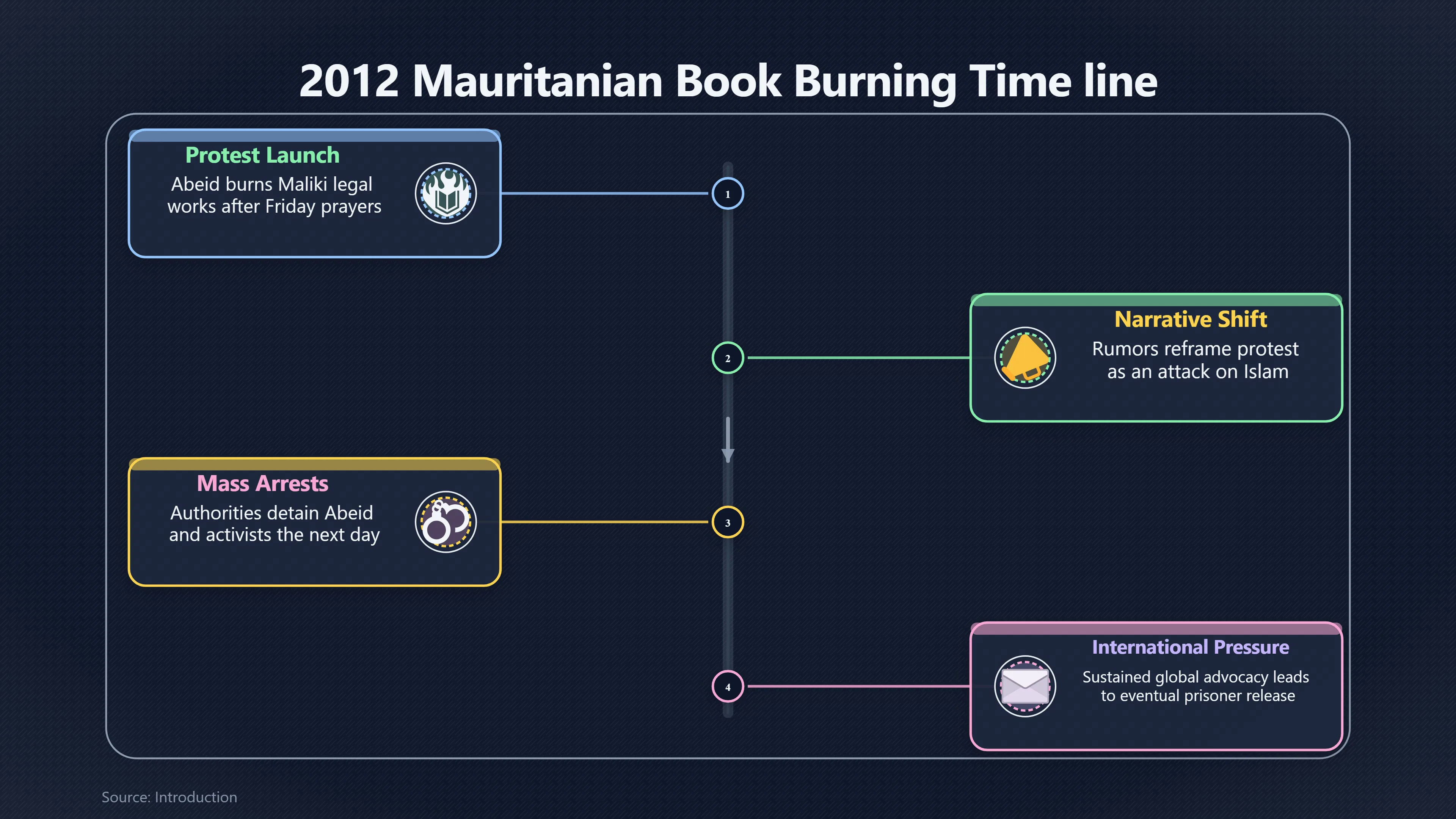
In April 2012, Mauritanian anti-slavery campaigner Biram Dah Abeid staged one of the country’s most controversial political protests by publicly burning selected works of Islamic jurisprudence that he said had been used to justify hereditary slavery. The act was intended as a symbolic rejection of legal interpretations rather than of Islam itself. Yet within hours it had been transformed by opponents into a story about an attack on the faith, provoking demonstrations, denunciations from religious leaders, demands for his execution and the arrest of Abeid and fellow activists.[resetdoc.org]resetdoc.orgbiram ould abeid and slavery in mauritaniaReset DOCFreedom and Democracy: Biram Ould Abeid and Slavery in Mauritania | Reset DOCMay 31, 2012…
The episode is significant not because it was a case of mass hysteria in the medical sense, but because it illustrates how rumours, religious authority and collective moral alarm can reshape the meaning of a political protest. It became a defining moment in Mauritania’s long-running dispute over slavery, race and the authority to interpret Islamic tradition.
Why Did a Book Burning Provoke Death Demands?
The protest took place on 28 April 2012 after Friday prayers in Nouakchott. Abeid, founder of the Initiative for the Resurgence of the Abolitionist Movement (IRA), argued that certain classical legal commentaries from the Maliki school of Islamic law had been used for generations to defend slavery and rigid social hierarchy in Mauritania. He and other activists publicly burned copies of those legal works as a symbolic rejection of what they regarded as human interpretations that had distorted Islam’s ethical message.[resetdoc.org]resetdoc.orgbiram ould abeid and slavery in mauritaniaReset DOCFreedom and Democracy: Biram Ould Abeid and Slavery in Mauritania | Reset DOCMay 31, 2012…
The distinction mattered enormously to the organisers. They maintained that they were not burning the Qur’an or rejecting Islam, but challenging later legal writings that they believed had been invoked to legitimise the enslavement of Black Mauritanians. Supporters also stated that pages containing Qur’anic verses or the name of God had been removed before the books were burned. Even so, that nuance rapidly disappeared from much public discussion.[resetdoc.org]resetdoc.orgbiram ould abeid and slavery in mauritaniaReset DOCFreedom and Democracy: Biram Ould Abeid and Slavery in Mauritania | Reset DOCMay 31, 2012…
For many religious scholars and ordinary believers, however, the books were respected components of the country’s religious heritage. Burning them was therefore interpreted as an assault on Islamic scholarship itself rather than as a protest against slavery. The symbolic act touched one of the most sensitive boundaries in Mauritanian public life: who has the authority to criticise long-established religious teaching.
What Biram Dah Abeid Burned and Why
The books were not random religious texts. They were works of Maliki jurisprudence, the legal tradition followed by the overwhelming majority of Mauritanian Muslims. Abeid argued that specific legal opinions preserved within this tradition had historically been used to justify:
- hereditary enslavement;
- unequal treatment based on ancestry;
- restrictions on the religious and social status of enslaved people; and
- the continued acceptance of slavery despite its legal abolition.
His protest was therefore aimed at what he viewed as the legal foundations of inherited servitude rather than at Islamic belief itself.[resetdoc.org]resetdoc.orgbiram ould abeid and slavery in mauritaniaReset DOCFreedom and Democracy: Biram Ould Abeid and Slavery in Mauritania | Reset DOCMay 31, 2012…
This distinction is important because many Muslim scholars who oppose slavery reject the idea that the religion itself requires the institution, while disagreeing strongly with Abeid’s method of protest. The dispute became as much about religious authority and acceptable forms of criticism as about slavery itself.
How Rumours and Sermons Transformed the Protest
The protest spread through Mauritanian society less because most people witnessed it directly than because competing narratives circulated rapidly afterwards.
Religious leaders condemned the burning as sacrilege. Public sermons, demonstrations and media reports increasingly described the event as an attack on Islam rather than as a protest against slavery. Government officials likewise condemned what they called the burning of “fundamental works of Islam”, reinforcing that interpretation.[ecoi.net]ecoi.netUSDOS – US Department of State (Author): “2012 International Religious Freedom Report - Mauritania”, Document #1087228 - ecoi.net…
As the controversy grew, some activists reported that rumours portrayed Abeid as an enemy of Islam or even as acting on behalf of foreign interests. Such claims widened the dispute beyond its original purpose by reframing a domestic argument over slavery as an alleged conspiracy against religion and the nation. Journalistic accounts describe how this reframing helped intensify public outrage and increased the personal danger facing the organisers.[The New York Review of Books]nybooks.comOpen source on nybooks.com.
This illustrates a common feature of moral panics. A real event occurred, but its meaning changed as it moved through sermons, rumours, political rhetoric and media coverage. The central public question became not whether slavery could be justified, but whether Islam itself had been insulted.
Slavery, Religious Authority and Competing Moral Claims
The controversy exposed two profoundly different moral frameworks.
For abolitionists, the protest argued that inherited slavery survived partly because respected legal commentaries continued to provide religious legitimacy for unequal social relations. Challenging those texts was therefore presented as necessary to dismantle both slavery and the ideas sustaining it.[Reset DOC]resetdoc.orgbiram ould abeid and slavery in mauritaniaReset DOCFreedom and Democracy: Biram Ould Abeid and Slavery in Mauritania | Reset DOCMay 31, 2012…
For many critics, however, burning revered legal works crossed a line that no political cause could justify. Even those who opposed slavery could regard the destruction of classical jurisprudence as an unacceptable attack on Islamic scholarship and religious tradition.
The resulting conflict was therefore not simply between supporters and opponents of slavery. It also concerned:
- who may reinterpret Islamic law;
- whether centuries-old legal authorities remain binding;
- how religious traditions should respond to modern human rights principles; and
- whether symbolic provocation advances or damages social reform.
These overlapping questions explain why the protest generated such an unusually intense response.
Arrests, Legal Action and Public Consequences
The authorities arrested Abeid and several other anti-slavery activists the day after the demonstration. They faced accusations including sacrilege and blasphemy alongside other charges connected with the protest. International human rights organisations criticised the arrests and argued that they reflected broader restrictions on freedom of expression and anti-slavery activism.[ecoi.net]ecoi.netUSDOS – US Department of State (Author): “2012 International Religious Freedom Report - Mauritania”, Document #1087228 - ecoi.net…
The detainees remained imprisoned for several months before judicial proceedings were eventually terminated on procedural grounds and many were released following sustained international pressure.[ecoi.net]ecoi.netUSDOS – US Department of State (Author): “2012 International Religious Freedom Report - Mauritania”, Document #1087228 - ecoi.net…
Although the criminal case did not end in convictions for blasphemy, the political impact proved lasting. The protest established Abeid as the country’s best-known anti-slavery activist while also making him one of its most polarising public figures.
Why the Episode Still Matters
The 2012 book burning remains one of the clearest examples in Mauritania of how disputes over religion, race and slavery can develop into episodes of collective moral alarm.
Rather than spreading through false reports alone, the controversy grew from a genuine symbolic act whose meaning became fiercely contested. Opponents viewed it as an assault on Islam, while supporters saw it as a necessary rejection of legal interpretations that had helped sustain hereditary servitude. Those competing interpretations generated demonstrations, threats, arrests and years of continuing political argument.[nybooks.com]nybooks.comOpen source on nybooks.com.
The episode also foreshadowed later Mauritanian controversies over freedom of expression and criticism of religious arguments for social hierarchy, including the debate surrounding blogger Mohamed Cheikh Ould Mkhaitir. Together, these cases reveal that Mauritania’s most significant collective-belief episodes have centred not on imagined dangers but on struggles over who may define religious legitimacy, challenge inherited authority and reshape the country’s understanding of justice.
Amazon book picks
Further Reading
Books and field guides related to Why Did a Book Burning Provoke Death Demands?. Use these as the next step if you want deeper reading beyond the article.
Folk Devils and Moral Panics the Creation of the Mods and Roc...
First published 1972. Subjects: Youth, great britain, Deviant behavior, Case studies, Subculture, Young adults.
Endnotes
1.
Source: resetdoc.org
Title: biram ould abeid and slavery in mauritania
Link:https://www.resetdoc.org/story/biram-ould-abeid-and-slavery-in-mauritania/
Source snippet
Reset DOCFreedom and Democracy: Biram Ould Abeid and Slavery in Mauritania | Reset DOCMay 31, 2012...
Published: May 31, 2012
2.
Source: ecoi.net
Link:https://www.ecoi.net/en/document/1087228.html
Source snippet
USDOS – US Department of State (Author): “2012 International Religious Freedom Report - Mauritania”, Document #1087228 - ecoi.net...
3.
Source: ecoi.net
Link:https://www.ecoi.net/en/document/1018198.html
4.
Source: ecoi.net
Link:https://www.ecoi.net/en/document/1333012.html
5.
Source: ecoi.net
Link:https://www.ecoi.net/en/document/1282413.html
6.
Source: youtube.com
Link:https://www.youtube.com/watch?v=Cua3jP-JYQI
Source snippet
Biram Dah Abeid - Finalist - 2013 Front Line Defenders Award for Human Rights Defenders at Risk...
7.
Source: youtube.com
Title: Biram Dah Abeid
Link:https://www.youtube.com/watch?v=SZZCpkoQmuE
Source snippet
Interview with Biram Dah Abeid, President of the IRA of Mauritania...
8.
Source: nybooks.com
Link:https://www.nybooks.com/articles/2017/11/23/last-slaves-in-mauritania/
9.
Source: Wikipedia
Title: Biram Dah Abeid
Link:https://en.wikipedia.org/wiki/Biram_Dah_Abeid
Additional References
10.
Source: researchgate.net
Link:https://www.researchgate.net/publication/355852349_Global_Shinqit_Mauritania%27s_Islamic_Knowledge_Tradition_and_the_Making_of_Transnational_Religious_Authority_Nineteenth_to_Twenty-First_Century
Source snippet
Several scholars advised the government to sponsor a compensation program in favor of the former masters, should the authorities move ahe...
11.
Source: biramdahabeid.org
Link:https://biramdahabeid.org/archives/5806
Source snippet
Biram Dah Abeid – prix des Droits Humains de l’ONUNovember 10, 2018 — BIRAM DAH ABEID, THE MAN FIGHTING SLAVERY IN MAURITANIA – BIRAM DAH...
Published: November 10, 2018
12.
Source: newyorker.com
Link:https://www.newyorker.com/news/news-desk/a-mauritanian-abolitionist-visits-the-united-states
Source snippet
The visit marked his longest imprisonment, resulting from protesting against land seizures and advocating for land rights of black Maurit...
13.
Source: biramdahabeid.org
Link:https://biramdahabeid.org/
Source snippet
Biram Dah Abeid – prix des Droits Humains de l’ONUJanuary 1, 2019 — Au début L’Initiative de résurgence du mouvement abolitionniste (Ira...
Published: January 1, 2019
14.
Source: youtube.com
Title: Biram Dah Abeid – Modern Day Hero
Link:https://www.youtube.com/watch?v=vrYmECtr8Dw
Source snippet
Biram Dah Abeid, Advocate for the abolition of slavery in Mauritania (English Translation)...
15.
Source: biramdahabeid.org
Link:https://biramdahabeid.org/archives/3875
16.
Source: ira-usa.org
Link:https://ira-usa.org/anniversary-of-the-burning-of-malikite-law-books/
17.
Source: biramdahabeid.org
Link:https://biramdahabeid.org/archives/4642
18.
Source: opendata.uni-halle.de
Link:https://opendata.uni-halle.de//handle/1981185920/109261
19.
Source: opendata.uni-halle.de
Link:https://opendata.uni-halle.de//handle/1981185920/109476
Topic Tree